Vol. 27 (2020): Perspektywy badawcze w glottodydaktyce polonistycznej
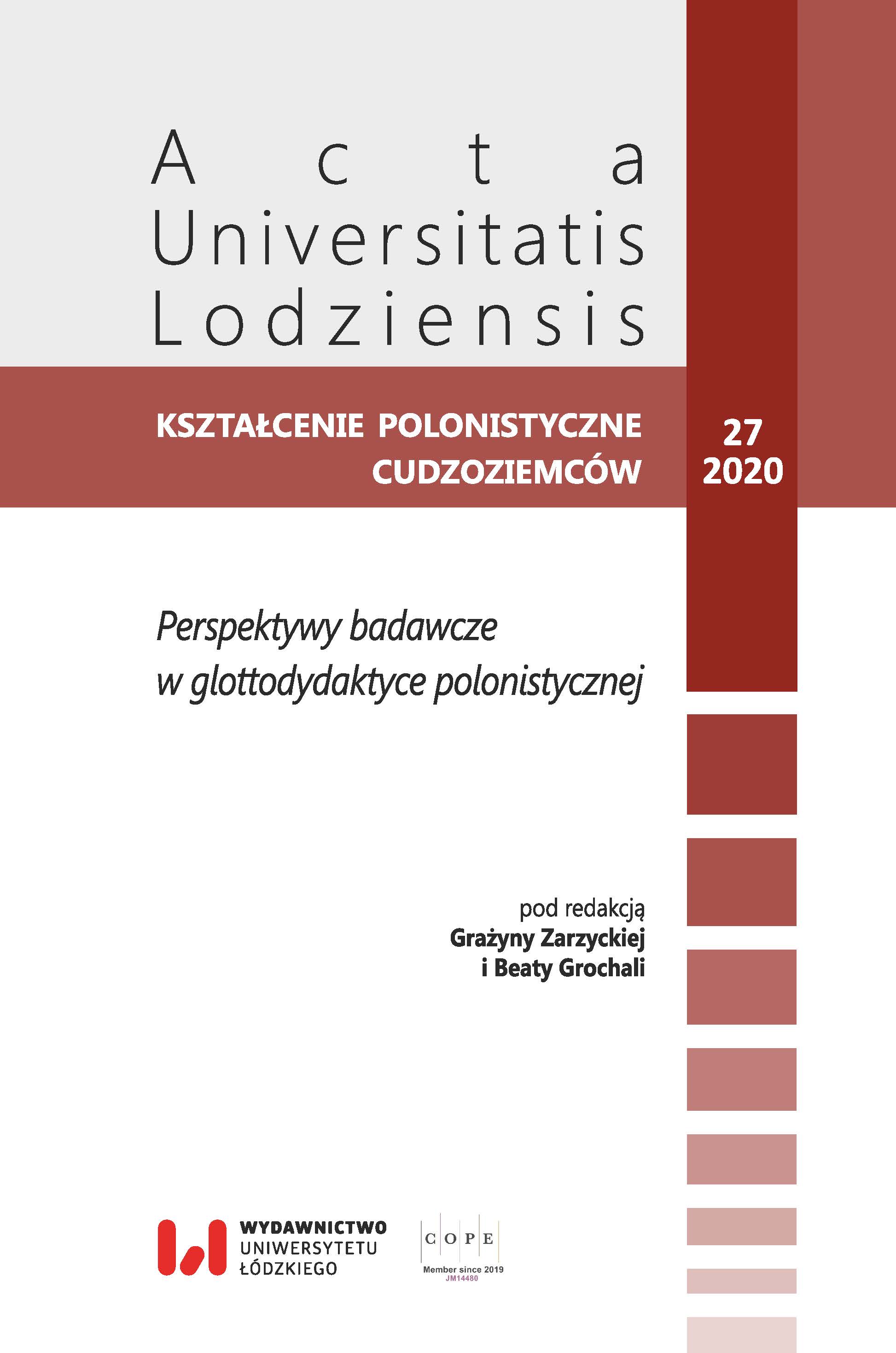
					View Vol. 27 (2020): Perspektywy badawcze  w glottodydaktyce polonistycznej

pod redakcją Grażyny Zarzyckiej i Beaty Grochali
Published: 2020-12-23

Full Issue

Other

Articles

  • The achievements and development prospects of teaching Polish as a non-native language

    Władysław T. Miodunka
    13-39
    DOI: https://doi.org/10.18778/0860-6587.27.34
  • Nobody’s or common? About natural and artificial mixed languages

    Ewa Lipińska
    41-59
    DOI: https://doi.org/10.18778/0860-6587.27.01
  • Gender, sex, and society. On the formation and usage of feminine forms in Polish and Slovenian

    Maria Wtorkowska
    61-80
    DOI: https://doi.org/10.18778/0860-6587.27.02
  • Transfer in related Slavic languages

    Marta Pančíková, Alexander Horák
    81-92
    DOI: https://doi.org/10.18778/0860-6587.27.03
  • The term “transidiomacity” as an attempt to find adequate linguistic notion for some cases in language teaching

    Andrey Babanov
    93-102
    DOI: https://doi.org/10.18778/0860-6587.27.04
  • Hungarian postpositions and Polish secondary prepositions – a comparative approach to language teaching

    Wiesław T. Stefańczyk
    103-110
    DOI: https://doi.org/10.18778/0860-6587.27.05
  • Modern stereotype of a Pole and a Ukrainian in the opinion of students of philology of the University of Lodz (on the basis of survey studies)

    Olga Fyłypec
    111-131
    DOI: https://doi.org/10.18778/0860-6587.27.06
  • Grammatical gender in teaching polish to Ukrainians: perspective from „inside” and „outside” of the Polish language system

    Ałła Krawczuk
    133-154
    DOI: https://doi.org/10.18778/0860-6587.27.07
  • Old pilots on the bridge, that is the discreet charm of the alternations

    Liliana Madelska
    155-176
    DOI: https://doi.org/10.18778/0860-6587.27.08
  • Average length Polish word

    Tomasz Moździerz
    177-192
    DOI: https://doi.org/10.18778/0860-6587.27.09
  • Genology as a thought style in terms of teaching polish as a foreign language

    Anna Dunin-Dudkowska
    193-208
    DOI: https://doi.org/10.18778/0860-6587.27.10
  • Genological traps for slavs from the east (on the basis of written works on certificate examinations in polish from 2019, B1 level)

    Grażyna Przechodzka, Viktoriia Hudy
    209-224
    DOI: https://doi.org/10.18778/0860-6587.27.11
  • Genre pattern of a complaint letter in teaching Polish as a foreign language

    Kamila Kwiatkowska
    225-240
    DOI: https://doi.org/10.18778/0860-6587.27.12
  • Foreign cuisine in Poland. Adapting names and dishes

    Jolanta Tambor
    241-265
    DOI: https://doi.org/10.18778/0860-6587.27.13
  • The culture of language or culture in language? The question in the context of teaching Polish as a non-native language

    Piotr Garncarek
    267-276
    DOI: https://doi.org/10.18778/0860-6587.27.14
  • Attitudes and behaviors of Chinese students as representatives of collective cultures – the glottodidactic perspective

    Adriana Prizel-Kania
    277-290
    DOI: https://doi.org/10.18778/0860-6587.27.15
  • Alternative music as a stimulus for intercultural dialogue

    Tomasz Wegner
    291-306
    DOI: https://doi.org/10.18778/0860-6587.27.16
  • The entry in the „Lexicon of emblems of polish culture” and glottodidactic practice. Proposals for solutions

    Beata Kułak
    307-321
    DOI: https://doi.org/10.18778/0860-6587.27.17
  • Polish culture emblems from the perspective of foreigners

    Magdalena Smoleń-Wawrzusiszyn
    323-338
    DOI: https://doi.org/10.18778/0860-6587.27.18
  • A thematic dictionary as a source of cultural competence (using the example of a Chinese-Polish dictionary)

    Elżbieta Sękowska
    339-348
    DOI: https://doi.org/10.18778/0860-6587.27.19
  • Teaching Polish studies in the new era: strategy and methods based on the example of the curriculum of teaching translation and interpreting

    Li Yinan
    349-365
    DOI: https://doi.org/10.18778/0860-6587.27.20
  • Polish – just like “another english”: perceptions of translanguaging and other bilingual practices in English and Polish FL classrooms in Taiwanese universities

    Natalia Tsai
    367-387
    DOI: https://doi.org/10.18778/0860-6587.27.21
  • Testing lexical competence in the context of its teaching: needs and reality

    Anna Seretny
    389-405
    DOI: https://doi.org/10.18778/0860-6587.27.22
  • Translation competence training theoretical and methodological considerations

    Kamil Szafraniec
    407-419
    DOI: https://doi.org/10.18778/0860-6587.27.23
  • The elements of civics during the lessons of polish as a foreign language

    Bartłomiej Maliszewski
    421-434
    DOI: https://doi.org/10.18778/0860-6587.27.24
  • Techniques for developing listening and speaking skills in Polish medical language textbooks

    Paulina Oczko
    435-450
    DOI: https://doi.org/10.18778/0860-6587.27.25
  • Testing Polish as a foreign language of young learners

    Agnieszka Rabiej, Małgorzata Banach
    451-467
    DOI: https://doi.org/10.18778/0860-6587.27.26
  • On teaching expressing the negative emotions in Polish as a foreign language lesson

    Barbara Łukaszewicz
    469-482
    DOI: https://doi.org/10.18778/0860-6587.27.27
  • Winged words in textbooks for teaching Polish as a foreign language

    Anna Brzozowska
    483-494
    DOI: https://doi.org/10.18778/0860-6587.27.28
  • Preparing a legend for working with children from the Polish diaspora

    Mateusz Gaze
    495-504
    DOI: https://doi.org/10.18778/0860-6587.27.29
  • Task-based language teaching concept in materials for teaching Polish as a foreign language

    Iwona Janowska
    505-526
    DOI: https://doi.org/10.18778/0860-6587.27.30
  • The use of the plain language concept to simplify texts for testing knowledge of Polish as a foreign language

    Anna Burzyńska-Kamieniecka
    527-542
    DOI: https://doi.org/10.18778/0860-6587.27.31
  • Elements of IB education in Polish language lessons in multicultural classes

    Natalia Kuźma
    543-558
    DOI: https://doi.org/10.18778/0860-6587.27.32
  • Is the Genial.ly app really phenomenal? About potential of online tool during lessons of Polish as a foreign language

    Paulina Kaźmierczak
    559-570
    DOI: https://doi.org/10.18778/0860-6587.27.33

