Vol. 28 (2021): Komunikacja – język – kultura. Nowe ścieżki w glottodydaktyce polonistycznej
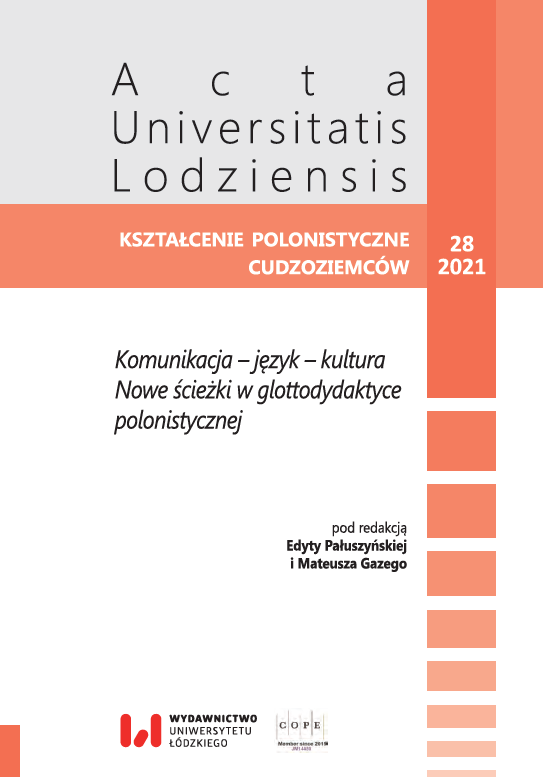
					View Vol. 28 (2021): Komunikacja – język – kultura. Nowe ścieżki w glottodydaktyce polonistycznej

pod redakcją Edyty Pałuszyńskiej i Mateusza Gazego

Published: 2021-12-30

Full Issue

Other

Articles

  • B2 level as the pivotal stage of achieving language proficiency

    Anna Seretny, Ewa Lipińska
    21-46
    DOI: https://doi.org/10.18778/0860-6587.28.02
  • The way of testing the level of mastery of the polish verb aspect in the state certificate examinations in polish as a foreign language at the B1 level in the light of new research on perfectiveness/imperfectiveness of verbs

    Beata Terka
    47-58
    DOI: https://doi.org/10.18778/0860-6587.28.03
  • The intercultural encounter as a communicative event subject to mediation

    Grażyna Zarzycka
    59-74
    DOI: https://doi.org/10.18778/0860-6587.28.04
  • Developing intercultural competence through books on Poland written by foreigners

    Justyna Zych
    75-92
    DOI: https://doi.org/10.18778/0860-6587.28.05
  • Photovoice as a learning and language needs assessment tool. A case study

    Karolina Zioło-Pużuk
    93-104
    DOI: https://doi.org/10.18778/0860-6587.28.06
  • Grammatical gender in polish and east slavic languages remarks on the accusative case

    Wiesław T. Stefańczyk
    105-116
    DOI: https://doi.org/10.18778/0860-6587.28.07
  • The didactics of polish declension and syntax in groups of east slavic students

    Dominika Izdebska-Długosz
    117-132
    DOI: https://doi.org/10.18778/0860-6587.28.08
  • Lexical interferences in written texts of Slavs from the East (based on written certificate papers of 2019, level B1)

    Grażyna Przechodzka, Wiktorija Hudy
    133-143
    DOI: https://doi.org/10.18778/0860-6587.28.09
  • The neurobiological and cultural aspects of the ways of acquiring and processing information, as exemplified by chinese students learning polish as a foreign language

    Adriana Prizel-Kania
    145-157
    DOI: https://doi.org/10.18778/0860-6587.28.10
  • Games in foreign language classrooms: Taiwanese students’ perspective

    Natalia Tsai
    159-174
    DOI: https://doi.org/10.18778/0860-6587.28.11
  • The polish language of students of arabic origin – comparative study

    Mateusz Gaze
    175-187
    DOI: https://doi.org/10.18778/0860-6587.28.12
  • Lesson structure, learning goal and objective implementation during polish language lessons in school for deaf and hearing-impaired children – on the necessity for the foreign language-like approach

    Katarzyna Jachimowska
    189-206
    DOI: https://doi.org/10.18778/0860-6587.28.13
  • The language of medicine (medical language) – a discussion on definition

    Paulina Oczko
    207-219
    DOI: https://doi.org/10.18778/0860-6587.28.14
  • For a semantic approach to derivation in foreign language teaching/learning

    Anna Seretny
    221-238
    DOI: https://doi.org/10.18778/0860-6587.28.15
  • Grammar with culture – on contemporary approaches to teaching grammar

    Bartłomiej Maliszewski
    239-253
    DOI: https://doi.org/10.18778/0860-6587.28.16
  • Functional types of substitutes in the structure of occasional phraseological innovations: interpretation with the didactic aspect taken into account

    Julia Stefanyszyn
    255-268
    DOI: https://doi.org/10.18778/0860-6587.28.17
  • Verne’s gates of the future. Developing the ability to describe an object

    Monika Válková Maciejewska
    269-284
    DOI: https://doi.org/10.18778/0860-6587.28.18
  • Academic genres in teaching polish as a foreign language (with the example of a scientific article)

    Anna Dunin-Dudkowskva
    285-295
    DOI: https://doi.org/10.18778/0860-6587.28.19
  • Sport texts in teaching polish as a foreign language

    Beata Grochala
    297-307
    DOI: https://doi.org/10.18778/0860-6587.28.20
  • Journalistic texts in developing communicative competence at the C2 level. Feature s of public and political di scour se in media

    Edyta Pałuszyńska
    309-322
    DOI: https://doi.org/10.18778/0860-6587.28.21
  • The number of actual words and the average polish words in texts and the relation to the readability scale of jasnopis.pl. Comparative analysis and practical implications

    Tomasz Moździerz
    323-340
    DOI: https://doi.org/10.18778/0860-6587.28.22
  • From a language teacher’s workshop. Application of knowledge about human rights in classes of polish as a foreign language at A1 level

    Magdalena Jurewicz-Nowak
    341-351
    DOI: https://doi.org/10.18778/0860-6587.28.23
  • Needs, possibilities and contexts of introduction of content related to human rights to the teaching of polish as a foreign language

    Iwona Pałucka-Czerniak
    353-363
    DOI: https://doi.org/10.18778/0860-6587.28.24
  • Eduroom on lessons of polish as a foreign language – a virtual escape room

    Paulina Kaźmierczak
    365-377
    DOI: https://doi.org/10.18778/0860-6587.28.25
  • Critical thinking strategies in lessons of polish as a foreign language in the age of remote education

    Irena Chawrilska
    379-391
    DOI: https://doi.org/10.18778/0860-6587.28.26
  • Teaching Polish as a Foreign Language in a New (Pandemic) Reality

    Rafał Maćkowiak, Paula Góralczyk-Mowczan
    393-424
    DOI: https://doi.org/10.18778/0860-6587.28.27

