
About the Journal

Publikacja Acta Universitatis Lodziensis. Folia Linguistica należy do serii zeszytów naukowych Uniwersytetu Łódzkiego. Pierwszy tom tego pisma ukazał się w 1981 r. Opracowania redakcyjnego Folia Linguistica od początku podjęli się pracownicy polonistycznych katedr językoznawczych: Katedry Historii Języka Polskiego i Katedry Współczesnego Języka Polskiego. Acta Universitatis Lodziensis. Folia Linguistica to pismo otwarte na różne teorie i punkty widzenia, ukazujące zmiany zachodzące w dawnym i współczesnym języku polskim. Znaleźć w nim można oryginalne artykuły badawcze ze wszystkich dziedzin językoznawstwa.

Acta Universitatis Lodziensis. Folia Linguistica na platformie Digital Commons (Elsevier)

Current Issue

No. 59 (2025): Od wspólnoty do języka. Od języka do wspólnoty
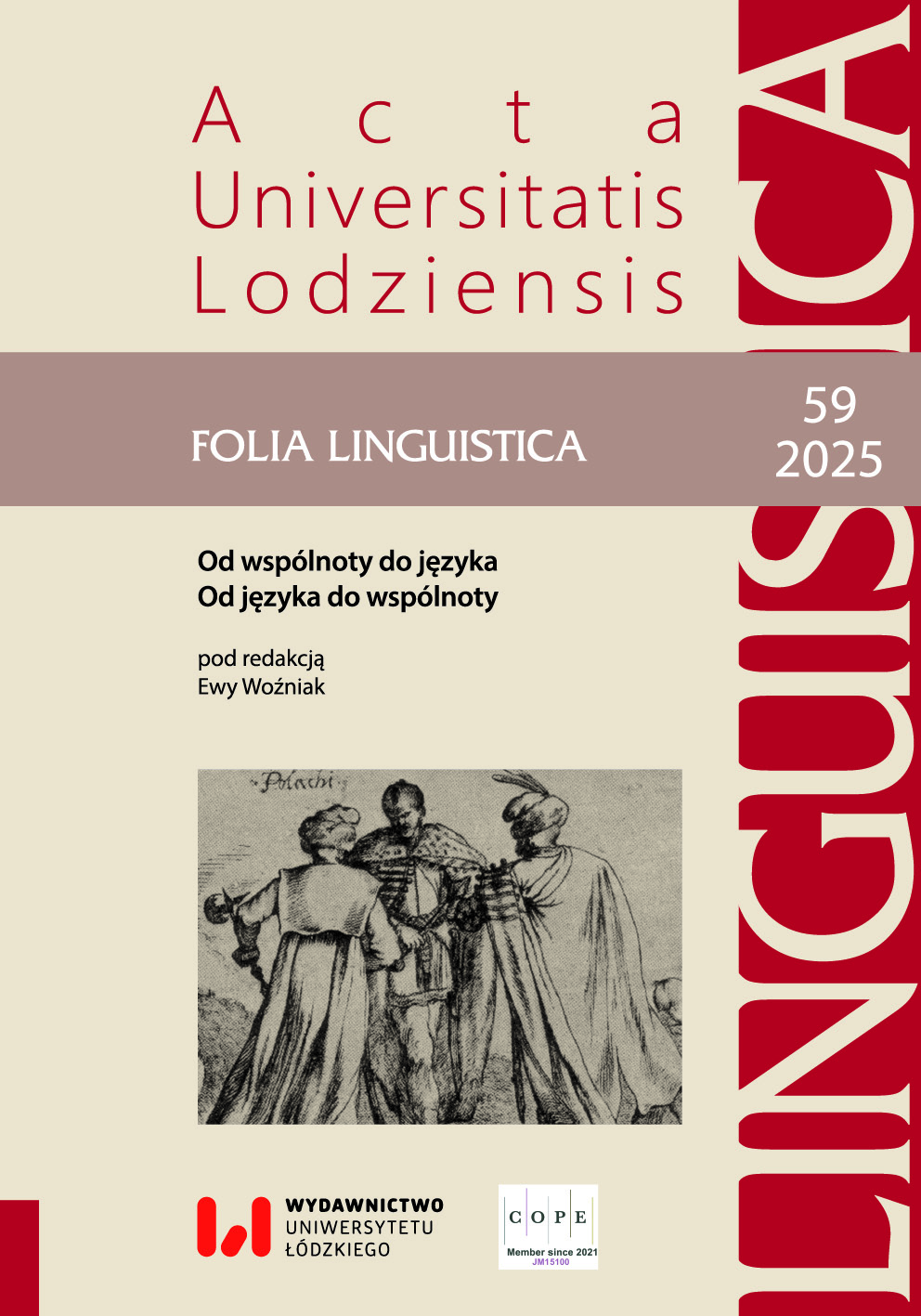
					View No. 59 (2025): Od wspólnoty do języka. Od języka do wspólnoty

pod red. Ewy Woźniak

Published: 28-11-2025
Full Issue

Articles

  • Which community: “komunikacyjna" or "komunikatywna”? — lexicographic considerations

    Jolanta Migdał
    7-14
    DOI: https://doi.org/10.18778/0208-6077.59.01
  • Sylva as a form of social memory of the noble community

    Dorota Szagun
    15-26
    DOI: https://doi.org/10.18778/0208-6077.59.02
  • Prospectuses and other editorial statements in the 18th-century Polish press: on building a communicative community

    Magdalena Pietrzak
    27-40
    DOI: https://doi.org/10.18778/0208-6077.59.03
  • Discourse of the Stations of the Cross Service on War

    Agnieszka Sieradzka-Mruk
    41-53
    DOI: https://doi.org/10.18778/0208-6077.59.04
  • The influence of the language of "De oratione communi seu fidelium" on the language of Polish universal prayers

    Iwona Pałucka-Czerniak
    55-69
    DOI: https://doi.org/10.18778/0208-6077.59.05
  • The family community as a decision-making body under the law. On Family Council in the Napoleonic Code from a linguistic perspective

    Magdalena Wismont
    71-83
    DOI: https://doi.org/10.18778/0208-6077.59.06
  • Who was bothered by the word “magistra”? On a certain type of feminine paradigmatic derivatives ending in "-a" in the history of the Polish language

    Ewa Woźniak
    85-100
    DOI: https://doi.org/10.18778/0208-6077.59.07
  • Presidential discourse as a discourse of collective memory: from local to national community

    Monika Kostro
    101-125
    DOI: https://doi.org/10.18778/0208-6077.59.08
  • The Textual Representation of Poles in Zaolzie in the Works of Adam Wawrosz

    Mateusz Gaze
    127-149
    DOI: https://doi.org/10.18778/0208-6077.59.09
  • Participation of Zielona Góra residents in the creation and functioning of city names

    Iwona Żuraszek-Ryś
    151-164
    DOI: https://doi.org/10.18778/0208-6077.59.10
  • Why and where? A name analysis of Polish Facebook groups related to autism

    Katarzyna Góra
    165-184
    DOI: https://doi.org/10.18778/0208-6077.59.11
  • Communicative community and its community-specific lexis on the example of interpersonal training groups

    Elżbieta Zaniewicz
    185-199
    DOI: https://doi.org/10.18778/0208-6077.59.12
  • Determinants of the schizophatic biolect in the language and texts within the community of people with schizophrenia

    Wojciech Lipski
    201-216
    DOI: https://doi.org/10.18778/0208-6077.59.13
  • Conversational strategies in broadcasts of women’s and men’s football matches

    Anita Filipczak-Białkowska
    217-233
    DOI: https://doi.org/10.18778/0208-6077.59.14

Other

View All Issues