Nr 9 (2020): Reading Venice
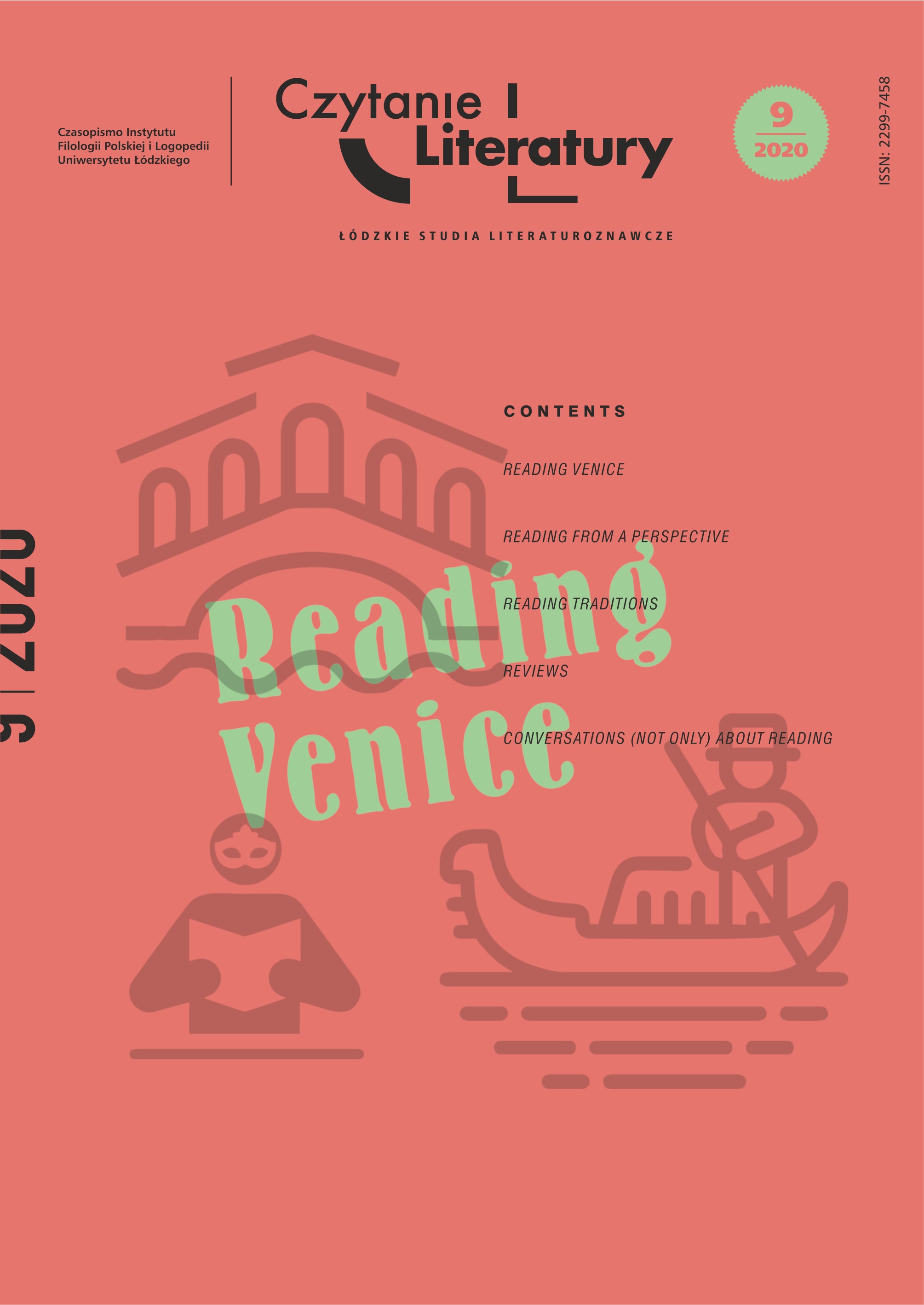
					Pokaż Nr 9 (2020): Reading Venice
Opublikowane: 2020-12-30

Pełny numer

Artykuły

  • Editorial

    Krystyna Pietrych
    7-9
    DOI: https://doi.org/10.18778/2299-7458.09.01
  • Venice in Polish Literature of the Latter Half of the 16th Century and in the 17th Century as a Model Political System, a Leading Centre in the Fight Against the Ottoman Empire, and the Centre of the Pilgrimage Culture

    Michał Kuran
    13-50
    DOI: https://doi.org/10.18778/2299-7458.09.02
  • A City Full of Life or a City Buried Alive? Vittorio Alfieri’s Venice and Venice in the Travel Journals by Polish Artists at the Turn of the 19th Century

    Olga Szadkowska-Mańkowska
    51-63
    DOI: https://doi.org/10.18778/2299-7458.09.03
  • Venice According to Odyniec (and Mickiewicz?) in Romantic Contexts

    Anna Kurska
    65-100
    DOI: https://doi.org/10.18778/2299-7458.09.04
  • On Several Polish Poems From 1829–1870 with Venice in the Background

    Maria Berkan-Jabłońska
    101-137
    DOI: https://doi.org/10.18778/2299-7458.09.05
  • Contemporary Icarus: Gustav von Aschenbach’s Journey towards the Sun

    Anna Sieradzan
    139-154
    DOI: https://doi.org/10.18778/2299-7458.09.06
  • Iwaszkiewicz’s Venice

    Krystyna Pietrych
    155-177
    DOI: https://doi.org/10.18778/2299-7458.09.07
  • “Literally, there were only a few steps between the cold and warmth, and between darkness and light.” The Image of the City in "Smutna Wenecja" by Wacław Kubacki

    Magdalena Kuran
    179-199
    DOI: https://doi.org/10.18778/2299-7458.09.08
  • Venice in Films. "Wenecja" by Jan Jakub Kolski (2010)

    Iwona Grodź
    201-214
    DOI: https://doi.org/10.18778/2299-7458.09.09
  • Venice in Poetry and Prose: Adam Wiedemann’s Visit to the City

    Agnieszka Czyżak
    215-226
    DOI: https://doi.org/10.18778/2299-7458.09.10
  • Venice from Another Perspective

    Francesco M. Cataluccio
    227-234
    DOI: https://doi.org/10.18778/2299-7458.09.11

Czytanie z perspektywy

  • The Category of Ugliness in "Historie maniaków" by Roman Jaworski

    Magdalena Sikorska
    237-252
    DOI: https://doi.org/10.18778/2299-7458.09.12
  • Form and Power On the Disciplinary Coding of National Identity in “Pamiętnik Stefana Czarnieckiego” by Witold Gombrowicz

    Tomasz Jativa
    253-267
    DOI: https://doi.org/10.18778/2299-7458.09.13
  • “A Production Center”: A Model of Creative Work in Tadeusz Konwicki’s Early Prose

    Martyna Miernecka
    269-285
    DOI: https://doi.org/10.18778/2299-7458.09.14

Czytanie tradycji

  • "Kwiaty polskie" by Julian Tuwim as a Reflection on Law, the Political System, and the State

    Maciej Kijowski
    289-308
    DOI: https://doi.org/10.18778/2299-7458.09.15
  • “Ten sam odwieczny wróg niebezpieczny.” The Universal Dimension of Tuwim’s Satire

    Elżbieta Sidoruk
    309-322
    DOI: https://doi.org/10.18778/2299-7458.09.16

Recenzje

Rozmowy

Inne