Vol. 37 No. 7 (2016): Censorship in the Polish People' s Republic
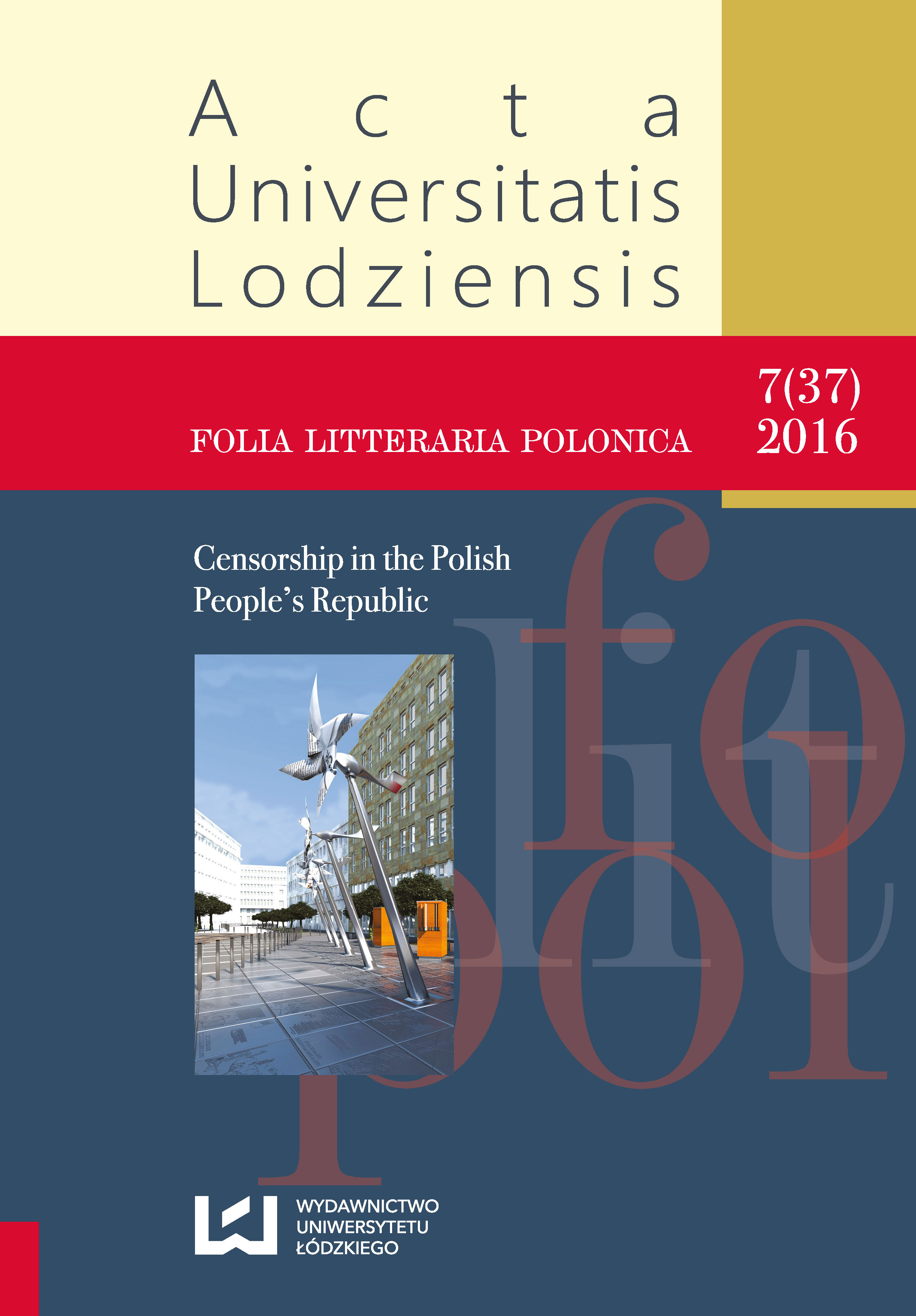
					View Vol. 37 No. 7 (2016): Censorship in the Polish People' s Republic

pod redakcją  prof. Marzeny-Woźniak Łabieniec

Zeszyt specjalny. Zadanie „Stworzenie anglojęzycznych wersji wydawanych publikacji”  finansowane w ramach umowy nr 948/P-DUN/2016 ze środków Ministra Nauki i Szkolnictwa Wyższego przeznaczonych na działalność upowszechniającą naukę.

tł. Karolina Marzec, Anna Banasiak


Published: 2016-10-20
Full Issue

Articles

  • Censorship in the PSL Press within the Period of the 1946 Referendum and the Legislative Sejm Election

    Piotr Swacha
    5-17
    DOI: https://doi.org/10.18778/1505-9057.37.01
  • Literary Competitions Organised by the Ministry of Culture and Arts in 1949–1950 in the Light of Archive Records

    Kamila Budrowska
    19-31
    DOI: https://doi.org/10.18778/1505-9057.37.02
  • Errata to the Stanisław Czernik’s Biography: 1949

    Wiktor Gardocki
    33-44
    DOI: https://doi.org/10.18778/1505-9057.37.03
  • Combating Adult Illiteracy in the People’s Republic of Poland (on the Example of Selected Documents of the Ministry of Education and the Office of the Government Plenipotentiary for Combating Illiteracy in 1949–1951)

    Magdalena Budnik
    45-56
    DOI: https://doi.org/10.18778/1505-9057.37.04
  • Out of Date. Remarks on the 1951 “Index of Books to be Immediately Excluded”

    Elżbieta Dąbrowicz
    57-72
    DOI: https://doi.org/10.18778/1505-9057.37.05
  • Theatre and Drama of Socialist Realism in the Context of Cryptotexts (Based on MKiS and WUKPPiW Material)

    Anna Wiśniewska-Grabarczyk
    73-84
    DOI: https://doi.org/10.18778/1505-9057.37.06
  • Politics, Poetics and “the Tragedy of Existence”. The Reception of Młyny Boże [the Mills of God] Novel Series by Kazimierz Truchanowski by the Censorship Bureau

    Kajetan Mojsak
    85-94
    DOI: https://doi.org/10.18778/1505-9057.37.07
  • Censorship Towards Czesław Miłosz in Poland in the Fifties after Having Chosen the Emigration

    Marzena Woźniak-Łabieniec
    95-109
    DOI: https://doi.org/10.18778/1505-9057.37.08
  • Censorship as a Taboo during Political “Thaw”

    Marzena Woźniak-Łabieniec
    111-119
    DOI: https://doi.org/10.18778/1505-9057.37.09
  • “There Aren’t any Dwarfs; They got out in Time”. Censored Image of the Home Army in Polish Poetry in 1956–1958

    Agnieszka Kloc
    121-138
    DOI: https://doi.org/10.18778/1505-9057.37.10
  • Censorship Towards the Subject of the Warsaw Uprising in Belles-Lettres in 1956–1958

    Agnieszka Kloc
    139-162
    DOI: https://doi.org/10.18778/1505-9057.37.11
  • The Issa Valley in Censorship Documents. On the Thaw Reception of Czesław Miłosz’s Novel

    Marzena Woźniak-Łabieniec
    163-181
    DOI: https://doi.org/10.18778/1505-9057.37.12
  • The Polish Trial of Kafka. On the Reception of Franz Kafka and So-Called “Dark Literature” by the Censorship Board

    Kajetan Mojsak
    183-201
    DOI: https://doi.org/10.18778/1505-9057.37.13
  • Routine But Ribald. Intimacy in Stefan Żeromski’s Journals

    Katarzyna Kościewicz
    203-220
    DOI: https://doi.org/10.18778/1505-9057.37.14
  • Institutional Censorship in Relation to Catholic Press during the Decline of People’s Republic of Poland (1989–1990)

    Kamila Kamińska-Chełminiak
    221-235
    DOI: https://doi.org/10.18778/1505-9057.37.15

