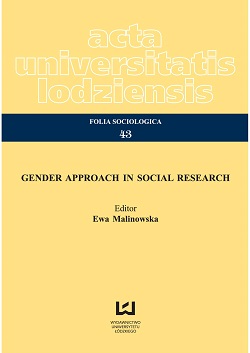
Gednerowe zróżnicowanie sposobów posługiwania się Internetem
DOI:
https://doi.org/10.18778/0208-600X.43.04Słowa kluczowe:
Internet, płeć, rozrywka, częstotliwośćAbstrakt
W artykule zaprezentowano wyniki polskiej edycji badania World Internet Project, gdzie wskazano na zróżnicowanie ze względu na płeć społeczno-kulturową zarówno jeśli chodzi o częstotliwość korzystania z Internetu, jak sposobu w jaki jest on używany. Główna różnica dotyczy wykorzystywania Internetu w celu rozrywki (gry, słuchanie muzyki, oglądanie filmów) częściej przez mężczyzn niż kobiety. W raporcie nie stwierdzono jednak znaczących dysproporcji ze względu na płeć społeczno-kulturową (gender gap) między polskimi użytkownikami Internetu.
Bibliografia
Batorski D. (2011), Korzystanie z technologii informacyjno-komunikacyjnych, [in:] Social Diagnosis 2011 Objective and subjective quality of life in Poland – Report, [Special issue], “Contemporary Economics”, vol. 5, no. 3.
Google Scholar
Boneva B., Kraut R., Frohlich D. (2001), Using E-mail for Personal Relationships: The Difference Gender Makes, Human-Computer Interaction Institute. Paper 87. http://repository.cmu.edu/hcii/87, (accessed on 20.11.2012).
Google Scholar
Boneva B., Kraut R. (2002), Email, Gender, and Personal Relationships, [in:] Wellman B., Haythornthwaite C. (eds.), The Internet in everyday life, Malden/Oxford/Melbourne/Berlin: Blackwell Publishers.
Google Scholar
DOI: https://doi.org/10.1002/9780470774298.ch13
Broos A. (2005), Gender and Information and Communication Technologies (ICT) Anxiety: Male Self-Assurance and Female Hesitation, “CyberPsychology & Behavior”, vol. 8, no. 1.
Google Scholar
DOI: https://doi.org/10.1089/cpb.2005.8.21
Comber C., Colley A., Hargreaves D. J., Dorn L. (1997), The effects of age, gender and computer experience upon computer attitudes; “Educational Research”, vol. 39, no. 2.
Google Scholar
DOI: https://doi.org/10.1080/0013188970390201
Dholakia R.R., Dholakia N., Kshetri N. (2003), Gender and Internet usage, [in:] Bidgoli H. (ed.), The Internet Encyclopedia, New York: Wiley.
Google Scholar
DOI: https://doi.org/10.1002/047148296X.tie070
Durndell A., Lightbody P. (1993), Gender and computing: change over time?; “Computers & Education”, vol. 21, no. 4.
Google Scholar
DOI: https://doi.org/10.1016/0360-1315(93)90036-I
Durndell A., Macleod H., Siann G. (1987), A survey of attitudes to, knowledge about and experience of computers, „Computers & Education”, vol. 11, no. 3.
Google Scholar
DOI: https://doi.org/10.1016/0360-1315(87)90051-0
Fallows D. (2005), How Women and Men Use the Internet; Pew Internet & American Life Project, Washington D.C.
Google Scholar
Ford N., Miller D. (1996), Gender differences in Internet perceptions and use, London, Aslib Proceedings, vol. 48, no. 7–8.
Google Scholar
Hafkin N., Taggart N. (2001), Gender, Information Technology, and Developing Countries: An Analytic Study, Office of Women in Development, Bureau for Global Programs, Field Support and Research, United States Agency for International Development.
Google Scholar
Hu T., Zhang P., Zhang X., Dai H. (2009), Gender Differences in Internet Use: A Logistic Regression Analysis, San Francisco, AMCIS Proceedings Paper 300. http://aisel.aisnet.org/amcis2009/300 (accessed on15.11. 2012).
Google Scholar
Ilie V., Van Slyke C., Green G., Lou H. (2005), Gender Differences in Perceptions and Use of Communication Technologies: A Diffusion of Innovation Approach, “Information Resources Management Journal”, vol. 18, no. 3.
Google Scholar
DOI: https://doi.org/10.4018/irmj.2005070102
Katz James E., Rice Ronald E. (2002), Social Consequences of Internet Use: Access, Involvement, and Interaction; Cambridge MA: MIT Press.
Google Scholar
DOI: https://doi.org/10.7551/mitpress/6292.001.0001
Kennedy T., Wellman B., Klement K. (2003), Gendering the Digital Divide, “IT & Society” vol. 1, no. 5.
Google Scholar
Kirkup, G. (1995), Gender issues and learning technologies, “British Journal of Educational Technology”, vol. 26, no. 3.
Google Scholar
DOI: https://doi.org/10.1111/j.1467-8535.1995.tb00344.x
Li N., Kirkup G. (2007). Gender and cultural differences in Internet use: A study of China and the UK, “Computers & Education”, vol. 48.
Google Scholar
DOI: https://doi.org/10.1016/j.compedu.2005.01.007
Pew Research Center (2012), Internet & American Life Project’s Tracking Survey conducted July 16 – August 7, 2012, http://pewinternet.org/Static-Pages/Trend-Data-%28Adults%29/Whos-Online.aspx (accessed on15.11. 2012).
Google Scholar
Quan-Haase, A., Wellman, B., Witte J.C., Hampton K.N. (2002), Capitalizing on the Net: Social Contact, Civic Engagement, and Sense of Community, [in:] B. Wellman, C. Haythornthwaite (eds.), The Internet in everyday life, Malden–Oxford–Melbourne–Berlin: Blackwell Publishers.
Google Scholar
DOI: https://doi.org/10.1002/9780470774298.ch10
Robinson J.P., Godbey G. (1997), Time for Life: The Surprising Ways Americans Use Their Time,, University Park: Pennsylvania State University Press.
Google Scholar
Scragg G., Smith J., Geneseo S. (1998), A study of barriers to women in undergraduate computer science, Atlanta, GA: SIGSCE technical symposium on Computer science education.
Google Scholar
DOI: https://doi.org/10.1145/273133.273167
Schumacher P., Morahan-Martin J. (2001), Gender, Internet and computer attitudes and experiences, “Computers in Human Behavior”, vol. 17, no. 1.
Google Scholar
DOI: https://doi.org/10.1016/S0747-5632(00)00032-7
Seybert H. (2007), Gender differences in the use of computers and the Internet, Eurostat Report 119/2007. http://epp.eurostat.ec.europa.eu/portal/page/portal/product_details/publication?p_product_code=KS-SF-07-119 (accessed on16.11. 2012).
Google Scholar
Thayer S.E., Aray S. (2006), Online Communication Preferences across Age, Gender, and Duration of Internet Use, “Cyberpsychology & Behavior”, vol. 9, no. 4.
Google Scholar
DOI: https://doi.org/10.1089/cpb.2006.9.432
Wellman B., Haythornthwaite C. (2002) The Internet in Everyday Life. An Introduction, [in:] B. Wellman, C. Haythornthwaite (eds.), The Internet in everyday life, Malden–Oxford–Melbourne–Berlin: Blackwell Publishers.
Google Scholar
DOI: https://doi.org/10.1002/9780470774298
Wilson K.R., Wallin J.R., Reiser C. (2003), Social Stratification and the Digital Divide, “Social Science Computer Review”, vol. 21, no. 2.
Google Scholar
DOI: https://doi.org/10.1177/0894439303021002001
Pobrania
Opublikowane
Jak cytować
Numer
Dział
Licencja

Praca jest udostępniana na licencji Creative Commons Attribution-NonCommercial-NoDerivatives 3.0 Unported License.