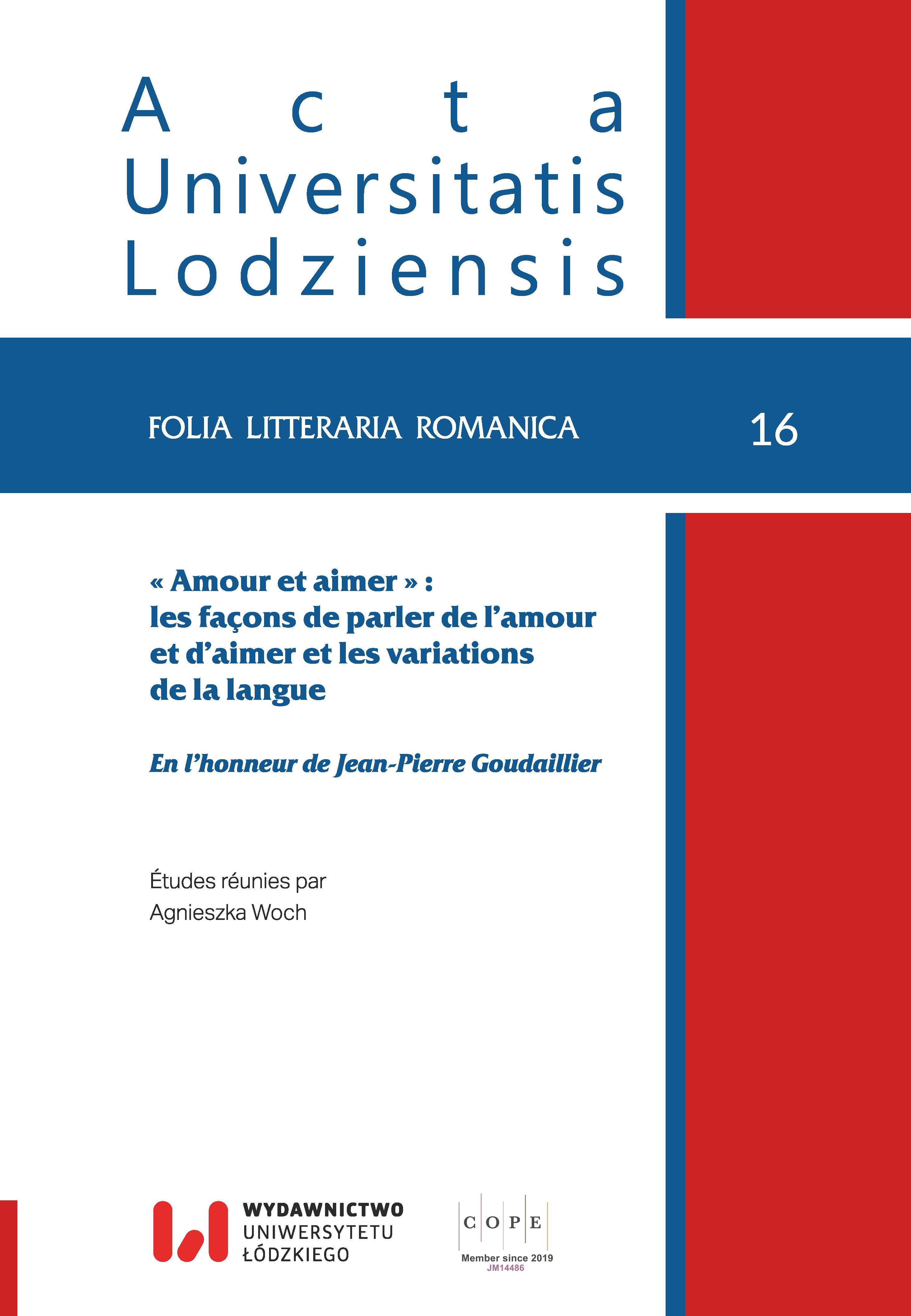
Love in French and in Polish – a Cognitive Study
DOI:
https://doi.org/10.18778/1505-9065.16.04Keywords:
cognitive semantics, love, Idealized Cognitive Models (ICMs), metaphor, metonymyAbstract
The description of the conceptualization of the notion of love is based on the analysis of the Polish and French proverbs and quotes. The linguistic cognitive method applied is based on establishing Idealized Cognitive Models (ICMs), i.e. metaphors and conceptual metonymies. The following six types of source domains grouping individual ICMs have been identified: a person; an abstract notion; an object, a living organism; a cosmogonic universal; and a cultural universal. ICMs have also been assigned to individual types of semantic universals. People comprehend love in terms of diversified categories: both axiological ones as well as physical reactions. Most ICMs occur in both languages. Poles describe love by means of all types of semantic universals, while Frenchmen, more frequently than us Poles, comprehend this emotion in terms of cultural universals. Conceptual paradigms construct in some cases such structures in which more detailed models are assigned to general, generic ICMs.
References
KLEIBER, Georges (1994), « Sur la définition du proverbe » in Nominales. Essais de sémantique référentielle (Kleiber, Georges éd.), Paris, Armand Colin, p. 207-224
KÖVECSES, Zoltán (1986), « Metaphors of Anger, Pride and Love. A Lexical Approach to the Structure of Concepts », Pragmatics and Beyond, An Interdisciplinary Series of Language Studies VI, no 8, Amsterdam, Philadelphia, p. 2-145 DOI: https://doi.org/10.1075/pb.vii.8
KRZYŻANOWSKA, Anna (2011), Aspects lexicaux et sémantiques de la description des noms d’affect en français et en polonais, Lublin, Wydawnictwo Uniwersytetu Marii Curie-Skłodowskiej
LAKOFF, George, JOHNSON, Mark (1980), Metaphors we live by, Chicago, University of Chicago Press
LAKOFF, George, JOHNSON, Mark (1985), Les métaphores dans la vie quotidienne, Paris, Les Éditions de Minuit
LANGACKER, Ronald (1987), Foundations of Cognitive Grammar, vol. 1, Theoretical Prerequisites, Stanford, Stanford University Press
LANGACKER, Ronald (1995), Wykłady z gramatyki kognitywnej, Lublin, Wydawnictwo Uniwersytetu Marii Skłodowskiej-Curie
LIPIŃSKA, Magdalena (2004), L’équivalence des proverbes polonais et des proverbes français, Łódź, Wydawnictwo Uniwersytetu Łódzkiego
NOWAKOWSKA-KEMPNA, Iwona (1995), Konceptualizacja uczuć w języku polskim, Warszawa, Wyższa Szkoła Pedagogiczna Towarzystwa Wiedzy Powszechnej
WIERZBICKA, Anna (1971), Kocha, lubi, szanuje. Medytacje semantyczne, Warszawa, Wiedza Powszechna
WIERZBICKA, Anna (1988), « L’amour, la colère, la joie, l’ennui, la sémantique des émotions dans une perspective transculturelle », Langages, no 89, p. 97-107 DOI: https://doi.org/10.3406/lgge.1988.1985
ZWIERZYŃSKA, Aldona (1992), « Wyidealizowane modele kognitywne pojęcia ‘miłość’ i ‘love’ przedstawionego w przysłowiach polskich i angielskich – porównanie», Język a kultura, no 8, p. 91-123
CARLIER, Robert, LALANNE, Jean-Louis, JOSSERAND, Pierre, DE SACY, Samuel (1977), Citations françaises, Paris, Larousse
HERTZ, Paweł, KOPALIŃSKI, Władysław (1975), Księga cytatów, Warszawa, Państwowy Instytut Wydawniczy
KRZYŻANOWSKI, Julian (1970), Nowa księga przysłów i wyrażeń przysłowiowych polskich, vol. 2, Warszawa, Państwowy Instytut Wydawniczy
MALOUX, Maurice (1985), Dictionnaire des proverbes, sentences et maximes, Paris, Larousse
MONTREYNAUD, Florence, PIERRON, Agnès, SUZZONI, François (1994), Le Robert. Dictionnaire des proverbes et dictons, Paris, Robert
SEGALEN, Martine (1975), « Le mariage, l’amour et les femmes dans les proverbes », Ethnologie française, no 5, p. 119-160
STAWIŃSKA, Krystyna (1997), Przysłowia polskie – przysłowia francuskie. Proverbes polonais – proverbes français, Warszawa, Wiedza Powszechna
SZYMAŃSKI, Kiejstut (1997), Niejedno ma imię. Aforyzmy o miłości, Wrocław, Wydawnictwo Europa
ŚMIECH, Tadeusz, TRZASKOWSKI, Zbigniew (1993), Dar słowa, Kielce, Wydawnictwo „Jedność”
Downloads
Published
Issue
Section
License

This work is licensed under a Creative Commons Attribution-NonCommercial-NoDerivatives 4.0 International License.
How to Cite