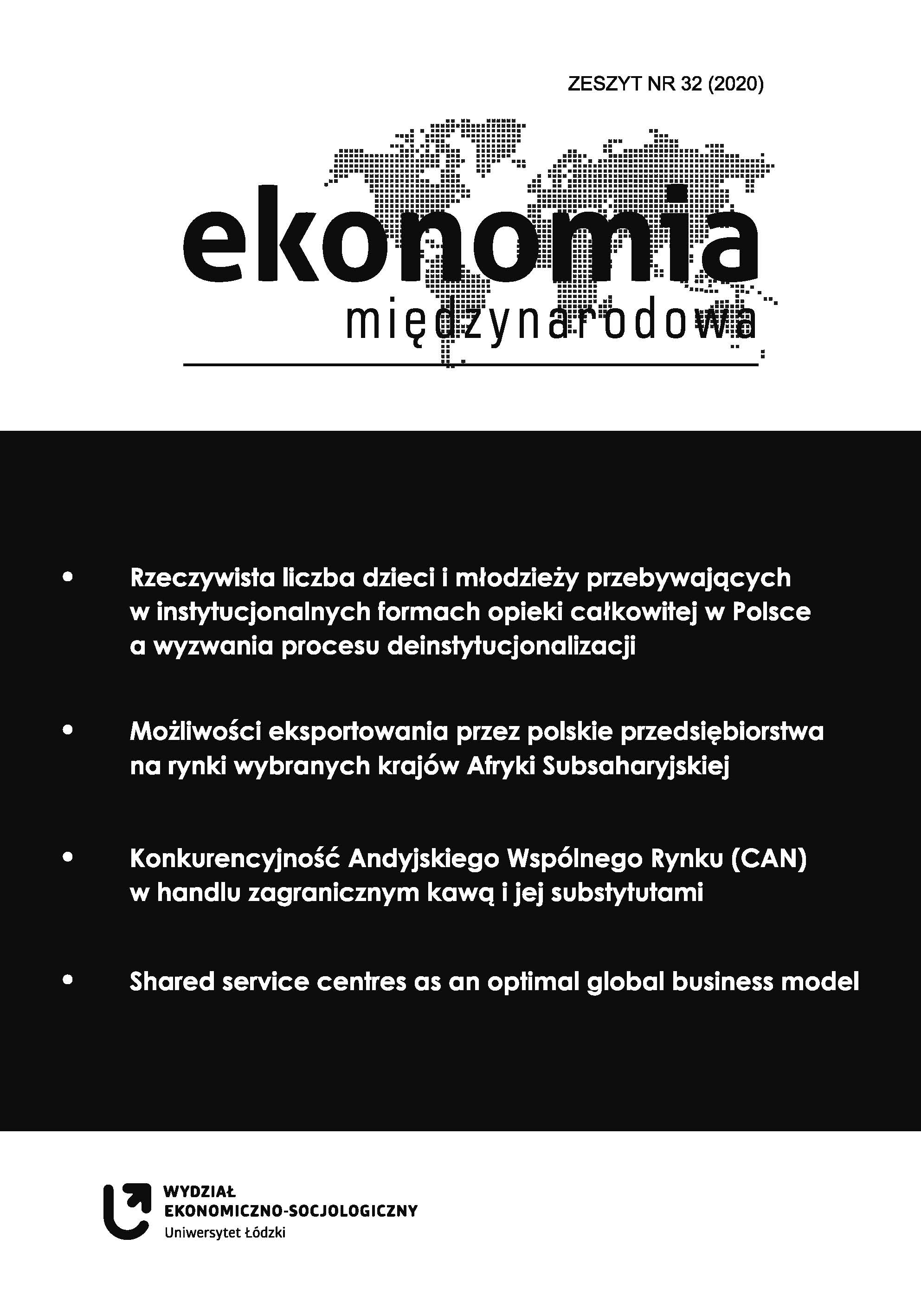
The competitiveness of the Andean Community (CAN) in foreign trade of coffee and substitutes
DOI:
https://doi.org/10.18778/2082-4440.32.03Keywords:
foreign trade, competitiveness, coffee and substitutes, Andean Community, CANAbstract
The article assesses the competitiveness of the member countries of the Andean Community – CAN in foreign trade of coffee and its substitutes in 1995 and 2019.
The study was conducted using quantitative indicators of international competitive position: RCA, IPR, RTA, LFI. The study showed that in 1995, there was a strong comparative advantage in the foreign trade of coffee and its substitutes in all CAN countries, in particular Colombia (high RTA index: 17,92, high LFI index: 25,28). In 2019, Bolivia’s comparative advantage (low RTA index: –0,56) and Ecuador (low index RTA: –0,21) was lost. A downward trend was observed for each member of the community (decrease in RCA, RTA, LFI index, increase in IPR index).
Downloads
References
Affortunato F., Ciommi M., Furia D., Vaccaro E. (2010), International Specialization and Vertical Differentiation, „Annals of the University of Oradea: Economic Science”, 1(1).
Avila D., Sandoval K. (2019), La competitividad del comercio de uva en el mercado internacional y en Estados Unidos: el caso de Mexico y Peru, „Revista Cimexus”, 14(1). DOI: https://doi.org/10.33110/cimexus140103
Balassa B. (1965), Trade Liberalization and Revealed Comparative Advantage, „The Manchester School of Economic and Social Studies”, 33(2). DOI: https://doi.org/10.1111/j.1467-9957.1965.tb00050.x
Benedictis L., Tamberi M. (2002), A note on the Balassa Index of Revealed Comparative Advantage, „Working Papers. Dipartimento di Economia”, 158. DOI: https://doi.org/10.2139/ssrn.289602
CEPAL (2020), Sistema Gráfico de Comercio Internacional, https://sgo-win-12-we-e1.cepal.org/dcii/sigci/sigci.html (data dostępu: 14.09.2020).
Cumbicus Torres E.M., Jiménez Azuero R.M. (2012), Análisis Sectorial del Café en la Zona 7 del Ecuador, http://dspace.utpl.edu.ec/bitstream/123456789/2703/1/338X1227.pdf (data dostępu: 14.09.2020).
Durante N.D.L., da Costa J.S., González M.V., Durante C.R.L. (2017), Competitividad de la soya y la carne bovina en Paraguay, „Investigación Agraria”, 19(2).
FAO (2020), Faostat, https://www.fao.org/faostat/en/#search/Coffee%2C%20substitutes%20containing%20coffee (data dostępu: 14.09.2020).
García R., Maldonado A. (2013), Competitividad del calzado de cuero colombiano: perspectiva de la ventaja comparativa revelada (1980–2008), „Revista Dimensión Empresarial”, 11(1).
ICO (2020), Exports of all forms of coffee by all exporting countries, http://www.ico.org/historical/1990%20onwards/PDF/2a-exports.pdf (data dostępu: 14.09.2020).
Kołodziejczak M., Kołodziejczak W., Pawlak K. (2010), Konkurencyjność sektora rolno-spożywczego nowych krajów członkowskich UE w handlu wewnątrzwspólnotowym, „Zagadnienia Ekonomiki Rolnej”, 1.
Lafay G. (1992), The measurement of revealed comparative advantages, [w:] M.G. Dagenais, P.A. Muet (red.), International Trade Modeling, Chapman and Hall, London. DOI: https://doi.org/10.1007/978-1-4757-2150-8_10
Majcher K. (2019), Przewaga komparatywna krajów Andyjskiego Wspólnego Rynku – CAN w międzynarodowym handlu towarami z Mercosur, „Ekonomia Międzynarodowa”, 27. DOI: https://doi.org/10.18778/2082-4440.27.01
Málaga J.E., Williams G.W. (2010), La competitividad de México en la exportación de productos agricolas, „Revista Mexicana de Agronegocios”, 27.
Nosecka B., Pawlak K. (2014), Wybrane problemy konkurencyjności sektora rolno- spożywczego w Polsce i Unii Europejskiej, Instytut Ekonomiki Rolnictwa i Gospodarki Żywnościowej, Warszawa.
Ocampo López O.L., Castañeda Peláez K., Vélez Upegui J.J. (2016), Caracterización de los ecotopos cafeteros colombianos en el Triángulo del Café, „Perspectiva Geográfica”, 22(1). DOI: https://doi.org/10.19053/01233769.6100
Recalde M.L., Barraud A. (2002), Competitividad de la carne vacuna en Argentina, „Actualidad Económica”, 12(52).
Rivera Silva M.R., Nikolskii Gavrilov I., Castillo Álvarez M., Ordaz Chaparro V.M., Diaz Padilla G., Guajardo Panes R.A. (2013), Vulnerabilidad de la producción del café (Coffea arabica L.) al cambio climático global, „Terra Latinoamericana”, 31(4).
Rudianto Y.L. (2009), Competitiveness Theory, „Die – Jurnal Ilmu Ekonomi dan Manajemen”, 6(1). DOI: https://doi.org/10.30996/die.v6i1.90
Segura J., Segura O. (2004), Indice de ventaja comparativa revelada: un indicador del desempeno y de la competitividad productivo-comercial de un pais, http://bibliotecadigital.agronet.gov.co/bitstream/11348/5885/1/2005112116568_VentajaComparativaRevelada.pdf (data dostępu: 14.09.2020).
Szymanik E. (2016), Konkurencyjność przedsiębiorstwa – główne aspekty, „Zeszyty Naukowe Uniwersytetu Ekonomicznego w Krakowie”, 953. DOI: https://doi.org/10.15678/ZNUEK.2016.0953.0507
UNCTAD (2020), Unctadstat. Data Center, https://unctadstat.unctad.org/wds/Report-Folders/reportFolders.aspx?sCS_ChosenLang=en (data dostępu: 14.09.2020).
Zielińska-Głębocka A. (2012), Współczesna gospodarka światowa. Przemiany, innowacje, kryzysy, rozwiązania regionalne, Wolters Kluwer, Warszawa.
Zielińska-Głębocka A., Rynarzewski T. (2006), Międzynarodowe stosunki gospodarcze. Teoria wymiany i polityki handlu międzynarodowego, Wydawnictwo Naukowe PWN, Warszawa.
Downloads
Published
Issue
Section
License

This work is licensed under a Creative Commons Attribution-NonCommercial-NoDerivatives 4.0 International License.
How to Cite