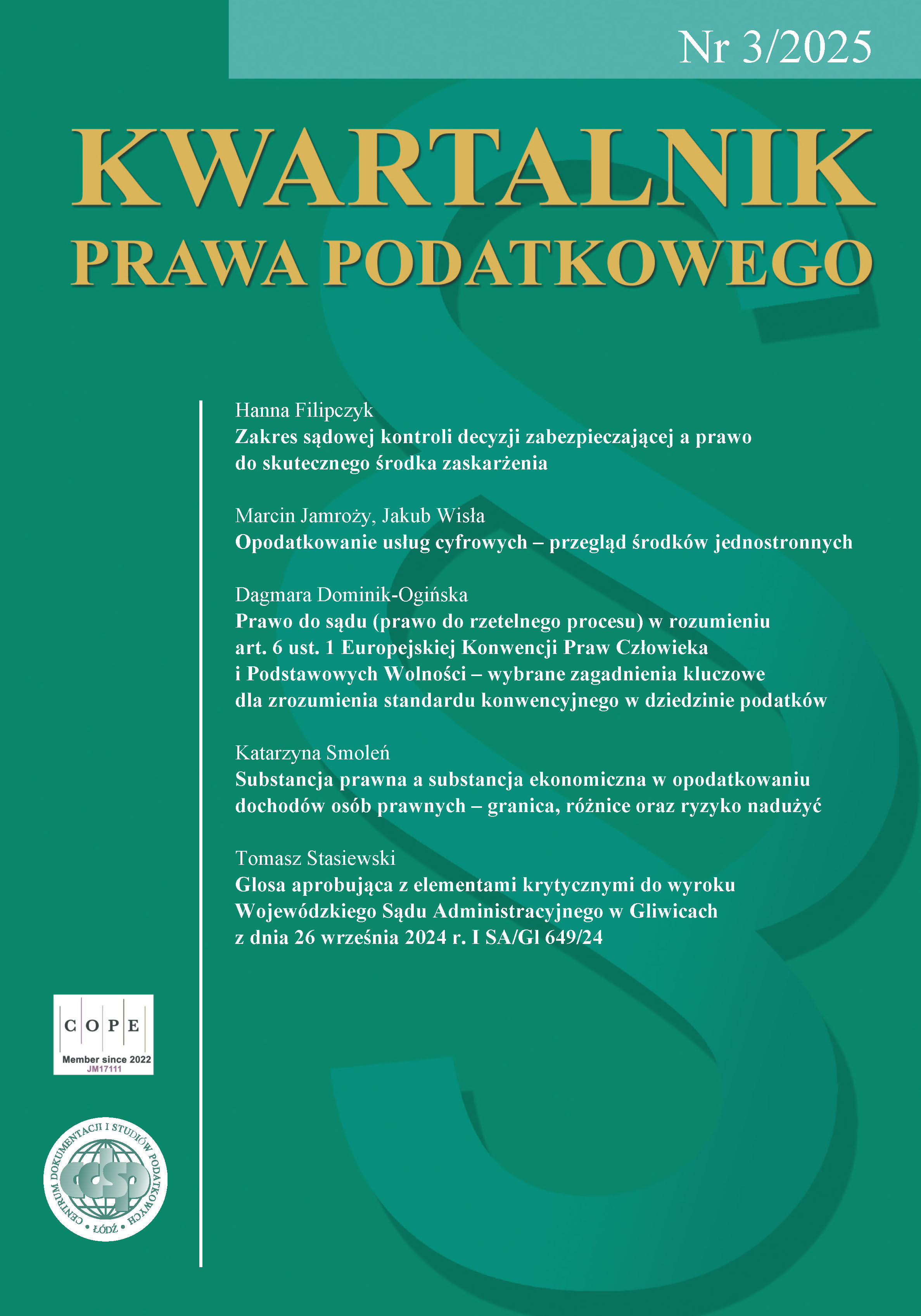
Legal substance versus economic substance in the taxation of corporate income – boundaries, differences and risks of abuse
DOI:
https://doi.org/10.18778/1509-877X.2025.03.04Keywords:
corporate income tax (CIT), legal substance, economic substance, BEPS, GAAR, transfer pricing, abuse of tax law, tax planningAbstract
This article addresses the relationship between legal substance and economic substance in the taxation of corporate income. The starting point is a definitional analysis of both concepts: while economic substance has been gaining increasing prominence in international and domestic tax discourse, legal substance – particularly in Poland – is still relatively rarely identified as a separate category of assessment, which may lead to an overlap between these concepts and potential interpretative challenges. The author examines the development of both categories in EU law (in particular, the Anti-Tax Avoidance Directive), in the work of the Organisation for Economic Co-operation and Development (notably the Base Erosion and Profit Shifting Project – BEPS), as well as their reception in national legislation, with special focus on the general anti-avoidance rule and specific anti-abuse rules (such as provisions introducing limitations on interest deductibility, the taxation of controlled foreign company income, and regulations on so-called exit taxation). The article also reviews the case law of the Court of Justice of the European Union, with the aim of illustrating practical examples of the application of legal and economic substance and highlighting possible tensions between them. In conclusion, the author proposes moving beyond the dichotomous distinction towards an additional “control” criterion – i.e. the assessment of who, in practice, exercises decision-making power over the use and development of resources. The control test may serve as a practical tool for both tax administrations and taxpayers, enabling them to distinguish genuine business structures from artificial arrangements that are merely formally endowed with assets or attributes of legal substance. Ultimately – in the author’s view – it is control that may determine the allocation of substance to a given legal entity and thereby define the permissible limits of tax planning.
Downloads
References
Aleksandrowicz M., Zalasiński A., Komentarz do wyroku TS z dnia 13 grudnia 2005 r. w sprawie C-446/03 Marks & Spencer plc v. David Hasley (Her Majesty’s Inspector of Taxes), [w:] Orzecznictwo Trybunału Sprawiedliwości Unii Europejskiej w sprawach podatkowych. Komentarz, Warszawa 2014.
Baerentzen S., The Effectiveness of General Anti-Avoidance Rules. Their Limits, Challenges and Potential in EU and International Tax Law, Amsterdam 2022, IBFD Doctoral Series.
Báez Moreno A., Irrelevant or Even Worse? The Vicious Dilemma of the New Tax Treaty Preamble, „Working Paper of the Max Planck Institute for Tax Law and Public Finance” 2024, no 7, https://doi.org/10.2139/ssrn.4946284
Baker P., Beneficial Ownership: After Indofood, „Gray’s Inn Tax Chambers” 2007, vol. 6, no 1.
Franczak A., Sztuczne struktury podatkowe i unikanie opodatkowania a swobody traktatowe – wprowadzenie i wyrok Trybunału Sprawiedliwości z 12.09.2006 r., C-196/04, Cadbury Schweppes plc i Cadbury Schweppes Overseas Ltd przeciwko Commissioners of Inland Revenue, „Europejski Przegląd Sądowy” 2025, nr 3.
GAARs – A Key Element of Tax Systems in the Post-BEPS World, red. M. Lang, J. Owens, P. Pistone, A. Rust, J. Schuch, C. Staringer, Amsterdam 2016, https://doi.org/10.59403/30p4eh0
Gillis R., The Limits of Legal Substance: Tax Avoidance and Equitable Remedies after Collins Family Trust, „Canadian Business Law Journal” 2022, vol. 66, no 3, https://doi.org/10.2139/ssrn.4235682
Kemmeren E., Prats A., Haslehner W., Heydt V., Kofler G., Lang M., Nogueira J., Raventos-Calvo S., de la Blétière E., Richelle I., Rust A., Shiers R., CFE ECJ Task Force: Opinion Statement ECJ-TF 1/2021 on the ECJ Decision of 20 January 2021 in Lexel AB (Case C-484/19) Concerning the Application of the Swedish Interest Deductibility Rules, „European Taxation” 2021, no 6.
Kempeneers C., Luts J., Case C-648/15 Austria v. Germany: Jurisdiction and Powers of the CJ to Settle Tax Treaty Disputes Under Article 273 TFEU, „EC Tax Review” 2018, no 1.
Kofler G., Lang M., Pistone P., Rust A., Schuch J., Spies K., Staringer C., Szudoczky R., CJEU – Recent Developments in Direct Taxation 2023, Wien 2024, Series on International Tax Law, vol. 142.
Kondej M., Wicher M., Projekt dyrektywy o zapobieganiu nadużywaniu przedsiębiorstw fasadowych do celów podatkowych, „Przegląd Podatkowy” 2022, nr 12.
Kuźniacki B., BO Bites Husky, GAAR Remains Toothless – Part II. The (Toxic) Relationship of BO and GAAR in Light of the Husky Energy case, Kluwer International Tax Law Blog, https://legalblogs.wolterskluwer.com/international-tax-law-blog/bo-bites-husky-gaar-remains-toothless-part-ii-the-toxic-relationship-of-bo-and-gaar-in-light-of-the-husky-energy-case/ (dostęp: 11.12.2025).
Kuźniacki B., Dynamic Interplay Between the ALS and the Principle of Prohibition of Abuse (also GAAR & PPT) in Light of X BV and Other Case Law of the CJEU, „Intertax” 2025, vol. 53, no 6–7, https://doi.org/10.54648/TAXI2025047
Kuźniacki B., Legal Substance and the Allocation of Income by a Resident State Are Decisive to Determine BO: the Canadian Federal Court of Appeal in Husky Energy, https://www.linkedin.com/pulse/legal-substance-allocation-income-resident-state-bo-court-kuźniacki-mbobf/?trackingId=evrI402zRaSFKWGgbWixsQ%3D%3D (dostęp: 11.12.2025).
Kuźniacki B., The Compatibility of the Substance over Form Doctrine with Tax and Investment Treaties: A Case Study of Lone Star v the Republic of Korea, „ICSID Review – Foreign Investment Law Journal” 2024, vol. 39, no 1, https://doi.org/10.1093/icsidreview/siad035
Lang M., Cadbury Schweppes’s Line of Case Law from the Member State’s Perspective, [w:] Prohibition of Abuse of Law, ed. R. de la Feria, S. Vogenauer, Oxford 2011, s. 436–458.
Li J., Economic Substance: Drawing the Line between Legitimate Tax Minimization and Abusive Tax Avoidance, „Canadian Tax Journal” 2006, no 1.
Majdowski F., Stosowanie regulacji CFC do podmiotów z państw trzecich na kanwie wyroku Trybunału Sprawiedliwości w sprawie unijnej swobody przepływu kapitału, „Przegląd Podatkowy” 2019, nr 6.
Majdowski F., Smoleń K., Finał postępowania w sprawie Apple – wyrok TS z 10.09.2024 r., C-465/20 P, potwierdza stanowisko Komisji Europejskiej, „Przegląd Podatkowy” 2024, nr 12.
Meussen G., Abuse of Tax Law in the European Union: Some Recent International and European Developments, [w:] Practical Problems in European and International Tax Law: Essays in Honour of Manfred Mössner, ed. H. Jochum, Amsterdam 2016, s. 317–331.
Model konwencji OECD. Komentarz, red. B. Brzeziński, Warszawa 2010.
Monsenego J., The Substance Requirement in the OECD Transfer Pricing Guidelines: What Is the Substance of the Substance Requirement?, „International Transfer Pricing Journal” 2014, vol. 21, no 1, https://doi.org/10.59403/3h9myhj
Morawski W., Międzynarodowe znaczenie terminu beneficial ownership (własność) odsetek, „Przegląd Podatkowy” 2011, nr 5.
Navarro A., The General Anti-Avoidance Rule of the EU Anti-Tax Avoidance Directive (ATAD GAAR): Interpretation and Implementation, „Working Paper of the Max Planck Institute for Tax Law and Public Finance” 2024, no 8, https://doi.org/10.2139/ssrn.4959980
Pinto Nogueira J.F., Kofler G., García Prats F.A., Haslehner W.C., Kemmeren E., Lang M., HJI Panayi C., Raventos-Calvo S., Richelle I., Rust A., Nordcurrent Group: Interpretation of the Anti-abuse Provision in the Parent Subsidiary Directive Opinion Statement ECJ-TF 2/2025 on the Decision of the CJEU of 03 April 2025 in Case C-228/24, Nordcurrent Group UAB, „CFE Europe Tax Advisers” 2025, https://doi.org/10.2139/ssrn.5409026
Prejs E., Opodatkowanie dywidend oraz prawo do zwrotu podatku zapłaconego na podstawie przepisów sprzecznych z prawem wspólnotowym (C-201/05), „Przegląd Podatkowy” 2008, nr 6.
Rusek J., Wykorzystanie koncepcji substance z perspektywy międzynarodowych regulacji podatkowych, „Kwartalnik Prawa Podatkowego” 2019, nr 1, https://doi.org/10.18778/1509-877X.2019.01.03
Smoleń K., Czym jest oraz czym nie jest substancja ekonomiczna? Próba systematyzacji pojęcia na podstawie przeglądu orzecznictwa międzynarodowego i krajowego, „Kwartalnik Doradca Podatkowy” 2025, nr 2.
Zimmer F., General Report: Form and Substance in Tax Law, „IFA Cahiers” 2002, vol. 87a.
Downloads
Published
Issue
Section
License

This work is licensed under a Creative Commons Attribution-NonCommercial-NoDerivatives 4.0 International License.
How to Cite




PlumX metrics