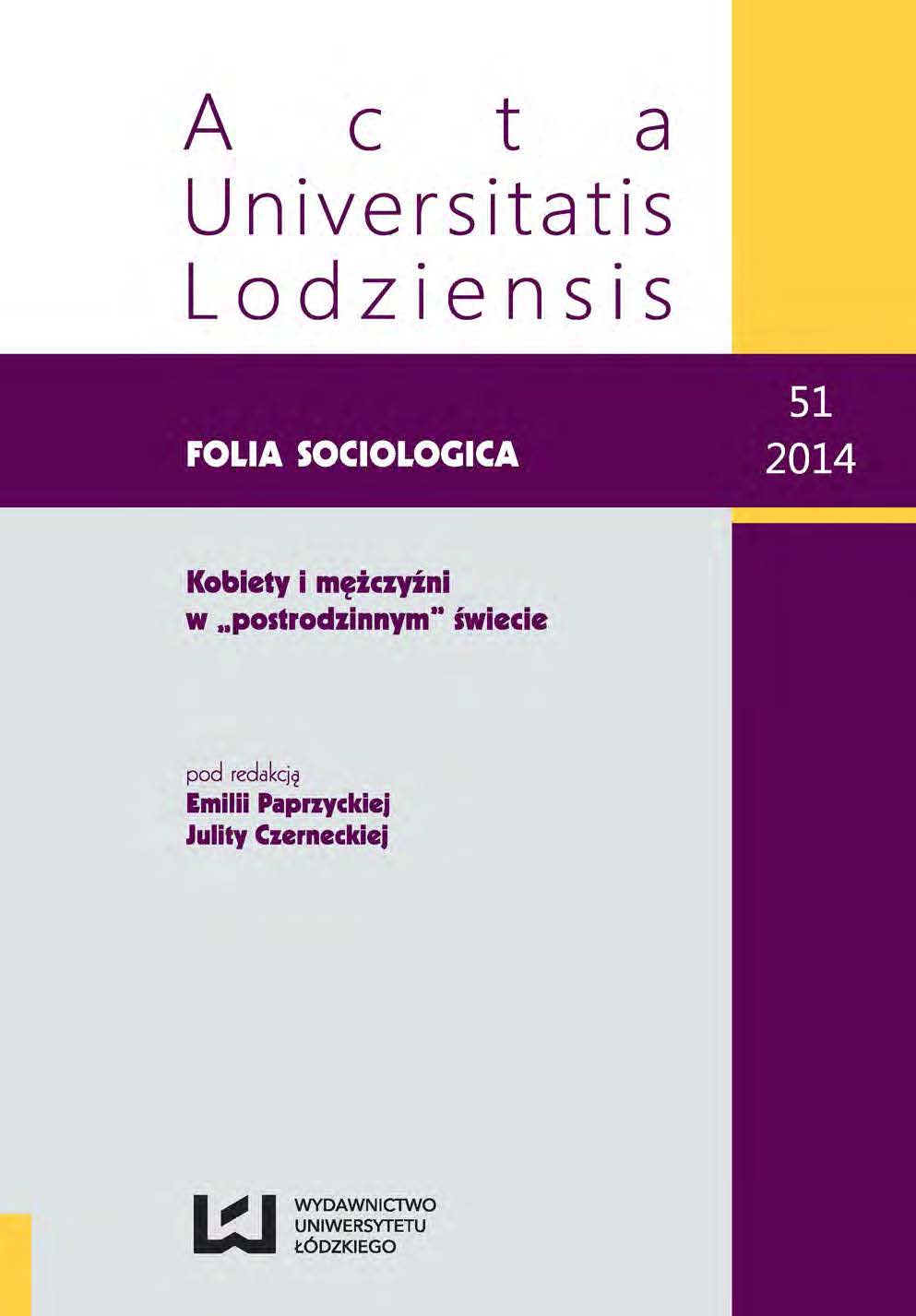
Współczesny świat zmian – alternatywy dla małżeństwa
DOI:
https://doi.org/10.18778/0208-600X.51.01Słowa kluczowe:
małżeństwo, kohabitacja, LATAbstrakt
Czasy współczesne wyznaczają kolejny rozdział w życiu społeczeństw. Poszerza się zakres możliwości dotyczących sposobów organizacji życia osobistego, przynosząc różnorodność form i sposobów organizacji bliskich związków. Małżeństwo przestało być jedyną dopuszczalną formą. Jednostki mogą żyć w związku małżeńskim, kohabitacyjnym czy typu LAT (Living Apart Together), mogą być bezdzietnymi małżeństwami z wyboru, a mogą też pozostać singlami. Przedstawiany artykuł zawiera analizę wpływu zmian społecznych na znaczenie małżeństwa, rozpowszechnianie się kohabitacji i relacji, gdy para nie dzieli wspólnego mieszkania i gospodarstwa domowego (LAT).Bibliografia
Amato P. R., Booth A., Johnson D. R., Rogers S. J. (2007), Alone together. How mar- riage in America is changing, Harvard University Press, Cambridge–London. DOI: https://doi.org/10.4159/9780674020184
Beck U. (2002), Społeczeństwo ryzyka. W drodze do innej nowoczesności, Wydawnictwo Naukowe Scholar, Warszawa.
Boguszewski R. (2008), Kontrowersje wokół rożnych zjawisk dotyczących życia małżeńskiego i rodzinnego, komunikat z badań, CBOS, Warszawa BS/54/2008.
Boguszewski R. (2013), Rodzina – jej współczesne znaczenie i rozumienie, komunikat z badań, CBOS, Warszawa BS/33/2013.
Bracher M., Santow G. (1998), Economic independence and union formation in Sweden, „Population Studies”, No. 52, s. 275–294. DOI: https://doi.org/10.1080/0032472031000150466
Buunk B. (1983), Alternative lifestyles from an international perspective: A trans-Atlantic comparison, [w:] E. D. Macklin, R. H. Rubin (eds.), Contemporary families an alternative lifestyles, Sage Publications, London–Beverly Hills–New Delhi, s. 308–330.
Castro-Martin T., Dominguez-Foulgueras M., Martin-Garcia T. (2008), Not truly partnerless: Non-residential partnerships and retreat from marriage in Spain, „Demographic Research”, No. 18 (art. 16), s. 443–468. DOI: https://doi.org/10.4054/DemRes.2008.18.16
Chambers D. (2012), A sociology of family life. Change and diversity in intimate relations, Polity Press, Cambridge.
Coontz S. (2005), Marriage, a history. How love conquered marriage, Penguin Books, New York.
Duberman L. (1974), Marriage and its alternatives, Praeger Publishers, New York–Washinghton.
Elliot F. R. (1986), The family. Change or continuity?, MacMillan Press Ltd., Houndmills, Basingstoke–Hampshire, London.
Giddens A. (2002), Nowoczesność i tożsamość. „Ja” i społeczeństwo w epoce późnej nowoczesności, Wydawnictwo Naukowe PWN, Warszawa.
Haskey J. (2005), Living arrangements in contemporary Britain: Having a partner who usually lives elsewhere and living apart together (LAT), „Population Trends”, No. 122, s. 35–45.
Hipsz N. (2013), Społeczne oceny alternatyw dla życia małżeńskiego, komunikat z badań, CBOS, Warszawa BS/32/2013.
Kalmijn M. (2007), Explaining cross-national differences in marriage, cohabitation, and divorce in Europe, 1990–2000, „Population Studies”, No. 61 (3), s. 243–263. DOI: https://doi.org/10.1080/00324720701571806
Kamp Dush C. M., Cohan C. L., Amato P. R. (2003), The relationship between cohabitation and marital quality and stability: Change across cohorts?, „Journal of Marriage and Family”, No. 65 (3), s. 539–549. DOI: https://doi.org/10.1111/j.1741-3737.2003.00539.x
Kasearu K., Kutsar D. (2011), Patterns behind unmarried cohabitation trends in Europe, „European Societies”, No. 13 (2), s. 307–325. DOI: https://doi.org/10.1080/14616696.2010.493586
Kiernan K. (2000), European perspectives on union formation, [w:] L. J. Waite (ed.), The ties that bind. Perspectives on marriage and cohabitation, Aldine de Gruyter, New York, s. 40–58.
Kiernan K. E., Estaugh V. (1993), Cohabitation, extra-marital childbearing and social policy, „Occasional Paper” 17, Family Policy Studies Centre, London.
Kwak A. (1994), Rodzina i jej przemiany, Instytut Stosowanych Nauk Społecznych Uniwersytetu Warszawskiego, Warszawa.
Kwak A. (2005), Rodzina w dobie przemian. Małżeństwo i kohabitacja, Wydawnictwo Naukowe „Żak”, Warszawa.
Levin I. (2004), Living apart together: A new family form, „Current Sociology”, No. 52 (2), s. 223–240. DOI: https://doi.org/10.1177/0011392104041809
Macklin E. D. (1980), Nontraditional family forms: A decade of research, „Journal of Marriage and Family”, No. 42 (4), s. 905–922. DOI: https://doi.org/10.2307/351832
Milan A., Peters A. (2003), Couples living apart, „Canadian Social Trends”, No. 2–6, Statistics Canada, kat. nr 11-008.
Nazio T., Blossfeld H.-P. (2003), The diffusion of cohabitation among young women in West Germany, East Germany and Italy, „European Journal of Population”, No. 19 (1), s. 47–82. DOI: https://doi.org/10.1023/A:1022192608963
Popenoe D. (2005), War over the family, Transaction Publishers, New Brunswick–London.
Popenoe D. (2009), Cohabitation, marriage, and child wellbeing: A cross-national perspective, „Social Science and Public Policy”, No. 46 (5), s. 429–436. DOI: https://doi.org/10.1007/s12115-009-9242-5
Régnier-Loilier A., Beaujouan É., Villeneuve-Gokalp C. (2009), Neither single nor in a couple: A study of living apart together in France, „Demographic Research”, No. 21 (art. 14), s. 75–108. DOI: https://doi.org/10.4054/DemRes.2009.21.4
Reimondos A., Evans A., Gray E. (2011), Living-apart-together (LAT) relationships in Australia, „Family Matters”, No. 87 (1), s. 43–55
Rocznik Demograficzny (2013), GUS, Warszawa.
Rose-Greenland F., Smock P. J. (2013), Living together unmarried: What do we know about cohabiting families?, [w:] G. W. Peterson, K. R. Bush (eds.), Handbook of marriage and the family, Springer, New York, s. 255–273. DOI: https://doi.org/10.1007/978-1-4614-3987-5_12
Ruspini E. (2013), Diversity in family life. Gender, relationships and social change, Policy Press, Bristol. DOI: https://doi.org/10.56687/9781447300946
Slany K. (1990), Związki konsensualne – nowa forma małżeństwa, „Problemy Rodziny”, nr 3 (171), s. 28–32.
Sobotka T., Toulemon L. (2008), Changing family and partnership behaviour: Common trends and persistent diversity across Europe, „Demographic Research” No. 19 (art. 6), s. 85–138. DOI: https://doi.org/10.4054/DemRes.2008.19.6
Syltevik L. J. (2010), Sense and sensibility: cohabitation in ‘cohabitation land’, „The Sociological Review”, No. 58 (3), s. 444–462. DOI: https://doi.org/10.1111/j.1467-954X.2010.01932.x
Szlęzak A. (1987), Konkubinat w świetle prawa państw kapitalistycznych, „Studia Prawnicze”, nr 4, s. 77–219.
Teachman J. (2003), Premarital sex, premarital cohabitation and the risk of subsequent marital dissolution among women, „Journal of Marriage and Family”, No. 65 (2), s. 444–455. DOI: https://doi.org/10.1111/j.1741-3737.2003.00444.x
Vespa J. (2014), Historical trends in the marital intentions of one-time and serial cohabitors, „Journal of Marriage and Family”, No. 76 (1), s. 207–217. DOI: https://doi.org/10.1111/jomf.12083
Yodanis C. (2010), The institution of marriage, [w:] J. Treas, S. Drobnič (red.), Dividing the domestic. Men, women, and household work in cross-national perspective, Stanford University Press, Stanford CA, s. 175–191. DOI: https://doi.org/10.11126/stanford/9780804763578.003.0009
Pobrania
Opublikowane
Numer
Dział
Licencja

Utwór dostępny jest na licencji Creative Commons Uznanie autorstwa – Użycie niekomercyjne – Bez utworów zależnych 4.0 Międzynarodowe.
Jak cytować