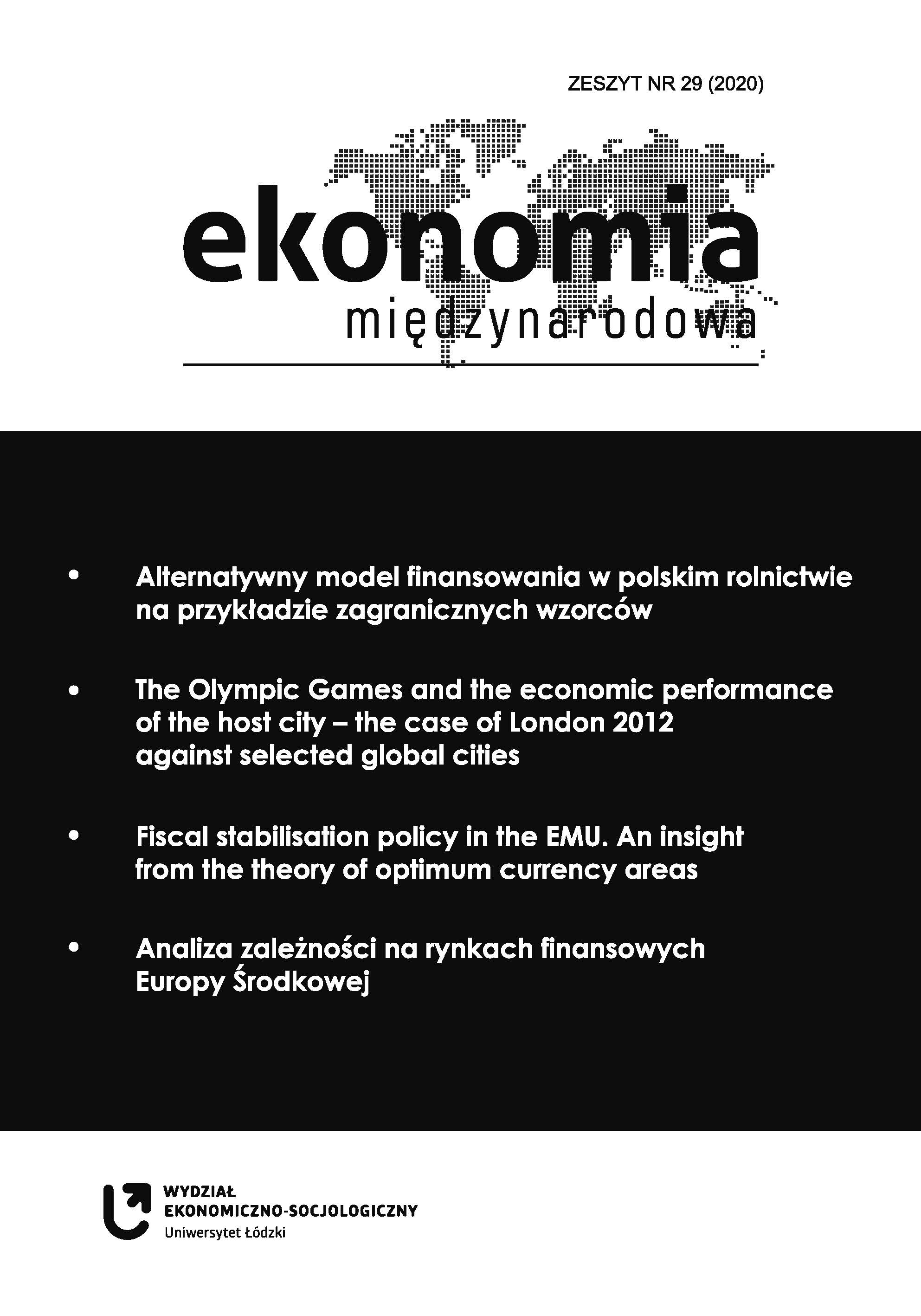
Fiscal stabilisation policy in the EMU. An insight from the theory of optimum currency areas
DOI:
https://doi.org/10.18778/2082-4440.29.03Keywords:
monetary union, fiscal policy, business cycles, stabilisationAbstract
The aim of the paper is to examine the role and place of the fiscal stabilisation policy in the European Monetary Union (EMU) from the perspective of the theory of optimum currency areas (OCA). We examine the theoretical underpinning for the policy to mitigate the economic fluctuations in a monetary union, and answer the questions of whether fiscal integration is a prerequisite for the “optimality” of a currency area and at what level of governance a stabilising fiscal policy should be conducted. We conclude with a short revision of how OCA theory is applied to the project of monetary and economic integration in the European Union (EU) and some conclusions for future development and research.
Downloads
References
Alcidi, C., & Thirion, G. (2016), Assessing the Euro Area’s Shock-Absorption Capacity: Risk Sharing, Consumption Smoothing and Fiscal Policy, CEPS Special Report, 146, CEPS Brussels.
Allard, C. et al. (2014), Toward a Fiscal Union for the Euro Area, IMF Staff Discussion Note, SDN/13/09, International Monetary Fund, Washington D.C.
Belke, A. (2013), Towards a Genuine Economic and Monetary Union – Comments on a Roadmap, ROME Discussion Paper Series, 4. DOI: https://doi.org/10.12924/pag2013.01010048
Bijak-Kaszuba, M. (1998), Regionalna liberalizacja handlu międzynarodowego a zmiany strukturalne zagranicznych obrotów towarowych kraju uczestniczącego (na przykładzie Polski), Wydawnictwo Uniwersytetu Łódzkiego, Łódź.
Bordo, M.D. et al. (2013), A Fiscal Union for the Euro: Some Lessons from History, CESifo Economic Studies, 59(3). DOI: https://doi.org/10.1093/cesifo/ift001
Corden, W. (1972), Monetary Integration, “Essays in International Finance”, International Finance Sections of Department of Economics of Princeton University, no. 93.
Corsetti, G.L. et al. (2014), The Time is Short and the Need Great: New Institutions and New Policies for a Workable EMU, CEPR, London.
Dabrowski, M. (2015), Monetary Union and Fiscal and Macroeconomic Governance, European Economy Discussion Papers, 013, September.
de Grauwe, P. (2009), Some Thoughts on Monetary and Political Union, [in:] L. Talani (Ed.), The Future of EMU, Palgrave Macmillan. DOI: https://doi.org/10.1057/9780230233898_2
de Grauwe, P. (2013), Design Failures in the Eurozone – Can They Be Fixed, European Economy Economic Papers, 491. DOI: https://doi.org/10.2139/ssrn.2215762
Eichengreen, B. (1990), One Money for Europe? Lessons from the US Currency and Customs Union, Economic Policy, 10. DOI: https://doi.org/10.2307/1344577
Eichengreen, B., Wyplosz, Ch. (2016), Minimal Conditions for the Survival of the Euro, Voxeu, 14 March. DOI: https://doi.org/10.1007/s10272-016-0569-z
Ethier, W.J. (1998), Regionalism in a Multilateral World, Journal of Political Economy, 106(6). DOI: https://doi.org/10.1086/250045
European Commission (2017), Further Steps towards Completing Europe’s Economic and Monetary Union, COM (2017) 821 final, 6.12.
European Commission (2018), A Modern Budget for a Union that Protects, Empowers and Defends, COM (2018) 321 final, 2.05.
Fidrmuc, J. (2005), The Endogeneity of the Optimum Currency Area Criteria and Intra-Industry Trade: Implications for EMU Enlargement, [in:] P. de Grauwe, J. Melitz (Eds.), Prospects of Monetary Unions after the Euro, CeSifo seminar series, MIT Press. DOI: https://doi.org/10.1093/cep/byh001
Fleming, J. (1971), On Exchange Rate Unification, The Economic Journal, 81. DOI: https://doi.org/10.2307/2229844
Frankel, J., & Rose, A. (1996), Endogeneity of the Optimum Currency Area Criteria, CEPR Discussion Paper, 1473, September. DOI: https://doi.org/10.3386/w5700
Frankel, J., & Rose, A. (1997), Is EMU More Justifiable Ex Post Than Ex Ante?, European Economic Review, 41. DOI: https://doi.org/10.1016/S0014-2921(97)00034-2
Frankel, J., & Rose, A. (1998), Endogeneity of the Optimum Currency Area Criteria, Economic Journal, 108(449), July. DOI: https://doi.org/10.1111/1468-0297.00327
Frankel, J., & Rose, A. (2000), Estimating the Effects of Currency Unions on Trade and Output, NBER Working Paper, 7857. DOI: https://doi.org/10.3386/w7857
Grubel, G.H. (1970), The Theory of Optimum Currency Areas, Canadian Journal of Economics, 1.3(2), May. DOI: https://doi.org/10.2307/133681
Ingram, J. (1962), Regional Payment Mechanisms: The Case of Puerto Rico, University of North Carolina Press.
Juncker, J.C. et al. (2015), Completing Europe’s Economic and Monetary Union, June.
Kenen, P. (1969), The Optimum Currency Area: An Eclectic View, [in:] R. Mundell, A. Swoboda (Eds.), Monetary Problems of the International Economy, University of Chicago Press.
Komisja Europejska (2018a), Wniosek. Decyzja Rady w sprawie systemu zasobów własnych UE, COM (2018) 325 final, 02.05.
Komisja Europejska (2018b), Wniosek. Rozporządzenie Rady określające wieloletnie ramy finansowe 2021–2027, COM (2018) 322 final, 15.05
Krugman, P. (1993), Lessons of Massachusetts for EMU, [in:] F. Torres, F. Giavassi (Eds.), Adjustments and Growth in the European Monetary Union, Cambridge University Press. DOI: https://doi.org/10.1017/CBO9780511599231.016
Krugman, P. (1993b), Geography and Trade, MIT Press, Cambridge USA.
Lutkowski, K. (2004), Od złotego do euro. Źródła obaw i nadziei, Twigger, Warszawa.
Marshall, A. (1925), Zasady ekonomiki, Wydawnictwo M. Arcta, Warszawa.
McKinnon, R. (1963), Optimum Currency Areas, American Economic Review, 52, September.
McKinnon, R. (2004), Currency Areas and Key Currencies: Mundel I versus Mundel II, Journal of Common Market Studies, 42(4). DOI: https://doi.org/10.1111/j.0021-9886.2004.00525.x
Misiak, M. (2013), Polityka stabilizacyjna w wieloszczeblowym systemie sprawowania władzy. Przykład Unii Gospodarczo-Walutowej w dobie kryzysu gospodarczo-finansowego, Centrum Europejskie Natolin, Warszawa.
Mongelli, F.P. (2002), New Views on the Optimum Currency Area Theory: What is EMU Telling Us, ECB Working Papers, 138, April. DOI: https://doi.org/10.2139/ssrn.357400
Mundell, R. (1961), The Theory of Optimum Currency Areas, American Economic Review, 51(4), September.
Mundell, R. (1973), Uncommon Arguments for Common Currencies, [in:] H.G.. Johnson, A.K. Swoboda (Eds.), The Economics of Common Currencies, Allen & Unwin, London.
Pisani-Ferry J. (2010), European Governance: What Went Wrong and How to Repair It, [in:] R. Baldwin et al. (Eds.), Completing the Eurozone Rescue: What More Needs to be Done, CEPR.
Snider, D. (1967), Optimum Adjustment Processes and Currency Areas, “Essays in International Finance”, International Finance Sections of Department of Economics of Princeton University, no. 62.
Tavlas, G.S. (1994), The Theory of Economic Integration, Open Economics Review, 5(2). DOI: https://doi.org/10.1007/BF01000489
Thirion, G. (2017), European Fiscal Union: Economic Rationale and Design Challenges, CEPS Working Document, 02, January
Tower, E, & Willet, T. (1976), The Theory of Optimum Currency Areas and Exchange Rate Flexibility, “Essays in International Finance”, International Finance Sections of Department of Economics of Princeton University, no. 11.
Downloads
Published
Issue
Section
License

This work is licensed under a Creative Commons Attribution-NonCommercial-NoDerivatives 4.0 International License.
How to Cite