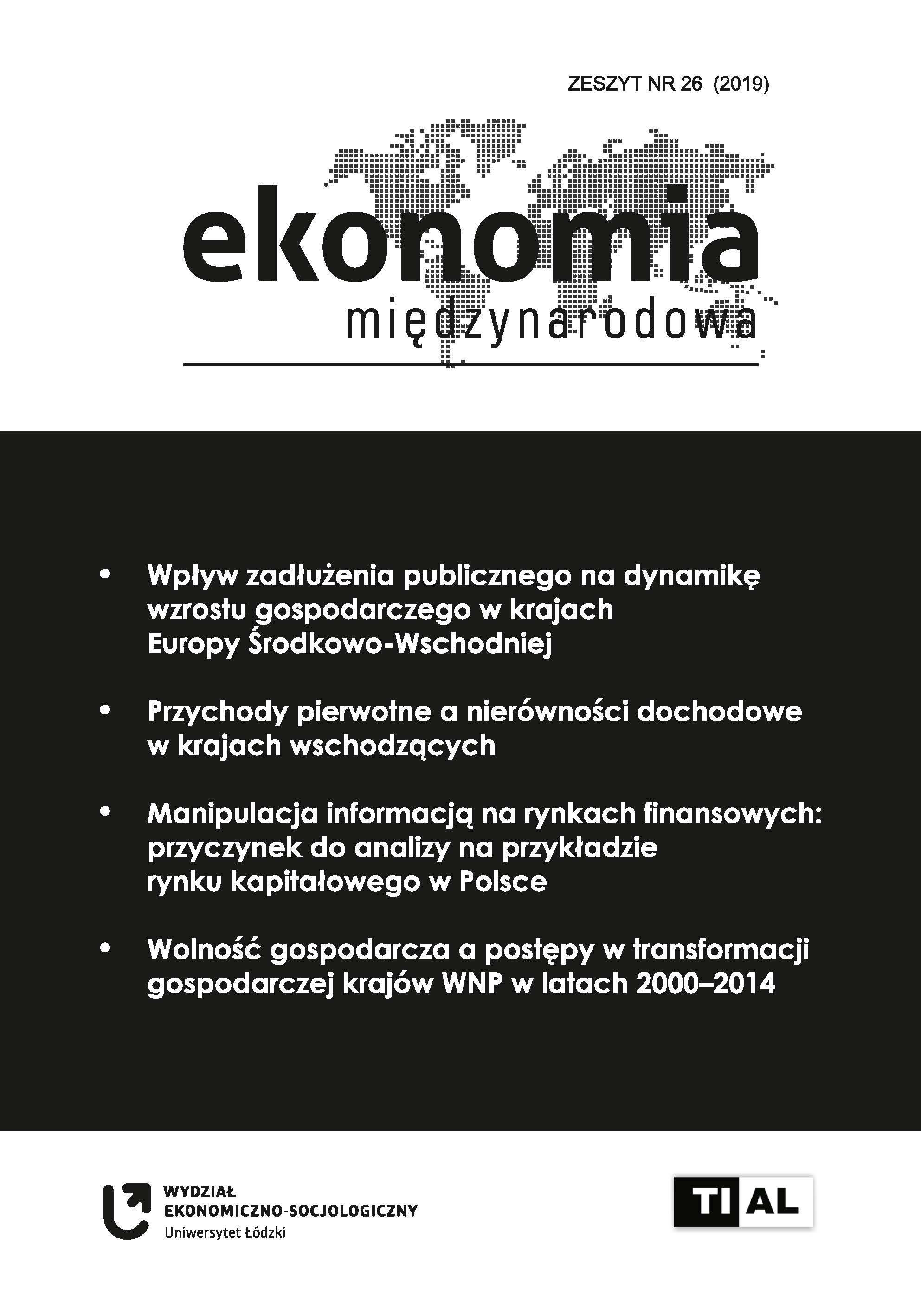
Primary income receipts and income inequality in emerging countries
DOI:
https://doi.org/10.18778/2082-4440.26.02Keywords:
income inequality, balance of payments, emerging markets, panel cointegrationAbstract
The rise in income inequality is often ascribed to globalisation and its various components, such as economic migrations and foreign direct investment. Previous research in this area focused on the relationship between income inequality and flows or stocks of migrants and capital. Little attention has been paid to income flows generated by these categories that are recorded in the balance of payments as primary income. Existing analysis explored the impact of migrants’ remittances on the distribution of income in developing countries. This article analyses the relationship between primary income receipts and income inequality using panel cointegration methods for a group of six emerging countries: Poland, the Czech Republic, Egypt, Russia, Turkey and Chile. In contrast to the existing literature, income inequality is measured by top percentile income share derived from fiscal data (World Inequalities Database). The results reveal a long run, positive relationship between primary income receipts as a share of GDP and top percentile income share. There is also a long-run causal relationship between a rise (fall) in primary income receipts and a rise (fall) in income inequality. The results are robust to alternative estimation methods (CCE, DOLS, VECM). The scope of this work is narrowed by the limited availability of comparable data for other emerging countries.
Downloads
References
Acemoglu D., Autor D. (2010), Skills, tasks and technologies: Implications for employment and earnings, „NBER Working Paper Series”, nr 16082, s. 154.
Akkermans D. (2017), Net profit flow per country from 1980 to 2009: The longterm effects of foreign direct investment, „PLoS ONE, 12 (6), https://doi.org/10.1371/journal.pone.0179244 (data dostępu: 19 marca 2019). DOI: https://doi.org/10.1371/journal.pone.0179244
Baltagi B. (2005), Econometric analysis of panel data, John Wiley & Sons, Chichester, s. 237–265.
Barbieri L. (2008), Panel cointegration tests: A survey, „Rivista Internazionale di Scienze Sociali”, t. 116, nr 1, s. 3–36.
Brzeziński M. (2017), Nierówności dochodowe i majątkowe w Europie – fakty, przyczyny, konsekwencje [w:] J. Kleer, K. Prandecki (red.), Zróżnicowanie dochodowe i społeczne Europy, PAN, Warszawa, 2017, s. 10.
Budnikowski A. (2014), Ekonomia międzynarodowa, PWE, Warszawa, s. 93–100.
Card D. (2009), Immigration and inequality, „American Economic Review: Papers and Proceedings”, 99 (2), s. 1–21.
Celik S., Basdas U. (2010), How does globalization affect income inequality? A panel data analysis, „International Advances in Economic Research”, t. 16, nr 4, s. 358–370.
Chintrakarn P. i in. (2012), FDI and income inequality: Evidence from a panel of U.S. states, „Economic Inquiry”, t. 50, nr 3, s. 788–801.
Choi C. (2006), Does foreign direct investment affect domestic income inequality?, „Applied Economics Letters”, t. 12, nr 12, s. 811–814.
Deng W., Lin Y. (2013), Parameter heterogeneity in the foreign direct investment – income inequality relationship: A semiparametric regression analysis, „Empirical Economics”, t. 45, nr 2, s. 845–872.
Feenstra R., Hanson G. (1995), Foreign investment, outsourcing and relative wages, „NBER Working Papers Series”, nr 5121, s. 53.
Guschanski A., Onaran Ö. (2018), Determinants of the wage share: A cross-country comparison using sectoral data, „CESifo Forum. Ifo Institut – Leibniz-
Institut für Wirtschaftsforschung an der Universität München”, t. 19, nr 2, s. 44–54.
Herzer D. i in. (2014), FDI and income inequality – evidence from Latin American economies, „Review of Development Economics”, 18(4), s. 778–793.
Herzer D., Nunnenkamp P. (2013), Inward and outward FDI and income inequality: Evidence from Europe, Review of World Economics, t. 149, s. 395–422.
Kierzenkowski R., Koske I. (2013), The drivers of labor income inequality – A literature review, „Journal of International Commerce, Economics and Policy”, t. 4, nr 1, s. 32.
Koechlin V., Leon G. (2007), International remittances and income inequality: An empirical investigation, „Journal of Economic Policy Reform”, t. 10, nr 2, s. 123–141.
Konopczak K., Welfe A. (2014), Efekt Balassy-Samuelsona i mechanizmy jego absorpcji, „Ekonomista”, nr 4, s. 463–489.
Leigh A. (2007), How closely do top income shares track other measures of inequality?, „The Economic Journal”, nr 117, s. 589–603.
Majeed T. (2016), Distributional consequences of remittances: Evidence from sixty-five developing countries, „Pakistan Journal of Commerce and Social Sciences”, t. 10 (2), s. 274–295.
MFW (2014), Balance of payments and international investment position compilation guide, MFW, Waszyngton, s. 620.
Mihaylova S. (2015), Foreign direct investment and income inequality in Central and Eastern Europe, „Theoretical and Applied Economics”, t. XXII, nr 2 (603), s. 23–42.
Mushtaq M. i in. (2017), Distributional impact of foreign remittances in Pakistan, „Pakistan Business Review”, July 2017, s. 320–338.
Nakonieczna-Kisiel H. (2016), Foreign direct investment and the balance of payments in Poland, Trends in the World Economy, t. 8, s. 111–123.
Perez R.P., Gomes C.N. (2015), Determinants and home country effects of FDI outflows. Evidence from Latin American countries, „ECLAC Studies and Perspectives Series”, nr 166, Mexico, s. 71.
Pesaran M. (2006), Estimation and inference in large heterogenous panels with a multifactor error structutre, „Econometrica”, nr 74, s. 967–1012.
Shen I. i in. (2010), Remittances and inequality: A dynamic migration model, „Journal of Economic Inequalities”, t. 8, s. 197–220.
Welfe A. (2018), Ekonometria, PWE, Warszawa, s. 486.
World Development Indicators, https://databank.worldbank.org/data (data dostępu: 19 marca 2019).
World Inequality Database, https://wid.world/data (data dostępu: 19 marca 2019).
World Inequality Report (2018), F. Alvaredo i in. (red.), World Inequality Lab, s. 300.
Downloads
Published
Issue
Section
License

This work is licensed under a Creative Commons Attribution-NonCommercial-NoDerivatives 4.0 International License.
How to Cite