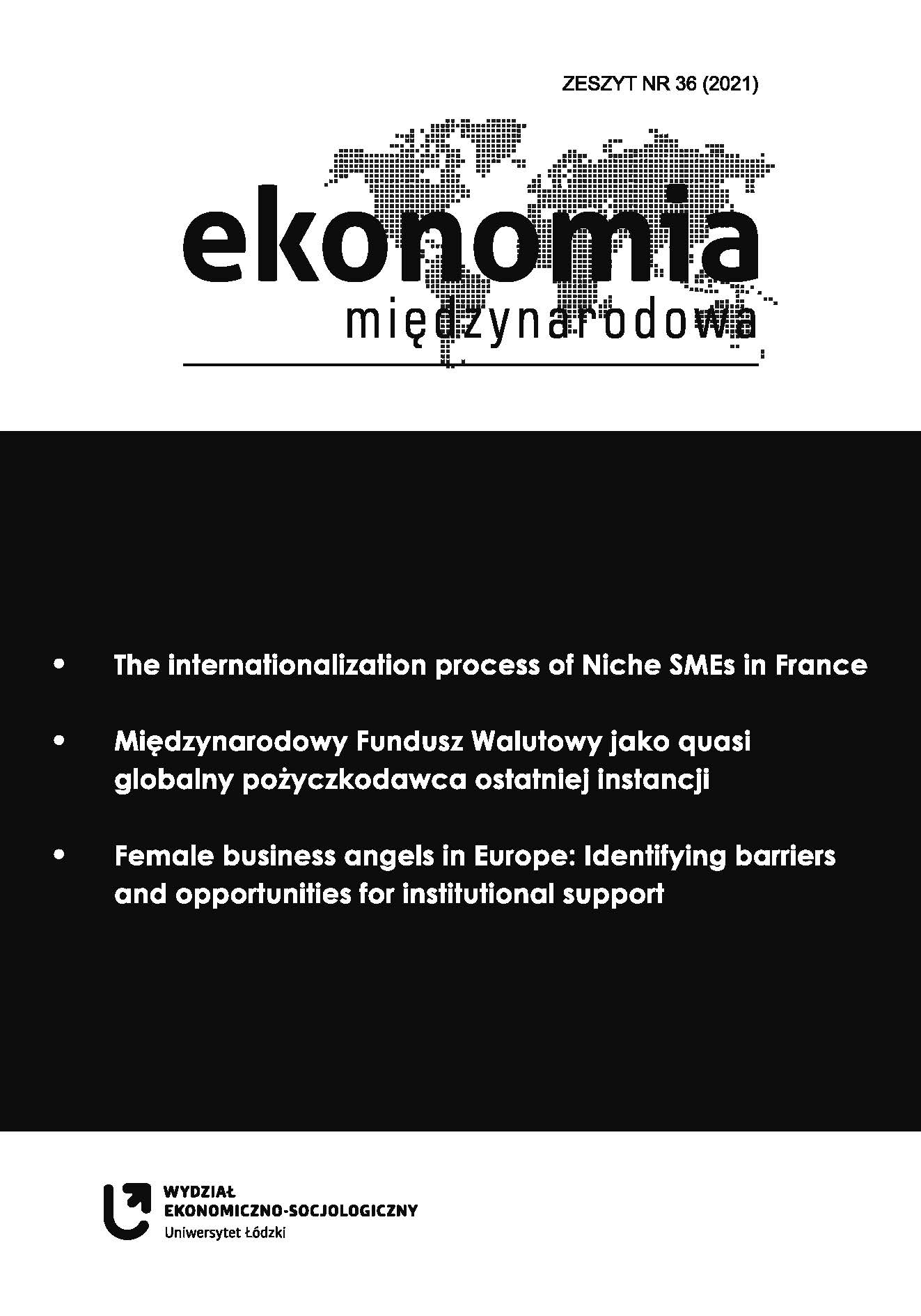
International Monetary Fund as a quasi global lender of last resort
DOI:
https://doi.org/10.18778/2082-4440.36.02Keywords:
international monetary system, lender of last resort, international currency, international liquidity, financial stability, currency swapAbstract
The purpose of this article is to analyze the capacities of the International Monetary Fund (IMF) related to the international lender of last resort (ILOLR) as well as to assess the measures that the Fund has taken in this regard during the global financial crisis (GFC) and the corona crisis. The thesis of this article is that the IMF remains the only international financial institution that is predisposed to act as ILOLR, however the Fund is able to do so only to a limited extent. The author has analyzed determinants and abilities of the IMF to perform the function of ILOLR. In this respect, creation of both unconditional and conditional international liquidity by the Fund was assessed. Subsequently, measures adopted by the IMF during the GFC and the corona crisis in both these areas have been analyzed. The author has pointed out that these undertakings have enhanced the Fund’s role as ILOLR. Nevertheless, barriers to the IMF’s role as ILOLR have been also identified. The analysis carried out lends support to the assertion that the IMF acts as ILOLR only to a limited extent and therefore it is substantiated to apply a term of quasi ILOLR with reference to the Fund.
Downloads
References
Allen W., Moessner R. (2010), Central Bank Cooperation and International Liquidity in the Financial Crisis of 2008–9, Bank for International Settlements, Special Paper No. 187. https://doi.org/10.2139/ssrn.1631791 DOI: https://doi.org/10.2139/ssrn.1631791
Bilski J. (2006), Międzynarodowy system walutowy. Kierunki ewolucji, Polskie Wydawnictwo Ekonomiczne, Warszawa.
Bogołębska J. (2008), Bank centralny jako pożyczkodawca ostatniej instancji. Współczesne dylematy realizacji funkcji, „Folia Oeconomica”, nr 221.
Bogołębska J. (2020), Stabilność międzynarodowego systemu walutowego. Problemy i kierunki reformy, Wydawnictwo Uniwersytetu Łódzkiego, Łódź. DOI: https://doi.org/10.18778/8220-103-1
Broz L. (2015), The Federal Reserve as Global Lender of Last Resort, 2007–2010, Systemic Risk Centre, Duscussion Paper No. 30.
Cohen B. (2004), The Macrofoundation of Monetary Power, University of California At Santa Barbara.
De Gregorio J., Eichengreen B., Takatoshi I., Wyplosz C. (2018), IMF Reform: The Unfinished Agenda, Centre for Economic Policy Research, London.
Duran C. (2015), The International Lender of Last Resort for Emering Countries: A Bilateral Currency Swap?, The Global Economic Governance Programme Working Paper No. 2015/108, University of Oxford.
Eichengreen B. (2002), Financial crises and what at to do about them, Oxford University Press, Oxford. https://doi.org/10.1093/acprof:oso/9780199257430.001.0001 DOI: https://doi.org/10.1093/acprof:oso/9780199257430.001.0001
Farhi E., Gourinchas P-O., Rey H. (2011), Reforming the International Monetary System, Centre for Economic Policy Research, London.
Fischer S. (1999), On the Need for an International Lender of Last Resort, „Journal of Economic Perspectives”, 13(4), Fall 1999. https://doi.org/10.1257/jep.13.4.85 DOI: https://doi.org/10.1257/jep.13.4.85
Fleming J.M. (1961), International Liquidity: Ends and Means, International Monetary Fund, Staff Papers, Vol. 8, Washington, DC. https://doi.org/10.2307/3866041 DOI: https://doi.org/10.2307/3866041
Frankiewicz D. (2016), Instytucja pożyczkodawcy ostatniej instancji – na przykładzie Międzynarodowego Funduszu Walutowego, „Studia i Prace Kolegium Ekonomiczno-Społecznego”, nr 4(28), Szkoła Główna Handlowa w Warszawie. https://doi.org/10.33119/KKESSiP.2016.4.8 DOI: https://doi.org/10.33119/KKESSiP.2016.4.8
Freixas X., Parigi B.M. (2014), Lender of Last Resort and Bank Closure Policy: A Post-Crisis Perspective, The Oxford Handbook of Banking. https://doi.org/10.1093/oxfordhb/9780199688500.013.0020 DOI: https://doi.org/10.1093/oxfordhb/9780199688500.013.0020
Gąsiorowski P., Grotte M., Frankiewicz D., Życieńska A., Walasik A. (2013), Dostosowania instrumentarium, zasad działania i zasobów Międzynarodowego Funduszu Walutowego w reakcji na światowy kryzys finansowy i gospodarczy, Narodowy Bank Polski, Warszawa.
Gislén M., Hansson I., Melander O. (2021), Dollar liquieity from the Federal Reserve to other central banks, „Sveriges Riksbank Economic Review”, No. 1.
Grotte M., Życieńska A. (2011), Międzynarodowy Fundusz Walutowy i stojące przed nim wyzwania, Narodowy Bank Polski, Warszawa.
Hennig R. (2015), The Global Liquidity Safety Net. Institutional Cooperation on Precautionary Facilities and Central Bank Swaps, Centre for International Governance Innovation, Working Paper No. 5.
Humprey T.M. (1989), Lender of Last Resort: The Concept in History, „Economic Review” March/April 1989.
IMF (2009), Press Release No. 09/85, International Monetary Fund, Washington, 24.03.2009. https://doi.org/10.5089/9781451808964.002 DOI: https://doi.org/10.5089/9781451808964.002
IMF (2011), Articles of Agreement, Washington, DC.
IMF (2017), IMF Quotas, International Monetary Fund, Washington, DC.
IMF (2018a), IMF Annual Report 2018: Building a Shared Future, Washington, DC.
IMF (2018b), IMF Financial Operations 2018, Washington, DC.
IMF (2020a), IMF Executive Board Approves Two-Year US$23.93 Billion Flexible Credit Line Arrangement for Chile, Press Release No. PR20/227, Washington, DC. https://doi.org/10.5089/9781513545998.002 DOI: https://doi.org/10.5089/9781513545998.002
IMF (2020b), IMF Executive Board Approves Two-Year US$11 Billion Flexible Credit Line Arrangement for Peru, Press Release No. PR20/224, Washington, DC.
IMF (2020c), IMF COVID-19 Response – A New Short-Term Liquidity Line to Enhance the Adequacy of the Global Financial Safety Net, Washington, DC.
IMF (2021), Build Forward Better, IMF Annual Report 2021, Washington, DC.
IMF (2022), A New Trust to Help Countries Build Resilience and Sustainability, https://blogs.imf.org/2022/01/20/a-new-trust-to-help-countries-build-resilience-and-sustainability/ (data dostępu: 25.01.2022).
Jurek M. (2011), Międzynarodowy system walutowy i systemy kursowe w warunkach integracji finansowej, Wydawnictwo Uniwersytetu Ekonomicznego w Poznaniu.
McDowell D. (2012), The US as Sovereign International Last-Resort Lender: The Fed’s Currency Swap Programme during the great panic of 2007–2009, „New Political Economy”, 17(2). https://doi.org/10.1080/13563467.2010.542235 DOI: https://doi.org/10.1080/13563467.2010.542235
Polański Z. (2012), Przemiany funkcji pożyczkodawcy ostatniej instancji w czasie kryzysu, [w:] W.L. Jaworski, A. Szelągowska (red.), Bankowość centralna, Wydawnictwo CeDeWu, Warszawa.
Scheubel B., Stracca L. (2016), What do we know about the global financial safety net? Rationale, data and possible evolution, Occasional Paper Series No. 177, September 2016, European Central Bank, Frankfurt am Main. https://doi.org/10.2139/ssrn.2843608 DOI: https://doi.org/10.2139/ssrn.2843608
Skopiec D. (2016), Znaczenie porozumień swapowych banków centralnych w tworzeniu oficjalnej płynności międzynarodowej, „International Business and Global Economy”, No. 35/2, University of Gdańsk.
Skopiec D. (2017), Akumulacja rezerw dewizowych we współczesnej gospodarce światowej, Oficyna Wydawnicza SGH, Warszawa.
Stawasz-Grabowska E. (2018), Pożyczkodawca ostatniej instancji w strefie euro. Nowa rola Europejskiego Banku Centralnego, Wydawnictwo Uniwersytetu Łódzkiego, Łódź. https://doi.org/10.18778/8142-420-2 DOI: https://doi.org/10.18778/8142-420-2
Szczepańska O. (2008), Stabilność finansowa jako cel banku centralnego. Studium teoretyczno-porównawcze, Wydawnictwo Naukowe SCHOLAR, Warszawa.
Truman E. (2010), The G-20 and International Financial Institution Governance, Working Paper No. WP 10–13, Peterson Institute for International Economics, Washington, DC. https://doi.org/10.2139/ssrn.1681547 DOI: https://doi.org/10.2139/ssrn.1681547
Truman E. (2013), Enhancing the global financial safety net through central-bank cooperation, https://voxeu.org/article/enhancing-global-financial-safety-net-through-central-bank-cooperation (data dostępu: 24.02.2022).
Wajda M. (2016), Działalność stabilizacyjna Międzynarodowego Funduszu Walutowego w latach 2008–2014, „Studia Ekonomiczne. Zeszyty Naukowe Uniwersytetu Ekonomicznego w Katowicach”, nr 266.
Weiss M.A. (2018), The International Monetary Fund, Congressional Research Service, Washington, DC.
Willimason J. (2004), A Short History of the Washington Consensus, Institute for International Economics, Washington, DC.
Zygierewicz M. (2008), Pożyczkodawca ostatniej szansy, „Bezpieczny Bank”, nr 2(37).
Downloads
Published
Issue
Section
License

This work is licensed under a Creative Commons Attribution-NonCommercial-NoDerivatives 4.0 International License.
How to Cite