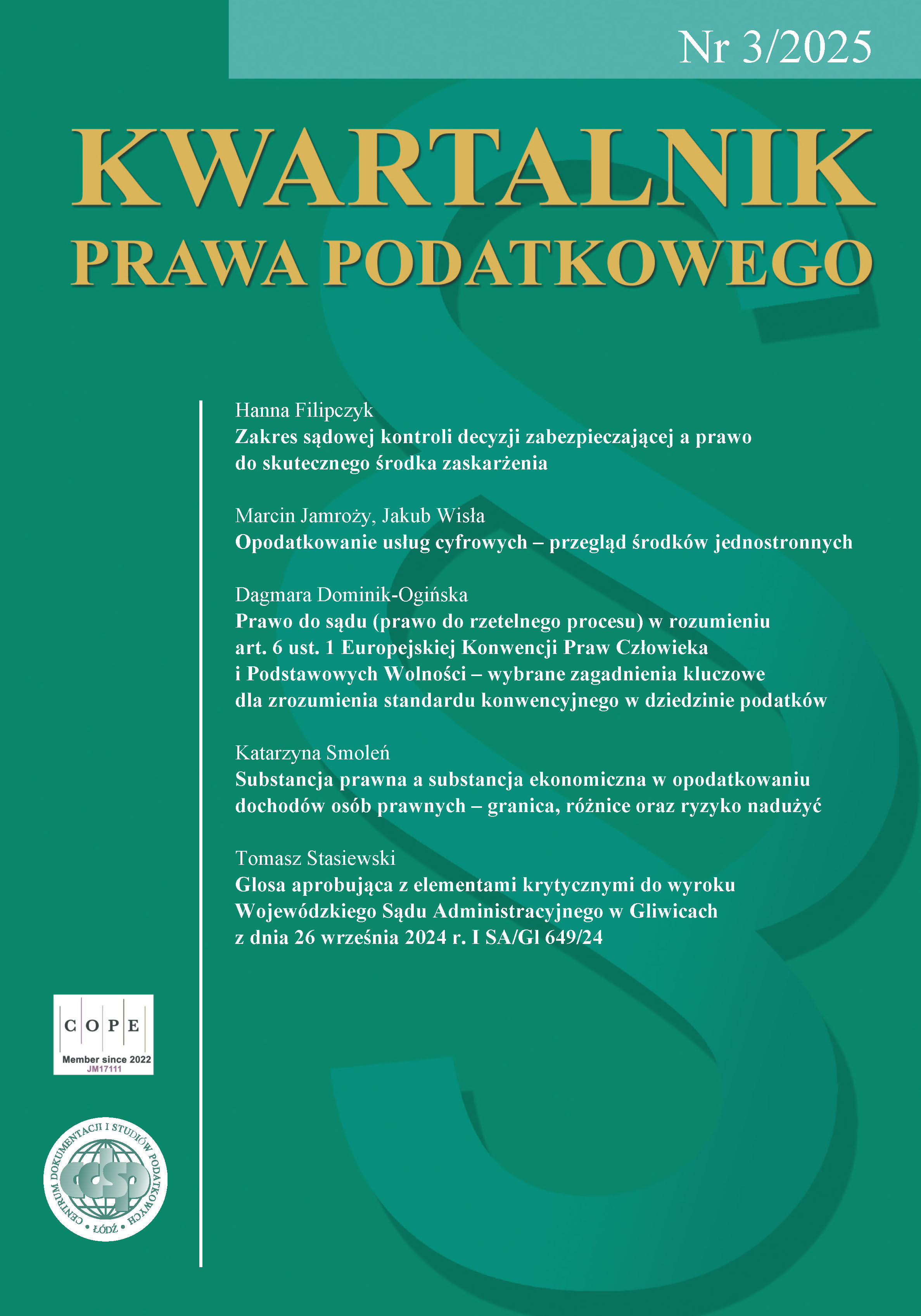
Opodatkowanie usług cyfrowych – przegląd środków jednostronnych
DOI:
https://doi.org/10.18778/1509-877X.2025.03.02Słowa kluczowe:
podatek cyfrowy, usługi cyfrowe, środki jednostronneAbstrakt
Podstawowym celem artykułu jest przegląd jednostronnych mechanizmów opodatkowania usług cyfrowych w różnych jurysdykcjach. Globalna reforma opodatkowania usług cyfrowych, oparta na założeniach Filaru I projektu BEPS 2.0 prowadzonego z inicjatywy OECD/G20, staje się coraz mniej prawdopodobna. Punktem odniesienia przy tworzeniu jednostronnych rozwiązań podatkowych stało się dla wielu państw członkowskich Unii Europejskiej rozwiązanie zaproponowane przez Komisję Europejską w projekcie dyrektywy dotyczącej podatku od usług cyfrowych (Digital Services Tax – DST). W większości przypadków podatek cyfrowy przyjmuje formę podatku od przychodów uzyskiwanych z określonych usług świadczonych w środowisku cyfrowym. Tego rodzaju podatki mają charakter selektywny, a ich konstrukcja służy przede wszystkim redystrybucji części wartości generowanej przez największe przedsiębiorstwa cyfrowe. Wnioski płynące z międzynarodowej analizy porównawczej mogą stanowić wkład w formułowanie założeń polityki podatkowej w Polsce w zakresie opodatkowania działalności cyfrowej.
Pobrania
Bibliografia
Ari I.E., Does the OECD’s Pillar One Solution Effectively Tax the Digital Economy? A Study of the Legal and Economic Incidence of Amount A, „LSE Law Review” 2024, no 9(2), s. 147–196, https://doi.org/10.61315/lselr.649
Bauer M., Digital Companies and Their Fair Share of Taxes: Myths and Misconceptions, „ECIPE Occasional Paper” no 03/2018, European Centre for International Political Economy, Brussels, luty 2018.
Bellavite L., Morabito D., Tognettini R., The Digital Service Tax in Italy: Main Characteristics and Practical Issues, „European Taxation” 2020, vol. 60, no 8, s. 351–356, https://doi.org/10.59403/1er2jc5
Bergas Forteza A., Digital Economy and Permanent Establishment, Again: A Mine, an Oil or Gas Well, and … Data Mining?, „Intertax” 2025, vol. 53, no 10, s. 654–664, https://doi.org/10.54648/TAXI2025057
Christians A., Taxing According to Value Creation, „Tax Notes International” 2018, vol. 90, s. 1379–1383.
de Wilde M.F., On the OECD’s “Unified Approach” as Frankenstein’s Monster and a Dented Shape Sorter, „Intertax” 2020, vol. 48, no 1, s. 9–13.
Devereux M.P., Vella, J., Implications of Digitalization for International Corporate Tax Reform, „Intertax” 2018, vol. 46, no 6–7, s. 550–559.
Dourado A.P., The OECD Unified Approach and the New International Tax System: A Half-Way Solution, „Intertax” 2020, vol. 48, nr 1, no 3–8.
Douvier P.J., Digital Services Taxes: French Law Approach and OECD’s Commitments, „International Transfer Pricing Journal” 2023, vol. 30, no 3, s. 149–153, https://doi.org/10.59403/2jk3dyt
Dudek P.M., Enduring Measurement as User Consideration on Social Media Platforms under EU VAT Law, „Intertax” 2025, vol. 53, no 8/9, s. 595–617, https://doi.org/10.54648/TAXI2025054
Englisch J. , Becker A., Taxing Where Value Is Created: What’s ‘User Involvement’ Got to Do With It?, „Intertax” 2019, vol. 47, no 2, s. 161–171.
Hongler P., Pistone P., Blueprints for a New PE Nexus to Tax Business Income in the Era of the Digital Economy, WU International Taxation Research Paper Series 2015, no 2015–15.
Mamajek S., Koncepcje opodatkowania zysku w sektorze cyfrowym, [w:] Podatki w ujęciu retrospektywnym i perspektywicznym, red. E. Małecka-Ziembińska, Poznań 2022, s. 140–160, https://doi.org/10.18559/978-83-8211-116-3/8
Parada L., Balancing DSTs and Geopolitics: The European Dilemma, „Tax Notes International” 2025, vol. 117, no 19, https://doi.org/10.2139/ssrn.5662270
Podatki i system podatkowy. Teoria i praktyka, red. P. Felis, M. Jamroży, Warszawa 2025.
Stevanato D., A Critical Review of Italy’s Digital Services Tax, „Bulletin for International Taxation” 2020, vol. 74, no 7, s. 413–424, https://doi.org/10.59403/276d5w5
Opublikowane
Numer
Dział
Licencja

Utwór dostępny jest na licencji Creative Commons Uznanie autorstwa – Użycie niekomercyjne – Bez utworów zależnych 4.0 Międzynarodowe.
Jak cytować




PlumX metrics