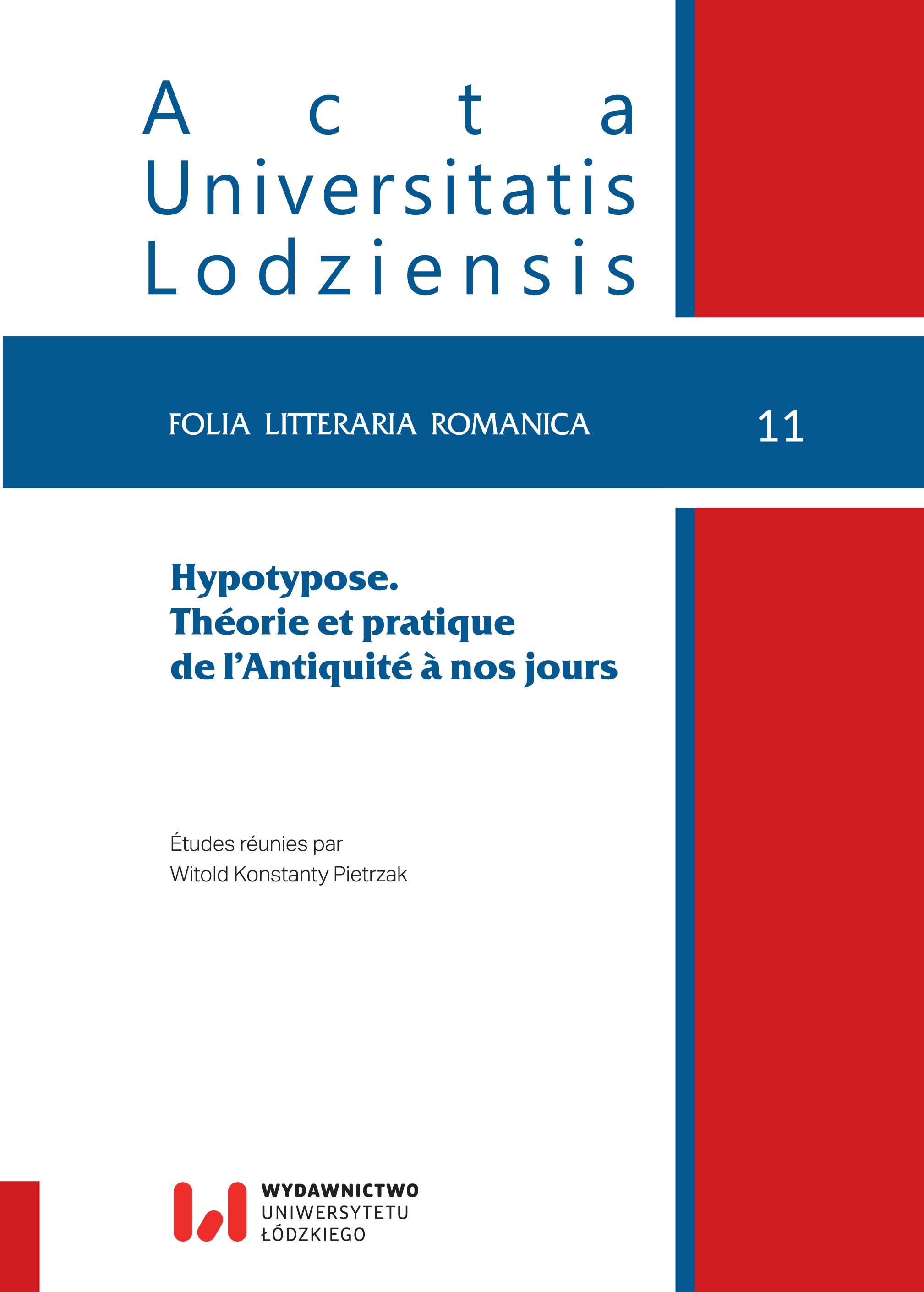
Convincing and Captivating the Reader: Hypotyposis in Medieval Castilian Travel Narratives
DOI:
https://doi.org/10.18778/1505-9065.11.04Keywords:
travel narratives, Castile, 15th century, storm, Pero Tafur, Andanças, Embajada a TamorlánAbstract
If travel narratives satisfy the reader’s curiosity by providing visions of an elsewhere, offering them the illusion of a travel they cannot do, and showing them wonders, characterized by their ability to surprise, we will find those texts use hypotyposis, a “speaking painting” that develops “the art of making present the absent” and “mak[ing] the unimaginable imaginable and the improbable, probable”. The development of travel narratives during the late Middle Age marked affimation of the individual and the rise of empiricism. Based on the personal experience of travellers (either real or fictional), these texts have to convince of their authenticity and transmit this direct vision (autopsiam) to make visible and palpable to the reader that unknown horizon unveiled by travelling. Hypotypose would be one of the tools erecting the travelogue as a relevant source of knowledge by sharing the traveller’s sensory experience. The valuation of empirical knowledge is based on the epiphany induced by hypotyposis.
References
Adam, Jean-Michel et Petitjean, André, Le Texte descriptif : poétique historique et linguistique textuelle, Paris, Nathan-Université, 1989
Boulay, Bérenger, « Effets de présence et effets de vérité dans l’historiographie », Écrire l’histoire, Littérature, no 159, 2010, p. 26-38 ; URL : http://www.jstor.org/stable/41705312 ; consulté le 26 juillet 2016
Buchet, Christian et Thomasset, Claude (éd.), Le Naufrage. Actes du colloque tenu à l’Institut Catholique de Paris (28-30 janvier 1998), Paris, Honoré Champion, 1999
Calame, Claude, « Quand dire, c’est faire voir, l’évidence dans la rhétorique antique », Études de lettres, Faculté des Lettres, Université de Lausanne, no 4, 1991, p. 3-22
Campbell, Mary B., The Witness and the Other World : Exotic European Travel Writing, 400-1600, Ithaca Cornell University Press, 1988
Cassin, Barbara, L’Effet sophistique, Paris, Nrf, Essais, Gallimard, 1995
Deluz, Christiane, « Pèlerins et voyageurs face à la mer, XIIe-XVIe siècles », in : Horizons marins, itinéraires spirituels, Henri Dubois, Jean-Claude Hocquet et André Vauchez (dir.), t. 2, Marins, navires et affaires, Paris, Sorbonne, 1987, p. 277-288
Fumaroli, Marc, L’Âge de l’éloquence, [Droz, 1980], Paris, Albin Michel, Bibliothèque de l’Évolution de l’Humanité, 1994
Ginzburg, Carlo, Le Fil et les traces. Vrai faux fictif, trad. par Martin Rueff, Lagrasse, Verdier Histoire, 2006
Herrero Massari, José Manuel, “El naufragio en la literatura de viajes peninsular de los siglos XVI y XVII”, Revista de Filología Románica 2.14 (1997), p. 205-213
Larner, John, Marco Polo y el descubrimiento del mundo, Barcelona, Paidós, 2001
Le Bozec, Yves, « L’hypotypose : un essai de définition formelle », L’Information Grammaticale, no 92, 2002, p. 3-7
Le Huenen, Roland « Qu’est-ce qu’un récit de voyages ?, in : Les Modèles du récit de voyages, Litterales no 7, 1990, p. 11-27
López Estrada, Francisco, “Fama literaria de Tamorlán en España durante el siglo XV”, in : Studia in Honorem Germán Orduña, Alcalá de Henares, Universidad de Alcalá de Henares, Servicio de Publicaciones, 2001, p. 369-374
Ochoa Anadón, José, “El valor de los viajeros medievales como fuente histórica”, Revista de Literatura Medieval 2 (1990), p. 85-102
Pérez Priego, Miguel Ángel (ed.), Andanças e viajes, Fundación José Manuel Lara, clásicos andaluces, Sevilla, 2009
Pérez Priego, Miguel Ángel, (ed.), Viajes medievales, II, Fundación José Antonio de Castro, Madrid, 2006
Richard, Jean, « Voyages réels et voyages imaginaires, instruments de la connaissance géographique au Moyen Âge », in : idem, Croisés, missionnaires et voyageurs, les perspectives orientales du monde latin médiéval, London, Variorum, 1983, p. 211-220
Richard, Jean, « La relation de voyage, instrument de la transmission du savoir géographique », in : La Transmission des savoirs au Moyen Âge et à la Renaissance, sous la dir. de Pierre Nobel, Presses Universitaires de Franche-Comté, 2005, p. 303-318
Tadié, Jean-Yves, Le Roman d’aventures, Paris, Quadrige, 1996
Traité du sublime, trad. de N. Boileau, éd. de F. Goyet, Le Livre de Poche, 1995
Downloads
Published
Issue
Section
License

This work is licensed under a Creative Commons Attribution-NonCommercial-NoDerivatives 4.0 International License.
How to Cite