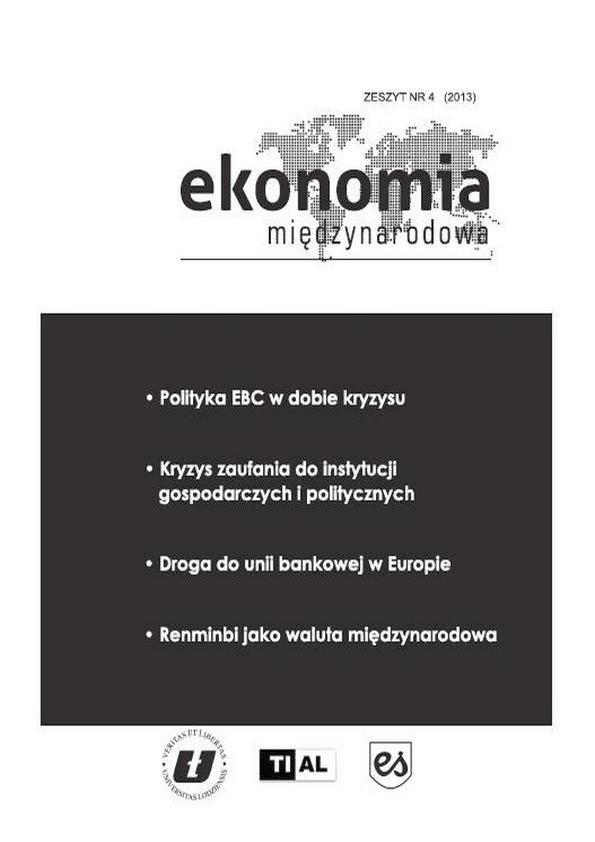
Renminbi jako waluta międzynarodowa – stan obecny oraz ocena perspektyw
DOI:
https://doi.org/10.18778/2082-4440.04.04Słowa kluczowe:
renminbi, światowy system walutowy, waluta międzynarodowaAbstrakt
Dominacja dolara amerykańskiego (USD) we współczesnym systemie walutowym wystawia zarówno gospodarkę światową, jak i gospodarki narodowe na ryzyko utrzymywania się nierównowag zewnętrznych, pojawiania się bąbli spekulacyjnych na rynkach aktywów czy też gwałtownych zmian wyceny rezerw dewizowych. W takich okolicznościach w kręgach ekonomicznych i politycznych coraz częściej poruszana jest kwestia uzyskania przez renminbi (CNY) statusu waluty międzynarodowej, czego konsekwencją byłoby substytuowanie USD w światowych finansach. Niniejszy artykuł przedstawia obecne znaczenie chińskiej waluty w globalnym systemie walutowym oraz wskazuje czynniki, które mogą wpłynąć na drogę CNY do statusu waluty międzynarodowej.
Pobrania
Bibliografia
Angeloni I., Benassy-Quere A., Carton B., Darvas Z., Destais C., Pisani-Ferry J., Sapir A., Vallee S. (2011), Global currencies for tomorrow: a European perspective, Bruegel Blueprint Series/CEPII Research Reports, tom XIII, Bruksela, Paryż.
Astley M., Giese J., Hume M., Kubelec C. (2009), Global imbalances and the financial crisis, „Bank of England Quartlerly Bulettin”, 2009Q3, Londyn, s. 178–190.
BIS (2013), Triennial Central Bank Survey: Foreign exchange turnover in April 2013: preliminary global results, Bank for International Settlements Monetary and Economic Department, Bazylea.
Chinn M., Frankel J. (2005), Will the Euro Eventually Surpass the Dollar as Leading International Reserve Currency?, NBER Working Paper, nr 11510, Cambridge, MA. DOI: https://doi.org/10.3386/w11510
De Grauwe P. (2009), Economics of monetary union, Oxford University Press, Oxford.
Dreger C., Zhang Y. (2011), On the Chinese house-price bubble, VoxEu Column, 15.07.2011 r. (data dostępu: 05.10.2013 r.).
Eichengreen B. (2011), The Dollar: Dominant no more?, VoxEu Column, 10.01.2011 r. (data dostępu: 03.10.2013 r.).
Eichengreen B. (2012), Exorbitant Privilege: The Rise and Fall of the Dollar and the Future of the International Monetary System, Oxford University Press, Oxford.
Eichengreen B., Flandreau M. (2010), The Federal Reserve, the Bank of England and the Rise of the Dollar as an International Currency, 1914–39, Bank for International Settlements Working Paper, nr 328, Bazylea. DOI: https://doi.org/10.2139/ssrn.1717802
Fontagne L., Foure J. (2013), Opening a Pandora’s Box: Modelling World Trade Patterns at the 2035 Horizon, CEPII Working Paper, nr 2013–22, Paryż. DOI: https://doi.org/10.2139/ssrn.2304662
Fratzscher M., Mehl A. (2011), China’s Dominance Hypothesis and the Emergence of a Tri-Polar Global Currency System, „European Central Bank Working Paper”, nr 1392, Frankfurt nad Menem. DOI: https://doi.org/10.2139/ssrn.1935891
Goldberg L. (2010), What is the status of the international roles of the dollar?, VoxEU Column, 31.03.2010 (data dostępu: 02.10.2013 r.).
Gourinchas P.O., Rey H. (2007), From World Banker to World Venture Capitalist: U.S. External Adjustment and the Exorbitant Privilege [w:] Clarida R. (red.), G7 Current Account Imbalances: Sustainability and Adjustment, NBER, Cambridge, MA, s. 11–66. DOI: https://doi.org/10.7208/chicago/9780226107288.003.0002
Greenwald M., Stiglitz J. (2010), A Modest Proposal for International Monetary Reform [w:] Griffith-Jones S., Ocampo J., Stiglitz J. (red.), Time for a Visible Hand: Lessons from the 2008 World Financial Crisis, „Initiative for Policy Dialogue Series”, Oxford University Press, Oxford, s. 314–344. DOI: https://doi.org/10.1093/acprof:oso/9780199578801.003.0017
Hamilton J. (2012), Future production from U.S. shale or tight oil, Econbrowser – Analysis of current economic conditions and policy, 18.12.2012 r. (data dostępu: 20.10.2013 r.).
Humpage O. (2009), Will special drawing rights supplant the dollar?, VoxEu Column, 08.05.2009 r. (data dostępu: 03.10.2013 r.).
Ito T., Koibuchi S., Sato K., Shimizu J. (2010), Why Has the Yen Failed to Become a Dominant Invoice Currency in Asia? A Firm-Level Analysis of Japanese Exporters’ Invoicing Behaviour, NBER Working Paper, Nr 16231, Cambridge, MA. DOI: https://doi.org/10.3386/w16231
Krugman P. (1984), The International Role of the Dollar: Theory and Prospect [w:] Bilson J., Marston R. (red.), Exchange Rate Theory and Practice, University of Chicago Press, s. 261–278.
NBP (2011), Międzynarodowa rola euro III, Narodowy Bank Polski – Departament Integracji ze Strefą Euro (DISE), Warszawa.
Portes R. (2009), Global imbalances [w:] Dewatripont M., Freixas X., Portes R. (red.), Macroeconomic stability and financial regulation: Key issues for the G20, Centre for Economic Policy Research (CEPR), Londyn.
Prasad E., Ye L. (2012), The Renminbi’s Role in the Global Monetary System, „Global Economy and Development at Brookings”, Waszyngton, DC. DOI: https://doi.org/10.2139/ssrn.2003668
Reade J., Volz U. (2011), Chinese infl ation, monetary policy and the dollar peg, VoxEu Column, 16.02.2011 r. (data dostępu: 10.10.2013 r.).
Reis R. (2013), The Portuguese Slump and Crash and the Euro Crisis, „Brooking Papers on Economic Activity”, Spring 2013, s. 143–210. DOI: https://doi.org/10.1353/eca.2013.0005
Rosati D. (2009), Przyczyny i mechanizm kryzysu fi nansowego w USA, „Ekonomista”, nr 3.
Rubaszek M. (2006), Nierównowaga globalna: przyczyny oraz możliwe rozwiązania, „Bank i kredyt”, nr 37 (7), s. 14–29.
Speller W., Thwaites G., Wright M. (2011), The future of international capital flows, „Bank of England Financial Stability Paper”, nr 12, Londyn. DOI: https://doi.org/10.2139/ssrn.1979424
Subramanian A., Kessler M. (2012), The Renminbi Bloc Is Here: Asia Down, Rest of the World to Go?, „Peterson Institute for International Economics Working Paper”, nr 12–19, Waszyngton, DC. DOI: https://doi.org/10.2139/ssrn.2298011
SWIFT (2011), RMB internationalisation: Implications for the global fi nancial industry, SWIFT White Paper, La Hulpe.
WTO (2013), World Trade Report: Factors shaping the future of world trade, World Trade Organization, Genewa.
Pobrania
Opublikowane
Numer
Dział
Licencja

Utwór dostępny jest na licencji Creative Commons Uznanie autorstwa – Użycie niekomercyjne – Bez utworów zależnych 4.0 Międzynarodowe.
Jak cytować