Tendencje rozwojowe klastrów w Niemczech
DOI:
https://doi.org/10.18778/2082-4440.11.02Słowa kluczowe:
inwestycje, klastry, RFN, atrakcyjność lokalizacjiAbstrakt
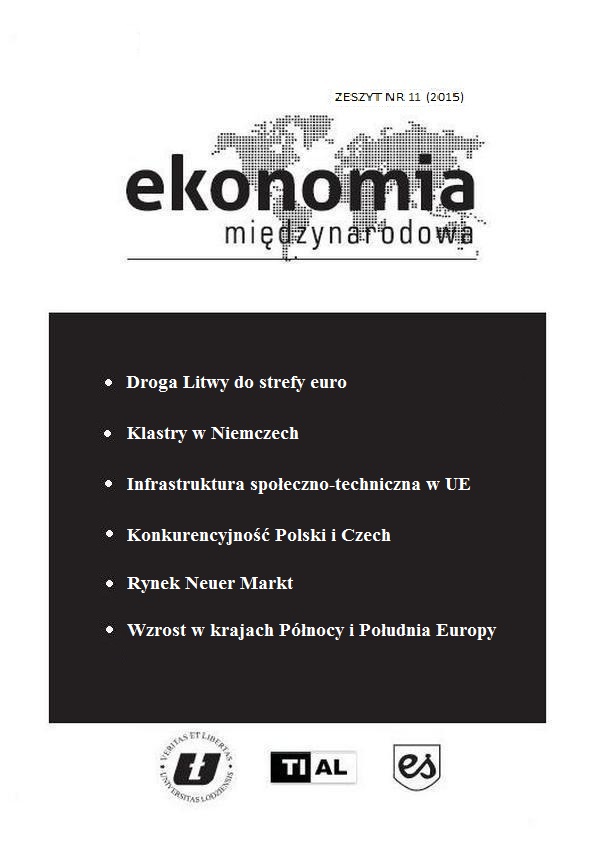
Choć rządy Wielkiej Koalicji mogą mieć negatywne skutki dla stanu niemieckich finansów publicznych, twierdzenie o pogorszeniu atrakcyjności lokalizacyjnej RFN wydaje się nadużyciem. Pozyskiwanie inwestorów wymaga oferowania pewnych pakietów czynników, np. w formie klastrów. W artykule podejmowana jest ocena tendencji rozwojowych niemieckich klastrów. Większość badanych skupisk podlega procesom ekspansji. Zanikanie gron (na wschodzie) wiąże się głównie z odchudzaniem, czyli szybszym spadkiem liczby zatrudnionych niż liczby działających firm, podczas gdy w przypadku Niemiec jako całości to relokacja – zmniejszanie się populacji aktywnych przedsiębiorstw przy słabszym spadku zatrudnionych w nich pracowników – jest zjawiskiem powszechniejszym. Procesy rozdrobnienia klastrów, a więc wzrostu liczby firm przy jednoczesnym zmniejszeniu zatrudnienia występują częściej niż odwrotna agregacja, kiedy to redukcji populacji przedsiębiorstw towarzyszy wzrost liczby pracujących. O ile dynamika rozwoju klastrów obserwowana w części wschodniej nie odbiega zasadniczo od tej zachodzącej w całych Niemczech, o tyle niepokoić może skala inwestycji i tempo ich wzrostu.
Pobrania
Bibliografia
Andersson T., Linking National Science, Technology and Innovation Policies with FDI policies, International Organization for Knowledge Economy and Enterprise Development IKED, 2005.
Apitzsch B., Piotti G., Institutions and sectoral logics in creative industries: the media cluster in Cologne, Environment and Planning 44(4), 2012, s. 921–936. DOI: https://doi.org/10.1068/a44285
Audretsch D., Knowledge, globalization and Regions: An Economist’s Perspective [w:] Dunning J., (eds.) Regions, Globalization, and the Knowledge-Based Economy, Oxford University Press 2000.
Baldi G., Harms P., DIW Roundup, Die neue Wachstumsdebatte, www.diw.de/de/diw_01.c.464429.de/presse/diw_roundup/die_neue_wachstumsdebatte
Bartelsman E., Haltiwanger J., Scarpetta S., Measuring and analyzing cross-country differences in firm dynamics, 2009 [w:] Dunne T., Jensen J.B., Roberts M.J. (eds.), Producer Dynamics: New Evidence from Micro Data, NBER Studies in Income and Wealth, www.nber.org/chapters/c12335.pdf DOI: https://doi.org/10.7208/chicago/9780226172576.003.0002
Barysch K., What Germany’s new coalition government means for the EU, CER online.
Beer Ch., Terstriep J., Clusterinitiativen unter Druck!?, Finanzierungsmodelle helfen Nachhaltigkeit sichern, Forschung Aktuell, No. 07/2010.
Bertschek I., Bonin H., Egeln J., Fuest C., Heinemann F., Hüschelrath K., Kappler M., Licht G., Löschel A., Schröder M., Herausforderungen für die deutsche Wirtschafts- und Finanzpolitik in der Legislaturperiode 2013–2017 ZEW Policy Brief, http://ftp.zew.de/pub/zew-docs/policybrief/pb08-13.pdf
Brachert M., Titze M., Kubis A., Identifying industrial clusters from a multidimensional perspective: Methodical aspects with an application to Germany, Regional Science Vol. 90, Issue 2, 2011, s. 419–439. DOI: https://doi.org/10.1111/j.1435-5957.2011.00356.x
Brainard L., Litan R., Services offshoring: Bane or boon and what to do?, CESIFO Forum 2/2004.
Brenner T., Identification of local industrial clusters in Germany, Regional Studies 40(9), s. 991–1004. DOI: https://doi.org/10.1080/00343400601047408
Brenner T., Innovation and cooperation during the emergence of local industrial clusters: An empirical study in Germany, European Planning Studies Vol. 13, Issue 6, 2005, s. 921–938. DOI: https://doi.org/10.1080/09654310500188522
Brodzicki T., Szultka S., Koncepcja klastrów a konkurencyjność przedsiębiorstw na podstawie Whalley, den Hertog 2000 oraz DTI 2000 [w:] Organizacja i Kierowanie, nr 4 (110), Warszawa, 2002.
Buhl C.M., Kontinuität, Stabilität und Effektivität – Wie Cluster nachhaltig erfolgreich sind, 2010, www.vdivde-it.de/publikationen/studien/kontinuitaetstabilitaet-und-effektivitaet-wie-netzwerke-und-cluster-nachhaltig-erfolgreich-sein-koennen
Bulmer S., Paterson W., Germany as the EU’s reluctant hegemon? Of economic strength and political constraint, Journal of European Public Policy, Vol. 20, No. 10, s. 1387–1405. DOI: https://doi.org/10.1080/13501763.2013.822824
Chemical industry clustering efforts in central Germany; www.euc2c.com/graphics/en/pdfs/mod9/Case,%20Chemicals%20Germany%20vF.pdf
Cluster in der Wirtschaftsförderung – vom Marketingbegriff zum Prozessmanagement, Difu-Berichte 3/2007.
Clusters of Enterprises and the Internationalization of SMEs: The case of Romanian Region of Timisoara, Summary report of the seminar held by the OECD Local Economic and Employment Development (LEED) Programme in Timisoara, Romania, 24 May, 2004.
Di Mauro F., Pappadà F., Eurozone external adjustment and real exchange rate movements: The role of firm productivity distribution, www.voxeu.org/article/exchange-rates-and-trade-adjustment-fat-tails-matter
Dohse D., Clusterorientierte Technologiepolitik in Deutschland: Konzepte und Erfahrungen, Technikfolgenabschätzung, Theorie und Praxis, Nr 1, 14, Jahrgang, März 2005, s. 33–41.
Dreger J., Heene A., European Integration and Europeanisation: Benefits and Disadvantages for Business, BEEP No. 29, 2013.
Dullien S., What does the German coalition agreement mean for the Eurozone, www.ecfr.eu
EBC COMPNET, www.ecb.europa.eu/home/html/researcher_compnet.en.html
Enright M., Regional Clusters and Multinational Enterprises, Independence, Dependence or Interdependence?, International Studies of Management and Organizations, Vol. 30, No. 2, 2000. DOI: https://doi.org/10.1080/00208825.2000.11656790
Eriksen B., Mikkelsen J., Competitive advantage and core competence [w:] Foss N., Knudsen C., Towards a competence theory of the firm, Routledge, London, New York 1996, s. 62–72.
Exzellenz. Das Clustermagazin Nordrhein-Westfalen Ausgabe 1 und 2; www.weissenberger-eibl.de/Presse/ExzellenzNRW_A3_D.pdf 2010.
EY Studie – Standort Deutschland Vorne bleiben 2014, www.ey.com/Publication/vwLUAssetsPI/EY_Studie_Standort_Deutschland_2014/$FILE/EY-Studie-Standort-Deutschland-2014.pdf
Farrell D., Report McKinsey Global Institute, Can Germany win from offshoring?, July 2004.
Feser E., Old and New theories of industrial clusters [w:] M. Steiner, Clusters and Regional Specialization, European Research in Regional Science 8, 1998.
Folkerts-Landau D., Grand coalition: Poor intentions, DeutscheBank Research, Standpunkt.
Foss N., Knudsen C., Towards a competence theory of the firm, Routledge, London, New York 1996, s. 1–10.
George K., Ramaswamy S., Rassey L., Next-shoring: A CEO’s guide Proximity to demand and innovative supply ecosystems will trump labor costs as technology transforms operations in the years ahead, McKinsey Quarterly, January 2014.
Germany Trade and Invest, FDI Reputation First Choice in Europe, www.gtai.de/GTAI/Navigation/EN/Invest/Business-location-germany/FDI/fdi-reputation.html 2014.
Godart O., Görg H., The Role of Global Value Chains for German Manufacturing, Kiel Institute for the World Economy, Christian-Albrechts-University of Kiel, www.dfait-maeci.gc.ca/economist-economiste/assets/pdfs/research/TPR_2011_GVC/14_Godart_and_Gorg_e_FINAL.pdf
Gorynia M., Jankowska B., Koncepcja klasterów jako sposób regulacji zachowań podmiotów gospodarczych, „Ekonomista” 2007, nr 3.
Götz M., Jankowska B., Główka C., How to Investigate Polish Clusters’ Attractiveness for Inward FDI? Addressing Ambiguity Problems, International Journal of Management and Economics (Zeszyty Naukowe KGŚ), No. 43, July–September 2014, s. 74–93; www.sgh.waw.pl/ijme DOI: https://doi.org/10.1515/ijme-2015-0004
Götz M., Cluster, Competitiveness, Attractiveness, Innovativeness – how do they fit together? in Proceedings of presentation papers, The 5th International Conference on Innovation & Management, December 10–11, 2008, UNU MERIT, Maastricht.
Götz, M. Clusters attractiveness for FDIs revisited: Might clusters adversely affect companies located inside? [w:] Management of Meaning in Organizations and 3xI Inventing, Innovating, and Interpreting in Business Poznan 2008 International Conference, PWSBIJO Poznań 2008, s. 138–150.
Hauser Ch., Country Report Germany, Institut für Mittelstandforschung (IfM) Bonn, 2005, www.ifm-bonn.org
Heng S., Industrie 4.0, Upgrade des Industriestandorts Deutschland steht bevor, www.dbresearch.de/PROD/DBR_INTERNET_DE-PROD/PROD0000000000328961.pdf;jsessionid=215AC66D7866866BD51ADA2234A4B319.srv-loc-dbr-de
Heymann E., Vetter S., Europe’s re-industrialisation. The gulf between aspiration and reality, EU Monitor European integration Deutschebank Research, www.diw.de/de/diw_01.c.480968.de/themen_nachrichten/diw_praesident_fratzscher_ist_vorsitzender_der_bmwi_expertenkommission_zur_staerkung_von_investitionen_in_deutschland.html
Industrie 4.0, Die nächste industrielle Revolution, IWD, www.iwkoeln.de/de/infodienste/iwd/archiv/beitrag/industrie-4-0-die-naechste-industrielle-revolution-165805
Industrielle Standortqualität, Wo steht Deutschland im internationalen Vergleich? IW-Studien, Schriften zur Wirtschaftspolitik aus dem Institut der deutschen Wirtschaft Köln 2013.
Industry as a growth engine in the global economy, IW Köln.
Industry concentration and regional innovative performance – empirical evidence for eastern Germany, IWH Diskussionpapiere 8/2009.
Jost T., Country profiles of inward and outward foreign direct investment, Vale Columbia Center on Sustainable International Investment.
Jost T., Inward FDI in Germany and its policy context, Vale Columbia Center on Sustainable International Investment, 2012.
Kauder N., Larin B., Potrafke N., Was bringt uns die große Koalition? Perspektiven der Wirtschaftspolitik, ifo Working Papers No. 172, Januar 2014. DOI: https://doi.org/10.1515/pwp-2014-0005
Keeble D., Wilkinson F., High-Technology Clusters, Networking and Collective Learning in Europe, Ashgate 2000.
Ketels Ch., Lindqvist G., Sölvell Ö., Strengthening Clusters and Competitiveness in Europe The Role of Cluster Organisations, The Cluster Observatory October 2012.
Kirchherr J., Scherf G., Suder K., Creating growth clusters: What role for local government? A systematic approach to implementation could help start-up ecosystems flourish, McKinsey & Company, Insights Publications, www.mckinsey.com/insights/public_sector/Creating_growth_clusters_What_role_for_local_government?cid=other-eml-alt-mip-mck-oth-1407
Krugman P., Competitiveness a dangerous obsession, Foreign Affairs No. 73 1994, za: Dohse D., Clusterorientierte Technologiepolitik in Deutschland: Konzepte und Erfahrungen, Technikfolgenabschätzung, Theorie und Praxis, No. 1, 14. Jahrgang – März 2005, s. 33–41.
Kultur- und Kreativwirtschaft, Baden-Württemberg, Datenreport 2010, http://mfw.baden-wuerttemberg.de/fileadmin/redaktion/m-mfw/intern/Dateien/Downloads/Industrie_und_Innovation/Datenreport_2012_Kultur-KreativwirtschaftBW.pdf
Lämmer-Gamp T., Meier zu Köcker G., Alslev Christensen T., Clusters, are individuals creating economic growth through cluster policies for cluster management excellence, 2011, http://ufm.dk/en/publications/2011/files-2011/clusters_indhold_web_v2.pdf
Laser Technology in Berlin-Brandenburg; http://optecbb.de/lang/media/download/Report_Laser_Technology_Berlin-Brandenburg_2010_en.pdf
Lawson C., Collective learning, system competences and epistemically significant moments, w Keeble D., Wilkinson F., High-Technology Clusters, Networking and Collective Learning in Europe, Ashgate, 2000.
Lundvall B., Johnson B., The learning economy, Journal of Industry Studies, 1(2), 1994. DOI: https://doi.org/10.1080/13662719400000002
Lundvall B., National Systems of Innovation: Towards a theory of innovation and interactive learning, London, Pinter Publisher, 1992.
Malmberg A., Maskell S., Localised learning and industrial competitiveness, Cambridge Journal of Economics, 1999, Vol. 23. DOI: https://doi.org/10.1093/cje/23.2.167
Malmberg A., Power D., (How) do (firms in) clusters create knowledge?, Department of Social and Economic Geography – Centre for Innovation and Industrial dynamics Uppsala University, prepared for DRUID Summer Conference 2003 on Creating, Sharing and Transferring knowledge. The role of Geography, Institutions and Organizations, Copenhagen June 12–14 2003, www.druid.dk/conferences/summer2003/Papers/MALMBERG_POWER.pdf
Markowska-Przybyła U., Polska polityka regionalna w aspekcie globalizacji [w:] Kaja J., Piech K., (red.) op.cit., Warszawa 2005.
Marshall A., Principles of economics, Macmillan, London 1920.
Martin R., Sunley P., Deconstructing clusters: Chaotic Concept or Policy Panacea?, Journal of Economic Geography, 3(1), 2002. DOI: https://doi.org/10.1093/jeg/3.1.5
Maskell P., Lorenzen M., The cluster as market organization, DRUID Working Paper, No. 03–14.
Meier zu Köcker G., Clusters in Germany. An empirical based insight view on emergence, financing, management and competitiveness of the most innovative clusters in Germany (2nd ed.) www.clusterplattform.at/fileadmin/user_upload/clusterbibliothek/625_Clusters_in_Germany_unter_P5.pdf
Meier zu Köcker G., Garnatz L., Klastry jako instrumenty inicjujące prace badawczo-rozwojowe między Niemcami a Koreą. Ciągłość, stabilność i efektywność.
W jaki sposób sieci i klastry mogą osiągnąć zrównoważony rozwój, Wydanie I, Polska Agencja Rozwoju Przedsiębiorczości 2012.
Nalebuff B., Co-opetition, London, Harper Collins Business, 1996 [w:] N. Driffield, J. Love, Foreign Direct Investment, Technology Sourcing and Reverse Spillovers, The Manchester, School, Vol. 71, No. 6, December 2003, s. 659–672. DOI: https://doi.org/10.1046/j.1467-9957.2003.00372.x
Nowara W., Zagraniczne dezinwestycje bezpośrednie – ujęcie teoretyczne, Ruch Prawniczy, Ekonomiczny i Socjologiczny 75, 2013/1, s. 197–212. DOI: https://doi.org/10.14746/rpeis.2013.75.1.14
Outlook for the German economy – macroeconomic projections for 2014 and 2015, Deutsche Bundesbank, Monthly Report, December 2013.
Pisani-Ferry J., The Euro Crisis and its Aftermath, Oxford 2014. DOI: https://doi.org/10.1093/acprof:oso/9780199993338.001.0001
Plum O., Hassink R., Analysing the knowledge base configuration that drives southwest Saxony’s automotive firms, European Urban and Regional Studies, April 2013, Vol. 20, No. 2, s. 206–226. DOI: https://doi.org/10.1177/0969776412454127
Porter M., Location, competition and economic development: Local clusters in a global economy, „Economic Development Quarterly”, Feb. 2000, Vol. 14, Issue 1. DOI: https://doi.org/10.1177/089124240001400105
Porter M., The competitive advantage of nations, Macmillan, London 1990. DOI: https://doi.org/10.1007/978-1-349-11336-1
Posen A.S., Getting Germany Past Internal Devaluation, Op-ed in Die Welt, www.piie.com
Prysiński Ł., Urban D., Miejsce przemysłu włókienniczego w rozwoju regionu łódzkiego [w:] H. Godlewska-Majkowska (red.), Restrukturyzacja regionów przemysłowych, Warszawa 2005.
R. Mudambi, Location, control and innovation in knowledge-intensive industries, „Journal of Economic Geography” Vol. 8, 2008, s. 699–725. DOI: https://doi.org/10.1093/jeg/lbn024
Regionale Cluster in Europa, Beobachtungsnetz der europäischen KMU 2002, Nr 3, Veröffentlichungen – GD Unternehmen, Europäische Kommission.
Roch H.O., Sternberg R., Entrepreneurship: The Role of Clusters Theoretical Perspectives and Empirical Evidence from Germany, Small Business Economics (2005)24, s. 267–292. DOI: https://doi.org/10.1007/s11187-005-1993-9
Rolf S., Learning from the Past? Why ‘Creative Industries’ can hardly be Created by Local/Regional Government Policies, ERDE 143, Issue: 4, s. 293–315.
Rosenfeld M., Franz P., Günther J., Heimpold G., Kronthaler F., Ökonomische Entwicklungskerne in ostdeutschen Regionen: Branchenschwerpunkte, Unternehmensnetzwerke und innovative Kompetenzfelder der Wirtschaft, Sonderheft 5/2006, IWH Halle.
Rosenfeld M., Franz P., Heimpold G., Economic ‘Clusters’ in East Germany: Evidence on the Location and Characteristics of Spatially Concentrated Industries, Post – Communist Economies, Abingdon, Mar 2007, Vol. 19(1), s. 73. DOI: https://doi.org/10.1080/14631370601163210
Runiewicz-Wardyn M., Knowledge Flows, Technological Change and Regional Growth in the European Union, Contributions to Economics, Springer 2013. DOI: https://doi.org/10.1007/978-3-319-00342-9
Sachverstaendigenrat zur Begutachtung der gesamtwirtschaftlichen Entwicklung, Jahresgutachten 2013/14, Wiesbaden.
Sapir A., Wolff G., The Great Transformation: Memo to the incoming EU presidents, Bruegel Policy Brief, July 04/2014.
Saxenian A., Regional advantage: culture and competition in Silicon Valley and Route 128, Cambridge, Harvard Univeristy, 1994 [w:] Rosenthal S., Strange W., The micro-empirics of agglomeration economies, Blackwell Companion to Urban Economics, April 2004.
Scherer R., Gutjahr M., Strauf S., Struggling for Attention? The importance of creative industries in Southern Germany, Actual Problems of Economics, Issue 131, 2012, s. 128–139.
Schmieding H., German Politics: Mind The Damage.
Słownik do Strategii Rozwoju Województwa Dolnośląskiego do roku 2020.
Spies J., Determinants of Inward FDI into German Federal States, www.etsg.org/ETSG2008/Papers/Spies.pdf
Star Clusters in Germany Center for Strategy and Competitiveness, CSC Stockholm School of Economic April 2011, www.clusterobservatory.eu/common/galleries/downloads/Star_clusters_Germany2.pdf
Sternberg r., Litzenberger T., Regional clusters in Germany – their geography and their relevance for entrepreneurial activities, European Planning Studies Vol. 12, Issue 6, 2004, s. 767–791. DOI: https://doi.org/10.1080/0965431042000251855
The Economist, A tale of two ecosystems, 03.10.2013. DOI: https://doi.org/10.1016/j.plrev.2013.01.007
The Economist, All together now, 18.01.2014.
The European Cluster, www.clusterobservatory.eu
The role of maritime clusters to enhance the strength and development of maritime sectors, 01.11.2008, Country report – Germany; http://ec.europa.eu/maritimeaffairs/documentation/studies/documents/germany_02_en.pdf
Third Alert Mechanism Report on macroeconomic imbalances in EU Member States, European Commission MEMO, 13.11.2013.
Timmer M.P., Los B., Stehrer R., de Vries G., Fragmentation, Incomes and Jobs. An analysis of European competitiveness, Working Paper Series, No. 1615 / November 2013, www.ecb.europa.eu/pub/pdf/scpwps/ecbwp1615.pdf DOI: https://doi.org/10.2139/ssrn.2354250
Titze M., Brachert M., Kubis A., The Identification of Regional Industrial Clusters Using Qualitative Input-Output Analysis (QIOA), Regional Studies Vol. 45, Issue 1, 2011, 89–102 . DOI: https://doi.org/10.1080/00343400903234688
Unternehmenssteuern. Die Konkurrenz schläft nicht, www.iwkoeln.de/de/presse/pressemitteilungen/beitrag/unternehmenssteuern-die-konkurrenz-schlaeft-nicht-164888
Vanberg V., 1994, Wettbewerb in Markt und Politik, Anregungen für die Verfassung Europas, Saint Augusting COMDOK Verlag [za:] Dohse D., Clusterorientierte Technologiepolitik in Deutschland: Konzepte und Erfahrungen, Technikfolgenabschätzung, Theorie und Praxis, Nr 1, 14. Jahrgang – März 2005, s. 33–41. DOI: https://doi.org/10.14512/tatup.14.1.33
Watt A., Unintended consequnces: The Implications of the German coalition agreement for Europe, www.social-europe.eu, 29.11.2013.
Westner M.K., Strahringer S., The current state of offshoring in Germany: Project characteristics and success patterns, Journal of Information Technology Management, Oestrich-Winkel, 01/2010; 21:49–70.
Wyszkowska D., Polityka regionalna jako instrument podwyższania konkurencyjności polskich regionów [w:] Kaja J., Piech K. (red.), Rozwój oraz polityka regionalna i lokalna w Polsce, Szkoła Główna Handlowa w Warszawie, Warszawa 2005.
Zur Wirtschaftspolitik: Strukturreformen auch in Deutschland erforderlich!, IWHPressemitteilung 41/2013, Halle 12.12.2013.
Pobrania
Opublikowane
Numer
Dział
Licencja

Utwór dostępny jest na licencji Creative Commons Uznanie autorstwa – Użycie niekomercyjne – Bez utworów zależnych 4.0 Międzynarodowe.
Jak cytować