Skip to main content
Skip to main navigation menu
Skip to site footer
Open Menu
Acta Universitatis Lodziensis. Folia Germanica
Home
Announcements
About
About the Journal
Editorial Team
Reviewers
Statistics
Indexing and archiving
Contact
Content
Latest Issue
Archives
Archives (1997-)
For Authors
Author Declaration Form
Copyright Notice
Digital accessibility - alternative texts
Editorial Instructions
Publication Fees
Submit your article
Journal Policy
Publication Ethics
Anti-plagiarism policy
Open Access Policy
Privacy Statement
Policy of the Lodz University Press on Generative Artificial Intelligence Tools
Register
Login
Home
/
Archives
/
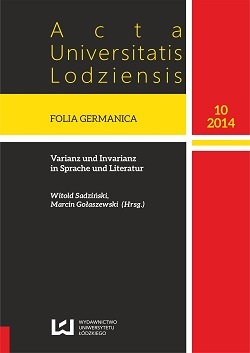
No. 10 (2014): Varianz und Invarianz in Sprache und Literatur
No. 10 (2014): Varianz und Invarianz in Sprache und Literatur
Published:
2014-12-30
Articles
Intertextuality in Franz Kafka’s works
Roman Sadziński
9-22
PDF (German)
DOI:
https://doi.org/10.18778/1427-9665.10.02
Variables and constants in static and dynamic valency
Małgorzata Żytyńska
23-43
PDF (German)
DOI:
https://doi.org/10.18778/1427-9665.10.03
Dynamics in language from a linguistic and neurocognitive perspective
Krzysztof Sakowski
45-54
PDF (German)
DOI:
https://doi.org/10.18778/1427-9665.10.04
Conventions in the interpretation process of conversational implicatures
Dariusz Prasalski
55-64
PDF (German)
DOI:
https://doi.org/10.18778/1427-9665.10.05
Some words about the adaptation of borrowed German words from the field of science in the Polish language
Katarzyna Sikorska-Bujnowicz
65-78
PDF (German)
DOI:
https://doi.org/10.18778/1427-9665.10.06
Slavic loanwords in the Austrian variant of the German language and their description in the “Duden” dictionaries: “Deutsches Universalwörterbuch” and “Wie sagt man in Österreich?”
Rafał Marek
79-92
PDF (German)
DOI:
https://doi.org/10.18778/1427-9665.10.07
Communicative codes between translational invariance and variance
Paweł Kubiak
93-111
PDF (Polish)
DOI:
https://doi.org/10.18778/1427-9665.10.08
Is nomen always omen? – reality and fiction in culinary terms in Polish and German
Joanna Szczęk, Marcelina Kałasznik
113-126
PDF (Polish)
DOI:
https://doi.org/10.18778/1427-9665.10.09
From dictionary to lexicon. Lexical infography in bilingual dictionaries
Witold Sadziński
127-134
PDF (Polish)
DOI:
https://doi.org/10.18778/1427-9665.10.10
Ideological conditions of the literature of the Third Reich. Nazi literature and cultural politics
Marcin Golaszewski, Elżbieta Tomasi-Kapral
135-151
PDF (German)
DOI:
https://doi.org/10.18778/1427-9665.10.11
Lost in the trenches. Semantics of the narrative of warspaces in Erich Maria Remarque’s “All Quiet on the Western Front”
Wolfgang Brylla
153-171
PDF (German)
DOI:
https://doi.org/10.18778/1427-9665.10.12
“There is no emigration literature, there are only interesting literary situations” – on the works of Polish writers in Germany after 1989
Karolina Błaszczyk
173-185
PDF (German)
DOI:
https://doi.org/10.18778/1427-9665.10.13
Transformations and references to German literary works (Friedrich Nietzsche and Günter Grass) in Stefan Chwin‘s novel “Dolina Radości” [Valley of Joy]
Joanna Bednarska - Kociołek
187-203
PDF (German)
DOI:
https://doi.org/10.18778/1427-9665.10.14
The new-old vampire. The horrible and the Nachzehrer [Undead] figure in “Vampirismus” by E. T. A. Hoffmann
Szymon Cieśliński
205-217
PDF (German)
DOI:
https://doi.org/10.18778/1427-9665.10.15
A quantitative analysis of the Jewish victims from Trier (Germany) in the Litzmannstadt Ghetto
Benjamin Koerfer
219-238
PDF (German)
DOI:
https://doi.org/10.18778/1427-9665.10.16
Other
Varianz und Invarianz in Sprache und Literatur
Witold Sadziński
7-8
PDF (German)
DOI:
https://doi.org/10.18778/1427-9665.10.01
Jolanta Mazurkiewicz-Sokołowska, Dorota Misiek, Werner Westphal (Hrsg.), Sprachkontakte und Lexikon. Festschrift zum 65. Geburtstag von Prof. Ryszard Lipczuk, Hamburg 2013, 309 S.
Marcelina Kałasznik
239-245
PDF (German)
DOI:
https://doi.org/10.18778/1427-9665.10.17
Lenka Vaňková et al. (Hrsg.), Emotionalität in deutschen und tschechischen Medientexten. In: Wissenschaftliche Schriften der Universität Ostrava, 269 (2012), 208 S.
Marcelina Kałasznik
247-251
PDF (German)
DOI:
https://doi.org/10.18778/1427-9665.10.18
Language
Deutsch
English
Polski
Make a Submission
Make a Submission
Cope
Keywords
Latest publications