
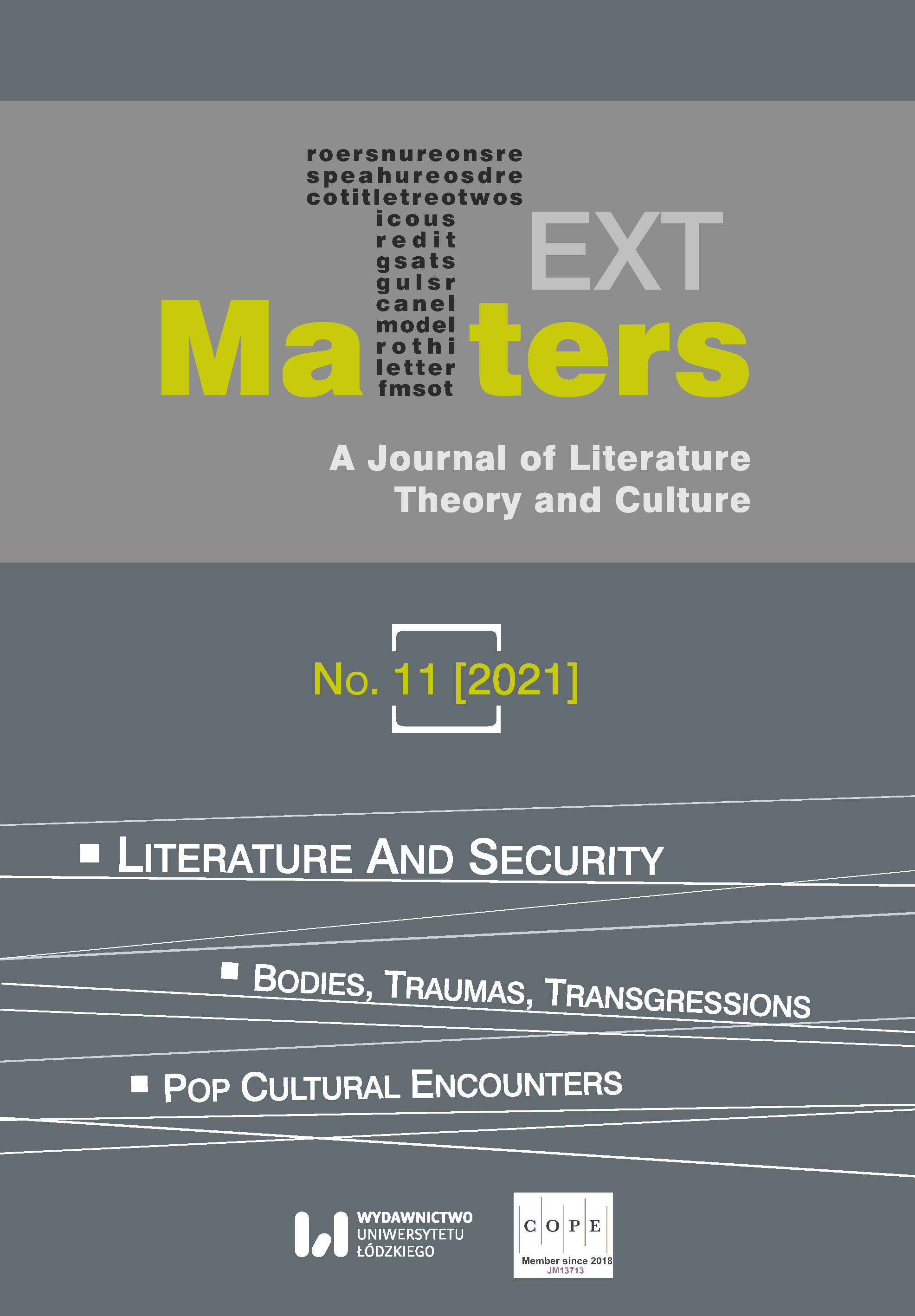
No. 11 (2021): Literature and Security / Bodies, Traumas, Transgressions / Pop Cultural Encounters

					View No. 11 (2021): Literature and Security / Bodies, Traumas, Transgressions / Pop Cultural Encounters

Guest Editor: Liam Gearon

Published: 2021-11-22

Full Issue

Articles

  • “Brought up to Live Double Lives”: Intelligence and Espionage as Literary and Philosophical Figures in Ciaran Carson’s Exchange Place and For All We Know

    Grzegorz Czemiel
    35-50
    DOI: https://doi.org/10.18778/2083-2931.11.03
  • Shibboleths of Grief: Paul Muldoon’s “The Triumph”

    Wit Pietrzak
    51-63
    DOI: https://doi.org/10.18778/2083-2931.11.04
  • Northern Ireland’s Interregnum. Anna Burns’s Depiction of a (Post)-Troubles State of (In)security

    Ryszard Bartnik
    64-83
    DOI: https://doi.org/10.18778/2083-2931.11.05
  • “. . .delivered from the lie of being truth”: The Affective Force of Disinformation, Stickiness and Dissensus in Randy Ribay’s Patron Saints of Nothing

    Vincent Pacheco, Jeremy De Chavez
    84-96
    DOI: https://doi.org/10.18778/2083-2931.11.06
  • Transforming the Ich-Du to the Ich-Es: The Migrant as “Terrorist” in Kabir Khan’s New York and Kamila Shamsie’s Home Fire

    Minu Susan Koshy
    97-105
    DOI: https://doi.org/10.18778/2083-2931.11.07
  • Victim-Warriors and Restorers—Heroines in the Post-Apocalyptic World of Mad Max: Fury Road

    Anna Reglińska-Jemioł
    106-118
    DOI: https://doi.org/10.18778/2083-2931.11.08
  • Aligning with Sociopaths: Character Engagement Strategies in Highsmith’s and Minghella’s Talented Mr. Ripleys

    Lech Zdunkiewicz
    119-136
    DOI: https://doi.org/10.18778/2083-2931.11.09
  • Mer-Hagography: The Erasure, Return and Resonance of Splash’s Older Mermaid

    Philip Hayward
    139-156
    DOI: https://doi.org/10.18778/2083-2931.11.10
  • From Romero to Romeo—Shakespeare’s Star-Crossed Lovers Meeting Zombedy in Jonathan Levine’s Warm Bodies

    Magdalena Cieślak
    157-177
    DOI: https://doi.org/10.18778/2083-2931.11.11
  • Lacanian Implications of Departures in Zemeckis’s Beowulf from Beowulf, the Old English Epic

    Nurten Birlik
    178-185
    DOI: https://doi.org/10.18778/2083-2931.11.12
  • Hercule Poirot and the Tricky Performers of Stereotypes in Agatha Christie’s Murder on the Orient Express

    Kenneth Eckert
    186-203
    DOI: https://doi.org/10.18778/2083-2931.11.13
  • Dystopias in the Realm of Popular Culture: Introducing Elements of Posthuman and Postfeminist Discourse to the Mass Audience Female Readership in Cecelia Ahern’s Roar (2018)

    Katarzyna Ostalska
    204-221
    DOI: https://doi.org/10.18778/2083-2931.11.14
  • Performing More-Than-Human Corporeal Connections in Kiki Smith’s Sculpture

    Justyna Stępień
    225-239
    DOI: https://doi.org/10.18778/2083-2931.11.15
  • “Never Trust a Survivor”: Historical Trauma, Postmemory and the Armenian Genocide in Kurt Vonnegut’s Bluebeard

    Alicja Piechucka
    240-262
    DOI: https://doi.org/10.18778/2083-2931.11.16
  • “My Monster Self”: Violence and Survival in Margaret Atwood’s Moral Disorder

    Nahid Fakhrshafaie, Alireza Bahremand
    263-278
    DOI: https://doi.org/10.18778/2083-2931.11.17
  • Narrative, Insecure Equilibrium and the Imperative to Understand: A Hermeneutics of Woundedness

    Małgorzata Hołda
    279-298
    DOI: https://doi.org/10.18778/2083-2931.11.18
  • Tragic Victims of Mania a Potu (“Madness from Drink”): A Study of Literary Nineteenth-Century Female Drunkards

    Irina Rabinovich
    299-318
    DOI: https://doi.org/10.18778/2083-2931.11.19
  • The Gospel of Divine Mercy in King Lear

    Małgorzata Grzegorzewska
    321-333
    DOI: https://doi.org/10.18778/2083-2931.11.20
  • Griselda’s Afterlife, or the Relationship between Shakespeare’s The Winter’s Tale, Chaucer’s The Clerk’s Tale and the Tale of Magic

    Andrzej Wicher
    334-352
    DOI: https://doi.org/10.18778/2083-2931.11.21
  • Mesmerization with the Lights On: Poe’s “The Facts in the Case of M. Valdemar”

    Robert Tindol
    353-368
    DOI: https://doi.org/10.18778/2083-2931.11.22
  • One Hundred Frogs in Steve McCaffery’s The Basho Variations

    Monika Kocot
    369-388
    DOI: https://doi.org/10.18778/2083-2931.11.23
  • Conceptualizing In-Text “Kshetra”: Postcolonial Allahabad’s Cultural Geography in Neelum Saran Gour’s Allahabad Aria and Invisible Ink

    Chhandita Das, Priyanka Tripathi
    389-403
    DOI: https://doi.org/10.18778/2083-2931.11.24
  • Episodic Literary Movement and Translation: Ideology Embodied in Prefaces

    Mir Mohammad Khademnabi
    404-417
    DOI: https://doi.org/10.18778/2083-2931.11.25

Other

  • Professor Dorota Filipczak In Memoriam

    Alison Jasper
    9-14
    DOI: https://doi.org/10.18778/2083-2931.11.01
  • Editorial: Literature and Security

    Liam Francis Gearon
    17-34
    DOI: https://doi.org/10.18778/2083-2931.11.02
  • A Review of Agnieszka Łowczanin, A Dark Transfusion: The Polish Literary Response to Early English Gothic: Anna Mostowska Reads Ann Radcliffe (Peter Lang, 2018)

    David Punter
    421-424
    DOI: https://doi.org/10.18778/2083-2931.11.26
  • Thinking about Thinking Nothing: A Review of Nolen Gertz’s Nihilism (MIT P, 2019)

    Pedro Querido
    425-427
    DOI: https://doi.org/10.18778/2083-2931.11.27
  • “Whenever there’s too much technology”: A Review of Don DeLillo’s The Silence (Scribner, 2020)

    Mark Tardi
    428-431
    DOI: https://doi.org/10.18778/2083-2931.11.28
  • A Review of Natalie Crohn Schmitt, Performing Commedia dell’Arte, 1570–1630 (Routledge, 2019)

    Piotr Morawski
    432-436
    DOI: https://doi.org/10.18778/2083-2931.11.29