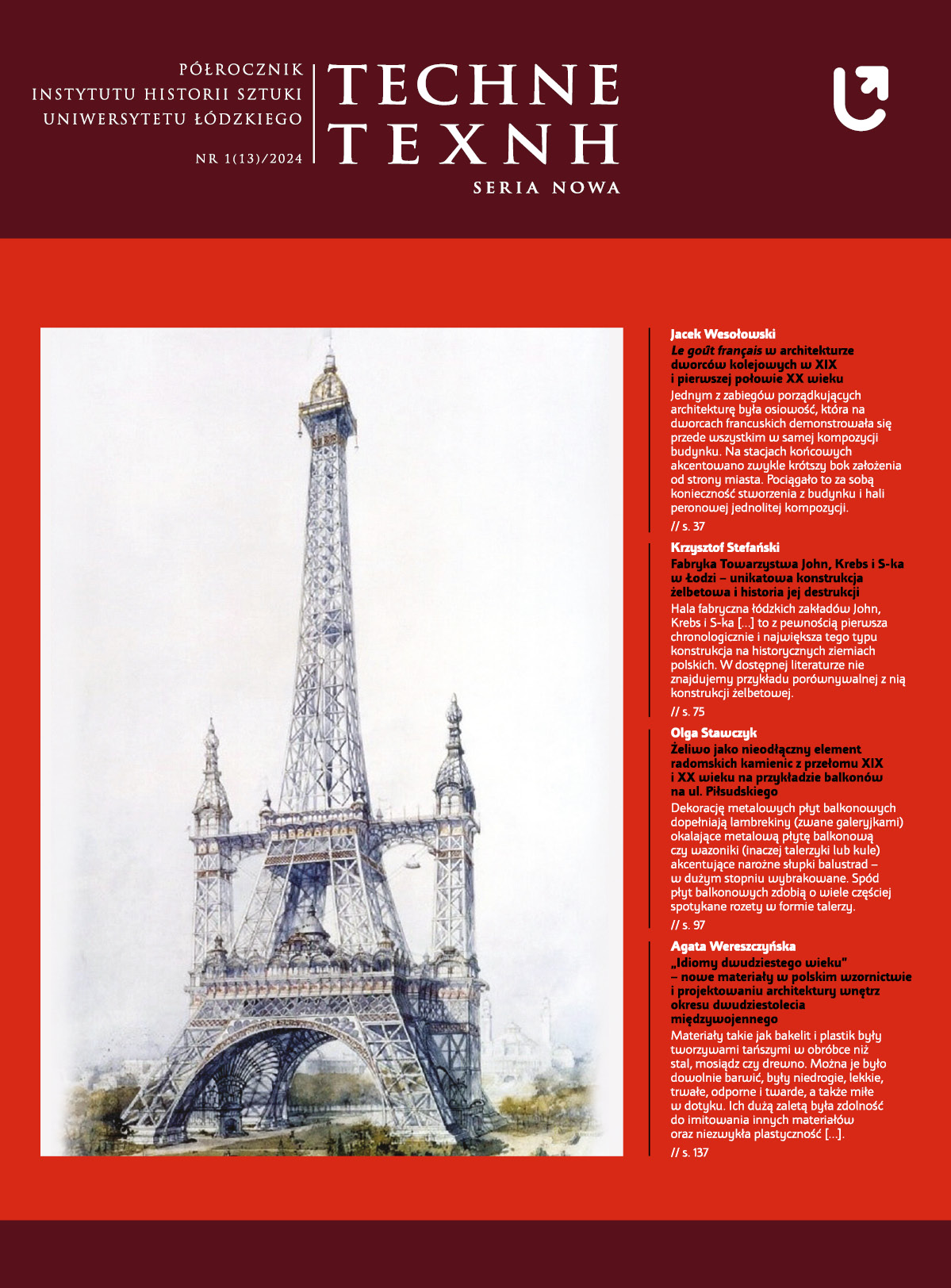
How was the Eiffel Tour built and how was it intended to be destroyed? 1885–1900
DOI:
https://doi.org/10.18778/2084-851X.17.02Keywords:
Gustave Eiffel, Eiffel Tower/Tour Eiffel, Paris, world exhibition, steel, construction, architecture, projects, history, polemic, durabilityAbstract
The aim of the competition – announced on 1 May 1886 – for the urban design of the World Exhibition in Paris in 1889 was selected the most interesting project, implementing the idea of creating a central point for organizing the communication of the exhibition. The planned project was to have a special setting, as celebrating the centenary of the Great French Revolution. The intention was to build a iron tower located on the Fields of Mars/ Champs de Mars. Its creators wanted to explore the structural and engineering possibilities embodied in a building that seemed to serve the glory of the French builders of the second half of the 19th century. Gustave Eiffel presented a project made with the participation of three other engineers from his studio, which was selected for implementation. It was a iron structure in the shape of slander tower, measuring about 312 meters high. Built in less than two years, it remained the tallest building in the world for four decades. This article is primarily to the controversy that the tower aroused among French intellectuals when it was accepted by crowds of visitors. The newspaper “Le Temps” (January 1887), two years before the opening of the 1889 Exhibition, published a letter signed by the most prominent names of the French artistic and intellectual world, demanding the rejection of the tower, considering it totally incompatible with the historical architecture of Paris. Gustave Eiffel, in the same newspaper, polemicized with opponents, highlighting the beauty, nobility of form, modernity and usefulness of the already emerging construction. The most intense attempts to transform the Tower of Paris took place during the preparations for the next World Exhibition in Paris in 1900. Subsequent part of the text, illustrated with documentary material, deals with attempts to demolish or rebuild the Eiffel Tower and finally preserve it in its original, as confirmed by history, perfect shape.
References
AIMON/OMO 1990 – Linda Aimon, Carlo Omo, Les Exposition universelle 1851–1900, Paris 1990.
Google Scholar
BACHA 2005 – Myriam Bacha, Les Exposition Universelles à Paris de 1855 à 1937, Paris 2005.
Google Scholar
BOILEAU 1893 – Louis-Charles Boileau, Causerie, „l’Architecture” 1893, s. 75.
Google Scholar
BOILEAU 1895 – Louis-Charles Boileau, Causerie, „l’Architecture”, 12 stycznia 1895, s. 445–449.
Google Scholar
CHASTENET 1953 – Jacques Chastenet, Histoire de la IIIe Republique, t. III, Paris 1953.
Google Scholar
COUCHOUD 1981 – Jean Paul Couchaud, Sztuka francuska II, tłum. E. Bąkowska, Warszawa 1981.
Google Scholar
DUROSELLE 1992 – Jean-Baptiste Duroselle, La France de la Belle époque, Paris 1992.
Google Scholar
EIFFEL 1887 – Gustave Eiffel, Réponse de Gustave Eiffel à la protestation des artistes du 14 février 1887, “Le Temps”, 14 lutego 1887, s. 4–11.
Google Scholar
EIFFEL 1900 – Gustave Eiffel, “La Tour de Trois Cents Mètres”, tłum. E. Jedlińska, Paris 1900.
Google Scholar
GIEDION 1941 – Siegfrid Giedion, Space, Time and Architecture, Cambridge, Mass. 1941.
Google Scholar
GIEDION 1968 – Siegfrid Giedion, Przestrzeń, czas, architektura. Narodziny nowej tradycji, tłum. J. Olkiewicz, Warszawa 1968.
Google Scholar
ISSAY 1937 – Raymond Issay, Panorama des expositions universelles, Paris 1937.
Google Scholar
JOBARD 2023 – Jean-Baptiste Ambroise Marcellin Jobard, Les nouvelles inventions aux Expositions Universelles; t. 2, Paris 2023.
Google Scholar
JULIAN 1974 – Philippe Julian, The Triumph of Art Nouveau. Paris: Exhibition 1900, London 1974.
Google Scholar
KOWALSKI et al. – Jacek Kowalski, Anna Loba, Mirosław Loba, Jan Prokop, Dzieje kultury francuskiej, Warszawa 2005.
Google Scholar
La Tour Eiffel… 1989 – 1889. La Tour Eiffel et Exposition universelles, red. Caroline Mathieu, Alexandre Labot, Laurence Le Loup, Réunions des musées nationaux, Musée d’Orsay, Paris 1989.
Google Scholar
LANDON 1981 – François Landon, Tour Eiffel, Paris, “Ramsay” 1981, nr 2198, s. 160.
Google Scholar
L’Exposition Universelle 2000 – L’Exposition Universelle de 1900, éd. Jean-Christophe Mabire, Paris 2000, s. 8.
Google Scholar
Le Livre des expositions 1990 – Le Livre des expositions universelles, 1851–1989, édition Musée des arts décoratifs – Hercher, Paris 1990.
Google Scholar
“Le Temps”, 14 lutego 1887.
Google Scholar
Moderniści o sztuce 1971 – Moderniści o sztuce, wybór i oprac. Elżbieta Grabska, Warszawa 1971.
Google Scholar
MÓR/KÖRÖSI 1985 – Grünwald Mór, Albert Körösi, [notatka bez tytułu], „Biuletyn Stowarzyszenia Węgierskich Inżynierów i Architektów”, tłum. Janos Brendel, Budapest 1895, s. 153.
Google Scholar
N.N., “l’Architecture”, 1895–1889.
Google Scholar
ORY 1982 – Pascal Ory, Les Expositions universelles de Paris, Paris 1982.
Google Scholar
ORY 1989 – Pascal Ory, L’Expo universelle, editions complexes, Bruxelles 1989.
Google Scholar
DOI: https://doi.org/10.1002/he.36919896707
PEVSNER 1978 – Nikolaus Pevsner, Pionierzy współczesności, tłum. Janina Wiercińska, Warszawa 1978.
Google Scholar
SEITZ 2001 – Frédéric Seitz, La Tour Eiffel. Cent ans de sollicitude, Belin Herscher, Berlin– Paryż 2001.
Google Scholar
VEY 2018 – François Vey, La Tour Eiffel, vérités et légendes, Paris 2018.
Google Scholar
ZAMOJSKI 2010 – Jan Zamojski, Dlaczego wciąż warto badać polską myśl filozoficzno-lekarską, [w:] Polska szkoła filozofii medycyny. Przedstawiciele i wybrane teksty źródłowe, red. Michał Musielak, Jan Zamojski, Poznań 2010, s. 11.
Google Scholar
CARMON 2002 – Michel Carmon, Eiffel, edit. Fayard, Paris 2002, https://www.paris-grad.com/14-fevrier-1887-les-artistes-contre-la-toureiffel/ [dostęp: 10.12.2023].
Google Scholar
Corus in construction – Exhibition buildings. Corusconstruction.com. Archived from the original on 5 October 2013. Retrieved 24 May 2010 [dostęp: 9.12.2023].
Google Scholar
Gustave Eiffel, tirées du livre La Tour de 300 mètres, Paris 1900, https://www.toureiffel.paris/fr/le-monument/histoire [dostęp: 10.12.2023].
Google Scholar
JOBARD 1844 – Jean-Baptiste Ambroise Marcellin Jobard, Nouvel économie social, où Monautopole, Paris 1844, https://www.google.pl/books/edition/Nouvelle_%C3%89conomie_sociale_ou_monautopol/bUdVAAAAcAAJ?hl=pl&gbpv=1&dq=Marcellin+Jobard&pg=PT3&printsec=frontcover [dostęp: 17.12.2023].
Google Scholar
SAVILLE – James Patrick Saville, Henry Bessemer. English inventor and engineer, https://www.britannica.com/biography/HenryBessemer [dostęp: 7.12.2023].
Google Scholar
Tour Eiffel, Paris, www.emporis.com [dostęp: 10.12.2023] https://fr.wikisource.org/wiki/R%C3%A9ponse_de_Gustave_Eiffel_%C3%A0_la_protestation_des_artistes_du_14_f%C3%A9vrier_1887 [dostęp: 10.12.2023].
Google Scholar
https://www.arthistoryresearch.net/review/figaro-exposition-1889.html [dostęp: 14.12.2023].
Google Scholar
https://www.colorado.edu/today/2005/01/04/elegant-shape-eiffel-tower-solved-mathematically-cu-boulder-prof [dostęp: 10.12.2023].
Google Scholar
https://www.gettyimages.ch/detail/nachrichtenfoto/engraving-gustave-raulin-architect-refused-project-for-nachrichtenfoto/959580056?language=fr [dostęp: 14.12.2023].
Google Scholar
https://www.newswise.com/articles/the-curious-case-of-the-eiffel-tower ; Elegant Shape Of Eiffel Tower Solved Mathematically By CU-Boulder Prof, 5 January 2005 [dostęp: 14.02.2023].
Google Scholar
Downloads
Published
How to Cite
Issue
Section
License

This work is licensed under a Creative Commons Attribution-NonCommercial-NoDerivatives 4.0 International License.






