Policy regarding peer review
The scientific review process begins with the submission of an application for an opinion on a scientific text, and ends with the final decision on it, and is coordinated by the journal editor dedicated to a given process.
In the first stage, the editorial office performs a formal evaluation of the text, and then appoints two independent reviewers affiliated outside the research unit from which the author (s) of the article comes. The review process follows the double-blind review process model, in which the authors of articles and reviewers do not know each other’s identity.
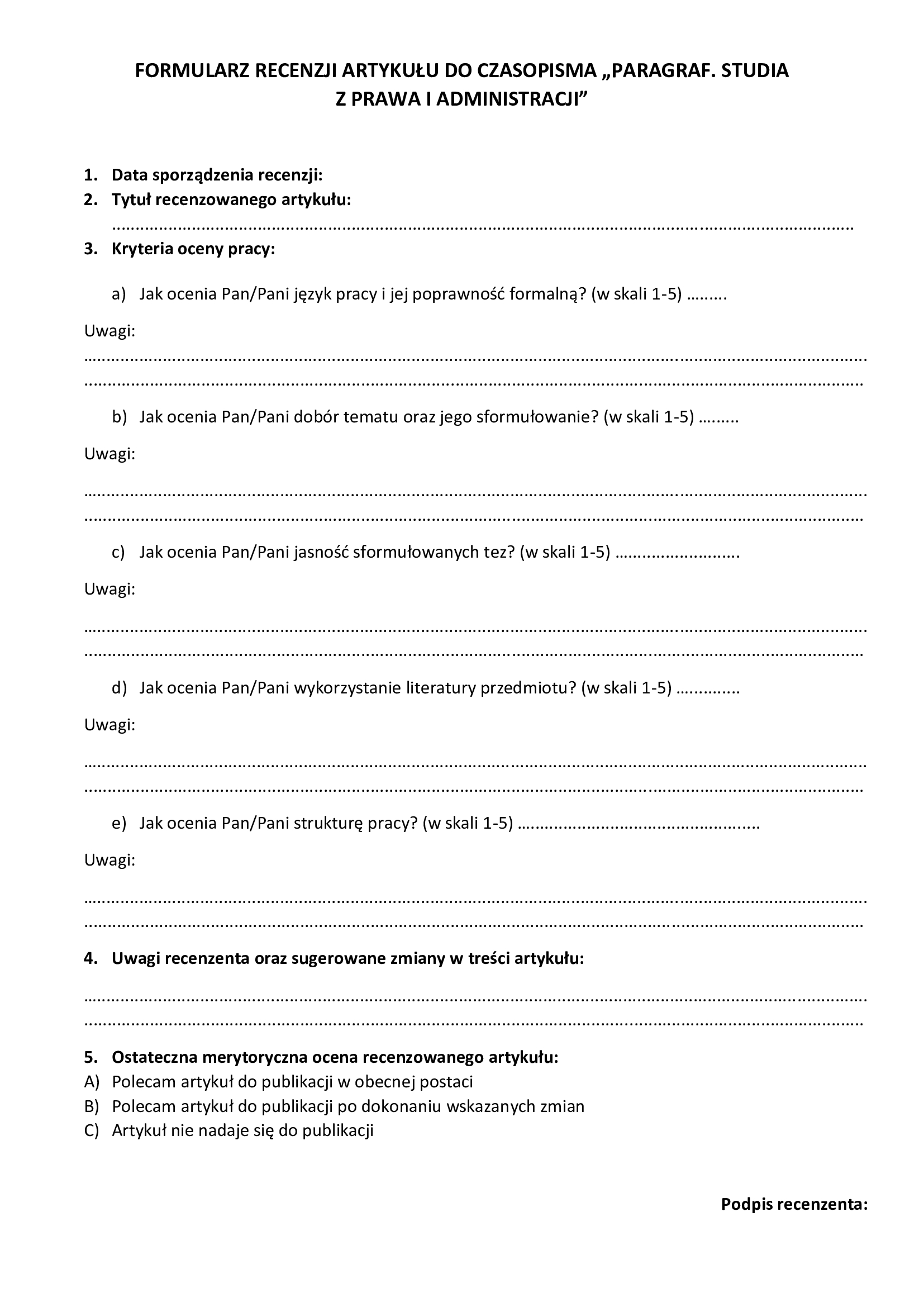
Reviews are made in writing (the Editorial Board has an appropriate review form) and end with an unambiguous conclusion regarding the approval of the article for publication or its rejection.
All reviewers should meet the following requirements:
- no conflict of interest with the authors (where a conflict of interest is considered to be the direct personal relationships between the reviewer and the author: second degree relationship, legal relationships, marriage, relationships of professional subordination or direct scientific cooperation in the last two years preceding the year of preparation reviews)
- having at least a doctoral degree
- showing current publications on a specific topic
In addition, they should:
- have the necessary knowledge to assess the quality of a given article
- uphold standards of professionalism and ethics
- enjoy an unblemished reputation as a scientist
Additionally, they cannot be members of the editorial office or scientific council of the journal.
Reviewers who accept the invitation to review are requested to submit their review within 3 weeks. An extension of this period may be obtained upon request.
In order to improve the review process, employees of WUŁ are in constant contact with reviewers, authors and editors.
The reviewer’s comments are then forwarded to the author. The rational and motivated conclusions presented in the review are binding for the author. He is obliged to take into account the recommendations of the reviewers and correct the text. Reviewers have the right to reverify the corrected text. If the author of the text does not agree with the conclusions of the reviewer, he has the right to present his editorial position in a polemical note.
Revised versions of articles may be sent to reviewers depending on whether they want to see the current version. All reviewers can access the latest version of the text via the OJS platform.
The decision to publish the text is made by the editor-in-chief after consulting the editorial board and, possibly, the scientific council, on the basis of an analysis of comments and conclusions contained in the reviews, together with any polemics of the author of the text and the final version of the text provided by the author, checking:
- proper selection of reviewers
- adequacy of reviewers’ opinions and the author’s attitude to them
- the overall scientific quality of the article
Reviewers are obliged to confidentiality in their opinions on the reviewed article and not to use the knowledge gained on this occasion before its publication.
The editor issues an unambiguous decision regarding the approval of the article for publication or its rejection.
The names of the reviewers of individual articles are not disclosed. The list of reviewers cooperating with the journal is published on the journal’s website once a year.
The reviewing procedure complies with the recommendations of the booklet Good Practices in Review Procedures in Science (MNiSzW, Warsaw 2011) and the COPE standards.
Criteria for the selection of articles for publication
Only articles that meet all of the following criteria are eligible for publication:
Thematic relevance – the article falls within the journal’s academic scope and deals with issues in the field of legal studies or related disciplines connected with law.
Originality of the work – the article constitutes an independent, original result of the author’s work and contributes new scholarly value to legal scholarship, in particular by presenting new research findings, analysing legal issues, offering an original interpretation of legislation or case law, or providing an innovative approach to the subject.
Academic standard – the paper demonstrates a high level of substantive quality, methodological soundness and sound reasoning.
Formal correctness – the article has been prepared in accordance with the journal’s editorial requirements, including rules on citation, footnotes, the bibliography and technical requirements regarding the text.
Scientific and ethical integrity – the author adheres to the principles of publication ethics, in particular those concerning authorship, the originality of the text, the proper citation of sources and the disclosure of any conflicts of interest.
Positive peer review – the article has received positive reviews prepared in accordance with the journal’s peer review procedure, and the author has incorporated the required amendments indicated by the reviewers and the Editorial Board.
Criteria for rejecting an article
The editorial board will refuse to accept an article for publication, in particular where:
the article does not correspond to the journal’s academic profile or subject area;
the paper lacks the characteristics of a scholarly work or does not offer any cognitive value;
the article contains significant substantive, methodological or logical errors that preclude its publication;
the author’s argumentation is insufficient, unreliable or not supported by current legislation, case law or academic literature;
the text does not meet the formal requirements specified by the Editorial Board, and the author has not rectified the identified shortcomings within the specified deadline;
the article breaches the principles of publication ethics, in particular by containing plagiarism, self-plagiarism, unreliable use of sources, manipulation of research results or undisclosed co-authorship (ghostwriting, guest authorship);
a plagiarism check reveals an unacceptable level of similarity to previously published works;
the author fails to incorporate the comments of the reviewers or the Editorial Board despite being requested to make corrections;
the article receives two negative reviews, or the reviewers unequivocally indicate that there are no grounds for its publication.
Criteria for selecting articles for publication
Where the number of submissions exceeds the journal’s publication capacity, the decision on whether to accept articles for publication is based, in particular, on:
thematic alignment with the profile and editorial plan of the relevant issue of the journal;
the results of the peer-review process and the assessment of the article’s academic quality;
the originality of the subject matter and the academic value of the study;
the topicality of the issue addressed and its significance for the development of legal sciences;
methodological soundness and the quality of the author’s academic approach;
the author’s timely incorporation of the amendments indicated by the reviewers and the Editorial Board;
adherence to high standards of publication ethics.
Template review: