
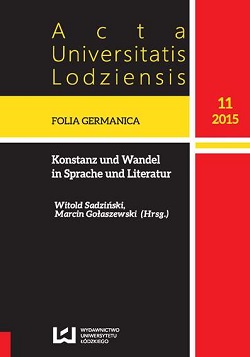
„[…] warum schläft denn nimmer nur mir in der Brust ein Stachel?“ Ernst Wiechert’s prose works in the 1930s
DOI:
https://doi.org/10.18778/1427-9665.11.13Keywords:
Ernst Wiechert, Inner Emigration, East Prussia, World War IAbstract
Ernst Wiechert’s prose written in the 1930s is best symbolized by Friedrich Hölderlin’s poem Abendphantasie (1799), in which the persona describes his loneliness and resignation, describing them as a thorn in his chest. The question of the identification of these feelings with the East Prussian writer is a major problem raised in the article. Wiechert certainly belongs to the group of writers associated with the so called Inner Emigration, and the studies by Herbert Wiesner, Ralf Schnell, Reinhold Grimm and Friedrich Denka support this thesis. Also, the method developed by Hubert Orlowski allows us to include or exclude literary works from inner emigration literature. This method turns out to be helpful in the interpretation of Wiechert’s works. Moreover, the question of Wiechert’s position on National Socialism is considered, which is full of contradictions, as well as his coming close to the Inner Emigration. On the basis of selected prose works created in the 1930s (e.g. Die Hirtennovelle, Die Majorin), the writer’s evolution from the ‘breakthrough of grace’ to becoming an inner emigrant will be presented. Particularly noteworthy are some relevant themes in his works such as World War I, the mother figure as a prefiguration of the ‘Great Mother’ myth, the writer’s stand on National Socialism or the Mazurian landscape.
Downloads
References
Albrecht G., Böttcher K., Greiner-Mai H., Krohn P. (1975), Lexikon deutschsprachiger Schriftsteller von den Anfängen bis zur Gegenwart, Leipzig, Bd. 2, S. 460–462.
Bachofen J.J. (1975), Das Mutterecht. Eine Untersuchung über die Gynaikokratie der alten Welt nach ihrer religiösen und rechtlichen Natur, Frankfurt/M.
Chatellier H. (1973), Ernst Wiechert im Urteil der deutschen Zeitschriftenpresse 1933–1945. Ein Beitrag zur nationalsozialistischen Literatur- und Pressepolitik, In: Recherches germaniques, Bd. 3,S. 153–195. DOI: https://doi.org/10.3406/reger.1973.914
Czarnecka M. (2004), Wieszczki. Rekonstrukcja kobiecej genealogii w historii niemieckiej literatury kobiecej od połowy XIX do końca XX wieku, Wrocław.
Gajdis A. (2014), Odległa prowincja. Prusy Wschodnie w prozie pisarzy niemieckich (1866–1945), Wrocław.
Ganzer-Gottschewski L. (1936), Ernst Wiechert und das Mutterrecht. In: Deutsches Volkstum, Bd.18, S. 203–207.
Heiting I. (1936), Der Muttergedanke als Zeitausdruck in neuerer Literatur, Bonn.
Herbermann N. (1935), Zu Ernst Wiecherts Dichtungen. In: Der Gral, Bd. 29S. 562–564.
Ingen F. van (1991), Zwischen „Totenwolf“ und „Totenwald“. Ernst Wiechert und die völkische Literatur. In: Onderdelinden S. (Hrsg.), Interbellum und Exil, Amsterdam, S. 140–161. DOI: https://doi.org/10.1163/9789004654242_012
Krenzlin L. (1999), Erziehung hinter Stacheldraht. Wert und Dilemma von Ernst Wiecherts konservativer Opposition. In: Ehrlich L., John J., Ulbricht J. H. (Hrsg.), Das dritte Weimar. Klassik und Kultur im Nationalsozialismus, Köln/Weimar/Wien, S. 149–161
Krenzlin L. (2012), Ernst Wiechert – kein einfaches Leben. Ein Schriftsteller als moralische Instanz in schwierigen Zeiten. In: Internationale Ernst-Wiechert-Gesellschaft Mitteilungen 14 (2012), S. 40–43.
Kunicki W. (1996), Ernst Emil Wiechert. In: Zybura M. (Hrsg.), Pisarze niemieckojęzyczni XX wieku. Leksykon encyklopedyczny PWN, Warszawa/Wrocław, S. 335.
Orłowski H. (2001), Posłowie. Ernst Wiechert a tradycje konserwatywne i emigracja wewnętrzna, In: Wiechert E., Proste życie, Olsztyn, S. 339–359.
Otto B. (2001), Unterwasser-Literatur. Von Wasserfrauen und Wassermännern, Würzburg.
Reiner G. (1974), Ernst Wiechert im Dritten Reich. Eine Dokumentation, Paris (Ernst-Wiechert-Bibliographie, 2. Teil).
Rosłan J. (1992), Ernst Wiechert. Życie i dzieło, Olsztyn.
Schnell R. (1967), Literarische Innere Emigration 1933–1945, Stuttgart.
Schoeps K.–H. J. (1992), Deutsche Literatur zwischen den Weltkriegen. Literatur im Dritten Reich,Bern u.a.
Wiechert E. (1934), Der Todeskandidat. La Ferme Morte. Der Vater. Drei Erzählungen, München.
Wiechert E. (1936), Von den treuen Begleitern, Hamburg.
Wiechert E. (1957), Jedermann. Geschichte eines Namenlosen (1929/1930). In: Wiechert E., Sämtliche Werke. Wien/München/Basel, 3. Bd., S. 305–538.
Wiechert E. (1959), Jahre und Zeiten. In: Wiechert E., Es sprach eine Stimme, Wien/München/ Basel, S. 191–636.
Wiechert E. (1967), Die Magd des Jürgen Doskocil. Frankfurt/M./Berlin.
Downloads
Published
Issue
Section
License

This work is licensed under a Creative Commons Attribution-NonCommercial-NoDerivatives 4.0 International License.
How to Cite