
Macbeth in Wartime Ukraine
Classic Private University, Ukraine https://orcid.org/0000-0001-6747-8664
Cherkasy Music and Drama Theatre, Ukraine https://orcid.org/0009-0005-7310-3291
Abstract
The article discusses the production of Macbeth by The Taras Shevchenko Academic Regional Ukrainian Music and Drama Theatre of Cherkasy, Ukraine. Directed by Stanislav Sadakliiev, this production of Macbeth premiered on 27 January 2024 and paved the way for a new series of theatrical adaptations of the Scottish play produced during the Russian-Ukrainian War. The first part of the article provides a brief overview of Macbeth’s theatrical reception in Ukraine, while the second part focuses on the 2024 staging, including the translation used to produce the effect of urgency for Macbeth in Ukrainian.
Keywords: Macbeth in Eastern Europe, Macbeth in Ukraine, Shakespeare in performance, Les Kurbas, contemporary Ukrainian theatre.
After Putin’s full-scale invasion of Ukraine in February 2022, it became only a matter of time before a new ‘wartime’ production of Macbeth appeared, as there was an urgent need to raise the topic of tyranny, provoke a discourse around usurping power, and cautiously predict the inevitable end of a dictator. The Taras Shevchenko Academic Regional Ukrainian Music and Drama Theatre in Cherkasy was the first to respond to the growing tension both on the frontline and in society nearly two years into the full-scale war initiated by the Russian dictator. Stanislav Sadakliiev’s Macbeth premiered on 27 January 2024 on the 703rd day of the war. This article focuses on the way in which this production used deliberate instability on stage to serve as a reflection of the uncertainty and turmoil faced by contemporary Ukraine, where the unpredictable nature of the production mirrored the harsh reality of a nation grappling with the devastating consequences of war and the fragile state of its future.
Macbeth remains one of the least staged Shakespearean plays in Ukraine, even though it has been labelled one of Shakespeare’s four great tragedies at least since A.C. Bradley’s famous declaration on the matter. Macbeth’s Ukrainian reception history started only in 1920, in the midst of the Russian Civil War, with Les Kurbas (1887–1937), avant-garde director and one of the leaders of the national-cultural movement known as The Executed Renaissance. Kurbas led a revolution in Ukrainian theatre in the early 20th century, bringing it to a world-class standard through highly experimental, intellectually rigorous productions. He both directed and performed the title role in Macbeth with the touring KyiDramTe (Kyiv Drama Theatre), and revisited the play four years later, in a new production at his innovative Berezil Theatre. By 1924, the Soviet Union had already been established, shaping a new ideological reality for Ukrainian theatre. The themes of tyranny and dictatorship grew increasingly sensitive as the regime consolidated its power through the Constitution adopted in January 1924. A year after its premiere, Kurbas reflected on the confrontation between the main opposing forces in the play:
Where is the conflict in Macbeth? The lust for power is the theme. The witches are the rising action. The conflict is what the play is made of. Macbeth standing there and contemplating whether to kill Duncan or not is a conflict of the soul, a moral conflict. That’s not what we’re interested in [...] but what causes the war, what must cause the war is the conflict. […] Macbeth isn’t the centre of the conflict, he is a part of it; the conflict lies in the state of affairs that causes the war, that is, in the contradictions of the social life.[1]
Les Kurbas’s socially charged reading of Macbeth, which framed the tragedy as a reflection of the broader class struggles rather than a purely personal moral dilemma, soon attracted the attention of Soviet censors. His bold interpretation was met with strict ideological control. The unfortunate fate of Kurbas later made many Ukrainian theatres hesitant to stage Macbeth because its leitmotifs too closely mirrored authoritarian realities. From that time on, the play was thought of as political with the criticism of the state expressed through the depiction of internal conflicts happening in the play (Makaryk 66–111).
Still, the bold interpretation of the Scottish play by Les Kurbas impacted the current generation of Ukrainian directors who opted for this particular play in order to make their own social or political statements. Macbeth. The Prologue dir. by Vlad Troitskyi (2004), Macbeth-17 dir. by Yevhen Sydorenko (2019), and Macbeth dir. by Roza Sarkisian (2020) all followed in the footsteps of Kurbas’s production. Vlad Troitskyi’s Macbeth: The Prologue reimagined Macbeth as part of a never-ending historical cycle of violence and revolution. As Beccy Smith observed in her Total Theatre review, the production was “less about Macbeth than about the inhumanity and madness borne of political corruption in Ukraine” (Smith). The abuse of power and the descent into tyranny on stage thus mirrored real-world conflict and moral decay, turning Macbeth into a pointed social critique of post-Soviet realities. More than a decade later, Macbeth-17, adapted by Dmytro Mamchur and staged with a very small cast, distilled the tragedy into the intimate conflict between Macbeth and Lady Macbeth. By focusing on their internal struggles and toxic alliance, the production explored the human roots of tyranny and the personal toll of ambition. In 2020, Roza Sarkisian offered a vastly different perspective, reinterpreting Macbeth through a feminist and wartime lens. By reversing traditional power dynamics, placing women in control while men remained largely powerless, Sarkisian questioned the very nature of authority, suggesting that the corruption of power transcends gender and persists in every political system.
In 2024, another Macbeth was staged, this time at The Taras Shevchenko Academic Regional Ukrainian Music and Drama Theatre of Cherkasy, Ukraine. The production was directed and sound-designed by Stanislav Sadakliiev, the theatre’s director, who took on the Shakespearean play and brought about his vision to Macbeth, as for him the play is a complex exploration of power and its profound effect on human nature, mirroring the course of world history, as he shared in an interview with Anastasiia Brynko (personal communication, 16 February 2024). Sadakliiev believes that Macbeth stands apart from Shakespeare’s other works due to its deep character transformations. It needs to be underlined that he chose the most recent translation by Oleksandr Hriaznov (2008) for this production because it featured fewer spells and softened some of the play’s more intense language, offering a slightly different take on the classic tragedy. Sadakliiev was the first to have used Hriaznov’s work for a theatre production.
The translation turned out to be one of the easiest for stage adaptation, actors’ memorisation and the viewers’ perception of the production. For example, Macbeth’s renowned quote: “Life’s but a walking shadow, a poor player that struts and frets his hour upon the stage and then is heard no more” (5.5.20–23) underwent a subtle shift in meaning in its Ukrainian translation:
Життя – тремтлива тінь, комедіант, що півгодини блазнював на сцені, забутий і освистаний.
[Zhyttia – tremtlyva tin, komediant, shcho pivhodyny blazniuvav na stseni, zabutyi i osvystanyi]
Life is a trembling shadow, a comedian who for half an hour played the fool on stage, forgotten and booed.
For comparison, the widely recognized translation by Borys Ten rendered the above quote as:
Життя – рухлива тінь, актор на сцені. Пограв, побігав, погаласував cвою часину – та й пропав
[Zhyttia – rukhlyva tin, aktor na stseni. Pohrav, pobihav, pohalasuav svoiu chasynu – ta i propav]
Life is a restless shadow, an actor on the stage. He played, ran around, made noise for his time – and then disappeared.
Meanwhile, the most intricate translation by Todos Osmachka presented it as:
Життя летюча тінь, актор, що на кону нещасний хваста, галасує, потім навіки забувається...
[Zhyttia letiucha tin, aktor, shcho na konu neshchasnyi khvasta, halasuie, potim naviky zabuvaietsia…]
Life is a fleeting shadow, an actor who, miserable on stage, boasts and makes noise, only to be forgotten forever…
Unlike the chosen version, these translations, with their more complex phrasing and heightened poeticism, presented greater challenges for actors and demanded a higher level of linguistic awareness from the audience, making them less accessible for a dynamic stage performance.
The production struck a balance between tradition and experiment. While its concept stayed within the conventional framework of Ukrainian academic theatre – marked by a solemn performance style, a linear narrative, and an audience-oriented approach – the director injected some experimentation. By eclectically blending opera with rap, incorporating pieces by Audiomachine (Draconian Dream), Federico Albanese (Meridian, By the Deep Sea, The Quiet Man), and Cirque du Soleil (Vai Vedrai), he introduced an unexpected sensuality, while moments of comic relief balanced the weight of the tragedy. The Witches (Anna Nimaiier, Iryna Zhara, and Anastasiia Ivahnenko) cast their spells through rap, using lyrics drawn from the songs, while Hecate (Nataliia Mamalyha) delivered them as a soaring aria. Lady Macbeth (Olena Brekharia) delivered a powerful and expressive rap performance reading Macbeth’s letter, beginning with “Я зустрів їх у день моєї перемоги…,” [They met me in the day of victory…; Ya zustriv yikh u den moyeyi peremohy…], infusing the lines with intensity and rhythm.
Following Stolen Happiness by Ivan Franko and The Rhinoceros by Eugène Ionesco, Macbeth marked the third collaboration between the director and his stage and costume designers, with Serhii Rydvanetskyi designing the stage and Natalka Rydvanetska the costumes. As in their earlier productions, the scenography embraced minimalism while remaining highly functional. The centrepiece was a dynamic, multifunctional platform that transformed seamlessly into a runway, a bridge, a barrier, a clock hand, a castle wall, and a stage – dictating the rhythm and tempo of the performance. The set also featured eight long, transparent sheets, which created an uncanny, ethereal effect: behind them, the souls of the murdered characters emerged, heightening the play’s supernatural quality and depth. The unconventional use of scenic space further blurred the boundary between audience and performers. The production fostered a sense of volatility, drawing spectators into its shifting, unstable world, with a moving stage, trapdoors, and action unfolding at the very edge of the proscenium stage and thus within the auditorium itself.
Visually, the production adhered to a monochrome palette dominated by white alongside shades of grey. Despite this restrained colour scheme, lighting played a crucial role in emphasising vibrancy and symbolism – shifting between hues of yellow, blue, purple, turquoise, and red to spotlight key moments. The backdrop featured a semi-abstract grey-and-white tree-like pattern, evoking the ominous presence of Birnam Wood. This motif extended to the characters’ costumes – except for the Witches, whose otherworldly nature was underscored by their flowing, weightless fabrics, which billowed eerily as if charged with an unseen force. Lady Macbeth’s costume changes mirrored her psychological descent. Initially, she wore a dark frock over a white, semi-transparent chemise. After the first murder, the white faded into a deep, blood-red hue, and by the final act, consumed by guilt, she appeared in a translucent red chemise, embodying her unravelling. Macbeth underwent a similar transformation: after claiming the crown, he traded his dark thane’s attire for a regal white suit, yet his essence – symbolised by his trousers, which retained their deep graphite shade – remained unchanged.
The stage, costume, lighting, and sound design created a captivating environment that reinforced the timeless theme of history endlessly repeating itself. Each element was carefully crafted to enhance the narrative’s depth, emphasising the cyclical nature of human civilisation and its repeated failure to heed past mistakes. Natalka Rydvanetska’s evocative costume design depicted eras and characters, while Stanislav Sadakliiev’s resonant soundscape and Yuliia Obukhova’s dynamic lighting seamlessly synchronised to deepen the emotional impact. This cohesive collaboration aligned with the director’s vision, illustrating that despite the passage of time, humanity remains trapped in an unending cycle of lessons unlearned, prompting reflection on the importance of true progress.
These visual transformations not only reflected the characters’ inner turmoil but also reinforced the production’s broader themes of power and its corrupting influence. In this context, the depiction of authority and control extended beyond Macbeth and Lady Macbeth, shaping the dynamics between other key figures on stage. The production’s representation of power dynamics was particularly impactful, given the context of the ongoing war in Ukraine and the broader political situation. Influential characters such as the Witches, Banquo (Serhii Bobrov), and the Murderers (Ruslan Lysinskyi and Denys Blyzniuk) maintained their dominance until the final moments of the performance. Bobrov’s acting as Banquo was natural and compelling. From the first line, he demonstrated a strong stage presence, effortlessly crafting a well-rounded portrayal of Macbeth’s friend and rival. Even as a ghost, he retained an unshakable presence, making Macbeth shudder with horror.
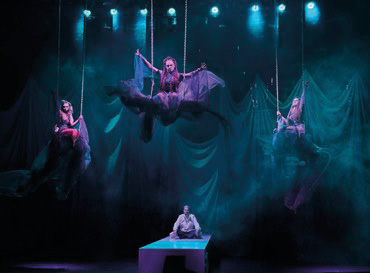
Both the Witches and the murderers performed in an exaggerated, eccentric manner, grimacing and bending their bodies. Despite their contrasting roles, they remained detached from the events unfolding: the Witches floated over the scene, seemingly fully understanding its inevitable outcome and performing their part with clockwork precision, while the Murderers carried out their grim orders with unsettling nonchalance, as if ignoring their power to shape fate. Using a watering can and a metal basin as killing tools, accompanied by a sound effect of water drops falling on a metal surface, they liquidated Banquo as well as Lady Macduff (Anzhelina Ivanova) and her son (Danylo Shevchenko). The latter had the weakest position in the production. Being a direct threat to Macbeth and his throne, they had no chance to survive. Lady Macduff inquired before being murdered:
Куди мені тікати? Кому я зло зробила? Що мені робити? Чи допоможе мій жіночий захист – Казати, що невинна?
[Kudy meni tikaty? Komu ya zlo zrobyla? Shcho meni robyty? Chy dopomozhe mii zhinochyi zakhyst – Kazaty, shcho nevynna?]
Where should I run? Who have I done wrong? What should I do? Will my feminine defence help me – saying that I am innocent? (4.2.81–87)
Denys Blyzniuk, who played the Second Murderer, took on seven more supporting roles, including: Messenger, Soldier, Doctor, Porter, Seyton, Servant, and Gentlewoman. With his expressive and slightly grotesque comic technique, Blyzniuk seamlessly combined these characters into one – a clown-trickster, providing much-needed comic relief during the most intense moments of Shakespeare’s tragedy.
The director highlighted changes in the power relationship throughout the performance. Lennox (Petro Holubchenko) and Ross (Pavlo Honcharov) had a striking moment of self-punishment – repeated slaps to their own faces – symbolising their awakening to the reality of Macbeth’s rule. This act vividly illustrated their realisation of the court’s corruption and their own complicity in it. It further revealed how easily they had been seduced by the promise of power, overlooking its inherent decay until its repercussions became inescapable. A comparable effect was achieved through the triple repetition of key phrases:
Та поки не пішов на Дунсинан Бірнамський ліс, боятись мені нема чого”
[Ta poky ne pishov na Dunsynan Birnamskyi lis, boiatys meni nema choho]
Till Birnam Wood remove to Dunsinane I cannot taint with fear (5.3.2–3)
and
Всіх боягузів вішати негайно!
[Vsikh boiahuziv vishaty nehaino!]
Hang those that talk of fear (5.3.43)
These visibly marked Macbeth’s inner transformation. Initially, Yakiv Kucherevskyi’s Macbeth had much physical dynamism, confidence, and some bravado, which added an unexpected comedic edge to his character. The actor masterfully captured the duality of his character – an outwardly strong military leader who, beneath the surface, was a vulnerable man easily swayed by his wife’s manipulations and the allure of power. However, as the weight of ambition bore down on him, his presence became increasingly haunted, culminating in the final monologue full of introspection and melancholy. By the end, crushed by the fulfilled prophecy, he appeared frustrated and acutely aware of his impending downfall.
Olena Brekharia’s portrayal of Lady Macbeth exuded a blend of feminine intuition, cunningness, fiery passion, and unwavering determination. The evolving dynamic between the spouses stirred a range of emotions – an initial sense of unease from witnessing their intimate moments, followed by contempt for Macbeth’s cowardice, then resentment at his cold indifference as his wife spiralled into madness, and ultimately, a deep admiration for their spiritual unity in the final scene. Their slow, hypnotic dance to a poignant melody towards the end of the performance was mesmerising, creating the illusion that they existed in a world of their own. Much like Bulgakov’s Master and Margarita, Macbeth and Lady Macbeth appeared bound by an unbreakable connection that transcended the chaos surrounding them. Despite their descent into darkness, their final moments suggested a kind of otherworldly reconciliation, as if, like the Master and Margarita, they had escaped judgment and found peace beyond the constraints of their doomed reality.
Using classical theatrical elements and bold contemporary choices, Stanislav Sadakliiev’s Macbeth at the Taras Shevchenko Academic Regional Ukrainian Music and Drama Theatre in Cherkasy offered a visually and emotionally gripping interpretation rooted in tradition, as well as an innovatively reimagined performance. The production marked the emergence of new Macbeths in Ukraine, with three of them following in 2025: by Ivan Uryvskyi in the Ivan Franko National Academic Drama Theater in Kyiv (opening night: 28 February 2025), by Linas Zaikauskas in the Dnipro Academic Drama and Comedy Theatre (opening night: 29 March 2025) and by Maya Kleczewska in the Ivan Franko National Academic Drama Theatre in Ivano-Frankivsk (opening night: summer 2025). This resurgence of interest in the play demonstrates its power to convey the current sense of political helplessness which many feel in the face of unrelenting tyranny.
Autorzy
Works Cited
Bradley, A. C. Shakespearean Tragedy: Lectures on Hamlet, Othello, King Lear, and Macbeth. London: Macmillan, 1904.
Makaryk, Irena. Shakespeare in the Undiscovered Bourn: Les Kurbas, Ukrainian Modernism and Early Soviet Cultural Politics. Toronto: University of Toronto Press, 2004. https://doi.org/10.3138/9781442679887
Shakespeare, William. “Macbeth.” Folger Shakespeare Library. https://www.folger.edu/explore/shakespeares-works/macbeth/read/. Accessed 18 December 2024.
Smith, Beccy. “Dakh Centre for Contemporary Arts, Macbeth: The Prologue.” Total Theatre 19 (2) (2007). https://totaltheatre.org.uk/archive/reviews/dakh-centre-contemporary-arts-macbeth-prologue. Accessed 18 December 2024.
Šekspìr, Vil’yam. Makbet. Per. Borisa Tena. Ukraïns’kij Šekspìrìvs’kij Portal [Шекспір, Вільям. Макбет. Пер. Бориса Тена. Український Шекспірівський Портал]. https://shakespeare.znu.edu.ua/makbet-pereklad-b-tena-2/. Accessed 18 December 2024.
Šekspìr, Vil’yam. Makbet. Per. Oleksandra Grâznova. Bìblìoteka ukraïns’koï lìteraturi [Шекспір, Вільям. Макбет. Пер. Олександра Грязнова. Бібліотека української літератури]. https://www.ukrlib.com.ua/world/printit.php?tid=9050. Accessed 18 December 2024.
Šekspìr, Vil’yam. Makbet. Per. Todosâ Os’mački. Kharkiv: State Publishing House of Ukraine, 1930. [Шекспір, Вільям. Макбет. Пер. Тодося Осьмачки. Kharkiv: State Publishing House of Ukraine, 1930].
Footnotes
- 1 Minutes of the Director’s Office. The Rylsky Institute of Art Studies, Folklore and Ethnology of NASU. Fund 42. Storage Item 24. Typewriting. (If not indicated otherwise, all translations are our own).