
The Hamlet Syndrome (dir. Niewiera & Rosołowski, 2022) – Drawing a Portrait of the Maidan Generation with Piotr Rosołowski
University of Lodz, Poland https://orcid.org/0000-0001-5446-5573
Abstract
Several months before Russia’s full-scale invasion of Ukraine in February 2022, two Polish filmmakers who specialize in documenting political, social and cultural transformations in Eastern Europe, Elwira Niewiera and Piotr Rosołowski, came up with the idea of combining the Hamlet figure with the then-emerging Ukrainian documentary theatre to draw a portrait of the Maidan generation born following the collapse of the Soviet Union. For this purpose, they cast five Ukrainians and a documentary theatre director, Roza Sarkisian, and asked them to rehearse an experimental version of Hamlet on a stage in Kyiv. The script of The Hamlet Syndrome documentary is based on stories the protagonists shared during and in between rehearsals. The article also features an interview with Piotr Rosołowski, co-director, co-scriptwriter and cinematographer of the film, in which he discusses the origins of the project, its challenges, development, reception, and the use of the Hamlet figure.
Keywords: The Hamlet Syndrome, H-Effect, war in Ukraine, Hamlet, Maidan, documentary theatre, documentary film.
Introduction
Several months before Russia’s full-scale invasion of Ukraine in February 2022, two Polish documentary filmmakers, Elwira Niewiera[1] and Piotr Rosołowski,[2] started an ambitious artistic project whose aim was to offer a complex portrait of the first generation born in independent Ukraine. To this effect, they initiated and then documented the process of rehearsals of an experimental stage production of Hamlet. They cast five Ukrainians and also found a talented Ukrainian documentary theatre director, Roza Sarkisian, to realize their goal. As a result of this endeavour, two interconnected yet autonomous projects were finalized: the documentary film The Hamlet Syndrome by Niewiera and Rosołowski released in 2022, and Sarkisian’s stage production H-Effect, whose fragments we see in the film’s closing. Sarkisian then continued to independently develop H-Effect in co-operation with Internationale Heiner Müller Gesellschaft, the outcome of which was performed, amongst other locations, in Teatr Polski in Poznań, Poland, during the festival “Bliscy Nieznajomi: Wschód” (Close Strangers: East) in September 2021.
Each member of the cast was a young adult when the pro-European Maidan protests began in late 2013 and early 2014, to be soon followed by a military conflict in the Donbas region and the annexation of Crimea. Those events marked a turning point in their lives when their hopes of joining Western Europe were brutally crushed. The script of The Hamlet Syndrome[3] is based on stories they shared during and in between rehearsals. The filmmakers follow them on and off-stage as the actors search for ways to process and communicate their personal traumatic experiences using the Hamlet figure as their template. As the documentary progresses, a multifaceted picture begins to emerge, resulting not just in one but multiple Hamlets, each with their own story to tell and trauma to overcome.
According to Irena Makaryk, Shakespeare frequently serves “as a point of reference for communal memory and understanding”, especially in the troubled times of conflict and war (Makaryk 7) since he “presents a fascinating case study of the nexus of problems binding together concepts of collective remembrance, history, war, and national identity” (4). It is, therefore, no surprise that Niewiera and Rosołowski would look to Shakespeare as “a kind of ‘sign’ or ‘symbol’ of cultural memory” (Makaryk 6), whose plays perform the role of
myths, fairy tales, and folklore which by their very nature depend on a communality of understanding. These forms and genres have cross-cultural, often cross-historical, readerships; they are stories and tales which appear across the boundaries of cultural difference and which are handed on, albeit in transmuted and translated forms, through the generations. (Sanders 45)
Shakespeare’s stories and characters have been adapted to different periods, cultural contexts and national settings, serving as a meaning-making tool. As Jan Kott puts it in Shakespeare Our Contemporary (1964), “Shakespeare is like the world, or life itself. Every historical period finds in him what it is looking for and what it wants to see” (3). Writing about Hamlet, the Polish critic states that “Many generations have seen their own reflections in the play” (53) because it can serve as a mirror in which we recognize ourselves and our present moment. He further argues that Hamlet is “one of the few literary heroes who live apart from the text, apart from the theatre” (52). Functioning not merely as Shakespeare’s fictional creation but also an archetypal figure who resonates with audiences across different historical and cultural contexts, Hamlet appears particularly worth analyzing through a contemporary lens (52–53).
It is for this reason that Niewiera and Rosołowski chose Hamlet as a play that is universally known, bringing instant connotations with existential angsts, moral dilemmas, political conflict, and its European legacy. According to Ruth J. Owen:
Hamlet has been a common currency across linguistic and cultural borders for four hundred years. No other English-language play has been the subject of such lasting fascination and appropriation among Europeans. No other translated play has had such a prominent role in the formation of national theatres and national identities in Europe, nor been used there so often to denounce political complacency and oppression. (1)
Boika Sokolova goes as far as proclaiming the play to be “an instrument of self-analysis across Europe, representing national concerns – be they German, Russian, Polish or others – at moments of crisis” (101–102). Similarly, Ton Hoenselaars finds Hamlet to be “a tragedy of infinite space and application” because it can appeal “to every nation and creed. It is difficult to find a European country where the play has not left its traces, even if only with a local rendering of ‘To be, or not to be’” (197). For Niewiera and Rosołowski, the Hamlet-inspired theatrical performance serves as a starting point for a conversation about the impact of the Maidan Uprising and the ensuing open conflict with Russia on each of the characters’ lives. The documentary presents a multidimensional portrait of young Ukrainian Hamlets, whose experiences, traumas, and views differ. Shakespeare’s tragedy serves as a canvas that unifies these stories and allows us to connect with them through our shared understanding of the play. It also provides the protagonists with a language through which to express themselves and explore their individual identities and viewpoints in the safe space of the bare stage, where opinions meet and clash, and wounds – once acknowledged – can begin to heal.
The film asks if “To be or not to be” is about having a choice or being deprived of an opportunity to even have one (fig. 1).[4]
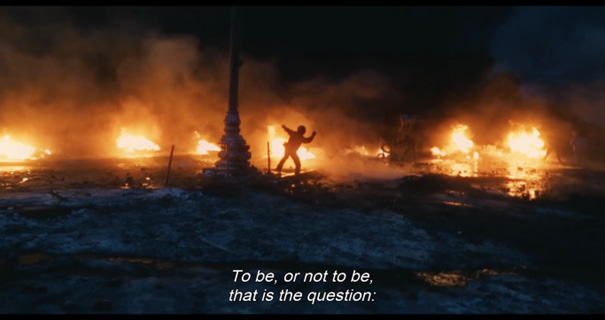
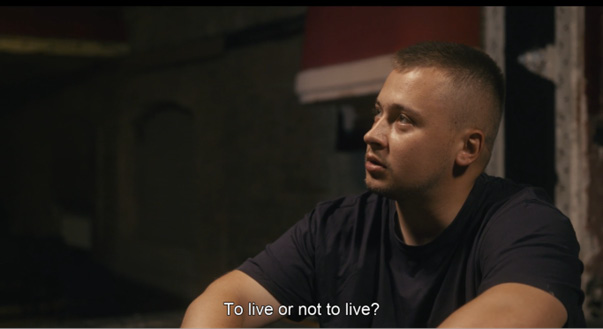
Indeed, for each of the protagonists, Hamlet’s soliloquy means something different. Slavik is a professional soldier fighting on the frontline, for whom Hamlet’s speech recalls the moment when he was captured and tortured by pro-Russian separatists (fig. 2).
Katya volunteered to join the army following her political awakening during the Maidan Revolution. She reminisces about carrying a grenade close to her chest, aware of the fate of captured female soldiers at the hands of the enemy. Roman, a university student, was drafted as a paramedic, unprepared to witness death daily because, as he explains to Katya, growing up in the times of peace did not prepare him to be “a natural born Rambo” (00:24:36) – that other brooding agent of revenge, Hamlet’s twin brother who does not think twice.
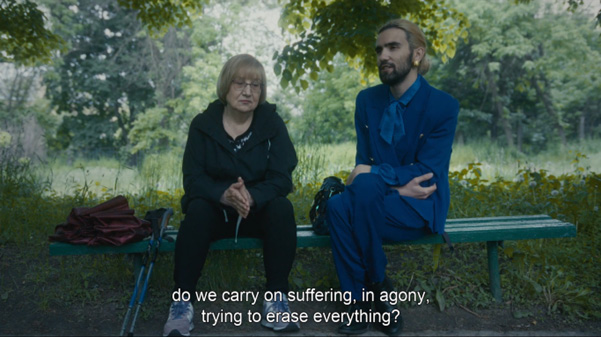
But not all the protagonists are soldiers, as the directors sought that the portrait of the Maidan Revolution is not limited to a military context only. Rodion, a talented stylist from Donbas, is an LGBTQ+ member who has had to fight his own battles, oppressed by his family’s and country’s homophobia (fig. 3). For him, life in Ukraine has never been easy or peaceful.
Finally, there is Oxana, a feminist actress suffocated by her country’s patriarchy, misogyny and oppressive nationalism which surged following the events of 2014. Despite their diverse and unique perspectives, they all share a sense of shattered dreams and hopes for peace, equality, and sovereignty that their Western colleagues take for granted.
If the term “the Hamlet Syndrome” has become a short-hand for procrastination, the film succeeds in de-trivializing that colloquial usage. Indeed, Slavik, Roman, Katya, Rodion, and Oxana face dilemmas of various proportions, such as the extreme situations described above. Yet, the prevailing sentiment that the film leaves the viewer with is that “the Hamlet Syndrome” now also encompasses trauma. Each of them has some deep wounds that need healing. If trauma is characterized by a broken narrative, then preparing the H-Effect and taking part in the documentary gives them a chance to access and verbalize their pain.
With its initial intention of telling the story of the forgotten conflict, the film has become a testament to the strength of the Ukrainian spirit. The reason the documentary resonates so deeply with international audiences is that it speaks to the universally shared dreams of self-determination and dignity. The Hamlet Syndrome offers viewers a glimpse into the complexity of the Ukrainian condition. Drawn towards the West and its ideas of democracy and human rights while at the same time enmeshed by its post-Soviet identity and totalitarian past, the young Maidan generation has borne the brunt of Putin’s imperial project. The bare stage of the Kyiv theatre where the rehearsals for H-Effect unfolded became a safe zone where they were allowed to explore and express their generational trauma. To the directors’ own surprise, the project created a space for healing, with sometimes unexpected results.
Since the outbreak of the full-scale invasion, Niewiera and Rosołowski have continued to show their support for the cast and crew of The Hamlet Syndrome project. Niewiera regularly organizes charity screenings of the film and meetings with its protagonists in Germany and Poland, to address the atrocities of the war, and emphasize the importance of a pan-European solidarity and the urgent need for material support for Ukraine. The proceeds go to Ukrainian paramedics, firefighters, soldiers and civilians. The artist has set up a charity association in Germany, Existentia, which collects money for specialist medical equipment, bullet-proof vests, drones, or sanitary towels for female soldiers. Its activities and the directors’ frequent visits to Kyiv to deliver humanitarian aid are documented on her personal Facebook profile. Her unrelenting dedication to the cause is a testament to the power of art as a political and activist project.[5] It seems that during their filming expedition in Ukraine, Niewiera and Rosołowski temporarily provided their protagonists with a “Shakespeare Shelter”, to quote the title of the present volume. Since the full-scale Russian invasion, they have resumed their project of care and solidarity, and continue to provide help to this day.
For the present article, I discussed The Hamlet Syndrome with Piotr Rosołowski, co-director, co-writer and director of cinematography in the following section. Our interview-framed conversation focuses on the birth of the project, its creative development, reception, and the use of the Hamlet figure.
A Conversation with Piotr Rosołowski[6]
What was the genesis of The Hamlet Syndrome?
We started thinking about it while working on our archival film The Prince and the Dybbuk about the Jewish Polish filmmaker Michał Waszyński. At that time, the Maidan Revolution was taking place in Ukraine and we were following this political turmoil in the media. We felt that something really important was happening that we wanted to document. We usually focus on Eastern European topics in our work. Waszyński lived at the beginning of the 20th century and was faced with Fascism and nationalism in Europe, so this time we decided that our next project should be about the present. We arrived in Kyiv a couple of years later with the idea of portraying the young Maidan generation who started the Revolution.
Early on, we knew we had to find an artistic key to make a movie about these people and this unique moment in Ukraine’s history, just a couple of years after the Revolution, the annexation of Crimea and the beginning of the war in Donbas. In the early stages, we felt that we needed to combine our film about the Ukrainian Maidan generation with a documentary theatre because this type of theatre was born during the Revolution, and many young Ukrainian theatre practitioners took part in it, for example, Nataliia Vorozhbit.[7]
At one point, we found an element which connected these two: it was the figure of Hamlet, which we thought was an archetypal figure of European culture that is understandable and known globally. In it, we found the key to tell our story. Our goal after our second visit to Ukraine in 2017 was to start looking for modern Ukrainian Hamlets.
At what point in your creative process did you decide on Shakespeare’s Hamlet? Did you contemplate any other works as your template?
We didn’t really have to think long and hard about it. Somehow it happened automatically and organically. It was obvious to us that the Hamlet figure fits and links different topics we wanted to explore in our movie, especially the forgotten war in Donbas. Initially, the conflict was a shock for people in the European Union but by the time we started our project in 2017, people had just got used to it. We decided to develop and initiate a theater production which could also be the foundation of our documentary film. Then, the next step was to use this archetypal Hamlet figure to give the topic a larger context and make it more international, understandable and timeless. As many theatre critics say, every generation has its own Hamlet, and I think at that time in Ukraine, it was quite obvious that this was the moment to search for modern Ukrainian Hamlets. At the beginning, we also considered Heiner Müller’s Hamletmachine. Its connection to the political turmoil in Eastern Europe thirty years ago was our source of inspiration. But in the end, we decided to go back to the core, to the classic figure of Hamlet, and I think it worked out well. In the end, the film is about the people and their stories, and the Hamlet figure serves as a kind of key to open up the stories and make them attractive, accessible and understandable for viewers who don’t necessarily follow the political developments and changes in Eastern Europe and Ukraine.
Why did you think Hamlet was the best vehicle through which to communicate and articulate the protagonists’ traumatic experiences?
This role of Hamlet in opening up the stories of the protagonists was easy to see in the film, especially at the beginning, because Hamlet was some kind of a filter which helped our protagonists look at themselves, their stories and the decisions they made. For example, early on, there is a scene with simple exercises that our theatre director, Roza, gives them. She asks if they can remember five different moments in their lives when they had to make a really important decision. At one point, Slavik says: “My dilemma was to live or to die”. He then starts to describe a moment when he was almost ready to commit suicide before going into Russian captivity in a destroyed Donbas airport after the defeat of the Ukrainian army. He was ready to kill himself but then he decided against it. For me, it’s the best example where you can see how he applied this filter of the Shakespearean tragedy to his own fate and turned “To be or not to be” into “to live or to die” as this most famous monologue corresponded with his own monologue at that moment. That’s when we knew that it was the right decision to make this project in one of the Kyiv theatres with Roza Sarkisian and to use Hamlet as an impulse to tell real stories. The Hamlet figure was opening up our protagonists, allowing them to dig into their own experiences and memories with the help of the timeless Shakespearean drama.
How did you choose your protagonists for the project? Can you discuss the casting process? You also cast the director, Roza Sarkisian. Why her?
At the beginning of our work, we met a couple of different Ukrainian documentary theatre directors who were also involved in this political and artistic movement in Ukraine. Through Elwira’s contacts, we knew Joanna Wichowska, a Polish dramaturg who worked a lot in Ukraine and contacted us with this small group of people. That’s how we met Roza. We decided to work with her early on. We understood each other very well. She was also fascinated by the idea of searching for modern Ukrainian Hamlets and using Shakespeare’s drama to make a current documentary theatre production. She also has a very interesting story of her own which was impossible to include in the film. She was a war refugee born in the Nagorno-Karabakh conflict zone in Armenia. She escaped as a child with her family to Kharkiv in Ukraine. I think that’s why in her work she’s always been interested in how war influences people’s lives.
Finding the protagonists was much more difficult and time-consuming. We were not only searching for protagonists for a movie but also for people who could perform on stage. We used our friends’ contacts. Pretty quickly we found Slavik, who wanted to be an actor and was studying in a theatre school in Kharkiv. We also found Oxana, a young actress engaged in critical political documentaries and underground independent theatre. We went to Ukraine six or seven times and met many different people: journalists, activists, a former anticorruption department office worker, and a very young policeman who was part of the riot police during the Maidan Revolution, on the other side of the barricade, but later changed his mind completely, and, of course, many volunteers, veteran organizations and soldiers who served in Donbas. Towards the end, we made an open call on Facebook. That’s how we found Katya. I remember that when she came, we were sure she had to be in our film because her story resonated with the Hamlet story when at one point you turn everything 180 degrees and go in a completely different direction. Katya told us that when the Maidan Revolution started, she was studying international relations in Kyiv. One day, a huge crowd of people was leaving the subway and pushed her in the direction of Maidan, where she stayed and then eventually decided to go to the frontline. During the protests, she read and discussed topics that she was not interested in before. It was the moment of her political awakening. This confrontation with the truth was also something that changed Hamlet’s life.
Was it difficult to find the location for the rehearsals? Why did you chose this particular theatre? Could you comment on the importance of choosing a bare stage?
It was also a long search because we knew it would be the main location of the film and also the theatre performance, so we were looking for a place with the right atmosphere which could house these emotions and this process. After seeing many different stages in Kyiv, we finally decided on the Mala Opera because of the beauty of this place. I still remember when Slavik arrived for the first time in this old partly rundown theatre and said: “Oh, so you chose a place for our rehearsals which has this spirit of our country”. That’s because it was a unique place, built during the time of the last Tsar of Russia, and then during the Soviet times, it was the Culture House for the local transportation workers in Kyiv. When we entered, there was a punk band rehearsing and a go-go dancing lesson, but also, as you put it in your question, there was this bare stage, this empty stage which was very beautiful and simple, and probably not renovated in the last 20 years. We decided to use it even though it lacked technical equipment. But we were prepared for this and I think it was the right decision because there was something special about that location. For the participants of the project, they were opening up in that unique atmosphere. For me, it was also a new experience to be part of the project because Elwira already had experience as a theatre practitioner. She had studied in the “Gardzienice” Theatre[8] in Poland and so she understood all the mechanics of it. But for me, it was my first time working on a stage production.
I also noticed that this simple bare stage was special. The best way to explain it is with the story of Slavik and Rodion. One is an openly LGBTQ+ person from Donetsk, a big city in the eastern part of Ukraine, and the other, Slavik, is quite a straight guy from a conservative family in a western Ukrainian province. Rodion only spoke Russian and was learning Ukrainian and Slavik didn’t speak Russian. But somehow they understood each other very well even though they were so different and came from different places. This relationship was only possible on that stage. We followed Rodion with the camera to the baptism of Slavik’s daughter and could see how Rodion didn’t really fit in that rural part of Ukraine, and that Slavik somehow didn’t have that openness for him. It was different on the stage and in real life because on the stage there was no context. And in normal life, you have all the society and the roles we play. So the friendship between Slavik and Rodin was only possible in that theatre, during that particular performance.
Your characters had undergone therapy before the filming and yet we can see how they still struggle with PTSD. How healing was the process of preparing and staging Hamlet for them? Is it too far-fetched to suggest that the play helps them find a language through which to express their trauma?
Of course, they were all traumatized, especially Roman, Slavik, Katya. Those who served in the army, went through the hell of war or captivity, and also Rodion. The interesting thing is that neither we nor Roza thought about the project as a kind of therapeutic or healing process. We didn’t expect that it could go so deep or have some instant results. We were mainly focused on the artistic challenge of the production. Of course, we were aware that we were working with people who were traumatized. They had different opinions on many topics, different experiences and ways to approach them, so we needed the right balance. But then we also saw, as in the case of Slavik, that it was a kind of a therapeutic process. He came to this project with the idea that it would be healing for him, which we see in the film. One of his psychotherapists told him that his goal was to look at what happened to him at a distance as if you’re watching a movie. It’s a very emotional, touching and dramatic movie but it doesn’t influence your life right now or not in a really strong way. We can see how Slavik develops distance in the film. Afterwards, he even went on to participate in this pretty famous TV show “Voice of Ukraine” where he was singing in the studio and telling his story. So, coming back to the question again, I don’t think that it’s too far-fetched to suggest that they found on the stage the language to express their trauma through Hamlet. I think they tried to find it and in some cases they did.
In your documentary, you made a conscious choice to avoid talking heads and a typical journalistic approach. Could you explain what motivated that artistic decision?
It was obvious from the very beginning that we were not making a journalistic film, a current affairs story. We always try to go deeper and to find some kind of an artistic way to talk about political problems. I think that’s the only way to tell timeless stories which could also be watched and enjoyed in the cinema years after the events. I remember that when we were finishing our film, the full-scale Russian invasion happened and somehow the film portrayed our protagonists in a different Ukraine, in different political circumstances than when we were making the movie. At the time of release, the film had the atmosphere of portraying this generation just shortly before the second act of this big tragedy, the second more brutal part of the Russian invasion of Ukraine. All of our protagonists were touched by this war in one way or another. I’m sure that this film will continue to be watched and discussed in the future. There are still screenings of The Hamlet Syndrome in Poland, Germany and other countries as we speak. I think it shows that the way we chose to make it was right because it’s still relevant even though the moment we portray is already in the past. But the problems we touch on in the film are still present and will continue to be present in Ukrainian society.
Your film is aesthetically beautiful. It feels like a very intimate portrait and a conversation. The camera appears invisible and very close to the protagonists. How did you achieve that level of intimacy and trust with your protagonists?
Maybe the big part of the answer is time because it took us a lot of time to find them. As I mentioned earlier, we initiated this theatrical production, so from the start, we were its artistic core and not observers from outside. Maybe that’s why the camera is invisible because we were part of this project, this group, this concept from the very beginning. We built relationships with them through meetings and time spent together. Here, I must mention Elwira because it was mainly her job to build these relations, to create a really good contact not only with them but also with their parents and friends to then be able to have the trust and be invisible with the camera. That was the key. And, aesthetically, I always wanted to be close to them even when they were trying to remember or perform the most dramatic moments of their lives. I knew that they trusted me and they were ready to be open and share these emotions with the viewers. I think it was unique for us as filmmakers to be so close with them and to participate in this very intense process of rehearsals and then to follow this up shooting intimate scenes with their families.
You completed the shoot before Russia’s full-scale invasion of Ukraine. How does this tragic context affect your view of your film? How does it impact its reception? I know Elwira is involved in organising humanitarian aid for your protagonists.
We finished the film after the full-scale invasion of Ukraine, and it was a difficult moment for us because we were still in contact with our friends, with the protagonists of the film. When it happened, we were all shocked by the scale of the invasion. At the same time, we were at the end of the editing and post-production of the film. We stopped our work and felt confused, wondering how to finish the film, whether we should add something or leave it as it is. In the end, we didn’t change anything because it talks about the outcome of the war, which is still relevant.
The political situation changed dramatically after the 24th of February 2022 and it also changed our perspective. I will speak here on behalf of Elwira, who started to spontaneously organize humanitarian aid for Ukraine. Right now she’s still doing it. She initiated a German association[9] which supports Ukraine and she’s regularly organising charity screenings of The Hamlet Syndrome in Germany and other countries. So it was a documentary film that portrayed real people and told real stories in a real context, but it also influenced the lives of the filmmakers, especially in Elwira’s case.
The reception of the film was also affected by the full-scale invasion. As I mentioned earlier, initially we wanted to make a movie about the forgotten war in Donbas, to show the price that young Ukrainians paid for the revolution and the war. And suddenly, it changed to become a film about a stigmatized generation which went through more than this forgotten war. The viewers’ perspective also changed. Now it was also a film about the victims and veterans of this war who are still fighting. The discussions after screenings for international audiences focused mainly on war trauma, how our protagonists are coping and what we can do to support them.
What we show in the film is only a small part because the war is still ongoing. It’s not just our protagonists, but also many other people we met during our work in Ukraine, theatre directors, sound recording specialists, artists and writers, who are now part of the Ukrainian army. The country is fighting an epic existential fight for Ukraine, and so there is no space for Hamlet’s dilemma. When I think of all the people we know, they have all had to make up their minds about whether to go to war or to leave. It’s impossible now to be neutral or indecisive because the aim of this invasion is to destroy Ukraine as an independent country. So you have to make up your mind if you are going to fight or to support this fight, or if you’re going to leave the country and try to start building your life somewhere else. I can only compare this again to the fate of Hamlet. We are now in the last act of this drama whose end remains uncertain but I still hope that Ukraine will win.
Autorzy
Works Cited
The Hamlet Syndrome. Dir. Elwira Niewiera and Piotr Rosołowski. Poland, Germany, 2022.
Hoenselaars, Ton. “Afterword: Hamlet’s Infinite Space.” The Hamlet Zone: Reworking Hamlet for European Cultures. Ed. Ruth J. Owen. Newcastle Upon Tyne: Cambridge Scholars Publishing, 2012. 197–200.
Kott, Jan. Shakespeare Our Contemporary [trans. Boleslaw Taborski]. New York: Doubleday & Company, 1964.
Makaryk, Irena R. “Introduction: Theatre, War, Memory, and Culture.” Shakespeare and the Second World War: Memory, Culture, Identity. Ed. Irena R. Makaryk and Marissa McHugh. Toronto: University of Toronto Press, 2012. 3–21. https://doi.org/10.3138/9781442698376
Owen, Ruth J. “Introduction: The Hamlet Zone.” The Hamlet Zone: Reworking Hamlet for European Cultures. Ed. Ruth J. Owen. Newcastle Upon Tyne: Cambridge Scholars Publishing, 2012. 1–6.
Rasmus, Agnieszka. Personal interview with Piotr Rosołowski. 19–23 October, 2024.
Sanders, Julie. Adaptation and Appropriation. London: Routledge, 2006. https://doi.org/10.4324/9780203087633
Sokolova, Boika. “Between Religion and Ideology: Some Russian Hamlets of the Twentieth Century.” Shakespeare Survey 54 (2001): 140–151. https://doi.org/10.1017/CCOL0521803411.013
Footnotes
- 1 Elwira Niewiera, director and scriptwriter, has studied theater and German studies at the University of Wrocław, in Poland, ethnology in Berlin, and acting in the Centre for Theatre Practices “Gardzienice”. She is author of well-known and award-winning documentaries made together with Piotr Rosołowski, including The Domino Effect (2014) – winner of the Golden Horn and the Golden Hobby-Horse at KFF 2014, the Golden Dove at DOK Leipzig 2014, and The Prince and the Dybbuk (2017) – winner of the Lion for the best documentary about cinema at the Venice Film Festival 2017 and the Eagle 2019 for the best documentary. She co-wrote and co-directed The Hamlet Syndrome.
- 2 Director, cinematographer, and scriptwriter Piotr Rosołowski has over 30 projects under his belt. He studied cinematography at the Katowice Film School, in Poland. Amongst many of his projects, he is co-author of Rabbit à la Berlin (2009) – a short documentary film which was nominated for an Oscar. He served as director of photography on another Oscar-nominated short fiction film On the Line (2012) by Reto Caffi. He co-wrote and co-directed The Hamlet Syndrome as well as served as its director of photography.
- 3 The documentary received numerous awards at different international festivals, including the main prize at Locarno International Film Festival, Hong Kong International Film Festival, Adelaide Film Festival, Golden Hobby-Horse of Cracow Festival, Special Jury Prize for The Most Original and Innovative Film at Millennium International Documentary Film Festival in Brussels, The Audience Award and Best Documentary Award at Trieste Film Festival.
- 4 All the images are screen grabs publishable under Fair Dealing.
- 5 Such a close involvement with the war effort is not without a personal cost, however, as she has admitted to exertion and mental anguish in interviews. To find out more about her personal involvement in the war effort and its mental challenges, see her interview for Zwierciadło magazine: https://zwierciadlo.pl/spotkania/wywiady/543592,1,elwira-niewiera-ukraina-to-moj-bol-fantomowy.read. Accessed 9 January 2026.
- 6 The personal interview was conducted between 19–23 October 2024.
- 7 Born 1975 in Kyiv, she is a Ukrainian playwright, director, screenwriter and theater curator who represents new Ukrainian drama.
- 8 Set up in 1977, the Centre for Theatre Practices “Gardzienice” is an alternative theatre company located in rural Poland. It is known for its experimental projects and rigorous acting training. Over the years, it has produced internationally successful productions.
- 9 For more information about Existentia see: https://www.existentia-ev.org/. Accessed 9 January 2026.