Affordances and Motivations of Guide Dog Puppy Raisers: Reasons for Starting, Continuing, and Quitting Volunteering
Kamil Pietrowiak*

University of Gdańsk, Poland
Abstract: The article explores the motivations of volunteer guide dog puppy raisers at three key stages of their involvement: beginning volunteering, continuing it, and ceasing the involvement. Drawing on qualitative research conducted with 34 puppy raisers from Poland and Slovakia, the author examines the main internal, external, and organizational factors that shaped their engagement in this form of volunteering. Using the concept of affordances, the study frames volunteering as one of many elements in the participants’ environment – its appeal and availability shaped by their current needs, aspirations, and circumstances. The article demonstrates that combining qualitative methods with the concept of affordances can support both the development of a functional approach to understanding volunteer motivation and the strategic management of affordances by organizations.
Keywords: motivations of volunteers, volunteer career, affordances theory, guide dogs
Afordancje i motywacje opiekunów zastępczych przyszłych psów przewodników: powody rozpoczęcia, kontynuacji i zakończenia wolontariatu
Streszczenie: Artykuł omawia motywacje wolontariuszy, pełniących funkcję opiekunów przyszłych psów przewodników, na trzech kluczowych etapach ich kariery: rozpoczęciu, kontynuacji i zakończeniu działalności wolontaryjnej. Na podstawie badań jakościowych przeprowadzonych wśród 34 wolontariuszy z Polski i Słowacji autor omawia główne czynniki wewnętrzne, zewnętrzne i organizacyjne, które wpływały na ich motywacje do angażowania się w tę działalność. Koncepcja afordancji umożliwiła przedstawienie wolontariatu jako oferty zauważonej przez uczestników badania, której atrakcyjność i dostępność zależały od aktualnej konfiguracji ich potrzeb, aspiracji i możliwości. Artykuł wskazuje, że metody jakościowe w połączeniu z koncepcją afordancji mogą być użyteczne zarówno w rozwijaniu funkcjonalnego podejścia do badania motywacji wolontariuszy, jak i w zarządzaniu ofertami organizacji pozarządowych.
Słowa kluczowe: motywacje wolontariuszy, kariera wolontariusza, teoria afordancji, psy przewodniki
Introduction
Research into volunteer motivation at different stages of involvement is important for several reasons, two of which seem particularly significant. First, since volunteering is by definition an activity undertaken freely and deliberately, without financial compensation and aimed at supporting others, it offers a valuable lens through which to examine human agency, decision-making, and solidarity (Wilson, 2000; Rochester, Paine, Howlett, 2010). Second, understanding what drives volunteers is essential for organizations that depend on their support. Insight into the needs, values, and challenges shaping volunteers’ decisions can improve recruitment strategies and help tailor support that encourages long-term commitment (Clary et al., 1994).
Volunteer motivation has been studied from a range of perspectives. Some research has explored how it relates to structural or demographic factors such as age (Almog-Bar et al., 2022), gender (Wiepking, Einolf, Yang, 2023), nationality or place of residence (Hustinx et al., 2010), social class and habitus (Dean, 2016), or public policy (Dean, 2014). Other studies have focused on volunteers’ conscious choices – namely the needs, values, or interests that guide their engagement (Maki, Snyder, 2017). One such approach is the functional perspective, and in particular the Volunteer Functions Inventory (VFI), a tool designed to categorize and measure the motivations underlying voluntary activity (Clary, Snyder, 1995; Clary et al., 1998).
This article proposes using the concept of affordances as a productive lens for understanding volunteer motivation, drawing on research with guide dog puppy raisers. While the notion of affordances does appear in studies adopting the functional approach, it is often applied in a simplified manner, with limited theoretical elaboration (Clary et al., 1998; Stukas et al., 2009; 2016). More recent publications using this concept focus on the effectiveness of communication methods and tools used to reach the audiences of various organizations (Raja-Yusof et al., 2016; Gray, Murray, Hopkins, 2021). This article, by contrast, sets out to demonstrate that the concept of affordances can help us understand the evolving interplay between volunteers’ needs, intentions, expectations, capabilities, decisions, and experiences – and how these shape what they are able or willing to perceive, as well as what remains inaccessible or unnoticed, within specific volunteering environments.
Literature review
Matching volunteer motivations and organizational offers
According to the functional approach, individuals act in a purposeful, goal-oriented manner, seeking solutions that address their needs and express their values (Clary, Snyder, 1995: 112). While their actions may appear similar on the surface, they are driven by different configurations of motivation, each linked to distinct psychological functions (Clary, Snyder, 1999: 156). The classic Volunteer Functions Inventory (VFI) identifies six core functions underlying the decision to begin or continue volunteering: values, social, career, protective, enhancement, and understanding (Clary, Snyder, 1995; 1999). Owing to its accessibility and broad applicability, the functional approach has been widely used in studies on volunteer motivation (Dwyer et al., 2013; Tsai et al., 2024).
This approach also takes into account a volunteer’s physical and social environment as the context in which decisions and behaviors unfold, highlighting the connection between motivations and the affordances offered by organizations and volunteering itself (Stukas et al., 2016). On this basis, satisfaction and continued engagement are both understood to depend on the alignment between individual motivations and the affordances available within the volunteer setting.
The Total Match Index (Stukas et al., 2009) builds on this idea, proposing that the greater the match between volunteers’ motivations and organizational offerings, the higher the satisfaction and commitment. Related studies have underscored the importance of alignment between volunteers’ and organizations’ values (Ihm, Baek, 2021), between individual interests and assigned tasks (Maki, Snyder, 2017), as well as between personal meaning or a sense of calling and the organization’s goals (Faletehan et al., 2021).
The functional approach and the matching principle also account for the dynamic nature of motivation and organizational offers over the course of volunteering, shaped by a variety of factors. One framework for analyzing this process is the Volunteer Process Model, which identifies three sequential and interrelated stages of involvement: antecedents, experiences, and consequences (Snyder, Omoto, 2008). These stages can be explored across individual, interpersonal, organizational, and systemic levels (Wilson, 2012; Qu et al., 2024). The processual nature of the volunteering career is also highlighted by Waldemar Dymarczyk (2023), who, based on an analysis of narrative biographical interviews, identifies its three main stages: preparation, institutionalization, and professionalization.
The concept of affordances
The concept of affordances was developed by James Gibson, who defined it as follows: “The affordances of the environment are what it offers the animal, what it provides or furnishes, either for good or ill” (Gibson, 2015: 119). In his theory, affordances are properties of the environment that arise in relation to a perceiving subject, depending on that subject’s perceptual and motor capabilities (Gibson, 2015: 130).
The idea has since been extended by psychologists, cognitive scientists, philosophers, and anthropologists. Edward S. Reed (1996) emphasized the communal and reciprocal dimension of affordances – largely absent from Gibson’s original work – which underpins social interaction. Through socialization, people come to understand that the affordances they perceive are also available to others, and that others may perceive and act on different affordances within the same environment.
Some scholars have used the concept to illustrate the inseparability of perception and action as well as the mutual shaping of subject and environment. Tim Ingold (1992; 2000) argued that perceiving affordances and acting on them according to one’s needs and abilities is simultaneously the cause and effect of one’s activity. In this view, the relationship between a person and the environment unfolds through continuous exploration and experimentation with what is offered by objects, events, and other living beings. Similarly, Maxwell J.D. Ramstead, Samuel P.L. Veissière, and Laurence J. Kirmayer (2016) pointed to the role of prediction and expectation – and their constant revision – in shaping how people engage with their surroundings. Perception and involvement develop through a dialectical rhythm of success and failure as well as satisfaction and frustration, which builds experience and guides future action.
A different perspective is offered by Jelle Bruineberg, Anthony Chemero, and Erik Rietveld (2019: 5234), who suggest distinguishing between general affordances and more specific “invitations” or “solicitations,” defined as “[…] attracting affordances [that] involve an experienced tension of something that stands out to be done.” A related distinction comes from Ludger Van Dijk and Erik Rietveld (2017), who introduced the concepts of a “landscape of affordances” – the full range of possible environmental offerings available to an organism with particular perceptual and action capacities – and a “field of relevant affordances,” referring to those that are especially salient given a person’s current needs and capabilities in a specific context. They also underscored the value of ethnography as a method for grounding the concept of affordances in lived experience – situated in time and place, and shaped by concrete environmental offerings, whether inviting or discouraging.
The role of volunteer guide dog puppy raisers
Guide dogs offer vital support to visually impaired individuals by increasing their sense of safety, independence, and agency, while also providing emotional reassurance in daily life (Sanders, 2000; Śmiechowska-Petrovskij, 2017). Preparing a dog for such a role requires more than specialized training; early socialization and foundational learning during the first year are equally essential. In many assistance dog organizations, this responsibility is entrusted to puppy raisers (PRs), also referred to as puppy walkers or foster families (Mai et al., 2021).
Puppy raisers are volunteers who care for and train future guide dogs over a period of 11–14 months, usually beginning when the puppies are around eight weeks old. They ensure the dogs’ well-being, addressing both physiological and emotional needs. Their role includes instilling appropriate behavior, teaching basic obedience, and introducing the puppy to diverse environments to prevent fear-based or aggressive reactions (Morwood et al., 2023).
These volunteers play a key role in supporting guide dog organizations by easing the workload of staff, reducing training costs, and enabling more dogs to be trained simultaneously. They also provide valuable insights into each dog’s health, temperament, and behavioral challenges, allowing for timely interventions when needed (Batt et al., 2009).
Puppy raising exists at the intersection of two forms of volunteering, namely it supports both non-human animals and humans (Maki, Snyder, 2017). On the one hand, it shares features with shelter-based animal volunteering, such as regular interaction or temporary in-home care (Guenther, 2017; Jacobs, 2017). However, unlike rescuing or rehoming abandoned animals, the aim here is to prepare a dog for a specialized working role and ensure its welfare. On the other hand, PRs indirectly support visually impaired people by fostering the future partnership that will enable greater autonomy. Unlike direct support for people with impairments, this contribution is mediated through the animal and may be less visible or measurable (Janus, Misiorek, 2019; Lukovenko et al., 2021; Chrostowska, 2022).
Volunteers’ affordances and motivations – research questions
The concept of affordances provides a useful lens for examining the motivations of individuals who engage in this specific form of volunteering. It supports the formulation of the following research questions:
RQ1: What specific affordances of puppy raising are perceived and experienced as inviting by individuals who decide to begin volunteering?
RQ2: Which affordances remain noticeable and motivating for individuals who continue volunteering as puppy raisers?
RQ3: What changes in the perception or availability of affordances contribute to the decision to discontinue volunteering as a puppy raiser?
These questions form the basis for interpreting the variability and trajectory of motivations among volunteers who have taken on the role of puppy raisers in organizations that train guide dogs for people with visual impairments.
Research methods
The experience of volunteer puppy raisers was one of the main themes within a broader research project conducted between 2021 and 2024. The project explored the process of training and living with guide dogs from the perspectives of multiple human actors: trainers, NGOs, volunteers, clients/handlers. Equally important was the observation of the dogs’ behavior as well as the collection and analysis of human participants’ beliefs regarding their agency, needs, and motivations. The project was carried out in collaboration with three guide dog training schools in Poland and two in Slovakia.
As part of the study, 28 interviews were conducted with 34 current and former puppy raisers. Six of these interviews involved two participants – either couples or family members jointly caring for a dog. On average, such an interview lasted 119 minutes. Selected participant excerpts are presented in the main text, while additional quotes related to volunteer motivation have been compiled in the project repository (Appendix 2). The Findings section contains references to specific parts of that file.
The participants were recruited with support from the partner organizations, with efforts made to ensure diversity in gender, age, dog experience, and puppy-raising background. At the time of the study, 19 participants were current or former puppy raisers with at least 10 months of hands-on experience. Seven were applicant trainees (APs) beginning their training to become guide dog trainers, one was a trainer (TR), and another one was both an organization manager (ORG) and a trainer for puppy raisers. More information about individual participants is provided in Appendix 1 of the project repository.
All the participants gave written consent to take part in the study. All quoted statements from the participants have been anonymized – names of people and dogs, as well as the names of towns, streets, and other identifying details, have been omitted. Visual materials presented in the project repository do not show the participants’ faces. One of the project’s ethical commitments was to share early drafts of academic outputs with the participants and invite their feedback. This approach was inspired by collaborative ethnography (Lassiter, 2005), which encourages participant involvement at various stages of the research process. The invitation to comment on draft texts was not intended as a means of “approving” the findings or altering the conclusions, but, rather, offered an opportunity to juxtapose – rather than merge – our perspectives, in a manner more in line with the anthropological concept of dialog (Field, 2008). Submitted comments were collected in Appendix 3 and archived in the project repository.
The interviews were recorded, transcribed, and thematically coded using the MAXQDA software. The first stage of coding followed an inductive approach, aiming to identify elements that shaped the volunteers’ experiences (Gibbs, 2007). In the second stage, selected codes were interpreted through the lens of the concept of affordances. Importantly, this concept was not pre-imposed but emerged from the data – particularly from the participants’ descriptions of puppy raising as an “opportunity,” “chance,” or “unexpected offer”. Accordingly, its application resulted from an iterative process shaped by the interplay between field material and theoretical insight (Winkin, 2007).
Viewing the data through the lens of the concept of affordances made it possible to group and interpret selected codes as internal, external, or organizational factors that either enabled or constrained action of volunteers. This led to the identification of key dynamics in volunteer trajectories across three phases: initiation (the recognition and exploration of an affordance), continuation (the positive confirmation and/or discovery of new affordances), and resignation (the negative confirmation, inaccessibility, or disappearance of the affordance). The analytical process is illustrated in Figure 1.
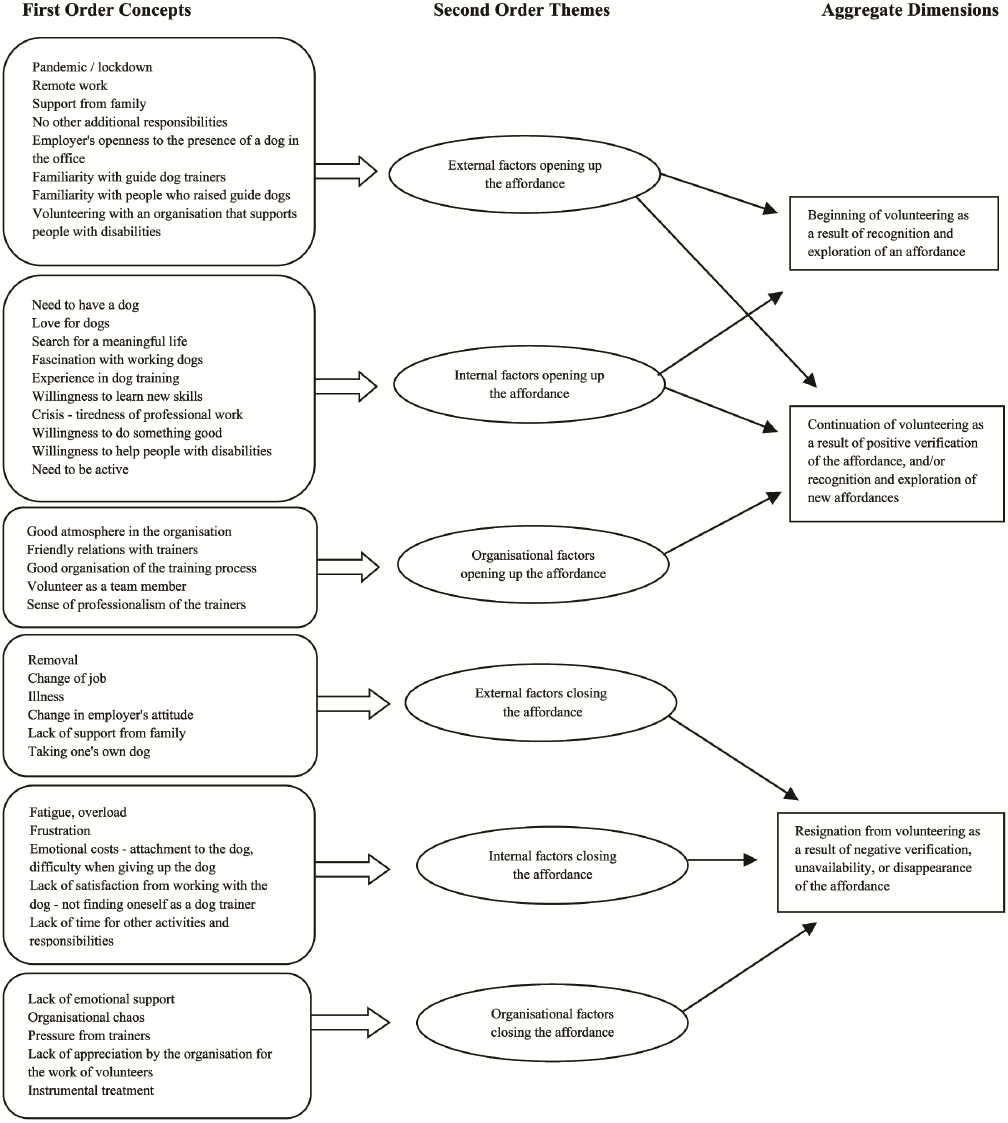
Source: figure created by the author.
Findings
Motivation to start as a volunteer puppy raiser
The participants had learned about volunteering opportunities with guide dog training organizations in various ways – most commonly through advertisements on social media, radio, or in print (22 participants). Eight participants had long been aware of the possibility of raising a future guide dog due to a prior interest in service dogs. Four interviewees knew someone who had been a puppy raiser, and that person became their first source of information – and sometimes inspiration.
The decision to contact a guide dog school and apply as a puppy raiser was usually tied to the participants’ own needs, aspirations, or personal and professional circumstances. Although their motivations varied in intensity and combination, most were able to identify what had primarily driven their decision to volunteer. Several recurring motivations emerged, reflecting different volunteer profiles.
For 15 participants, the main motivation was the desire to have a dog – something they could not fully commit to due to concerns about long-term responsibility, uncertainty about their readiness, health issues, limited housing conditions, or the lack of time. For them, volunteering appeared as a surprising and appealing opportunity to temporarily care for a dog and test whether they were ready for full-time ownership.
This motivation took two distinct forms. The first one – “a dog for me” – was typical of people living alone or younger individuals still living with their parents and dependent on their decisions (Appendix 2: 1a):
PR14: I always liked dogs. But I know that a dog is a very big responsibility, and I am in this situation that I live alone. Taking a puppy from the foundation was a matter of checking myself out, whether I could handle it. Because this is only for a year, a year and a half. And it was a bit of a test.
The second version – “a dog for us,” “for the family,” or “for the children” – was about sharing the experience. Raising a puppy together was seen as a way to create a pleasant family atmosphere, face a challenge as a group, and teach children about the responsibilities of having a dog at home (Appendix 2: 1b):
PR13b: Having a year with the dog was very attractive for us, because we wouldn’t have this responsibility for life, but would see for ourselves what it would be like. For us it was a test, we tested how as partners, we would cope with looking after an animal.
A common primary motivation (7 interviewees) was the desire to gain or develop knowledge and skills in dog training. This applied both to those with little or no previous experience and to more experienced individuals, including those who had trained their own dogs. For some, this interest was linked to aspirations of becoming professional dog trainers (Appendix 2: 1c):
R1: I already had enough knowledge and wanted to test it and try getting a puppy. […] As for the idea of raising a guide dog, let’s say 80% of my motivation was to take a dog and test what I can do, learn more about working dogs, not just doing dog sports.
For another seven participants, volunteering was closely tied to a life or career crisis and a need to redefine their lives or find a new meaning. In four cases, this involved a desire to reconnect with a long-abandoned passion for dogs – often one they had set aside in youth due to family or practical obligations (Appendix 2: 1d):
PR6: I got caught up in corporate life and my passion for animals diminished. But after a while it came back in a way that I just felt unhappy. And I went back to my roots to get to know myself. And the first thought was dogs.
Four participants viewed volunteering primarily as a way to do something meaningful beyond the boundaries of family life – something “for others” or “for the world.” Unlike those reigniting a personal passion, their focus was clearly on the needs of others as the source of a meaning (Appendix 2: 1e):
PR5: I assumed it would be something good, because it improved someone’s life and functioning. It’s a bit like that, I don’t like to just help, I prefer it to be focused. I can’t change the whole world, but I can change the whole world for one person.
Two participants began puppy raising because they personally knew people with visual impairments. One had volunteered as an assistant to blind individuals, while the other worked for an organization supporting blind and partially sighted people. While their love of dogs also mattered, both emphasized the importance of witnessing the impact that assistance dogs had on people’s lives. Additionally, one interviewee with no prior connection to visually impaired people stated that helping them was the primary – or even sole – motivation, which made their case an exception (Appendix 2: 1f).
Helping a visually impaired person – or, more broadly, helping others – was mentioned by 19 interviewees. However, it was rarely mentioned as the primary or sole reason. More often, it appeared as one of several motivations, sometimes introduced later in the interview to highlight the meaning of the activity or to balance more self-focused reasons (Appendix 2: 1g).
Finally, for four participants, the COVID-19 pandemic and lockdown was the key factor in their decision to start volunteering. The shift to remote work drastically changed their routines and unexpectedly made puppy raising seem possible and manageable (Appendix 2: 1h).
Motivation to continue as a volunteer puppy raiser
Out of the 34 interviewees, 20 chose to continue volunteering after handing over their first puppy. During the study period, 9 participants had experienced raising a second puppy, while 11 had fostered more than two. The main reason for continuing, shared by all the participants, was the satisfaction and joy of daily interaction with a dog, complemented by the rewarding experience of observing the training progress (Appendix 2: 2a). For eight interviewees, the dog’s constant presence was also valuable, especially when accompanying them to work or public places where “regular” dogs are usually not allowed (Appendix 2: 2b).
PR19b: That first experience wasn’t so bad, either at work or at home. Besides, you were training this dog for the sake of someone’s better future.
PR19a: Yes, that was important. But mostly, it was the thought that this dog would be with me all the time and that I would learn something. It was a bit selfish, that reason.
In 12 interviews, the participants expressed a wish to take on a new challenge and further develop their skills as dog trainers. This motivation was especially common among those aiming for professional or semi-professional involvement in dog training, including work with assistance dogs (Appendix 2: 2c). Three interviewees described training as a welcome break from work and routine – something active, engaging, and mentally refreshing (Appendix 2: 2d).
For four volunteers, the emotional aspect was crucial: continuing helped them cope with the grief, sadness, and emptiness following the departure of their first puppy (Appendix 2: 2e).
PR4a: It was a straightforward decision because [partner’s name – K.P.] already knew he would be going to the office, so I would be sitting on my own, working remotely, without a dog, and just some dog hair from [first puppy’s name – K.P.]. So we decided that we needed to mend our hearts by taking in another dog, straight away.
The friendly, understanding atmosphere, especially the sense of being seen and supported by trainers, also strengthened motivation. Some participants described feeling like partners in the process – acknowledged, agentive, and valued. This included help with training, veterinary care, and arranging substitute foster care during holidays or emergencies – contrasting sharply with the full responsibility of owning a dog (Appendix 2: 2f).
PR11: We decided not to get our own dog because we are aware that it is a very big responsibility. It is a decision you take for several years. But here, it is for a year and then you can take a break. This is where the foundation helps a lot, because when you want to go somewhere, they help to arrange care.
For five interviewees, meeting visually impaired guide dog handlers further reinforced their commitment. Sometimes, this was a meeting with the person who received the dog they had raised; in other cases, it involved observing handlers with other dogs. These encounters helped them understand their personal role and contribution to the guide dog training process (Appendix 2: 2g).
PR18: I was able to see people working with dogs and see exactly what these dogs can do. That’s when I felt I was doing a great job. I realised that this was also partly the outcome of my own work, of caring, struggling, trying. I felt that I was part of this big puzzle. When you see that with your own eyes, it completely changes your perspective. You realize that these people need these dogs more than I do.
Unlike the decision to start volunteering, the decision to continue was typically more complex – rooted in a combination of emotions, values, and evolving needs (Appendix 2: 2h). Among the most experienced volunteers, these motivations appeared to intertwine and reinforce one another over time, making it difficult to single out a dominant reason for continuing.
Giving up volunteering as a puppy raiser
Out of the 34 participants, 19 decided to resign from or suspend their roles as volunteer puppy raisers, with 16 of them doing so after raising the first puppy. This group includes those who, during the study period, were in the process of handing over the dog and chose not to take on another one, as well as individuals who had already ended or paused their involvement earlier. Eight of these 19 participants expressed an intention to remain involved as dog sitters. The category of “discontinuing volunteering” does not include individuals who, during the course of their involvement, transitioned into other roles within the organization – such as staff members or trainers – as in some cases they continued to raise puppies on a voluntary basis.
The decision to step down was shaped by a range of overlapping factors. For 8 interviewees, the most common reason was fatigue resulting from the time-consuming and labor-intensive nature of dog care, which came as a surprise to some first-time volunteers. Others found it difficult to balance the responsibilities of puppy raising with their obligations at home or at work. Feelings of being overwhelmed were particularly common among those caring for a dog on their own (Appendix 2: 3a).
PR14: It takes a lot of time and a lot of work. In the long run, it would be hard to continue doing this on my own. That is also a factor why I choose not to host a second dog right now. Looking back, the cost was too high.
Similar feelings were reported by those participants who had hoped to raise a dog as a family, but found themselves handling most of the care and training alone. In such cases, the decision to resign reflected a negative or disappointing outcome of this “family test” of life with a dog.
Two families who succeeded in sharing puppy care chose to resign after deciding they were ready to adopt a dog of their own. They preferred building a lasting bond over facing repeated handovers, which volunteering required. In both cases, the emotional difficulty of saying goodbye and the desire for a stable, long-term relationship were central (Appendix 2: 3b).
PR4b: From my point of view, raising a puppy is hard work. And once you’ve got the reward of all that hard work, by the end of the year you’ve got a nice, well-trained dog, and then you have to hand her over. And you get another puppy that has to be trained from scratch. […] It was all-consuming and we have other life goals too, we’d like to focus on other things.
A slightly different set of motivations was behind the decision of three participants who accepted the organization’s offer to adopt the puppies they had been raising, after the dogs were excluded from further training for health or behavioral reasons. These individuals did not see it as logistically feasible to adopt a dog while also committing to full-time puppy raising. Nevertheless, they expressed a willingness to support the organization in other ways – such as promotional activities or weekend volunteering.
Other changes in personal circumstances also played a crucial role in the decision to refrain from taking on another puppy. Seven participants who enjoyed the experience and were willing to continue ultimately found it unfeasible due to family, health, or work-related reasons (Appendix 2: 3c).
PR18: Right now, due to personal circumstances, I don’t have a new puppy. I don’t know how things are going to work out within my family this year, so I decided that I wouldn’t be able to give as much as I would like. […] I know that my husband doesn’t want to get into it again. The last dog was difficult and a bit too much for him. I think he’s afraid the next one would be the same. I think the next step is choosing: the dog or the husband [laughs].
In five cases, resignation or suspension was partly driven by dissatisfaction with the organization. Reported issues included poor communication, the lack of clarity regarding volunteer responsibilities, disorganization, mismatched expectations, and a sense of being unappreciated or treated as merely functional (Appendix 2: 3d).
PR14: There is also the aspect of working with the organization that I don’t rate as so good. I think it should be better organized. You asked if I felt appreciated. I didn’t. And you dedicate a great deal of your time to the organization. They get a lot out of it. And maybe these volunteers should be better looked after, so that they want to come back, do it again, to avoid this kind of disappointment.
Notably, five other participants who voiced similar frustrations chose to continue, motivated by a strong sense of purpose and personal satisfaction. Over time, some transitioned to working with other assistance dog organizations.
Discussion
The research findings identified internal, external, and organizational factors that either “opened” or “closed” affordances perceived by volunteers involved in puppy raising for guide dog schools. These factors either motivated action or hindered involvement. Internal factors primarily concerned volunteers’ emotions and needs as well as their attitudes, experience, and skills. External factors were partly beyond their control and related to their current life, work, or family circumstances. Organizational factors stemmed from the relationship between volunteers and the organization, including communication and management practices.
The collected data made it possible to address the research questions (RQ1, RQ2, RQ3). The first step toward becoming a puppy raiser (RQ1) often involved “accidentally” encountering an advertisement for the opportunity. The quotation marks reflect the algorithm-driven nature of social media platforms, where such ads tend to reach users already open to particular affordances (e.g., dog lovers) (see Lee, Hosanagar, Nair, 2018).
Regardless of the source, for most participants the information resonated with conscious or unspoken dreams and needs, and appeared unexpectedly appealing. A smaller number had known about the opportunity beforehand but had neither the time nor the motivation to engage. In their case, the impulse to act arose not simply from noticing the affordance, but from a shift in circumstances that made it more appealing and attainable.
For some, the COVID-19 lockdown and remote work created favourable conditions for volunteering. These changes supported puppy raising in two ways: by freeing up time for and attention to the dog, and by turning the dog into a practical means of navigating mobility restrictions – effectively serving as a legal pass during lockdown. This form of affordance reveals a distinct motivational pattern among puppy raisers, differing from other types of volunteers, whose pandemic experiences were more often framed by altruism, social justice concerns (Kulik, 2021), or the loss of direct contact with beneficiaries (Yates, Difrancesco, 2022).
The vast majority of the participants chose to begin volunteering because they saw it as an opportunity “for me,” responding to personal needs, dreams, or aspirations. For some, the chance to host a dog in a safe, structured setting felt like an appealing test. In these cases, the affordance did not respond to a clearly defined desire to own a dog but opened up a new possibility – to prove oneself as a dog carer. Those with a strong desire to live with a dog considered puppy raising alongside alternatives such as adopting a pet or volunteering at a shelter, but ultimately saw it as the safest option (Van Dijk, Rietveld, 2017). For experienced dog owners, the role offered an opportunity to expand their training skills while contributing to a broader social goal.
Across different motivational configurations, all the participants mentioned helping others as a relevant factor in their decision. It was central for those who viewed volunteering as a way to “do good” or to bring meaning to lives not fully fulfilled by professional work. However, in most cases, the desire to help appeared more as a supporting theme – important, but not the primary trigger for engaging in the activity.
While the decision to begin volunteering as a puppy raiser was based on personal assumptions and expectations, the decision to raise another dog typically followed a positive verification of one’s needs, emotions, and abilities – one grounded in the actual experience of dog care and organizational demands (RQ2). This decision did not always reflect a simple alignment between initial motivations and received benefits. For instance, in the case of the “test drive” approach to dog ownership, one might expect that those who passed this test would adopt their own dog and end their involvement, while those left unsatisfied would abandon both volunteering and the idea of dog ownership altogether.
In practice, however, some individuals who began with this motivation unexpectedly discovered new affordances within the volunteering experience. These additional benefits encouraged them to stay involved. A common example was the enjoyment of emotional connection with the dog – typical of human–dog relationships (Horowitz, 2019) – without the long-term responsibility and emotional burden associated with dog ownership.
Others who began volunteering to “find meaning” or help others later discovered a talent for dog training or formed strong personal ties within the organization – factors that became central to their continued engagement. Regardless of the specific configuration of affordances, the experiences of long-term volunteers lend support to the Total Match Index, which suggests that satisfaction and sustained involvement increase with the number of matches between individual needs and organizational opportunities (Stukas et al., 2009).
In nine cases, volunteering unexpectedly evolved into a multi-year path that opened the possibility of pursuing a new career as a guide dog trainer. This affordance of puppy raising often did not stem from prior plans or clearly defined goals but emerged through direct involvement, as volunteers acquired new knowledge, developed skills, and discovered hidden aptitudes (Ingold, 2000). A key turning point in this process was also the shift from “a puppy raiser volunteer” to “a trainer volunteer,” which strengthened role identity and deepened the sense of connection with the organization (Chacón, Vecina, Dávila, 2007).
Alongside internal and organizational elements, certain external factors also supported continued involvement. These included family support, flexible work arrangements, and employers’ openness to dogs in the workplace. Sharing dog care within the household helped integrate volunteering into daily life. Likewise, aligning professional and volunteer roles made the experience more predictable and less stressful (Chur-Hansen et al., 2014: 8). Such conditions made the affordances of volunteering more accessible and appealing (Bruineberg, Chemero, Rietveld, 2019).
More experienced puppy raisers gradually became aware of their role’s broader significance within the guide dog training process. This often shifted motivation toward more altruistic aims, redirecting attention from immediate satisfaction to the long-term goal of improving the lives of visually impaired individuals (Nowakowska, 2024). In some cases, this shift was prompted by meeting a visually impaired handler working with a guide dog. Such encounters enabled volunteers to step outside their own perspective and recognize the affordances and benefits perceived by others in the process (Reed, 1988).
This kind of shift could be observed across three dimensions. First, they began to recognize the needs of the visually impaired person, who – through their work – had the chance to receive a well-mannered dog. Second, experienced volunteers expressed a greater sense of responsibility for the well-being of the dogs themselves. In this context, preparing puppies for the next stage of their job was expected to help the dogs become more comfortable in their role as guides. Finally, if the volunteers felt understood and appreciated by other actors, they gradually saw their involvement as part of the teamwork and support offered within the organization (Dwyer et al., 2013).
Within the adopted theoretical framework, stepping away from volunteering is understood as the result of a negative verification or the disappearance of an initially perceived affordance (RQ3). Resignation could stem from a combination of disappointments and mismatches between expectations and experience, or from a change in a single but decisive factor that made continued participation difficult or impossible (Allen, Mueller, 2013).
In the first scenario, resignation was primarily driven by internal and organizational factors – such as fatigue, frustration, the lack of family support, and a perceived lack of appreciation from the organization – mirroring findings from other studies on puppy raisers (Chur-Hansen et al., 2014; DeWitt, 2020; Morwood et al., 2023). In such cases, although the affordance of raising another dog remained perceptible, it lost its appeal as an invitation to act (Bruineberg, Chemero, Rietveld, 2019). In the second scenario, resignation was unrelated to satisfaction, arising instead from life changes such as professional, family, or health-related circumstances.
These findings offer a basis for broader reflection on volunteer motivation. They suggest that satisfaction and continued engagement do not necessarily result from a straightforward match between motivations and affordances (Stukas et al., 2009). Rather, volunteers often revise their initial expectations and come to identify new affordances linked to their role, which gain significance over time. In this sense, affordances within the volunteering environment not only correspond to existing motivations but may also generate new ones that support long-term involvement.
Finally, the study draws attention to the role of specific external factors in the decision to end volunteering – factors that have often been overlooked or dismissed as mere “excuses” (Wilson, Musick, 1999: 247; Rochester, Paine, Howlett, 2010: 138–139). For some participants, the decision to resign was not driven by dissatisfaction or a lack of will, but by changes in life circumstances that made further involvement unfeasible, despite the continued appeal of the activity (see Dwyer et al., 2013: 198). This points to the importance of recognizing the interplay between the desire to continue, the possibility of continuing, and the actual continuation of volunteering. It also highlights the need to address external barriers that may hinder sustained participation, regardless of individual motivation or satisfaction.
Conclusion
The findings highlight the complex set of factors shaping both the initial and sustained motivations of guide dog puppy raisers. The concept of affordances allowed these decisions to be understood within the broader context of individuals’ environments, positioning volunteering as one among many possible opportunities – more or less visible, attractive, or accessible depending on the person’s current configuration of needs and circumstances. This perspective offers a valuable complement to functional approaches to volunteer motivation, particularly as a theoretical lens for qualitative research into specific forms of volunteering.
Organizational implications
This research may prove valuable for organizations that rely on volunteer support, particularly assistance dog training schools. The findings indicate that the motivations behind starting to volunteer often differ significantly from those that sustain ongoing involvement. This highlights the importance of tailoring support, communication, and incentives to the specific stages of volunteers’ engagement.
Secondly, while internal organizational factors alone may not guarantee long-term commitment, they clearly strengthen volunteers’ willingness to stay involved – especially when personal benefits are accompanied by social and community-oriented experiences.
Thirdly, the study draws attention to the significant role of external circumstances, which may hinder or prevent continued volunteering even when the participants are satisfied and their needs have been met. Maintaining connections with former volunteers may therefore be beneficial, enabling their return when life circumstances shift once again.
Limitations
Certain limitations of the presented study must be acknowledged. This article does not examine how recruitment and communication practices influence the decision to volunteer. Addressing this would require including individuals who withdrew before raising a puppy – often due to dissatisfaction with initial contact or training. In order to gain a more comprehensive understanding, future research should also consider the perspectives of these ‘would-be’ volunteers. Another area worth exploring is the nature of the opportunities and benefits offered directly by organizations, and how these are perceived by both current and prospective volunteers.
Acknowledgements
I wish to thank all the study participants – puppy raisers and NGO members – for their openness and willingness to collaborate and share knowledge and experience. I am thankful to all the organizations that allowed me to accompany them during training and other activities in Poland (‘Fundacja na rzecz Osób Niewidomych Labrador – Pies Przewodnik’, ‘Fundacja VIS MAIOR’, ‘Fundacja Pies Przewodnik’, ‘Jerzy Przewięda Szkolenie i Tresura Psów’) and in Slovakia (‘Psi na život’, ‘Výcviková škola pre vodiace a asistenčné psy’).
Supplementary materials
The supplementary materials are available in the project repository: https://repod.icm.edu.pl/dataset.xhtml?persistentId=doi:10.18150/VQFHPV
Autorzy
* Kamil Pietrowiak
Cytowanie
Kamil Pietrowiak (2026), Affordances and Motivations of Guide Dog Puppy Raisers: Reasons for Starting, Continuing, and Quitting Volunteering, „Przegląd Socjologii Jakościowej”, t. XXII, nr 1, s. 6–27, https://doi.org/10.18778/1733-8069.22.1.01
References
Allen Joseph A., Mueller Stephanie L. (2013), The Revolving Door: A Closer Look at Major Factors in Volunteers’ Intention To Quit, “Journal of Community Psychology”, vol. 41(2), pp. 139–155, https://doi.org/10.1002/jcop.21519
Almog-Bar Michal, Ashkenazi-Anor Mayrav, Hersberger-Langloh Sophie E., Compion Sara, Butcher Jacqueline (2022), Age Is But a Number? An Exploration of Age Differences in Episodic Volunteering, “VOLUNTAS: International Journal of Voluntary and Nonprofit Organizations”, vol. 33(3), pp. 483–496, https://doi.org/10.1007/s11266-022-00491-6
Batt Lara, Batt Marjolyn, Baguley John, McGreevy Paul (2009), The Value of Puppy Raisers’ Assessments of Potential Guide Dogs’ Behavioral Tendencies and Ability to Graduate, “Anthrozoös”, vol. 22(1), pp. 71–76, https://doi.org/10.2752/175303708X390482
Bruineberg Jelle, Chemero Anthony, Rietveld Erik (2019), General ecological information supports engagement with affordances for “higher” cognition, “Synthese”, vol. 196(12), pp. 5231–5251, https://doi.org/10.1007/s11229-018-1716-9
Chacón Fernando, Vecina María Luisa, Dávila María Celeste (2007), The Three-Stage Model of Volunteers’ Duration of Service, “Social Behavior and Personality: An International Journal”, vol. 35(5), pp. 627–642, https://doi.org/10.2224/sbp.2007.35.5.627
Chrostowska Bożena (2022), Wolontariat koleżeński jako forma wsparcia psychospołecznego osób w spektrum autyzmu – przykład programu wolontariat koleżeński „Mary i Max”, “Studia Pedagogiczne. Problemy Społeczne, Edukacyjne i Artystyczne”, vol. 40, pp. 93–110.
Chur-Hansen Anna, Werner Lucy-Kate, McGuiness Clare, Hazel Susan (2014), The Experience of Being a Guide Dog Puppy Raiser Volunteer: A Longitudinal Qualitative Collective Case Study, “Animals”, vol. 5(1), pp. 1–12, https://doi.org/10.3390/ani5010001
Clary E. Gil, Snyder Mark (1995), Motivations for volunteering and giving: A functional approach, “New Directions for Philanthropic Fundraising”, vol. 8, pp. 111–123, https://doi.org/10.1002/pf.41219950809
Clary E. Gil, Snyder Mark (1999), The Motivations to Volunteer: Theoretical and Practical Considerations, “Current Directions in Psychological Science”, vol. 8(5), pp. 156–159, https://doi.org/10.1111/1467-8721.00037
Clary E. Gil, Snyder Mark, Ridge Robert D., Copeland John, Stukas Arthur A., Haugen Julie, Miene Peter (1998), Understanding and assessing the motivations of volunteers: A functional approach, “Journal of Personality and Social Psychology”, vol. 74(6), pp. 1516–1530, https://doi.org/10.1037/0022-3514.74.6.1516
Clary E. Gil, Snyder Mark, Ridge Robert D., Miene Peter K., Haugen Julie A. (1994), Matching Messages to Motives in Persuasion: A Functional Approach to Promoting Volunteerism, “Journal of Applied Social Psychology”, vol. 24(13), pp. 1129–1146, https://doi.org/10.1111/j.1559-1816.1994.tb01548.x
Dean Jon (2014), How structural factors promote instrumental motivations within youth volunteering: a qualitative analysis of volunteer brokerage, “Voluntary Sector Review”, vol. 5(2), pp. 231–247, https://doi.org/10.1332/204080514X14013591527611
Dean Jon (2016), Class Diversity and Youth Volunteering in the United Kingdom: Applying Bourdieu’s Habitus and Cultural Capital, “Nonprofit and Voluntary Sector Quarterly”, vol. 45(1), pp. 95–113, https://doi.org/10.1177/0899764015597781
DeWitt Amy L. (2020), Returning a Puppy for Dog Guide Training: Factors That Affect Grief in Puppy Raisers and the Decision to Foster Again, “Journal of Visual Impairment & Blindness”, vol. 114(4), pp. 289–300, https://doi.org/10.1177/0145482X20941324
Dwyer Patrick C., Bono Joyce E., Snyder Mark, Nov Oded, Berson Yair (2013), Sources of Volunteer Motivation: Transformational Leadership and Personal Motives Influence Volunteer Outcomes, “Nonprofit Management and Leadership”, vol. 24(2), pp. 181–205, https://doi.org/10.1002/nml.21084
Dymarczyk Waldemar (2023), The Processual Nature of Volunteer Engagement: A Reconstruction of Career Patterns Based on the Narratives of Interviewees Involved in Non Profit Activities, “Przegląd Socjologii Jakościowej”, vol. XIX, no. 4, pp. 202–227, https://doi.org/10.18778/1733-8069.19.4.09
Faletehan Aun Falestien, Van Burg Elco, Thompson Neil Aaron, Wempe Johan (2021), Called to volunteer and stay longer: the significance of work calling for volunteering motivation and retention, “Voluntary Sector Review”, vol. 12(2), pp. 235–255, https://doi.org/10.1332/204080520X15929332587023
Field Les W. (2008), “Side by Side or Facing One Another”: Writing and Collaborative Ethnography in Comparative Perspective, “Collaborative Anthropologies”, vol. 1(1), pp. 32–50, https://doi.org/10.1353/cla.0.0011
Gibbs Graham (2007), Analyzing Qualitative Data, London: Sage, https://doi.org/10.4135/9781849208574
Gibson James J. (2015), The Ecological Approach to Visual Perception, Hove: Psychology Press.
Gray F. Elizabeth, Murray Nicola, Hopkins Kane (2021), Affordances of e-Newsletters for NPO General-Public Stakeholders, “VOLUNTAS: International Journal of Voluntary and Nonprofit Organizations”, vol. 32(5), pp. 1165–1181, https://doi.org/10.1007/s11266-021-00374-2
Guenther Katja M. (2017), Volunteers’ Power and Resistance in the Struggle for Shelter Animal Survival, “Sociological Forum”, vol. 32(4), pp. 770–792, https://doi.org/10.1111/socf.12376
Horowitz Alexandra (2019), Our Dogs, Ourselves: The Story of a Singular Bond, New York: Scribner.
Hustinx Lesley, Handy Femida, Cnaan Ram A., Brudney Jeffrey L., Pessi Anne Birgitta, Yamauchi Naoto (2010), Social and Cultural Origins of Motivations to Volunteer: A Comparison of University Students in Six Countries, “International Sociology”, vol. 25(3), pp. 349–382, https://doi.org/10.1177/0268580909360297
Ihm Jennifer, Baek Young Min (2021), Why do participants in voluntary organizations leave? Exploring the relationship between value congruence and length of stay, “Nonprofit Management and Leadership”, vol. 31(3), pp. 505–524, https://doi.org/10.1002/nml.21442
Ingold Tim (1992), Culture and the Perception of the Environment, [in:] Elisabeth Joan Croll, David Parkin, Bush Base: Forest Farm Culture, Environment, and Development, London: Routledge, pp. 39–56.
Ingold Tim (2000), The Perception of the Environment: Essays on Livelihood, Dwelling and Skill, London: Routledge.
Jacobs Molly S. (2017), Why Can’t You Just Follow the Rules? Volunteer Rule Breaking and Disruptive Behavior, “VOLUNTAS: International Journal of Voluntary and Nonprofit Organizations”, vol. 28(1), pp. 26–43, https://doi.org/10.1007/s11266-016-9784-2
Janus Edyta, Misiorek Anna (2019), Why Do People Help Each Other? Motivations of Volunteers Who Assisted Persons with Disabilities During World Youth Day, “Journal of Religion and Health”, vol. 58(3), pp. 1003–1010, https://doi.org/10.1007/s10943-018-0625-z
Kulik Liat (2021), Multifaceted volunteering: The volunteering experience in the first wave of the COVID‐19 pandemic in light of volunteering styles, “Analyses of Social Issues and Public Policy”, vol. 21(1), pp. 1222–1242, https://doi.org/10.1111/asap.12284
Lassiter Luke E. (2005), The Chicago Guide to Collaborative Ethnography, Chicago: University of Chicago Press.
Lee Dokyun, Hosanagar Kartik, Nair Harikesh S. (2018), Advertising Content and Consumer Engagement on Social Media: Evidence from Facebook, “Management Science”, vol. 64(11), pp. 5105–5131, https://doi.org/10.1287/mnsc.2017.2902
Lukovenko Tatiana, Kalugina Natalia, Sorokin Nikolay, Bulavenko Oleg (2021), Accompanying Persons with Disabilities at University: Skills Development among Volunteers, “International Journal of Instruction”, vol. 14(2), pp. 935–952, https://doi.org/10.29333/iji.2021.14253a
Mai Dac L., Howell Tiffani, Benton Pree, Bennett Pauleen C. (2021), Beyond puppy selection – considering the role of puppy raisers in bringing out the best in assistance dog puppies, “Journal of Veterinary Behavior”, vol. 42, pp. 1–10, https://doi.org/10.1016/j.jveb.2020.11.002
Maki Alexander, Snyder Mark (2017), Investigating Similarities and Differences Between Volunteer Behaviors: Development of a Volunteer Interest Typology, “Nonprofit and Voluntary Sector Quarterly”, vol. 46(1), pp. 5–28, https://doi.org/10.1177/0899764015619703
Morwood Sam, Mai Dac L., Bennett Pauleen C., Benton Pree, Howell Tiffani J. (2023), Exploring the Experiences of Volunteer Assistance Dog Puppy Raisers from the Same Program at Two Australian University Campuses, “Animals”, vol. 13(9), 1482, https://doi.org/10.3390/ani13091482
Nowakowska Iwona (2024), Altruists will be Altruists, but What About Individualists? The Role of Future Time Perspective and Social Value Orientation in Volunteers’ Declarations to Continue Engagement in Three Time Horizons, “VOLUNTAS: International Journal of Voluntary and Nonprofit Organizations”, vol. 35(3), pp. 503–514, https://doi.org/10.1007/s11266-023-00613-8
Qu Guoliang, Ju Enxia, Qin Guanglun, Chen Xuhai, Luo Yangmei (2024), Profiles of volunteers’ motivations and positive experiences relate to their sustained volunteering during the COVID‐19 pandemic, “Journal of Community & Applied Social Psychology”, vol. 34(1), e2748, https://doi.org/10.1002/casp.2748
Raja-Yusof Raja-Jamilah, Norman Azah-Anir, Abdul-Rahman Siti-Soraya, Nazri Nurul’adilah, Mohd-Yusoff Zulkifli (2016), Cyber-volunteering: Social media affordances in fulfilling NGO social missions, “Computers in Human Behavior”, vol. 57, pp. 388–397, https://doi.org/10.1016/j.chb.2015.12.029
Ramstead Maxwell J.D., Veissière Samuel P.L., Kirmayer Laurence J. (2016), Cultural Affordances: Scaffolding Local Worlds Through Shared Intentionality and Regimes of Attention, “Frontiers in Psychology”, vol. 7, pp. 1–21, https://doi.org/10.3389/fpsyg.2016.01090
Reed Edward S. (1988), The Affordances of the Animate Environment: Social Science from the Ecological Point of View, [in:] Tim Ingold (ed.), What Is an Animal?, London: Routledge, pp. 110–126.
Reed Edward S. (1996), Encountering the World: Toward an Ecological Psychology, Oxford: Oxford University Press.
Rochester Colin, Paine Angela Ellis, Howlett Steven (2010), Volunteering and Society in the 21st Century, Basingstoke: Palgrave Macmillan.
Sanders Clinton R. (2000), The Impact of Guide Dogs on the Identity of People with Visual Impairments, “Anthrozoös”, vol. 13(3), pp. 131–139, https://doi.org/10.2752/089279300786999815
Snyder Mark, Omoto Allen M. (2008), Volunteerism: Social Issues Perspectives and Social Policy Implications, “Social Issues and Policy Review”, vol. 2(1), pp. 1–36, https://doi.org/10.1111/j.1751-2409.2008.00009.x
Stukas Arthur A., Hoye Russell, Nicholson Matthew, Brown Kevin M., Aisbett Laura (2016), Motivations to Volunteer and Their Associations With Volunteers’ Well-Being, “Nonprofit and Voluntary Sector Quarterly”, vol. 45(1), pp. 112–132, https://doi.org/10.1177/0899764014561122
Stukas Arthur A., Worth Keilah A., Clary E. Gil, Snyder Mark (2009), The Matching of Motivations to Affordances in the Volunteer Environment: An Index for Assessing the Impact of Multiple Matches on Volunteer Outcomes, “Nonprofit and Voluntary Sector Quarterly”, vol. 38(1), pp. 5–28, https://doi.org/10.1177/0899764008314810
Śmiechowska-Petrovskij Emilia (2017), Pies przewodnik w orientacji przestrzennej i samodzielnym poruszaniu się osób z niepełnosprawnością narządu wzroku, [in:] Jadwiga Kuczyńska-Kwapisz, Emilia Śmiechowska-Petrovskij (eds.), Orientacja przestrzenna i poruszanie się osób z niepełnosprawnością narządu wzroku: współczesne techniki, narzędzia i strategie nauczania, Warszawa: Wydawnictwo Naukowe UKSW, pp. 233–253.
Tsai Amber C.Y., Newstead Toby, Lewis Gemma, Chuah Swee-Hoon (2024), Leading Volunteer Motivation: How Leader Behaviour Can Trigger and Fulfil Volunteers’ Motivations, “VOLUNTAS: International Journal of Voluntary and Nonprofit Organizations”, vol. 35(2), pp. 266–276, https://doi.org/10.1007/s11266-023-00588-6
Van Dijk Ludger, Rietveld Erik (2017), Foregrounding Sociomaterial Practice in Our Understanding of Affordances: The Skilled Intentionality Framework, “Frontiers in Psychology”, vol. 7, https://doi.org/10.3389/fpsyg.2016.01969
Wiepking Pamala, Einolf Christopher J., Yang Yongzheng (2023), The Gendered Pathways Into Giving and Volunteering: Similar or Different Across Countries?, “Nonprofit and Voluntary Sector Quarterly”, vol. 52(1), pp. 5–28, https://doi.org/10.1177/08997640211057408
Wilson John (2000), Volunteering, “Annual Review of Sociology”, vol. 2, pp. 215–240.
Wilson John (2012), Volunteerism Research: A Review Essay, “Nonprofit and Voluntary Sector Quarterly”, vol. 41(2), pp. 176–212, https://doi.org/10.1177/0899764011434558
Wilson John, Musick Marc A. (1999), Attachment to Volunteering, “Sociological Forum”, vol. 14(2), pp. 243–272.
Winkin Yves (2007), Antropologia komunikacji: od teorii do badań terenowych, translated by Wojciech J. Burszta, Agnieszka Karpowicz, Warszawa: Wydawnictwa Uniwersytetu Warszawskiego.
Yates David, Difrancesco Rita Maria (2022), The view from the front line: shifting beneficiary accountability and interrelatedness in the time of a global pandemic, “Accounting, Auditing & Accountability Journal”, vol. 35(1), pp. 85–96, https://doi.org/10.1108/AAAJ-08-2020-4811