Competences of a social activist leader in the opinion of social activists, on the example of a study conducted as part of the civic incubator project
 https://orcid.org/0000-0002-5915-8641
https://orcid.org/0000-0003-3745-2548
Abstract. Social activity, understood as activity in both non-governmental organisations and informal groups, not only fulfils critical social functions, but also plays a measurable economic role, generating employment, providing professional experience and responding to key community needs. Effective management of such organisations relies on a competent team and, above all, on a leader capable of setting a strategic direction, making key decisions and ensuring overall effectiveness.
This article identifies the competencies considered essential for leaders of social activity based on the perspectives of activists who work with them in both formal and informal contexts. The research question is: What should be the competencies of a leader of social activity, in the opinion of social activists?
The international CIVIC INCUBATOR project (2024–2026) provides the empirical basis, funded under the Citizens, Equality, Rights and Values (CERV) programme. As part of the project, public consultations with representatives of informal groups were held in Łódź on 13 December 2024. Using the design thinking methodology, participants developed Persona – a conceptual profile of an effective grassroots leader – which was the basis for analysing the desired characteristics, skills and behaviours. The study highlights the growing convergence of leadership competencies between the third sector and business, while emphasising their clear focus on social impact.
Keywords: informal groups, NGO, leader, community, social activism, NGO management, leader, design thinking.
Kompetencje lidera społecznego w opinii społeczników na przykładzie badania przeprowadzonego w ramach projektu civic incubator
Abstrakt. Aktywność społeczna, rozumiana jako działalność zarówno w organizacjach pozarządowych jak i grupach nieformalnych – pełni nie tylko ważne funkcje społeczne, ale także odgrywa wymierną rolę gospodarczą, generując zatrudnienie, zapewniając doświadczenie zawodowe i odpowiadając na kluczowe potrzeby społeczności. Skuteczne zarządzanie takimi organizacjami opiera się na kompetentnym zespole, a przede wszystkim na liderze zdolnym do wyznaczania strategicznego kierunku, podejmowania kluczowych decyzji i zapewniania ogólnej efektywności.
W niniejszym artykule określono kompetencje uważane za niezbędne dla liderów aktywności społecznej, w oparciu o perspektywy aktywistów współpracujących z nimi zarówno w kontekście formalnym, jak i nieformalnym. Pytanie badawcze brzmi: jakie powinny być kompetencje lidera aktywności społecznych w opinii społeczników?
Podstawę empiryczną stanowi międzynarodowy projekt CIVIC INCUBATOR (2024–2026), finansowany w ramach programu „Obywatele, równość, prawa i wartości” (CERV). W ramach projektu 13 grudnia 2024 r. w Łodzi przeprowadzono konsultacje społeczne z przedstawicielami grup nieformalnych. Korzystając z metodologii design thinking, uczestnicy opracowali Personę – koncepcyjny profil skutecznego lidera oddolnego – który posłużył jako podstawa do analizy pożądanych cech, umiejętności i zachowań. Badanie podkreśla rosnącą zbieżność kompetencji przywódczych między trzecim sektorem a biznesem, jednocześnie podkreślając ich wyraźną orientację na wpływ społeczny.
Słowa kluczowe: grupy nieformalne, organizacja pozarządowa, lider, społecznik, aktywność społeczna, zarządzanie organizacją pozarządową, lider, design thinking.
1. Introduction
The third sector refers to the sphere of social activities distinct from those undertaken by governmental institutions and commercial enterprises. The term is intended to highlight the unique character of initiatives carried out within this sector, distinguishing them from both state and business organizations (Lasocik 1994; Major, Spałek 2022). Whereas in the business sector the primary objective is the pursuit of profit, and in the public sector the dominant role is played by legal frameworks that impose adherence to specific procedures, the principal motivation for activities within the third sector is the commitment to values (Mikołajczyk 2023).
Civic activity is regarded as individual action taken in the public interest. The analyzed involvement, whether undertaken independently or in association with others acting in the same way, such as in informal groups, aims to improve the social situation of the local community (Murawska 2020). Such initiatives may include both intervention measures, e.g. in crisis situations, and long-term development projects. An important element of these initiatives is voluntary participation and motivation based on the values of solidarity, reciprocity and responsibility for the common good (Skrzypiec 2016). Grassroots forms of activity, even if small in scale, can act as a catalyst for broader social change by creating networks of cooperation and strengthening the sense of agency among a given community (Kajdanek 2012). In this sense, social activism can be understood as one of the manifestations of social movements, whose primary distinguishing feature is the desire to bring about social change or to strive to prevent it (della Porta, Diani 2006; Bardzik 2011).
Both social movement theory and management theories emphasize that even in structures that are declaratively flat and devoid of formal leaders, forms of leadership emerge that are dispersed, situational and networked, resulting from the position of participants in interpersonal relationships and access to resources (della Porta, Diani 2006; Peterson, Kim 2012; Gronn 2002). Such leadership plays an important role in coordinating activities, framing and representing the group to external actors, which increases the ability of movements to mobilize and negotiate effectively (della Porta, Diani 2006; Uhl-Bien 2006).
The primary objective of this article is to identify and present the key competencies of a social activity leader as perceived by social activists – that is, individuals who collaborate with such leaders within both formal and informal organizational frameworks. Based on the conducted research, we therefore pose the following research question: What competencies should a leader of social activities possess according to the opinions of community activists?
The empirical basis of this study is the research material collected within the framework of the international CIVIC INCUBATOR project[1], conducted between 2024 and 2026 and funded by the Citizens, Equality, Rights and Values (CERV) programme. As part of this initiative, a public consultation was held on 13 December 2024 in Łódź, aimed at capturing the perspectives of representatives of informal groups regarding the functioning of such groups.
2. Context in Poland
After the collapse of Solidarity in the 1990s, the nature of informal movements in Poland shifted markedly. Their objectives moved from resistance to authorities toward addressing specific problems and driving change (Ost 2005). These movements focused on narrow thematic areas (Kubik 1994), and adopted lobbying and mediation as tools typical of democratic systems (della Porta, Diani 2006). Many informal groups formalized into NGOs to access funding opportunities (Gliński 2006). After 2000, new grassroots initiatives emerged, including urban protests, tenant and climate movements, feminist mobilizations, and digital activism (Jacobsson, Korolczuk 2017). Another wave followed in 2022, when Russia’s full-scale invasion of Ukraine spurred unprecedented civic engagement in Poland to support forced migrants (Jasiecki 2023; Fihel et al. 2025). Survey data confirm this surge: in 2023, 44% of Poles declared involvement in social activities; 4% participated outside NGOs, and 16% combined both (CBOS 2024). In 2024, 65% reported ever doing voluntary, unpaid community work – the highest level in 22 years – while 35% had no such experience (CBOS 2024). These figures illustrate the enduring strength of non-formalized, trust-based civic action.
According to Poland’s Central Statistical Office, 103,400 non-profit organizations operated in 2022, engaging 8.3 million members (GUS 2023). Klon/Jawor Association estimated around 65,000 active NGOs (Charycka, Gumkowska, Bednarek 2022). That year NGOs provided 153,400 full-time jobs (1.4% of national employment), employed 439,000 individuals under civil contracts (GUS 2023). These numbers underscore the economic role of NGOs, many rooted in earlier initiatives undertaken within informal groups. Informal settings often act as training grounds where members gain skills, experience, and social capital crucial for establishing formal organizations. It is important to note that volunteerism remains the dominant operational model in Polish NGOs: used by 95.1% of organizations and involving around 3 million people (Charycka, Gumkowska, Bednarek 2022). These data are of considerable analytical importance, as they provide some insight into the scale of social activity. Research also highlights the increasing role of women across the third sector and voluntary initiatives (Charycka, Gumkowska, Bednarek 2022). This is all the more significant given that informal groups are not included in official statistics, as they are not subject to mandatory registration.
Informal groups remain closely linked to Polish NGOs, functioning as complementary structures that provide grassroots engagement, flexibility, and access to local communities (Giza-Poleszczuk 2004). These connections not only enhance the organizational capacity of NGOs but also facilitate the transfer of resources, knowledge, and social capital between formal and informal spheres of civil society. They often receive support through umbrella institutions and programs such as microgrants.[2] Some groups eventually formalize to secure continuity and overcome structural barriers to fundraising.
The sustainability of Poland’s third sector has weakened. The Civil Society Organization Sustainability Index, stable between 2.0 and 2.5 from 1998 to 2017, has exceeded 2.6 since 2018, reaching 2.9 in 2020 and 2022 – placing it in the “developing stability” category (USAID 2023). Organizational capacity, a key stability factor, declined from 2.6 in 2017 to 3.0 in 2020, remaining there through 2022. Political polarization, the war in Ukraine, and changing international funding disrupted long-term strategies, fueling ad hoc initiatives often lacking structure. At the same time, international humanitarian actors introduced higher standards of transparency, governance, and engagement, increasing professional employment. Although NGOs now display longer lifespans, strong governance frameworks are still rare. In most organizations, leadership remains concentrated in individuals whose competencies are critical for translating strategies into effective action (USAID 2023). This underscores the pivotal role of leaders in ensuring stability and implementing planned activities.
3. Theoretical framework
In the literature, the third sector, including informal groups, is often classified as value-based organizations (Edwards, Sen 2002; Kraemer 2011; Mikołajczyk 2023). Management by values emphasizes organizational cultures rooted in shared principles, which constitute the foundation of their functioning (Bell-Laroche et al. 2014; Denier et al. 2019; Katzenbach, Smith 2015; Schein 2010; Cheverton 2007; Jaakson, 2010). Owing to deep-rooted values and strong community ties, such organizations can effectively respond to social and environmental challenges beyond the reach of public and commercial institutions. Often mission-driven and guided by ideals (Bruni, Semrilli 2014), they attract individuals motivated by higher purposes (Kraemer 2011). Engagement emerges through shared emotions and concern for collective welfare (Miklaszewska 1998; Kulik 2009; Gliński, Palska 1997), forming the essence of voluntary activity. The role of the leader is therefore very important in them.
Both management studies and the sociology of social movements underline the necessity of leadership for effective collective action, though not always in formalized roles. Management theories treat leadership as a determinant of organizational effectiveness, focusing on direction-setting, mobilization, and coordination (Kotter 1990). Contemporary approaches, such as distributed or relational leadership, stress that leadership arises from social interactions, networks, and resources rather than formal hierarchy (Gronn 2002; Uhl-Bien 2006; Pearce, Conger 2003). It encompasses fostering collaboration, building trust, and enabling adaptive problem-solving (Yukl 2013). Transformational and servant leadership further emphasize motivating and empowering members, aligning individual and collective goals, and sustaining performance (Bass, Riggio 2006; Greenleaf 2002). These frameworks demonstrate that leadership effectiveness depends not only on positional authority but also on relational influence, social capital, and the capacity to integrate diverse contributions – particularly relevant for informal, collaborative networks (Carmeli, Meitar, Weisberg 2006; Bolden 2011).
Sociology, in turn, frames informal groups as social movements shaped not only by leadership but also by collective identities, solidarity networks, and the pursuit for change (della Porta, Diani 2006; Eyerman, Jamison 1991). Leaders here act less as authorities and more as facilitators of participation, framing, and mobilization. Even in horizontal structures, leadership performs multiple essential functions that are critical for the effectiveness and sustainability of collective action: they define goals and collective identity, allowing participants to align around shared interpretations (della Porta, Diani 2006; Snow, Benford 1988). They also coordinate activities across networks and ensure efficient use of resources and skills (Morris, Staggenborg 2004). Acting as intermediaries with policymakers, media, and institutions, they shape public representation and access to resources (Ganz 2010; Tilly 2004).
Importantly, leadership in informal groups often emerges from credibility, expertise, and trust within social networks rather than from formal authority. Such influence can be situational and distributed, with actors assuming framing, coordinating, or mobilizing roles depending on context (della Porta, Diani 2006; van Zomeren, Postmes, Spears 2008). Leadership is thus understood as a process embedded in interactions and collective meaning-making. Informal leaders bridge internal and external dynamics, manage conflicts, and enhance adaptive capacity under shifting conditions (Edwards 2014). Consequently, even movements rejecting hierarchy rely on leadership to sustain engagement, achieve objectives, and translate grassroots energy into outcomes.
Both management and sociological perspectives therefore agree: effective leadership – whether formal, informal, distributed, or situational – is essential for organizational and collective efficacy. Efficient operations require appropriate leadership (Drucker 2006; Mintzberg 2019). This is particularly evident in social organizations and informal groups.
A substantial body of research explores how leadership and management practices from the business sector may be adapted to NGOs and social movements (Anheier, Toepler 2022; Lewis 2014; Hailey, James 2004; Drucker 1990; Gliński 2006; Skrzypiec 2016). Ganz and McKenna (2019) propose a framework for social movement leadership based on five interdependent practices: relationship building, narrative, strategy, structure, and action. These focus on mobilization, shared storytelling, strategic planning, organizational structuring, and collective action. While leadership in informal groups remains understudied, existing research highlights that its effectiveness lies less in charisma or authority and more in building relationships, engaging participants through coherent narratives, and mobilizing toward shared objectives (Ganz 2010), which aligns with the classification of value-based organizations. Informal leaders serve as coordinators, mediators, and strategists, leveraging knowledge, credibility, and networks to strengthen group capacity and external negotiation (Ganz 2010). Leadership here emerges as a collective process, grounded in trust, clear communication, and continuity of action.
Research specifically examining leaders of informal groups is still limited. Most studies focus on NGO leaders or informal leadership in general, overlooking the distinctive dynamics of non-formalized groups. Addressing this gap remains an important task for scholarship.
4. Research methodology
The empirical basis of this study is the research material collected within the framework of the international CIVIC INCUBATOR project, conducted between 2024 and 2026 and funded by the Citizens, Equality, Rights and Values (CERV) programme. In the initial phase of the project, efforts were undertaken to gain an in-depth understanding of informal groups, the reasons for their emergence, and the motivations behind their decision to remain informal. To this end, an online survey and a series of public consultations were conducted. These instruments facilitated the collection of opinions from members of informal groups regarding their needs and the types of support they expect.
The public consultations were grounded in the principles of the Design Thinking methodology. In accordance with its first stage – empathy – the process aimed to develop a so-called Persona. For this purpose, a tool commonly employed in marketing, known as the “empathy canvas model,ˮ was utilized. Within the framework of the project, the Persona was conceptualized as the average leader of grassroots social initiatives.
Public consultations in Poland took place on December 13, 2024, at the OPUS Center in Łódź. The meeting gathered 21 individuals actively engaged in social initiatives within the Łódź Voivodeship, who had the opportunity to share their experiences and jointly develop solutions aimed at strengthening the capacity of informal groups.
The consultations were documented through facilitator notes and audio recordings, which were subsequently transcribed and thematically coded to identify recurring patterns. The participants of the consultation were predominantly women: 14 women and 6 men. Participants, aged from their early twenties to late seventies, represented diverse educational backgrounds and professional experiences, spanning grassroots activism to formal NGO leadership. While their activity areas varied – social integration, culture, sports, ecology, and education – they all shared active engagement in local initiatives. The names of informal groups are not included in the project reports due to the need for anonymisation.
After being acquainted with the principles governing the consultation process, participants were divided into four discussion group (four tables), each facilitated by a designated moderator. The consultations lasted for 2.5 hours and were structured into five rounds. During the first round, participants attempted to answer the question: What is the profile of an average member of an informal group? The second round aimed to identify the motivations for participating in informal groups, the perceived benefits of membership, and the difficulties faced in their activities. The third and fourth rounds were thematically linked and focused on articulating the expectations that members of informal groups hold towards local governments, NGOs, and central authorities. Initially, expectations were recorded separately at each table, after which their importance was assessed. The final stage involved the formulation of common demands shared by all participants in the Łódź consultation meeting.
It should be noted that the task of collectively reconstructing the profile and competencies of an “average leader” may have influenced the responses, encouraging self-referential or aspirational portrayals that reflect both the participants’ experiences and their visions of effective leadership.
This article focuses specifically on presenting the results of the first stage of the consultations presenting results from Poland. The research question guiding the analysis was: What competencies should a leader of social activities possess according to the opinions of community activists? Further comparative analysis covering data from Romania, Spain, Greece and Hungary will be carried out as part of further project work.
5. Results
Participants in the public consultations encountered difficulties in clearly defining the socio-demographic characteristics (such as gender, age, or education) of a typical representative of an informal group. This difficulty stemmed primarily from their diverse social experiences, participation in multiple civic initiatives, and broad exposure to various attitudes and models of social engagement. Additionally, respondents expressed a reluctance toward generalizations and stereotyping.
In their opinion, the primary determinants of social activity are not demographic factors but rather psychosocial predispositions, particularly a willingness to engage and a desire to influence the social environment.
It was noted that women are more likely to show greater interest in social issues; however, their potential for engagement may be limited by professional and family obligations. Nevertheless, participants indicated that women are more often perceived as socially engaged individuals, a perception that is corroborated by empirical data collected by the Public Opinion Research Center (CBOS) and the Klon/Jawor Association regarding civic activity within the non-governmental sector (Charycka, Gumkowska, Bednarek 2022).
Higher education was perceived by the respondents as a supportive, though not a determining, factor for effective engagement within informal groups. It may facilitate, among other things, the understanding of project documentation, the drafting of official correspondence, and more efficient navigation of administrative structures. However, it was emphasized that so-called “life experience” holds crucial importance, and its possession is not directly dependent on the level of formal education. Individuals with lower levels of education may encounter barriers in operating within informal structures and, as noted, may sometimes experience social stigma – they may be ‘laughed at by those around them’ (2 discussion group).
According to the participants, the fundamental characteristics of an effective social activist include the ability to diagnose social problems, initiative in undertaking remedial actions, and leadership competencies enabling the mobilization of other community members. Among the key attributes of a leader-activist, participants highlighted qualities such as: charisma, courage, consistency, experience, patience, risk awareness, substantive knowledge, self-confidence, and the ability to provide support to others.
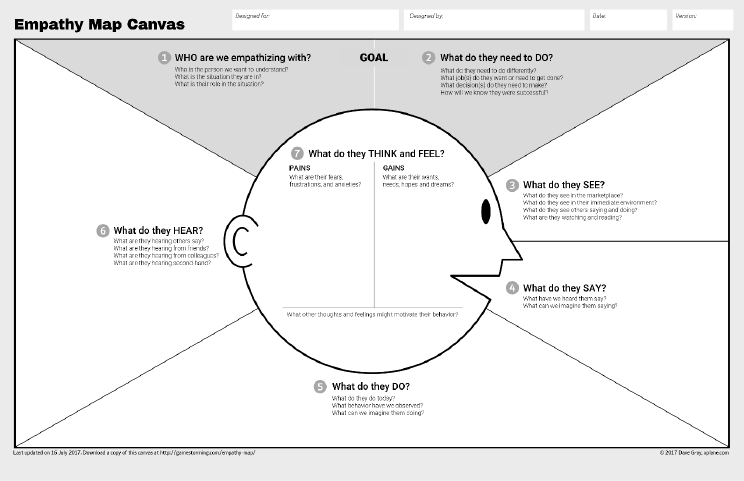
Source: https://medium.com/@davegray/updated-empathy-map-canvas-46df22df3c8a (accessed: 10.04.2025)
Leaders of informal groups are individuals who are active and eager to share their passion for social engagement. They are not passive observers of their local communities; rather, they consciously seek to address various social issues. According to the participants of the consultations, the activities undertaken by these leaders include:
- initiating and sustaining actions,
- sharing their passion with others,
- engaging others in collective activities,
- organizing community initiatives,
- acting informally and without material incentives,
- building relationships based on trust and cooperation,
- serving as mediators between different groups,
- utilizing human and material resources in a creative manner,
- fostering motivation among others.
A leader must be long-term oriented to ensure the cohesion of their group, demonstrate resilience in crisis situations and the ability to integrate and motivate group members. Patience, creativity, and a sense of responsibility are among their key traits. A leader is expected to exhibit leadership and organizational skills, as well as possess life experience, enabling them to effectively convey ideas and concepts. They are empathetic and “believes in building social trustˮ (3 discussion group).
It was noted, however, that excessive autonomy among leaders may sometimes evolve into authoritarian and perfectionist attitudes, which hinder the functioning of the group. Such tendencies were described as a “belief in one’s own infallibilityˮ (discussion group 4) and a “lack of openness to the opinions of othersˮ (discussion group 1). This attitude was illustrated by the following observation: “He believes he knows best, and therefore may not listen to other opinions.ˮ As a result, there is a risk of problems within the team and even the end of its activities.
Participants of the consultations stated that the leaders and members who form informal groups and engage in social activities “are driven (…) by the lack of courage of others to act” (2 discussion group), as well as by the discomfort they feel towards reality, which initiates a desire for change. They experience a strong sense of agency and responsibility for their local communities. Their engagement is further driven by the opportunity to connect with like-minded individuals active in similar fields, fostering the exchange of experiences and ideas. Informal groups create a safe space for individuals, allowing them to develop their interests and passions. These groups are characterized by a non-judgmental and friendly atmosphere towards their members. That is why it is so important for leaders to focus not only on achieving goals but also on the moral and ethical principles of teamwork.
One of the motivating factors for social engagement may be a feeling of loneliness and a need for belonging. Members of informal groups thus seek communities built on shared life experiences and values. There is a belief among them that cooperation within a group enables them to achieve social goals that would be difficult to accomplish individually. Participation in informal groups often has a spontaneous character and does not require formalization, which fosters inclusivity and diversity among members.
From the perspective of the conducted public consultations, effective functioning within informal groups requires the development of interpersonal competencies, such as empathy, the ability to build relationships, and the capacity to engage others. Managerial skills such as time management, task delegation, team motivation, the ability to creatively utilize available resources and to solve social problems innovatively – are also of critical importance.
Summarizing the constructed PERSONA profile, it is worth emphasizing that, in the European context, the characteristics identified correspond to the key competences for lifelong learning, as outlined in the Recommendation of the European Parliament and of the Council of 18 December 2006 on key competences for lifelong learning (2006/962/EC, OJ L 394, 30.12.2006). In particular, they align with social and civic competences, as well as the sense of initiative and entrepreneurship. Moreover, the competencies highlighted during the consultations correspond with those identified in the relevant academic literature, drawing on both managerial and leadership competency frameworks. The results corroborate prior mentioned studies showing that effective leaders in social movements and informal groups combine diagnostic skills, charisma, resilience, and the ability to mobilize others (Ganz 2010; Morris, Staggenborg 2004; Hailey, James 2004). They also align with the perspective of della Porta and Diani (2006), as the leader attributes identified by participants enable them to perform the functions of framing, mobilization, and coordination within informal movements. This confirms the tendency to integrate these two fields within the non-profit sector. The above-mentioned competencies are understood as a combination of soft skills and a profound understanding of the principles of social conduct, including knowledge of rights, democratic procedures, and the ability to actively participate in social life. Leaders of informal organizations must therefore demonstrate a high level of agency, combined with creativity, innovativeness, and a willingness to take risks aimed at generating social change.
6. Conclusions
The analysis of leadership competencies in the context of human resource management within NGOs enables the formulation of several key conclusions. First and foremost, the management of human resources should not be treated as secondary to the mission of the organization. On the contrary, it ought to constitute an integral component of organizational practice, requiring a well-designed strategy, the application of appropriate tools, and continuous development of leadership competencies. This approach necessitates the recognition of interpersonal relationships, organizational structure, and value systems as fundamental factors influencing organizational effectiveness. Such a perspective is strongly supported by empirical evidence gathered from social activists, who emphasized the importance of volunteer work, the dedication of personal time to mission-driven activities, and the deep identification with organizational values and goals. Without effective human resource management, NGOs are unlikely to achieve sustainable and efficient operations.
The empirical material collected during the research highlights the significance of competencies such as the ability to build partnership-based relationships, legal awareness, the capacity to create coherent remuneration systems, and concern for the psychological well-being of the whole group. In this conceptualization, the leader is not an executor of strategies but a co-creator of organizational practices – an individual responsible for both achieving performance outcomes and fostering a supportive organizational climate. These soft skills gain particular significance in light of professional burnout, discrimination, and mobbing, which have been identified as persistent challenges in the third sector (Charycka, Gumkowska, Bednarek 2022).
Inadequate management or violations of employees’ rights within the third sector can lead to the loss of those individuals who show a willingness to be socially active. This applies to both informal groups and NGOs. Research conducted by the Klon/Jawor Association shows that those who leave organizations with a sense of unfair treatment rarely return to the non-profit sector, whether as employees, volunteers, or donors (Charycka, Gumkowska, Bednarek 2022). Consequently, the civil sector loses the opportunity to collaborate with individuals possessing valuable social potential.
In conclusion, leadership in informal groups should not be understood solely as the pursuit of objectives or outcomes. Equally important is the cultivation of an attitude, a system of values, and the capacity to reflect on the organization as a community of people. Only such a model of leadership – conscious, reflective, and inclusive – enables the creation of sustainable and resilient organizations capable of effective action in a dynamically changing social and economic reality.
Autorzy
* Agata Chutnik
* Agnieszka Murawska
Bibliography
Anheier H., Toepler S. (2022), Nonprofit Organizations: Theory, Management, Policy (3rd ed.), Routledge, London.
Bardzik N. (2011), Ruchy społeczne – nowa, ważna siła polityczna, “Kultura i Społeczeństwo,” no. 1.
Bass B.M., Riggio R.E. (2006), Transformational leadership, “Psychology Press” (2nd ed.).
Bell-Laroche D., MacLean J., Thibault L., Wolfe R.A. (2014), Leader perceptions of management by values within Canadian national sport organizations, “Journal of Sport Management,” vol. 28.
Bolden R. (2011), Distributed leadership in organizations: A review of theory and research, “International Journal of Management Reviews,” no. 13(3), pp. 251–269.
Bruni L., Smerilli A. (2014), The economics of values-based organisations, Routledge, London.
Carmeli A., Meitar R., Weisberg J. (2006), Self-leadership skills and innovative behavior at work, “International Journal of Manpower,” no. 27(1), pp. 75–90.
CBOS (2024a), Aktywność w organizacjach obywatelskich, https://www.cbos.pl/SPISKOM.POL/2024/K_028_24.PDF (accessed: 20.07.2025)
Charycka B., Gumkowska M., Bednarek J. (2022), Kondycja organizacji pozarządowych 2021, Stowarzyszenie Klon/Jawor, Warszawa.
Cheverton J. (2007), Holding our own: Value and performance in nonprofit organisations, “Australian Journal of Social Issues,” no. 42(3), https//doi.org/10.1002/j.1839-4655.2007.tb00068.x
della Porta D., Diani M. (2006), Social movements: An introduction, 2nd ed., Blackwell Publishing, Malden, MA.
Denier Y., Dhaene L., Gastmans C. (2019), You can give them wings to fly: a qualitative study on values-based leadership in health care, “BMC medical ethics,” no. 20(1), pp. 1–17, https://doi.org/10.1186/s12910-019-0374-x
Drucker P.F. (1990), Managing the Non-Profit Organization: Principles and Practices, HarperCollins, New York.
Drucker P.F. (2006), The Effective Executive: The Definitive Guide to Getting the Right Things Done, Harper Business, New York.
Edwards M. (2014), Civil Society (3rd ed.), Polity Press, Cambridge.
Edwards M., Sen G. (2002), NGOs, social change and the transformation of human relationships: a 21st century civic agenda, [in:] M. Edwards, A. Fowler (eds.), The Earthscan Reader on NGO Management, Earthscan, London.
Eyerman R., Jamison A. (1991), Social movements: A cognitive approach, The Pennsylvania State University Press
Fihel A., Homel K., Jaroszewicz M., Lesińska M., Bentz A.-S. (2025), Diaspora at war: mobilization of the Ukrainian diaspora in the first 2 years of the full-scale aggression of Russia against Ukraine, “Journal of Refugee Studies,” no. 38(3), pp. 704–721, https://doi.org/10.1093/jrs/feaf006
Ganz M. (2010), Leading Change: Leadership, Organization, and Social Movements, [in:] N. Nohria, R. Khurana (eds.), Handbook of Leadership Theory and Practice, Harvard Business School Press, pp. 509–550.
Ganz M., McKenna L. (2019), The practice of social movement leadership, “Mobilizing Ideas.”
Giza-Poleszczuk A. (2004), Przemiany więzi społecznych: zarys teorii zmiany społecznej, Wydawnictwo Naukowe PWN, Warszawa.
Gliński P. (2006), Style działań organizacji pozarządowych w Polsce: Grupy interesu czy pożytku publicznego? Warszawa: IFiS PAN.
Gliński P., Palska H. (1997), Cztery wymiary społecznej aktywności obywatelskiej, [in:] H. Domański, A. Rychard, Elementy nowego ładu, Wydawnictwo IFiS PAN, Warszawa.
Greenleaf R.K. (2002), Servant leadership: A journey into the nature of legitimate power and greatness (25th anniversary ed.), Paulist Press.
Gronn P. (2002), Distributed leadership as a unit of analysis, “The Leadership Quarterly,” no. 13(4), pp. 423–451.
GUS (Statistics Poland) 2023, https://stat.gov.pl/obszary-tematyczne/gospodarka-spoleczna-wolontariat/gospodarka-spoleczna-trzeci-sektor/dzialalnosc-stowarzyszen-i-podobnych-organizacji-spolecznych-fundacji-spolecznych-podmiotow-wyznaniowych-oraz-samorzadu-gospodarczego-i-zawodowego-w-2022-r-wyniki-wstepne,3,10.html (accessed: 07.04.2025).
Hailey J., James R. (2004), Trees die from the top: International perspectives on NGO leadership development, “Voluntary Action,” no. 6(1), pp. 19–36.
https://medium.com/@davegray/updated-empathy-map-canvas-46df22df3c8a (accessed: 10.04.2025).
Jaakson K. (2010), Management by values: are some values better than others?, “Journal of Management Development,” vol. 29, no. 9, pp. 795–806, https://doi.org/10.1108/02621711011072504
Jacobsson K., Korolczuk E. (eds.) (2017), Civil Society Revisited: Lessons from Poland, Berghahn Books.
Jasiecki K. (2023), Pomoc humanitarna dla uchodźców z Ukrainy jako katalizator nowej aktywności społecznej w Polsce, „Studia Politologiczne,” no. 2(68), pp. 138–157, https://doi.org/10.33896/SPOLIT.2023.68.8
Kajdanek K. (2012), Suburbanizacja po polsku, Zakład Wydawniczy Nomos, Kraków.
Katzenbach J.R., Smith D.K. (2015), The Wisdom of Teams: Creating the High-Performance Organization, Harvard Business Press.
Kotter J.P. (1990), A Force for Change: How Leadership Differs from Management, Free Press, New York.
Kraemer Jr. H.M. (2011), From values to action: The four principles of values-based leadership, John Wiley & Sons, New York.
Kubik J. (1994), The power of symbols against the symbols of power: The rise of Solidarity and the fall of state socialism in Poland, University Park, Pennsylvania State University Press.
Kulik E. (2009), Samoorganizacja społeczna na przykładzie dzielnicy Zamysłów – studium socjologiczno-historyczne, [in:] R. Morawski, T. Jemczura (eds.), W kierunku samoorganizacji społecznej. Społeczeństwo obywatelskie w działaniu, Wydawnictwo Państwowej Wyższej Szkoły Zawodowej, Racibórz.
Lasocik Z. (1994), Kilka uwag o roli organizacji pozarządowych w państwie demokratycznym, Fundusz Współpracy/Cooperation Fund BORDO, Warszawa.
Lewis D. (2014), Non-Governmental Organizations, Management and Development (3rd ed.), Routledge, London.
Major P., Spałek S. (2022), Communication and building positive relationships within project teams in non-governmental organizations, “Scientific Papers of Silesian University of Technology Organization And Management Series,” no. 158.
Miklaszewska J. (1998), Obecność wartości w życiu publicznym, [in:] J. Miklaszewska (ed.), Polityka i świat wartości. Uczestnictwo obywateli w życiu społeczno-politycznym, Fundacja „Międzynarodowe Centrum Rozwoju Demokracji,” Kraków.
Mikołajczyk P. (2023), What organizational values drive NGOs to be successful? Evidence from Polish non-governmental organizations (NGOs) and the theory of management by values, “Management and Business Administration. Central Europe,” no. 28(1), pp. 7–22.
Mintzberg H. (2019), Zarządzanie, Wydawnictwo Nieoczywiste, Warszawa.
Morris A.D., Staggenborg S. (2004), Leadership in social movements, [in:] D.A. Snow, S.A. Soule, H. Kriesi (eds.), The Blackwell companion to social movements, Blackwell Publishing, pp. 171–196.
Murawska A. (2020), Aktywność obywatelska mieszkańców Łodzi i Iwanowa – struktura i uwarunkowania, Wydawnictwo Uniwersytetu Łódzkiego, Łódź.
Ost D. (2005), The Defeat of Solidarity, Cornell University Press.
Parlament Europejski (2006), Zalecenie Parlamentu Europejskiego i Rady nr 2006/962/WE z dnia 18 grudnia 2006 r. w sprawie kompetencji kluczowych w procesie uczenia się przez całe życie, Dz.U. L 394 z 30.12.2006.
Pearce C.L., Conger J.A. (eds.) (2003), Shared Leadership: Reframing the Hows and Whys of Leadership, Sage, Thousand Oaks.
Peterson R.S., Kim K. (2012), Leadership in small groups and teams: Toward a theory of group leadership, [in:] M.A. Neale, B.M. Mannix (eds.), Research on managing groups and teams: Looking back, moving forward: A review of group and team-based research, vol. 14, Emerald Group Publishing Limited, pp. 27–47.
Schein E.H. (2010), Organizational culture and leadership (4th ed.), Jossey-Bass, San Francisco.
Skrzypiec R. (2016), Przywództwo w organizacjach pozarządowych – specyfika i wyzwania, “Trzeci Sektor,” no. 35(1), pp. 15–28.
Snow D.A., Benford R.D. (1988), Ideology, frame resonance, and participant mobilization, “International Social Movement Research,” vol. 1, pp. 197–217.
Tilly C. (2004), Social movements, Paradigm Publishers.
Uhl-Bien M. (2006), Relational Leadership Theory: Exploring the social processes of leadership and organizing, “The Leadership Quarterly,” no. 17(6), pp. 654–676.
USAID (2023), 2022 Civil Society Organization Sustainability Index, https://www.fhi360.org/wp-content/uploads/2024/02/csosi-europe-eurasia-2022-report.pdf (accessed: 18.11.2024).
Van Zomeren M., Postmes T., Spears R. (2008), Toward an integrative social identity model of collective action: A quantitative research synthesis of three socio-psychological perspectives, “Psychological Bulletin,” no. 134(4), pp. 504–535.
Yukl G. (2013), Leadership in Organizations (8th ed.), Pearson, Boston.
Footnotes
- 1 https://civic-in.eu/
- 2 Small financial supports for local grassroots initiatives. They can be requested by informal groups of at least three adults, even without NGO status. Applications are usually submitted to local city or municipal offices or NGOs running microgrant programmes.