Alcohol in the lives of young adults a biographical analysis. Research report
 https://orcid.org/0000-0002-2343-9943
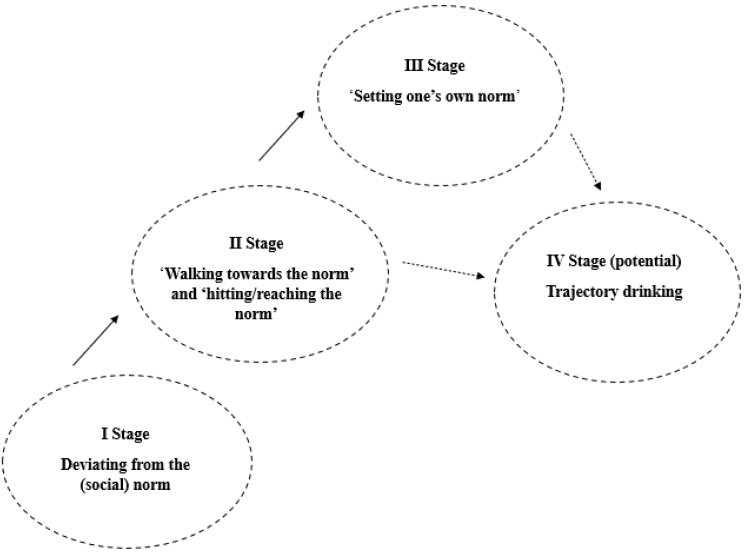
Abstract. In this study, the leading theme was the broadly understood experience related to alcohol consumption among young adults. As a result of the biographical data analysis, three socially conditioned stages of the ‘career’ of becoming an alcohol consumer were reconstructed: initiation stage (with its subprocesses: ‘deviating from the norm’, ‘walking towards the norm’ and ‘hitting/reaching the norm’), the second one – ‘setting one’s own norm’ and the third one – a potential stage – termed ‘trajectory drinking’ which can also be described as ‘the stage of permanent transgression of norms’. Distinct characteristics characterise each stage, but at the same time, it remains strongly connected to the others. This connection is emphasised by the basic social process called the ‘normalisation of drinking’. At each stage, social actors participating in the social activity of alcohol consumption grapple with expectations, pressures and potential sanctions regarding when and how one should or should not drink.
This qualitative sociological study analysed transcriptions of 35 narrative biographical interviews with young adults. It applied the classic version of the grounded theory methodology.
Keywords: alcohol drinking, young adults, career, grounded theory methodology, autobiographical narrative interview, symbolic interactionism.
Alkohol w życiu młodych dorosłych analiza biograficzna. Raport badawczy
Abstrakt. Tematem prezentowanego badania było szeroko rozumiane osobiste doświadczenia picia alkoholu przez młodych dorosłych. W wyniku analizy danych biograficznych zrekonstruowano trzy społecznie uwarunkowane etapy „kariery” stawania się konsumentem alkoholu: etap inicjacji (z jego subprocesami: „odstawaniem od normy”, „dochodzeniem do normy”, „dobiciem/dojściem do normy”), drugi – „ustalaniem własnej normy” i trzeci potencjalny etap określony jako „picie trajektoryjne”, który można również określić jako etap „permanentnego przekraczania norm”.
Każdy etap charakteryzuje się odmiennymi cechami i uwarunkowaniami, ale jednocześnie pozostaje silnie powiązany z pozostałymi. Ten związek podkreślany jest przez podstawowy proces społeczny nazwany „normalizacją picia”. Na każdym bowiem etapie aktorzy uczestniczący w społecznej aktywności konsumpcji alkoholu zmagają się z oczekiwaniami, naciskami i potencjalnymi sankcjami dotyczącymi tego, kiedy i jak należy lub nie należy pić.
W niniejszym badaniu przeanalizowano 35 transkrypcji wywiadów biograficznych z młodymi dorosłymi. Zastosowano przy tym procedury klasycznej wersji metodologii teorii ugruntowanej.
Słowa kluczowe: picie alkoholu, młodzi dorośli, kariera, metodologia teorii ugruntowanej, autobiograficzny wywiad narracyjny, interakcjonizm symboliczny.
1. Introduction
This article is the result of a research project conducted by its author and sociology students from the University of Lodz as part of a practical tutorial in Qualitative Research Methodology in the 2022/2023 academic year.[1] Temporal and organisational constraints, inherent to the cycle of such classes, influenced the choice of the research topic. The selected issue needed to be feasible to investigate within several months. Accordingly, quick and easy access to respondents was an important criterion and, moreover, the research topic had to be sufficiently engaging to encourage participants to give extensive interviews. Furthermore, the research problem had to resonate with the researchers themselves, who would recognise that it was also ‘their problem’. In the course of the discussion, the tutorial participants decided that the topic of alcohol consumption among their peers fit these parameters well. In this case, ‘peers’ referred to individuals from their social circle, such as friends, acquaintances and ‘friends of friends’. It was also crucial for the chosen topic to be socially relevant.
2. Research problem, method of analysis and data
The specificity of the tutorials conducted by the author of this report lies in its focus on a biographical perspective, which is the most extensively discussed and implemented one from the broad spectrum of possible approaches. This perspective involves studying immediate personal experiences of social life participants and situating these experiences within the ‘life stories’ of social actors (Schatzman, Strauss 1966; Wengraf 2001, Rosenthal 2004, 2006; Kaźmierska, Waniek 2020; Dymarczyk 2023). Such studies typically concentrate on a particular theme, i.e. a type or area of activity of social actors, such as professional activity, family life, personal passions, educational trajectories, social life, volunteering or other aspects of interest to the researcher. The idea is therefore to reconstruct a ‘life story’ through the lens of a central theme or issue. In the present study, this leading theme was the broadly understood experience related to alcohol consumption among young adults.[2] The cognitive goal was to reconstruct these experiences within the context of personal actions and attitudes, as well as participation in social and friendship circles, family life and the broader social environment, including place of residence, education and work. It was important to illustrate the stages of ‘becoming familiar’, ‘getting accustomed’ and ‘normalising’ the socially conditioned relationships with alcohol and, more importantly, with the individuals involved in these activities. It was also important to examine the origins of this ‘familiarisation’, the people who mediate(d) this process and the way they do (did) it, and to understand the strategies adopted by social actors in response to the presence of alcohol in their lives. Consequently, one of the primary goals in the study was to reconstruct the stages of the ‘career’ of becoming an alcohol consumer and a ‘reviewer’ of such practices and their contexts. In doing so, it should be noted that, from the perspective of symbolic interactionism – the theoretical framework adopted here – a career is the ‘moving perspective in which the person sees his life as a whole and interprets the meaning of his various attributes, actions, and the things which happen to him’ (Hughes 1964: 63, cited in Konecki 1988: 227; see also Goffman 1961; Glaser, Strauss 1967; Prus, Sharper 1977; Prus, Grills 2003; Wagner 2006; Dymarczyk 2018, 2023).
The initial research design was based exclusively on narrative interviews, with the aim of eliciting spontaneous, multifaceted and extensive accounts of experiences with alcohol, as these reflections are naturally interwoven into the personal biographies of the interviewees (Schatzman, Strauss 1966; Wengraf 2001; Rosenthal 2004, 2006; Kaźmierska, Waniek 2020; Dymarczyk 2023). In the course of the interviews, however, it became evident that adhering strictly to the rule of ‘I initiate the topic and you tell the story’ posed challenges for some participants-narrators and, at times, also the researchers. It quickly became clear that the shared experiences, proximity, and sometimes even intimacy between the researcher and the interviewee made it impossible to establish an ‘artificial’ listener-narrator relationship. As a result, it was soon decided that it would be equally appropriate – and even necessary – to apply semi-structured interviews with a low degree of standardisation, aided by a list of key information sought and/or interview guidelines (Lutyński 1968: 24–28; Przybyłowska 1978: 62–67; Konecki 2000: 169–170).
From the analytical perspective, we employed procedures developed within the grounded theory methodology (Glaser, Strauss 1967; Glaser 1978; Strauss, Corbin 1994, 1998; Konecki 2000; Charmaz 2006). Thus, the selection of participants (interviewees) for the study was based on theoretical sampling, which means that ‘this process of data collection is controlled by the emerging theory’ (Glaser 1978: 36). In our case, only the first interviews were conducted with people defined as ‘a person who has/had contact/experience with alcohol’ – a criterion that could, in practice, include nearly anyone. Subsequently (simultaneously with coding and its result), the procedure consisted in the constant comparative method, i.e. the interviewees were selected in such a way as to generate or supplement subsequent categories (e.g. patterns of ‘careers’ among individuals who drink and/or experience drinking-related situations) and their properties (contexts as well as the conditions of occurrence and implementation).[3]
This report is based on transcripts of 35 interviews conducted primarily in the fourth quarter of 2022 and the first quarter of 2023. The shortest interview lasted approximately 15 minutes, while the longest one exceeded 50, with most interviews ranging between 20 and 30 minutes. The total recording time exceeded 13 hours, resulting in more than 290 pages of transcripts, prepared according to standard norms for this type of data. Most of the interviewees were born and were living in large urban centres, mainly the Polish city of Lodz. However, many of them had only recently started the urban phase of their biographies. On the other hand, some are still living in small towns or villages. The study involved a total of 19 men, 14 women and two nonbinary individuals, all aged between 18 and 23 years.
Reaching the interviewees had also certain limitations. First, they were individuals from the broadly defined circle of students who carried out the field stage of the research. Thus the interviewees were their friends or “friends of friends”. Consequently, the vast majority of participants came from central Poland and many were students. Second, the research process was significantly limited by duration of the course (one semester) within which the study was conducted. When examining the results and conclusions, it’s worth keeping these caveats in mind.
3. Career stages
Alcohol consumption is a social activity (Prus 1983; Seaman, Ikegwuonu 2010; Sudhinaraset, Wigglesworth, Takeuchi 2016). Therefore, it arises from interactions with the surroundings and, at the same time, has a processual character (Glaser, Strauss 1967; Blumer 1969), which allows us to reconstruct the stages of alcohol-related experiences within the context of social actors’ biographies. In the following sections, we outline these stages along with their determinants, and look at how they are perceived, described and evaluated by the interviewees. The central axis organising the claims contained in this report is the basic social process discovered in the study – in this case, the ‘normalisation of drinking’ (see: Appendix No. 2).
4. The first stage of the career
Identifying the moment when alcohol becomes part of a young person’s biography is usually problematic. One does not need to consume alcohol to experience the ambiance of a drinking environment, to face the consequences of the drinking habits of one’s loved ones and experience negative emotions, traumas and tragedies as a result. Even if the drinking practices of household members do not trigger any dramatic incidents, the mere observation of their behaviours and rituals can often socialise young people into future drinking. Another issue is the precise moment of ‘alcohol initiation’. Can one speak of such initiation when a young child secretly ‘dips their finger in a glass of champagne’ during a New Year’s Eve party or a family gathering? Or when exposure to alcohol occurs as an isolated incident?
In this research project, we adopted the definition of ‘career’ derived from symbolic interactionism. The implication of this approach is that the perspective of the social actor is the primary criterion, i.e. how the actor perceives their own biography, the events, interactions or social relationships the actor attributes meaning to, and how the actor (re)constructs life episodes and connect them into logical sequences, thus giving continuity to their life story. Consequently, it was the interviewees themselves who determined which events to recall and narrate, and what kind of significance to ascribe to them.
The first conscious and intentional exposure to alcohol typically occurred within a peer group in situations where control exercised by the caregivers had been diminished – for example, during overnight stays on school trips. Less commonly, it occurred during family celebrations at home, i.e. with the consent of parents or guardians. For the sake of accuracy, it should be noted that six interviewees reported drinking alcohol for the first time before the age of thirteen, while nine had their first experience by the age of fourteen. Overall, 29 out of 35 participants had already experienced alcohol initiation before reaching the legal age of adulthood.[4]
Although only a few interviewees did not drink alcohol before the age of eighteen, the eighteenth birthday party was frequently highlighted in many narratives as a significant moment – a biographical turning point (Strauss 1959: 95). In the context relevant to this study, the legally and socially sanctioned act of drinking alcohol is perceived as a marker of a status change that should be universally recognised and communicated through a rite of passage (van Gennep 1977), symbolising the entry into adulthood:
N 11 (F, 20) And the time of my eighteenth birthday came. I had a party and there was a coming-of-age ceremony. It was actually about an hour before my birthday, in terms of timing. And my godmother was first to come up to me, with a drinking glass. (2) Well, and I said, no, no! But, okay, I took the drink. They gave me a drink to try. And the taste of vodka, you know, wasn’t exactly very good ((laughing)). Well, so my first alcohol came from my godmother at my eighteenth birthday party.
N 13 (F, 20) I remember it was at my friend’s 18th birthday party at her place, and well, it was like that thing that happens at 18th birthdays, you get to drink your first glass there, (...) this was my first real experience, and then it seemed normal to me, like crossing the threshold to ‘adulthood’ ((gesture of air quotes, laughing lightly)). It seemed cool to some extent.
N 14 (F, 20) And there were also situations at my cousin’s wedding where another cousin of mine came up to me, he saw that my glass was empty, he poured me some, and he was like ‘Just in case, don’t tell auntie, don’t tell auntie, I didn’t give you anything’ and I was like, ‘But you do know that I’m over 18, right?’ and he was totally shocked that I had turned 18, and that I was drinking alcohol, and that I was allowed to, and that it was acceptable now ((laughing)) among so many relatives.
The ludic aspect cannot be overlooked either. Having fun is a natural way of spending leisure time, especially for young people who are not yet burdened by daily work and family responsibilities. In addition to the ritualistic 18th birthdays described above, there are many other opportunities to enjoy communal consumption of alcohol. The interviewees often shared memories about parties with friends and acquaintances. It was not uncommon for these to contain digressions outside the main line of the narratives, which, to use Fritz Schütze’s term, can be described as Hintergrundkonstruktion (background constructions) (Schütze 1984, (1992) 2016; Kaźmierska 2016). These stories often took the form of romanticised and nostalgic recollections:
N 19 (M, 22) I lived in the countryside, and there was a pond nearby (...) We’d go there, with one mate, sometimes with two, and we’d drink, swim or have bonfires; and we did it at these bonfires; for the bonfires, we’d always buy, well, say, six beers or eight, a larger number. And we’d sit around these bonfires until four or five in the morning. Usually, there was just the two of us staying up all night, me and this good friend of mine, and we’d talk about all sorts of things, mostly we’d laugh, have fun, fry sausages.
N 20 (F, 20) Basically, it became a regular thing – whenever all of us would meet somewhere in the park, by the rail tracks. Well, and during the summer holidays, we’d mostly hang out by the lake, and drink there too, you know, it wasn’t just drinking, but alcohol was definitely part of it, and, to be honest, it’s been present since then until now. It’s mainly on weekends, it’s practically every week, and it’s mainly whisky on Saturdays, and beer on Sundays – that’s the custom. ((with a smile)).
Regardless of the age at which alcohol initiation occurred, the important context of this situation, as clearly articulated in the interviews, comprises the expectations, sometimes pressure, from the peer group and other reference groups, such as older peers or family members, directed towards the social actor. More precisely, the interviewees described their perceptions of these pressures, their attitudes towards them, and actions taken as a result:
N3 (F, 20) I mean, I think, on the one hand, it was sort of a group idea – I wasn’t alone at the time, there were some other people with me, so there was probably a bit of group pressure, but I didn’t feel forced by anyone.
N6 (M, 20) My first time with something stronger ((alcohol)) was when I was 17. It was vodka. I went to a wedding with my ex-girlfriend, to her sister’s wedding. And, well, I didn’t want to drink. But her brothers and sisters kept saying, ‘What? Aren’t you going to have a drink with your brother-in-law, with your sister-in-law?’ So I ended up drinking quite a lot.
N22 (M, 21) I remember we were drinking flavoured beer that at that time for sure, well, and then some older blokes showed up with vodka. And, as you know, under the pressure – social pressure from the older blokes – we started drinking, too. (...) You know, when the older ones were watching, we had to drink.
The above quotes reflect the more or less oppressive influence of ‘significant others’ and/or reference groups on an individual’s decision. However, there are additional, arguably more nuanced, motives for alcohol initiation. For example, our interviewees occasionally mentioned a socially motivated but nevertheless more volitional process of comparing themselves to others – often more experienced consumers or social circles:
N13 (F, 20) I remember, I’m sure it was at a friend’s 18th birthday party at her house, and, well, it was like, you know, the way things are at 18th birthdays – you drink your first shot there, then the second one; and I remember drinking half measures, I drank halves; and I remember I felt really bad about it at the time, drinking just halves because I felt weak. Weak because, you know, everyone else was drinking full shots, and there I was drinking halves.
N34 (M, 21) I was surprised that they ((the lads)) could down vodka just like that, in one go. I was a bit unsure how to go about it. I was a bit worried that something would go wrong, like I’d choke or something. But I looked at it, got over it, and, well, down it went.
N2 (F, 23) All in all, compared to other places, for example, if you take Wieluń, compared to Pątnów, which is a village, everyone here started drinking at a later moment. I was actually one of the first people to start drinking alcohol. ‘Cause people in Wieluń started drinking already back in primary school.
Comparing oneself with others and, more importantly, the subsequent actions of aligning one’s behaviour to that of Others often reflect conformism. Naturally, such conformism typically stems from two sources. Firstly, it may be a reaction to the previously mentioned expectations and pressures exerted by the group. Secondly, it reflects a need for acceptance and belonging, and the fear of rejection, as succinctly expressed by one participant: (N30) ‘It would be embarrassing if they thought you were a loser’. Being labelled a ‘loser’ can, in fact, have tangible consequences, as illustrated by the experience of one interviewee (N11): ‘Well, after the New Year’s Eve party, there was a situation where another party was coming, but my friends didn’t invite me. And they didn’t invite me because... because I don’t drink, because I don’t know how to have fun’.
These motivations have a particularly strong impact during adolescence. Young people in this developmental stage are often ‘tested’ by members of the group they aspire to join, but are also often willing to experience new and – at that stage – forbidden sensations and states. It is precisely the curiosity about such experiences, combined with the allure of the ‘forbidden fruit’, that encourages adolescents to decide to consume alcohol:
N 25 (M, 21) (all underage participants in the drinking party) ... they felt like they were doing something a bit dodgy, not exactly legal. (...) It was more fun that way, like they weren’t alone.
N 27 (F, 19) ... it was a wild time and it was fun back then, it was something totally illegal ((smiling)). Everyone wanted to do it, absolutely.
Initial encounters with alcohol can be satisfying or unsatisfactory. At this point, the social actor makes a decision whether to forgo further attempts at consumption, and at fitting into the mainstream (N 9, N 10) – which involves the dramatic choice of abstaining – or to adapt their behaviour to align with that of Others.
In the context of what has been described above, the process of alcohol initiation should be viewed in two dimensions: the peer-social dimension and the socio-cultural dimension. The former dimension concerns the pressure exerted by the group on the social actor and, above all, how the actor responds to this pressure. Here, the conformist motive is significant. The need to be accepted facilitates the decision to begin consuming alcohol. On the other hand, the comparisons made by the actor during social gatherings largely influence the manner of consumption. This process typically follows a sequence. At the initial stage, the debutant ‘deviates from the norm’, cautiously ‘testing’ their capabilities, and observing the reactions triggered by the alcohol consumed. If these first experiences are recognised as positive and non-threatening, the actor ‘aligns themselves’ with the drinking patterns prevailing in their social environment. The actor accepts the frequency, intensity and format of such practices, along with the ‘charm’ of the ‘forbidden fruit’. Naturally, this occurs with some consideration of personal preferences regarding the type of alcohol, the constraints imposed by social control (e.g. exercised by parents or neighbours) or involvement in other activities, etc. We have described this moment of alcohol initiation as ‘walking towards the norm’ and ‘hitting/reaching the norm’.[5] They constitute sub-processes within the first stage of the consumer career. We will say more about this in the next section. In socio-cultural terms, the focus lies on the positioning and ‘self-positioning’ of the social actor in a certain normative, symbolic and legal order. A crucial aspect, however, is the legitimisation of alcohol consumption by family and close relatives. The acquiescence to open alcohol consumption typically occurs during family gatherings such as weddings, funerals, or New Year’s Eve celebrations (see: Friese, Grube, Moore, Jennings 2012). Another significant moment is the milestone of turning eighteen, representing both the customary and legal threshold of adulthood. This moment very often takes on a ritualistic character, in the form of a boisterous party with toasts to honour the celebrant. During such occasions, the new adult performs actions to reassure the participants that they are a worthy and competent member of the ‘world of adult drinkers’.
5. The second stage of the career
In the first stage of the alcohol consumption career, i.e. the initiation into alcohol consumption, understood as subprocesses, we distinguished three moments: ‘deviating from the norm’, ‘walking towards the norm’ and ‘hitting/reaching the norm’. It is important to note that during this initial period, adolescents typically consume small amounts of alcohol, especially at the beginning, while carefully monitoring their own reactions. Over time, they begin to drink enough to make sure they do not significantly deviate from the social norm. However, on some occasions, beginners try to explore the limits of their alcohol tolerance, seek admiration from fellow drinkers and/or simply, due to inexperience, unintentionally put themselves into a state of significant intoxication:
N7 (M, 20) I remember the first amount of vodka I drank by myself. It was half a litre of lemon vodka. Back then, I think, lemon vodka had 37,5% alcohol content. Since I drank it in about an hour, all by myself, (2) but it was/. But I remember that’s how it all started, I was feeling amazing at that moment, and I stayed there; I drank half a litre all by myself, and everyone, really everyone was impressed. I was the best.
N 31 (F, 20) Julka taught me how to drink, which was cool back then because I could compete with the lads at drinking; and, you know, normally people think that girls just drink wine ((mockingly)) and that’s it. And here I was, ‘put the booze on the table’, and I competed with them, ‘cause I could LOL; and that’s probably the only positive thing about it, I mean, I could show the lads that I had a bigger one ((laughing)).
Excesses such as those outlined above are not exceptional. The early stages of an alcohol consumption career are full of various situations that, one might say, ‘happen’ to the social actor. A certain degree of unpredictability and adventurousness are typical at this stage. Over time, young drinkers gain experience and learn how their body reacts to different quantities, strengths and types of alcohol. This knowledge allows them to develop their own ‘drinking style’. This stage of the career, which takes into account the constant comparison with other drinkers, can be described ‘setting one’s own norm’:
N 20 (F, 20) Now I know what the consequences are; I’ve really learnt stuff about myself, I’ve learnt all that; I know what happens; I know some things are just bad, and I avoid them. I know what’s the right amount for me so that I don’t end up absolutely wasted, just enough to have a good time. So, yeah, I’ve learnt it all, I’ve got that baggage of experience ((laughing)) after being, well, just a turd. One could say I’ve completed my internship, right?
N 31 (M, 22) Well, and I’ve learned how to drink. ‘A lot’ doesn’t equal ‘fun’. I mean, it’s fun at first, but not afterwards. It depends. You’ve got to learn the difference between a party where you just want to ‘get plastered’ and a get-together. You have to figure out your own style, set your own benchmark. It all depends on who you’re with, when and why. But I’ve learnt to control it and manage it. And that’s fine. That kind of stupid drinking, just for the sake of it, that’s gone now. That’s what I think.
‘Setting one’s own norm’ emerges as a result of the interplay of several factors. Firstly, social actors learn how their body reacts to drinking: the types, quantities and frequencies of drinking that lead to specific reactions. They learn which behaviours and their effects are pleasurable versus those that are not. Secondly, social actors gain an understanding of social situations that are conducive to drinking and how to either induce or avoid them, i.e. they identify the consumer attitudes and roles that are accepted or rejected by the actors and the reasons why. Thirdly, ‘setting one’s own norm’ arises from experiencing biographical changes, such as entering into ‘serious’ personal relationships, transitioning to a new educational setting and/or taking up a job, which frequently results in moving to a new place of residence. These transitions are frequently accompanied by the broken or weakened relationships and ties with one’s previous social environment and community:
N 3 (F, 20) I think, overall, since I moved out to study. Yeah, that was it. I definitely drink less alcohol now. (...) I definitely drink less often rather than more often compared with… well, the times when I was still in secondary school.
Interviewer: What has changed between the moment now – when you drink less, and more for the taste of it – and the past, when you were in secondary school or middle school, and you were drinking much more?
N 3: Well, first of all, my surroundings have changed, and I also have friends who, well, I just hang out with them having a good time, and I don’t necessarily drink that much; that’s definitely a factor. Another factor is that I am more health-conscious, and it’s probably not exactly great for my body when I drink so often. (2) Well, you know, it costs money, so I don’t want to spend money, and there aren’t as many occasions to drink. You know, I’m at the uni, I need to get enough sleep, sometimes I’d go to a party and have a drink, or meet up with friends, but it feels like I used to drink more back in secondary school.
N 30 (M, 20) During my university years, I’ve hardly been drinking at all because I have nobody to drink with, so to speak, in the sense of the old crew, so to say, with the old crew. Well, it’s not the same city where/ I mean, because I moved to another city to do my degree, and you know, the whole environment changes, and your old connections are gone, and I always drank together with my old friends/ well, we always drank together, for many years. (...) So yeah, it’s not the same thing as it was back then, and I think it’s not something that will come back.
It is worth noting that our findings are controversial, and even contradict many common-sense beliefs about living and ‘making the most of one’s life’ outside the previous social environment or community. Indeed, according to a popular opinion, young people who have rid themselves of the control exercised by their loved ones and the community in which they were raised, are particularly susceptible to the allure of social life, which often involves frequent participation in various gatherings centred around alcohol consumption. However, this belief may persist within older generational cohorts. Let us remember that in the era of real socialism, when these cohorts were young, the notion of the ‘perpetual student’ (i.e. someone who extends the time of their education due to the lack of real prospects for a fulfilling professional career) often led to a presentist attitude, consisting in ‘living for the day’, without any long-term plans or actions (Tarkowska 1992). In contrast, in today’s era, it is almost a rule to perceive the period of education as a prelude to a ‘real’ professional career. At the same time, there is a relatively wide range of job opportunities available for students or those pursuing further education. Ultimately, the intensive daily commitment to work and education does not encourage ‘wasting time’ on unproductive activities, such as social gatherings and accompanying feasts, including those involving alcohol. We do not want to argue that young people on the cusp of their careers drink significantly less today than in the past, as systematic nationwide surveys do indicate a certain change across age and gender cohorts of consumers. Clearly, the gap between the drinking frequency among men and women has visibly narrowed.[6] Representatives of both genders consume alcohol in nearly the same proportions, and, moreover, the drinking style and social contexts in which these activities occur are also undergoing a kind of ‘democratisation’, a phenomenon also revealed in our research.
It should be made clear once again that drinking is a social activity (Prus 1983; Seaman, Ikegwuonu 2010; Sudhinaraset, Wigglesworth, Takeuchi 2016). The observed changes in the frequency and manner of alcohol consumption characteristic of this career stage result from the actor leaving their previous social environment. Earlier practices and patterns of alcohol consumption often prove inadequate in new settings and environments. Therefore, a need arises for the actor to adapt to the norms and customs prevailing in the new social circle. Thus, ‘one’s personal norm’ actually results from a combination of personal experiences as an alcohol consumer, biographical changes and the influence of the – usually new – social environment.
6. The third stage of the career
The final reconstructed stage of a young alcohol consumer’s career has been termed ‘trajectory drinking’ and, following the criterion adopted for the previous stages, it can also be described as ‘the stage of permanent transgression of norms’. This is a potential rather than a universal stage. While the earlier stages can be regarded as relatively common among young alcohol drinkers, this stage represents a development that may occur only in the lives of a certain number of drinkers. The concept of trajectory, introduced by Anselm L. Strauss and Barney G. Glaser (1968, 1970) and further developed in relation to biographical processes by Fritz Schütze and Gerard Riemann (1991, 1992, 1997), denotes a process of disorder and suffering that intrude upon an individual’s life course. It is characterised by the unpredictability of events and the loss of control over their progression. In the context of interest for this paper, a trajectory occurs when an individual can no longer control the frequency or quantity of their alcohol consumption:
N 7 (M, 20) The thing was that, back then, I’d just buy a 100 ml bottle after school, and that was enough for me. I didn’t drink any more on the same day. And those days blurred together, so for two months of going to school, I’d buy a 100 ml or a 200 ml bottle, but I wasn’t drinking a lot then. (...) Then I took a break, and then I started smoking weed every day. (...). Then ((after my father’s death)) I would drink, say, once every three days, no more than half a litre. It was all rounded up like that. And I made it through to the summer holidays (...) and I ended up simply drinking small amounts every day, around, say, 200 or 300 millilitres, but it kept increasing day by day. Well, I can say that during the two months of summer holidays, I just drank day after day. And it’s been a few months now. I can now say that I haven’t had two days in a row without alcohol, without some kind of substance.
N 24 (M, 21) I was really drinking a lot, compared to the situation now, I feel I can’t take as much drink as I used to. Now, when I drink, I can’t remember what happened. Back then, when I mixed alcohols, for instance, I could still remember everything, and I felt fine the next day. Today, when I mix drinks, I can’t remember what happened. I wake up in the morning, asking myself what happened, wondering if did something wild. Then I hear from others that I did this or that, and it’s embarrassing. (...) I’ll say this – when I don’t drink, I don’t drink; but then I’ll have an occasional drink, and when I start drinking, maybe I have some kind of problem, some kind of craving kicks in, and I need to keep going, I have to go get another beer because it feels like I haven’t had enough drink yet.
The transition to trajectory drinking must be considered in the broader context of the social actors’ overall biographies. The interviewees often indicated that their socialisation and upbringing took place in environments where alcohol was accepted and consumed on various occasions – or even without any particular occasion. Some admitted that their loved ones were, or are, addicted to alcohol. In some cases, the memories of the prevailing ‘climate’ were dramatic. For example, one previously cited interviewee (N7) expressed the idea of his own addition being hereditary and fatalistic, as reflected in the belief expressed by his drinking father: ‘he knew ((sic!)) that everyone had to go through this stage ((of drinking))’. A similarly fatalistic tone was used by the interviewee (N2) who had been beaten by her drunken brother: ‘in the psychological examination ((during the divorce process)), it was revealed that they ((the parents)) were alcoholics to some extent. The general conclusion is that practically every one of us ((children)) is an alcoholic’. In contrast, another interviewee (N14) recounted the words of her older brother who, upon seeing his sister drinking, remarked: ‘Oh, she’s my own flesh and blood, she knows how to drink, you can tell she got it from me, I set a good example for her’. These quotes are just selected examples, carved out from the whole sequence of broader experience of growing up in homes where drinking was a ‘natural activity’. It would probably not be an overstatement to apply the label ‘Adult Children of Alcoholics’ (ACoA) to some of our interviewees.
Another significant context is the intensity of engagement with the peer group. When one reference group dominates over others, the values and norms of that group are readily internalised and enacted. The interviewees repeatedly emphasised that the drinking style – encompassing frequency, quantity and type of alcohol, the places and occasions for shared drinking, and the strategies for dealing with difficult or unforeseen situations – was taken for granted as a framework where the life of the micro-community took place.
However, some individuals consistently begin to transgress the norms of alcohol consumption – not only the ‘external norms’, but also sometimes also those established within ‘their own group’. This marks a straightforward path to being labelled a deviant or an outsider (Becker 1966). An individual who violates the norms finds themselves in a dramatic situation. On the one hand, they are usually tied to the conventional system of social expectations and its demands, and, on the other hand, they are engaged in a destructive practice of continuous drinking. For as long as possible, the individual tries to rationalise and neutralise the dissonance between their personal behaviour and the norms prevailing in their reference groups and society at large. They employ strategies that enable them to maintain a relatively positive self-image and still feel like a member of the collective. These strategies, known as neutralisations, are used whenever there is an acute divergence between the official, inherently conformist system of values and the accompanying normative system, and the underlying system of norms and values that are actually practised (Dymarczyk 2018: 144). It is worth emphasising that such rationalisations/neutralisations appear across all stages of the alcohol consumption career. However, they emerge with greater frequency when an actor reaches the third – and most dangerous – stage.
Returning to the main topic, let us recall the five commonly used neutralisation techniques reconstructed by Gresham Sykes and David Matza (1957), namely: denial of responsibility, denial of injury, denial of victim, condemnation of condemners, and appeal to higher loyalties. These techniques are so general and widespread that the rationalisations described by the authors have the valence of a substantive theory. In later years, the theory was expanded to include additional, equally common techniques (Klockars 1974; Minor 1981; Coleman 2002; Lyman 2000; Nelson, Lambert 2001), such as: denial of negative intent, claim to normality of the behaviour (or recognition of the ‘everybody else is doing it’ rule) and the rationalisation involving the ‘claim of the relative acceptability of the behaviour’ claiming the behaviour as normal compared to others, more deviant ones.[7] Therefore, let us now examine the neutralisations that emerged in the narratives collected in the present study:
N 1. (M, 21) I think we’ll drink that much some time in future because it’s quite a normal thing.
N 20 (F, 20) Actually, any event is good. But I have the impression that this is the case in the vast majority of homes.
Researcher: Do you think that’s good? Do you think that’s bad? Well, I mean, in general, that this is the case in most homes?
N: I mean, I don’t, not quite, I don’t just think this is the case. I know this is the case.
In the excerpts quoted above, the narrators employed the ‘everybody else is doing it’ rule (a normal thing, in most homes), while simultaneously invoking the neutralisation technique of claiming recognition of normality. It can also be argued that this instance also involves denial of responsibility, since when something is perceived as ‘the norm’ and is widespread, then the individual is not as much making an autonomous decision as they are conforming to common practice.
A similar mechanism applies, particularly in the context of peer pressure, when the social actor appeals to higher loyalties. In this case, as mentioned earlier, an effort is made to avoid the label of a ‘loser’ (N 17), but also when the actor places a high value on belonging to a group where drinking is the norm:
N 35 (F, 23) I didn’t have good contact with people. I was withdrawn. (...) Then I got involved with this crew and things are OK now. We have a lot of fun, we throw parties and do all sorts of stuff together, and life isn’t boring, ‘cause our town is bloody boring. Boredom is the worst thing – it kills you, and we try to deal with it together. We’ve got our own little world. (...) Let others say what they want ((about us)). As if they’re so perfect themselves, are they?
In the aforementioned narrative, in addition to the appeal to higher loyalties (fighting boredom), we also find a neutralisation technique consisting in ‘condemnation of the condemners’ (As if they’re so perfect themselves, are they?). Incidentally, if the social actor becomes fully socialised within extreme groups associated with drinking (e.g. We’ve got our own little world), neutralisations may cease to be necessary since the subcultural norms of excessive drinking will dominate, and the actor will no longer be sensitive to mainstream norms (Piacentini, Chatzidakis, Banister 2012: 843).
Another reconstructed neutralisation is denial of injury:
N 4. (M, 21) No, because I never really get hangovers. Usually. My young body handles alcohol just fine the next day.
N 26. (M, 21) If someone likes the taste of a particular vodka, it doesn’t mean they’re an alcoholic. (...) Nothing serious is happening.
In a similar vein, we can describe a technique that we have termed ‘frequency correction’ when it comes to the involvement in drinking:
N 3. (F, 20) Yes, I’d need to review some recent period of time. I think in the last 3 months, it’s been, let’s say, once a week. (...) Well, maybe twice a week in total. Yes. Let’s count twice a week, but I think that twice a week is not an intoxication, in the sense of getting drunk to some horrible state.
N 8. (F, 18) I like to have a drink when there’s a cool party or something, but I think it’s about five times a month, well, not quite, maybe three times.
This technique is particularly interesting as it explicitly relates to the interaction between the interviewee and the researcher. When speaking about their alcohol-related experiences, narrators experience discomfort, likely embarrassment or shame, which they alleviate by spontaneously correcting the reported frequency (and also the quantity) of their drinking/intoxication incidents. A similar phenomenon often involves the use of euphemisms, emphasis, diminutives and jokes, intended to ‘cover up’ the negative emotions and the shame present in situations when one discloses uncomfortable behaviours and events (cf. Scheff 1984, 1990; Scheff, Ratzinger 1991).
Those who consistently exceeded the norms regarding the frequency and quantity of alcohol consumption (even those prevailing in their community) displayed anxiety in addition to shame. While experiencing a trajectory, however, interviewees rarely admitted outright that they had lost control, falling into a destructive addiction. Instead, they would sometimes project their pain and fear onto an imagined ‘Other’ – a potential recipient of their confessions – which took the form of dramatic appeals:
N 4 (M, 21) What can I say? ‘Kids, don’t drink alcohol, or you’ll end up badly!’
N 7 (M, 20) Kids, don’t drink alcohol! No, hang on! Kids, do drink alcohol, but do it reasonably, and don’t do drugs, or you’ll be swept off the bloody board!
7. Summary
This study focused on revealing the processual nature of alcohol consumption by young adults. We traced the successive stages of their ‘alcohol drinking careers’, starting from their initial encounters with alcoholic beverages up to the present day. While each stage is characterised by distinct characteristics and conditions, it remains connected to the others. This connection was emphasised by the so-called basic social process generated during the analysis, i.e. the normalisation of drinking. At each stage, social actors participating in the social activity of alcohol consumption grappled with expectations, pressures and potential sanctions regarding when and how one should or should not drink (cf. Prus, Irini 1980; Prus 1983).
In the first stage of their career, in addition to curiosity about the taste of the ‘forbidden fruit’, the conformist motive is particularly prominent. Young people feel a strong need to belong to a peer group and take steps to make themselves look credible in the eyes of others. As novices, they often stand out from the group and make mistakes. However, they gradually learn the technique of drinking, they also learn how to spot the effects and how to derive pleasure from the activity (cf. Becker 1966). In this learning process, they are supported by the peer group and, at times, also by family members and relatives. Over time, they achieve proficiency in drinking (‘walking towards’ and ‘hitting/reaching’ the norm). Symbolically, this stage is linked to ‘initiation into adulthood’ through participation in a rite of passage, i.e. the celebration of the 18th birthday (cf. van Gennep 1977).
After reaching the status of experienced consumers, with a relatively established position within their group, social actors acquire a more reflective attitude towards their drinking activity, which typically involves establishing their own benchmark. Social actors devise their personal drinking strategies with regard to the frequency, type and quantity of alcohol consumed, as well as the situations in which such consumption occurs. This certainly does not mean that actors become free from social expectations and peer pressure. However, experience and routine allow them to exert better control over drinking compared to the previous stage. This period is usually marked by new challenges for young people, such as starting higher education and/or a career, and entering into relatively stable relationships. These transitions are often accompanied by changes in the place of residence and social environment. Paradoxically – and contrary to the popular claim that ‘escaping home’ necessarily involves more partying and drinking – this change frequently entails a decision to drink ‘lower quantities, and less often’. Young people who leave their previous universe (orbis) gain an opportunity to adjust their previous lifestyle – a kind of carte blanche. How they will take advantage of this situation is another matter. The pattern noticed in the interviews (although not universal) consisting in ‘slacking off with drinking’[8] clearly proves that drinking is a social activity and is socially regulated.
We previously mentioned the routine of drinking, which has a dual dimension. On the one hand, it can foster the development of ways to control drinking and, on the other, it can contribute to alcohol dependency. Of course, beyond routine, other factors are of utmost importance, such as socialisation within an environment where alcohol was consumed regularly and excessively, as well as various traumas. Therefore, one can talk about the third stage of young adults’ alcohol career: trajectory drinking (importantly, this is only a potential stage). Trajectory drinking entails a loss of control over the quantity and frequency of alcohol consumption. In the social dimension that is of interest here, this typically elicits a negative reaction from other people in the surrounding community. Even if the actors’ behaviour had previously been tolerated, consistent and regular transgression of the usual norms of alcohol consumption may earn them the label of deviants (Goffman 1963; Becker 1966). The stigma experienced by heavy drinkers is a situation they try to cope with. If they want to be recognised as a ‘normal person’ and still belong to their specific community and society per se (which is usually the case), they usually employ a range of neutralisation techniques to maintain a relatively positive self-image and present themselves favourably to the group they care about. Since alcohol drinking is inherently social, it is the community that sets its own norms and rules. This is the framework in which social actors seek to position themselves. If they fail to meet these rules, they become real outsiders, with all the associated consequences of this fact. Indeed, social actors are generally aware of this reality. However, young adults’ decisions about the path destined for them will be ultimately determined by time, life experiences and the effort made to reflect on them.
Autorzy
* Waldemar Dymarczyk
Bibliography
Becker H.S. (1966), Outsiders. Studies in the Sociology of Deviance, Free Press, New York.
Blumer H. (1969), Symbolic Interactionism. Perspective and Method, Prentice Hall, Englewood Cliffs, NJ.
Charmaz K. (2006), Constructing Grounded Theory. A Practical Guide Through Qualitative Analysis, Sage, London.
Coleman J.W. (2002), The Criminal Elite: The Sociology of White-Collar Crime, St. Martin’s, New York.
Dymarczyk W. (2018), Przestrzenny wymiar karier menedżerów i przedsiębiorców (Spatial Dimension of Careers of Managers and Entrepreneurs), Wydawnictwo Uniwersytetu Łódzkiego, Łódź.
Dymarczyk W. (2023), The Processual Nature of Volunteer Engagement: A Reconstruction of Career Patterns Based on the Narratives of Interviewees Involved in Non-Profit Activities, “Przegląd Socjologii Jakościowej,” no. 19(4), pp. 202–227.
Friese B., Grube J.W., Moore R.S., Jennings V.K. (2012), Parents’ Rules about Underage Drinking: A Qualitative Study of Why Parents Let Teens Drink, “Journal of Drug Education,” no. 42(4), pp. 379–391.
Glaser B.G. (1978), Theoretical Sensitivity, Sociology Press, San Francisco.
Glaser B.G., Strauss A.L. (1967), The Discovery of Grounded Theory: Strategies for Qualitative Research, Aldine, Chicago.
Glaser B.G., Strauss A.L. (1968), Time for Dying, Aldine, New York.
Glaser B.G., Strauss A.L. (1970), Anguish: The Case Study of a Dying Trajectory, The Sociology Press, Mill Valey.
Goffman E. (1961), Asylums: Essays on the social situation of mental patients and other inmates, Anchor Books, New York.
Goffman E. (1963), Stigma. Notes on the Management of Spoiled Identity, Simon & Schuster, New York.
Hammersley M., Atkinson P. (2000), Metody badań terenowych, Zysk i S-ka, Poznań.
Hughes E.C. (1964), Men and Their Work, The Free Press, Glencoe Ill.
Kaźmierska K., Waniek K. (2020), Autobiograficzny wywiad narracyjny. Metoda-technika-analiza, Wydawnictwo Uniwersytetu Łódzkiego, Łódź.
Klockars C.B. (1974), The Professional Fence, Free Press, New York.
Konecki K.T. (1988), Praca w koncepcji socjologii interakcjonistycznej, “Studia Socjologiczne,” vol. 1, pp. 227–245.
Konecki K.T. (2000), Studia z metodologii badań jakościowych, Wydawnictwo Naukowe PWN, Warszawa.
Lutyński J. (1968), Ankieta i jej rodzaje na tle podziału technik otrzymywania materiałów, [in:] Z. Gostkowski, J. Lutyński (ed.), Analizy i próby technik badawczych w socjologii, vol. 2, Ossolineum, Wrocław.
Lyman S. (2000), Accounts: Roots and Foundations, [w:] D.B. Clifton (ed.), Encyclopedia of Criminology and Deviant Behaviour, Brunner-Routledge, Philadelphia.
Minor W.W. (1981), Techniques of Neutralization: A Reconceptualization and Empirical Examination, “Journal of Research in Crime and Delinquency,” no. 18(2), pp. 295–318.
Nelson (Adie) E.D., Lambert R.D. (2001), Stick, Stones and Semantics: The Ivory Tower Bully’s Vocabulary of Motives, “Qualitative Sociology,” no. 24(1), pp. 83–106.
Piacentini M.G., Chatzidakis A., Banister E.N. (2012), Making Sense of Drinking Techniques of Neutralisation and Counter-neutraisation in Negotiating Alcohol Consumption, “Sociology of Health and Illness,ˮ no. (34)6, pp. 841–857.
Prus R.C. (1983), Drinking as Activity. An Interactionist Analysis, “Journal of Studies on Alcohol,ˮ no. 44(3), pp. 460–475.
Prus R.C., Grills S. (2003), The Deviant Mystique: Involvements, Realities, and Regulation, Preager, Westport, CT.
Prus R.C., Sharper C.R.D. (1977), Road Hustler: The Career Contingencies of Professional Card and Dice Hustlers, Lexington Books, Lexington, MA.
Przybyłowska I. (1978), Wywiad swobodny zestandaryzowaną listą poszukiwanych informacji i możliwości jego zastosowania w badaniach socjologicznych, “Przegląd Socjologiczny,ˮ vol. 30, pp. 53–68.
Riemann G., Schütze F. (1991). “Trajectoryˮ as a basic theoretical concept for analyzing suffering and disorderly social processes, [in:] D.R. Maines (ed.), Social organization and social process: essays in honor of Anselm Strauss, De Gruyter, New York, pp. 333–357.
Riemann G., Schütze F. (1992), “Trajektoria” jako podstawowa koncepcja teoretyczna w analizach cierpienia i bezładnych procesówspołecznych, “Kultura i społeczeństwo,ˮ no. (36)2, pp. 89–109.
Rosenthal G. (2004), Biographical Research, [in:] C. Seale, G. Gobo, J.F. Gubrium, D. Silverman (eds.), Qualitative Research Practice, Sage, London, pp. 48–64.
Rosenthal G. (2006), The Narrated Life Story: On the Interrelation Between Experience, Memory and Narration, [in:] K. Milnes, Ch. Horrocks, N. Kelly, B. Roberts, D. Robinson (eds.), Narrative, Memory and Knowledge: Representations, Aesthetics and Contexts, University of Huddersfield Press, Huddersfield, pp. 1–16.
Schatzman L., Strauss A. (1966), Social Class and Modes of Communication, Communication and Culture, [in:] A.G. Smith (ed.), Reading in the Code of Human Interaction, Holt, Rinehart & Winston, New York, pp. 442–453.
Scheff T.J. (1984), Being Mentally Ill, Aldine Transaction, Piscataway.
Scheff T.J. (1990), Microsociology. Discourse, Emotion and Social Structure, Chicago University Press, Chicago–London.
Scheff T.J., Ratzinger S. (1991), Emotions and Violence: Shame and rage in destructive conflicts, Free Press, Lexington.
Schütze F. (1984), Kognitive Figuren des Autobiografischen Stegreiferzählens, [in:] M. Kohli, G. Robert (eds.), Biographie und Soziale Wirklichkeit: neue Beiträge und Forschungsperspektiven, Stuttgart, pp. 78‒117.
Schütze F. (1997), Trajektorie cierpienia jako przedmiot badań socjologii interpretatywnej, “Studia Socjologiczne,ˮ no. 144(1), pp. 11–56.
Seaman P., Ikegwuonu T. 2010, Drinking to Belong. Understanding Young Adults’ Alcohol Use Within Social Networks, Joseph Rowntree Foundation, research report: https://www.jrf.org.uk/sites/default/files/jrf/migrated/files/alcohol-young-adults-full.pdf (access: 16.09.2023).
Sierosławski J. (2020), Używanie alkoholu i narkotyków przez młodzież szkolną. Raport z ogólnopolskich badań ankietowych zrealizowanych w 2019 r., Krajowe Biuro ds. Przeciwdziałania Narkomanii, Państwowa Agencja Rozwiązywania Problemów Alkoholowych, Instytut Psychiatrii i Neurologii, Warszawa.
Strauss A.L. (1959), Mirrors and Masks: The search for identity, Transaction Publishers, New Brunswick–London.
Strauss A.L., Corbin J. (1994), Grounded Theory Methodology: An Overview, [in:] N.K. Denzin, Y.S. Lincoln (eds.), Handbook of Qualitative Research, Sage, London, pp. 273–285.
Strauss A.L., Corbin J. (1998), Basics of Qualitative Research: Techniques and Procedures for Developing Grounded Theory, Sage, Thousand Oaks.
Sudhinaraset M., Wigglesworth C., Takeuchi D.T. (2016), Social and Cultural Contexts of Alcohol Use: Influences in a Social-Ecological Framework, “Alcohol Research,ˮ no. 38(1), pp. 35–45.
Sykes G.M., Matza D. (1957), Techniques of Neutralization: A Theory of Delinquency, “American Sociological Review,” no. 22(6), pp. 664–670.
Tarkowska E. (1992), Czas w życiu Polaków. Wyniki badań, hipotezy, impresje, IFiS PAN, Warszawa.
van Gennep A. (1977), The Rites of Passage, Routledge and Kegan Paul, London–Henley.
Wagner I. (2006), Career Coupling: Career Making in the Elite World of Musicians and Scientists, “Qualitative Sociology Review,ˮ no. 0(II)3, pp. 78–98.
Wengraf T. (2001), Qualitative Research Interviewing: Biographic Narratives and Semi-structured Methods, Sage, London.
Appendix
Appendix 1: Coding families with main codes, dimensions, contexts, conditions
(inspired by Barney G. Glaser 1978 and Anselm L. Strauss and Juliet Corbin 1990, 1998):
Coding families (and high order codes examples):
Interactions – joint action, reciprocity and sharing, instructing, teaching to notice effects, avoiding/problematic contact, looking for a close relationship, conforming to, confronting to
Strategies – imitation, hiding, controlling the actions/effects, neutralization, denial, confirmation/admission, treatment/seeking support, disconnection
Identity/Self – self-image/concept, collapse of self-image/concept, changes of self-image/concept, self-evaluation, conversion/transformation, self-realization, positioning
Cutting Point – turning point, crucial event, loss of control, health decline, sobering up/therapy, disclosure
Process – stages, stopping stages/acceleration stages, duration, getting into/getting out of addiction, progression/gradation or slowdown
Cultural influences – social origins/background, family/educational/professional upbringings patterns and aspirations, religiosity, subcultures affiliation, patterns of drinking
Dimensions, contexts and conditions:
Family with addictions – family without addictions
High standard of living (growing up) – low standard of living (growing up)
Type of family (e.g. complete, divorced, multi-children, multigenerational)
Place and changes of residence/work/education
Degree of intimacy with (family/partnership, community, peer group)
High level of awareness of addiction – low level of awareness of addiction
Sex and age
Appendix 2: Basic Social Process – Normalisation of drinking
Footnotes
- 1 The fieldwork was carried out by: Paulina Ośródka, Agnieszka Pietrzyk, Patrycja Przezorska, Bianka Przygucka, Maciej Rymkiewicz, Małgorzata Sabała, Magda Siwek, Tomasz Sobczak, Amelia Sobieraj, Laura Stadniczuk, Łukasz Stopczyński, Klaudia Surdykowska, Krzysztof Walaszczyk, Eden Wysokińska-Malka, Julia Zagrodnik, Alesia Zhukouskaya, Klaudia Zielińska.
- 2 In this paper, the term ‘young adults’ refers to individuals of age who are in their second decade of life. In the social sense, they are ‘on the threshold’ of, or just beginning their career, pursuing educational ambitions, embarking on or planning to live ‘on their own’ and/or starting their ‘own family’. However, this study faced a certain limitation: none of the interviewees were over the age of 25. Thus, one can describe the studied group as ‘early young adults’.
- 3 The study employed all types (and stages) of data coding appropriate for GT methodology. Starting with open coding, through selective, axial and theoretical (memos) coding. A useful organizing tool was also the so-called “coding families” developed by Barney Glaser (1978: 73–82), (see Appendix No. 1).
- 4 According to a 2019 study conducted under the ‘European School Survey Project on Alcohol and Drugs’, 80% of teens aged 15–16 and 92.8% of those aged 18–19 had consumed alcohol in their lives at least once (Sierosławski 2020).
- 5 The Polish word ‘dobicie’ (hitting) used here is an in vivo code taken from one of the interviews.
- 6 ‘In 2010, the relatively largest number of alcohol drinkers was found among the youngest respondents (aged 18–24 years). Today, these individuals fall into the 25–34 age group, which suggests that their style of alcohol consumption does not change over time’ (CBOS 2019: 2). ‘Today’s 18–24-year-olds differ in important ways from their peers surveyed in 2010. Back then, 98% of men in this group declared drinking for alcohol, against 90% today. As regards women in this age group, 79% in 2010 and 89% today admit drinking alcohol. Thus, it can be said that the youngest men drink less than their peers nine years ago, while women drink more’ (CBOS 2019: 3).
- 7 More neutralisation techniques than the ones mentioned in this text have been identified, but they are not directly applicable in the context of the problem described herein.
- 8 The term ‘luzowanie’ (‘slacking off with drinking’) is an in vivo code.