‘Snatched Away’: Ageing Bias in Vulva Positive Social Media and Stock Photography Images of the Vulva
 https://orcid.org/0000-0001-5487-3171
University of Victoria, School of Nursing
kimdaly@uvic.ca
SUMMARY
Although images of cis and trans women’s sexual anatomy are often taken up as acts of feminist pride, symbolizing women’s empowerment, images of older women’s genitals remain much less visible. In this study, I used visual content analysis to determine the representation of ageing bias in a vulva positive social media site and in a stock photography website. The study results confirm a lack of representation in popular visual culture, so that the discursive production of older women’s sexual anatomy remains centered on medical and social notions of menopausal deficiency. Notions of atrophy, decay, and ignored anatomy create challenges in the attainment of satisfactory images for self-identification, physical knowledge, and sexual health for women at midlife and beyond. I make recommendations about how older women’s sexual anatomy might become part of visual culture, with the potential to be developed as a site of feminist activism.
KEYWORDS – ageing, vulva, feminism, sexual health, visual analysis
« Vulve vieillie volée » : Biais de vieillissement de la vulve dans des images positives au sein des médias sociaux et de la banque d’images photographiques
RÉSUMÉ
Bien que les images d’organes génitaux des femmes cisgenres et trans soient acceptées comme acte de fierté féministe, les images génitales des femmes de 3e âge apparaissent beaucoup moins. Lors de cette étude, je me suis servie d’une analyse de contenu visuel pour déterminer le biais de vieillissement à travers un site médiatique et un site-web de banque d’images. Les conclusions de l’étude confirment un manque de représentation dans la culture populaire visuelle ce qui résulterait en une production discursive des organes sexuels des femmes âgées comme centrées sur des conceptions sociales d’une déficience ménopause. Les idées basées sur l’atrophie, la dégradation, et une anatomie oubliée relèvent des défis pour obtenir des images satisfaisantes d’identification de soi, de compréhension corporelle, et de santé sexuelle pour des femmes au mi-temps de la vie. Certaines recommandations sont formulées comment l’anatomie sexuelle des femmes âgées pourrait faire partie d’une culture visuelle et, éventuellement, être incorporée d’un site consacré à l’activisme féministe.
MOTS-CLÉS – le vieillissement, la vulve, le féminisme, la santé sexuelle, l’analyse de contenu visuel
The CIA should hire us as spies, / Only women over
fifty, because / We are truly invisible. / We pass
through checkpoints / As if through spider webs / With
only the slime of derision.[1]
Depictions, picturing and seeing are ubiquitous
features of the process by which most human beings
come to know the world as it really is for
them…[S]ocial change is at once a change in the regime
of representation.[2]
If you change the way you look at things the
things you look at change.[3]
Introduction: Implications of the deficit lens
Ageing in Western culture is viewed through a deficit lens. Women whose value and sense of self are often linked to cisgender and heteronormative standards of attractiveness have much to lose as their physical bodies age. Older women often describe a sense of becoming invisible[4], finding ways to come to terms with the social losses incurred as their physical body becomes less representative of youthful standards of beauty. Some physical aspects of ageing are often represented in the public sphere, for example, the ageing of facial features, but other parts of ageing bodies, especially sexual anatomy, often escape representation. Some scholars, and even sex positive health care providers have overlooked this lack of representation of older women’s sexual anatomy. In this study I examine ageing bias using visual content analysis in current images of the vulva in a body positive social media site and in a stock photography website. Based on the results and my analysis I argue that ignored anatomy creates challenges in the attainment of satisfactory images for self-identification, physical knowledge, and sexual health for women at midlife and beyond. My theoretical position draws attention to the importance of critically interrogating current discursive practices that influence the social construction of ageing. In expanding representations, the ageing vulva could become part of visual culture, developed as a site of feminist activism.
In this paper I outline the implications of viewing older women’s sexual anatomy through a deficit lens. Secondly, I review some of the literature related to the representation of older women’s sexual anatomy in the public sphere. Thirdly, I describe the methods and results of the current study. Finally, I make recommendations about how images of older women’s sexual anatomy might become part of visual culture to so that ageing women are seen in new ways, resisting current discursive practices.
When discussing female sexual anatomy, it is important to clarify the terminology I use because many choices are available when referring to female genitalia. In this paper I use the word vulva, referring to female sexual anatomy including the labia, the clitoris, and the vagina. The terms vulva, female sexual anatomy, and genitalia are used interchangeably, acknowledging that, strictly speaking, this usage may not be anatomically accurate but corresponds to everyday understanding among health care providers in the Western world.
In writing this article, I came to realize that I had few visual points of reference to draw upon in considering how the physical markers of ageing affect the appearance of the vulva. Easily accessible options were limited. I could rely on self-examination, the smallest sample size, or settle for reading texts about the expected physical decline : the loss of labial fullness, the changes in skin colour, vulvar dryness, sagging, and atrophy.[5] I might even hear the occasional joke about the disappointments that come with ageing genitalia or read the trite, euphemistic, and somewhat dismissive descriptions found in pharmacy pamphlets about the “Change of Life”, but if I sought a visual experience to know more about what was happening to my body, research would be required. As a white, cisgender, middle-aged, and middle-class citizen of the Western world, saturated with sexualized content and talk about health sexuality and active ageing, I would have to go looking, because women have little access to images of older people’s genitals.[6]
Without visual points of reference and without seeing or being seen, all important aspects of knowing and understanding[7], how do older women make sense of the relationship between their sexual body and the self as they age? Emerging relational and bodily experiences theories link women’s internalized representations of bodies to their experience of desire.[8] Given the connection between the internalized representation of the body and desire, what does it mean to be a (sexual) person, when time and patriarchal structures collude so that parts of the physical body become almost invisible in everyday life? The physical nature of anatomy means that visual images, or their exclusion, matter in the discursive construction of the genitalia. Ageing vulvas that do not meet youthful and gendered standards might become subject to “radical erasure.”[9]
As a nurse educator and as a clinical counsellor, my interest in these questions extends beyond personal or academic inquiry. The invisibility of older women and ageing sexual anatomy and the related shame and clinical conversation avoidance have practical implications for those aiming to promote sexual health and wellness.[10] Body parts that are almost invisible in the public sphere are unlikely to become a topic for conversation in an exam room or a counselling office, even when these conversations might provide accurate information on vulvar health, the physical changes of ageing, or discussions about related sexual health concerns. Research shows that women and health care providers avoid conversations about genital health or sexual health in the context of clinical care, including nursing care.[11] Women are often reluctant to discuss the genital changes that come with ageing, any possible discomfort, and health-related concerns due to embarrassment or prior negative clinical interactions concerning sexual health issues.[12] Yet, at the same time, two-thirds of postmenopausal women in one study hoped and expected that health care providers would be the ones to initiate these conversations about sexual health[13], but they are often disappointed.[14] Foregone conversations, social stigma, and invisible sexual anatomy limit what can be known, valued, or even understood.
Related literature review
I am certainly not the first to point to the lack of representation of women’s ageing bodies, particularly the vulva, in everyday life. Challenging the invisibility of older women, both in their lives and in their physical representations in the public sphere is a time-honoured feminist tradition.[15] An extensive body of research has attended to the cultural representations of the vulva, through which it is made (in)visible.[16] Between the 16th and 21st centuries, images of female sexual anatomy first became visible in the public sphere.[17] Since that time, research about representation has signaled how women’s sexual anatomy has been disciplined throughout history, through regimes of representation specific to the social and political contexts of the moment.[18] In the second wave of feminism, images of female sexual anatomy became more politicized and taken up as acts of feminist pride in the North American Women’s Health Movement and beyond. Evolving regimes of representation continue to serve as cultural reference points that people of all genders have used to make sense of the vulva and their experiences. Much less attention, however, has been accorded to intersectional analyses of ageing and women’s sexual anatomy.
Warren and Richard’s participatory research that supported older women in the critique of dominant representations of ageing included artwork that was a self-representation of an ageing pubis.[19] The creator of this artwork commented: “These sorts of things, like the balding pubic area, for example, are missing from the whole story of ageing.”[20] Applebroog, an American feminist artist, also considered intersections of ageing and female sexual anatomy in her 2010 Monalisa work, which featured “blown-up digital versions of earlier vulva drawings.”[21] These vulva drawings, used to paper a translucent house, redefined multiple discourses of the ageing vulva and their relationship to domesticity, ageing, and the history of feminism’s body politics.
Medical and nursing discourses on the ageing vulva in midlife and post-menopause have largely centered on problematic storylines of atrophy and dryness, related to declines in estrogen, deficiencies requiring medical treatment.[22] Victorian-era physicians positioned ageing women at the center of a physical crisis when the nervous system became disordered, marking a dangerous passage through menopause.[23] However, it was Robert Wilson, a British gynecologist who practiced in the U.S., who enshrined the notion that menopause should be treated as a disease, to prevent among other things, the shriveling of genitals that he described as one aspect of the menopausal state of “living decay”[24] labelled in older medical texts as “Vulvovaginal Atrophy”. More recently, physicians have chosen a new term, the “Genitourinary Syndrome of Menopause.”[25] Although this new term is perhaps less stigmatizing, the emphasis still rests on physiological processes of atrophy and decay that align with cultural storylines of the vulva’s “inherited ugliness”[26] and intersect with the “aversion that attends older women’s bodies.”[27]
A closer consideration of public images of ageing female sexual anatomy, with an eye to ageism and sexualities would allow health care providers and scholars to understand and address power relations and social inequities and consider the vulva as a site of activism. As Frischherz observed, because the vulva is “both a site of pleasure and birth, it occupies a space of both private and public contestation.”[28] This paper offers a new contribution to the feminist work that has gone before by examining the connections between gender and current visual representations of the ageing vulva in two different but present-day types of online media: The Vulva Gallery, a social media site created to celebrate the diversity of vulvar anatomy, and a popular stock photography site, Shutterstock. I set aside the larger society’s pornographic yet more private representations of the vulva, where ageing is usually abhorred, choosing instead to examine current and everyday visual representations of sexual anatomy that play a strong part in shaping what is.
Some would claim that concentrating on the visual discourse of the ageing vulva, separating it from the rest of the ageing body, is a project fraught with unintended and negative consequences. In choosing this singular aspect of sexual anatomy, I could be accused of fragmenting and relegating parts of the physical body to the category of the exotic for my own scholarly purposes, of “othering,” especially when the vulva is often viewed through a misogynistic lens that can be both subjugating and voyeuristic.[29] However, the price of silence, ignoring visual representations of the vulva, or its erasure, seemed a higher a price to pay, complicit with the exclusions of the male gaze. Scholars of visual studies have pointed out that acts of seeing and being seen hold more complicated possibilities beyond objectification and subjugation.[30] The premise of my work is that there is value in looking at the ageing body, its parts and the whole. Like many other feminists, I view the body as social construction that does not deny the materiality of the physical form, yet the body is always taken up in certain ways that could be made different. In examining visual representations of the vulva, I consider some of the complexities that attend the social construction of the body – what it means to see and been seen, especially given that representations of sexual anatomy are connected to both pleasure and desire. Many human experiences, particularly sexual experiences, involve seeing and being seen, engaging a valued process of negotiation between people, “involving complex circuits of identification and desire” that extend beyond the subjection of the gaze.[31]
Methods
I examined images of the vulva in two types of online media, The Vulva Gallery[32], (https://www.instagram.com/the.vulva.gallery/) an online gallery and educational platform, and the popular stock photography site, Shutterstock (https://www.shutterstock.com/home).[33] The content of these two sites was examined for ageing bias. All images of vulvas available on these sites were included in my analysis. In analyzing the visual content, I determined the ratio of younger versus older vulvar anatomy represented in these two types of online media and analyzed images representing older female sexual anatomy when applicable.
The Vulva Gallery
The Vulva Gallery was created by artist and activist Hilde Atalanta in 2016, to celebrate the diversity of vulvar anatomy and to give visibility to the images of the vulva. The Vulva Gallery features vulva portraits accompanied by personal stories and illustrations, all based on real vulvas. People who are interested in becoming part of the gallery are invited to contact Hilde Atalanta.
On December 15th, 2019, I examined the entire Vulva Gallery, reviewing submissions from the first post on August 18th, 2016, up to the date of my review. I looked for vulva portraits of participants who identified themselves as 50 years of age or older, or images that featured any visible signs of ageing. I examined each image looking for any signs consistent with ageing processes: white, greying, or thinning pubic hair, thinning labia, or looser labia, and/or participants’ stated age. Many, but not all the participants who have a vulva portrait done in the gallery included their age as part of the personal story they shared with their portrait. To conclude my research, I also contacted The Vulva Gallery creator, artist, and activist Hilde Atlanta to tell them about my work and confirm the results of my analysis.
Shutterstock
I also conducted a search in Shutterstock, a popular stock photography website, completed in April 2021. The images held by Shutterstock are labelled by a series of keywords denoting the thing, event, or person that the image is intended to represent. These keywords refer to a combination of the “tangible things that are depicted in the image,”[34] as well as the more abstract ideas that the image is designed to represent. Users enter a search term(s) identifying the type of image they are looking for. The website will then display all the images that have been assigned keyword(s) that match the search terms, thus providing a window through which to view and critically reflect on common understandings in visual culture. I searched the site using the term terms “vulva” and then “vulva AND ageing” to locate images for my analysis.
Results
The Vulva Drawing Gallery
Four hundred vulva portraits were submitted between August 2016 and December 15th. By December 15th, 2019, over a three-year period, no one making a submission to this vulva portrait gallery identified themselves as being over the age of fifty. Hilde Atlanta agreed that, overall, very few participants in the gallery were over the age of fifty, and although she had not kept statistics on participant demographics, she estimated that between one and three portraits in total had been submitted by participants over fifty, during the period of the review. Even in a site dedicated to representing the vulva, celebrating diversity and difference, images of ageing sexual anatomy were rarely included.
Shutterstock stock photography website
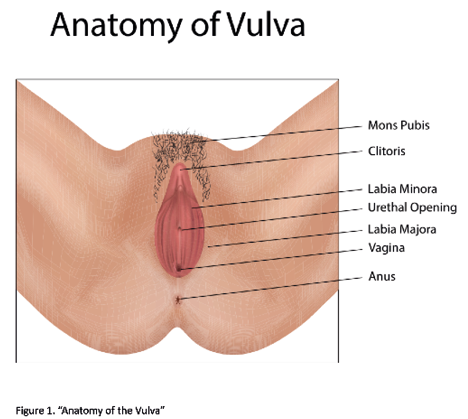
Using the search term “vulva” 1,738 images were retrieved, falling into three broad categories: (a) anatomical drawings of the vulva; (b) anatomical forms that represented more abstract renditions of genital anatomy, for example, simple black and white line drawings; or (c) metaphorical representations of the vulva that most often featured flowers or fruit. There were no images of material bodies, because these would be deemed to be pornographic in this context. Coloured anatomical drawings retrieved in the search depicted both internal and external female genitalia. The coloured anatomical drawings of external genitalia featured pink mucosa, taut labia, dark pubic hair, and thin legs. When the surrounding skin or limbs were included, the skin was almost always white. There was one anatomical drawing in the entire collection that showed tawny coloured skin. This collection of anatomical drawings suggested that genital anatomy belonged to people who were white, young, and thin. A typical example of an anatomical drawing in the collection can be seen in Figure 1 below.
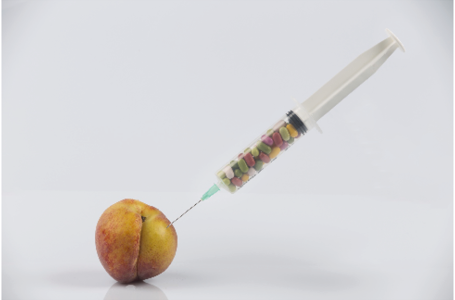
A search using the terms “vulva AND ageing” yielded 15 images. These included seven images of dried rose petals labelled “Dry Rose Concept Female Vagina and Female Health” (Figure 2), two images of dried leaves, labelled “Vulva Shaped Autumn Leaf” and “Beautiful Autumn Leaf on Black Background,” one image of a peach being injected with a syringe filled with pills, “Female Menopause and Sexual Disease Metaphor: Peach and Syringe with Pills Meaning Cosmetic and Health Treatment for Female Ageing,” (Figure 3) and one image of an dried avocado, “An Aged Avocado Skin and Pit Represent Labia and Women’s Genitals.” (Figure 4).


Searches using the terms “vulva AND older” produced no matches. Finally, searches using the terms “vulva AND older women” and then “vulva AND older woman” again produced no matches.
In this set of everyday images in stock photography, these few images of the ageing vulva were restricted to the realm of the metaphorical, suggesting drying, shriveled, or decaying parts or alternatively, genitalia in need of medical treatment for “Female Menopause and Sexual Disease.” There were no anatomical drawings to view representing the visible physiological changes that come with ageing.
Discussion
Ageing vulvas remain almost invisible in two current cultural resources in the public sphere: in one example of a body and vulva positive social media, The Vulva Gallery, and in the popular stock photography sites, Shutterstock. These study findings extend and confirm that vulvas which do not meet gendered and normalizing standards of youthfulness are often erased in the visual discourse of the everyday, occupying the category of that-which-must-not-be-seen. In the absence of a reservoir of visual images, older women and their bodies are subject to erasure[35], adding to “cultural invisibility and derision,”[36] and limiting possibilities in older women’s lives. When you fail to see yourself represented, it is a challenge to integrate, envision, and navigate what it means to grow old, especially as a sexual person.[37] When older women’s sexual anatomy is invisible or subject to derision, that marginality can be adopted and internalized, shaping what it is and limiting what might be.
Mock[38], a feminist writer, reminds us that resistance is possible. Despite cultural invisibility and negative representations, vulvas that are sagging, thinning, and no longer useful for reproduction, still exist – they “are still there,”[39] and it is likely that they matter to some people, at least some of the time, as they continue negotiate the gap between the body as a lived experience and ideals.
Viewed from a women’s health perspective, genital self-image is central to sexual and psychosocial health[40] and for most women, body image is often a lifelong issue, deserving consideration both in feminist and nursing theory, policy and practices around healthy ageing.[41] How should policy and practices be changed to introduce ageing sexual anatomy to visual culture? In a post-feminist world, I argue that we are not beyond deploying “old” second-wave feminist strategies that aim to interrupt the relegation of older women and their genitalia to private spaces. If ageing vulvas were represented in the public sphere, exposing tensions that stem from the gendered contradictions between public and private worlds, personal experiences might be changed, and regimes of representation might be resisted and understood differently. Provided with a reservoir of visual images, more accurate knowledge about sexual anatomy, and different understandings, women might navigate and envision the ageing process differently, offering more options for responsive action in their personal and collective lives.
Because older women have so few opportunities to create or view images of themselves[42], how images of ageing sexual anatomy might be taken up in the public sphere remains unexplored territory, even among feminist activists, nurses, and other sex positive health care providers, possibly to be developed as a site of feminist activism. Arts-based feminist work has traditionally led the way in bringing older women’s bodies away from the margins, but few projects that center on women’s ageing bodies have focused on sexual anatomy.
I make any suggestions for promoting alternative representations with some caution. Attaining alternative representations of ageing genitalia in the public sphere is difficult to achieve in the hierarchical networks of power that Collins describes, encouraging inequity in the distribution of social resources.[43] In addition, Foucauldian critics have warned against the dangers of pressing for or normalizing self-exposure, presenting increased opportunities to monitor, criticize, and control women’s bodies.[44] Yet, some older women, not unaccustomed to speaking out and voicing their own oppositional knowledge, have rebelled. These women have resisted the request to move on “to the margins of visibility.”[45] When older women tell stories and create images that represent their bodies and their circumstances, they challenge the erasure and pervasive discourses of ageing.[46] Hearing women’s perspectives and understanding how networks of power operate makes it possible to consider the vulva as a site of oppression and political struggle, a site at which it is possible to advance collective or individual interests. It is through the recognition of such struggles that women might come to understand their social context and make plans to change it.[47]
Four forums for activism have centered on older women’s bodies and older women’s experience, working to challenge current practices of representation and producing oppositional knowledge. These forums include (a) participatory research, (b) arts-based activism, (c) body positive social media sites, and (d) women’s health promotion. I will describe what I see as the possibilities in each area of practice or research.
- 1. Participatory action research
- From a critical feminist and critical gerontological perspective[48], participatory research approaches legitimize older women’s standpoint to analyze the visual representation of ageing bodies, including ageing genitals. An analysis of certain topics (relationships, ageing selves, sexuality in ageing, sexual anatomy, images vs. experiences, the invisibility and the visibility of the ageing bodies) and how these topics interrelate allows the creation of oppositional knowledge. In this context, participatory action research examining the discursive production of ageing female sexual anatomy and oppositional knowledge might provide ways of seeing and being seen, revising ageist and sexist interpretations.
- 2. Arts-based activism
- Contemporary feminist arts-based activism continues a long and respected feminist tradition, propelling images of the vulva into the public sphere and analyzing its relationship to social contexts, integrating themes of gender, power, sexuality, pleasure and desire, and domesticity.[49] Frischherz observed that women bringing vulvae in the public sphere “invokes agency,”[50] working to move shame from the private to public realm, where it can be reframed and attributed to social contexts that could be made otherwise.
- 3. Body positive social media
- Engagement with vulva positive social media sites such as The Vulva Gallery examined in this study may provide solidarity, social support, and accurate sexual health information to women of all ages, while celebrating vulva diversity.[51] Research has shown how women who contribute to these sites challenge normativity and create resistance by reframing how bodies are being looked at, serving a basis for reinterpreting individual and collective experience.[52]
- 4. Nursing and feminist health promotion
- Sexual health researchers recommend increased variety and visibility in showing the effects of ageing in visible depictions of female genitalia.[53] Since women’s internalized representations of their bodies are integral to their experiences of pleasure and desire,[54] more accurate visual reference points, including arts-based visual displays could promote dialogue between older women, patients, and their health care providers. These additional visual reference points, as the basis of frank discussion, could present entry-points in negotiating the multiple, complex meanings embedded in the embodied experience of ageing bodies and ageing sexual bodies. Accurate information, enriched understanding, and more-positive constructions of female sexual anatomy might also reduce growing investments made in genital surgery, including the most controversial interventions aimed toward “vaginal rejuvenation,”[55] performed primarily for esthetic reasons, and often related to the normal processes of ageing.
I also see the possibility of group health visits to provide anticipatory guidance and support for mid-life women and elders. Group health visits could include information exchange and community-building using arts-based approaches. Group medical visits providing anticipatory guidance about menopause have already been embraced by the medical community as a method of increasing practice efficiency, but additional motives inspire my suggestion. Drawing inspiration from second- and third-wave feminism, participants could make their own fabric or felted vulvas, enacting a new frankness and valorizing what it means to them as the material body ages. This arts-based approach would produce easily executed, yet accessible and playful products, making the connection between representation and empowerment, and between playfulness and pleasure and desire. Group crafting activities, as described, draw on the feminist knitting projects described by Helen King and others[56], aiming to work against the view that the ageing female genitals/body might only be read as deficient and invisible, and therefore unmentionable. Some women might even choose to attend a session on women’s midlife health if they thought it might extend beyond a presentation about decay and decline, presented in flat and sterile tropes of midlife health teachings.
In addition to promoting alternative visual discourses, opportunities for empowerment, and alternative ways of ageing, I suggest that health care providers maintain a critical awareness regarding the content of sexual-health-promotion resources. Sexual-health resources for midlife women may offer platitudes and glib reassurances, shaped in stereotyped, cisgender, white, affluent, and heteronormative accounts of growing older. These collude in many ways with the societal request to move to the margins and give up on the discursive production of identity. Life in the margins includes expectations of “acting” one’s age, ignoring that life is a continuum and that “women’s bodies do not exist in a timeframe that defines them as experiencing life before and after menopause.”[57]
There is considerable research on how women’s genitals are represented in the public sphere, but few feminist scholars and even fewer feminist nurse scholars have analyzed the current visual discourses of everyday that bring older women’s sexual anatomy into existence. The current study confirms a lack of representation in two current social media sites. Even in The Vulva Gallery, dedicated to celebrating body positivity, vulva diversity, and women’s empowerment, older women were rarely represented. In the Shutterstock stock photography site older women’s genitalia occupy only the realm of metaphor – that-which-must-not-be-seen. In a world where visual images are central to our understanding, the discursive production of older women’s sexual anatomy, by default, remains centered on medical and social notions of deficiency, describing a process of atrophy and decay – abject parts. What is represented to us shapes our understanding, so it is not surprising that older women often wrestle with their invisibility and their insertion into narratives of decline and decay that are “always already”[58] there. Some seek alternatives by navigating the complex and contradictory terrain of embodied ageing to find new ways of looking and being seen.
The strategies proposed here introduce variety and visibility in depicting older women’s sexual anatomy, reminding us of the importance of pleasure and desire and the agency that might be enacted in looking and being seen.[59] Critical awareness by feminists, artists, and health professionals of the visual representations of ageing bodies, including ageing sexual anatomy, could deconstruct dominant discourses. However, putting new images and more images into circulation will not be enough. Feminist intersectional analyses resist the power relations and social inequity that underlie the societal requests to move older women to the margins. Under different conditions, the visual landscape of our imagination can work in ways we cannot anticipate, transcending present discourses and inviting new beginnings.
Limitations
The results of my study must be viewed with some limitations. I examined visual images in one sex and body-positive social-media site and one stock photography site. It is possible that the modest scope of my analysis had some influence on my results. Given the relatively recent proliferation of body-positive social-media sites, additional research is needed to establish the generalizability of these findings. It would be useful to obtain a larger and more diverse sample of social media sites, beyond the scope of this study, to support the current findings. Future studies could examine additional images found in both print media and especially in feminist print media, to see how ageing sexual anatomy is represented differently there. In addition, an analysis of the text accompanying many of the images in The Vulva Gallery could enrich understanding of social and power relations at play in this site. Analysis of this text could contextualize the images and what it means to the women who participate in this vulva-positive website and others like them.[60]
Centering older women’s bodies and older women’s experience of their sexual anatomy in the visual landscape remains relatively uncharted cultural territory in the West. The potential exists to challenge current practices of representation, producing oppositional knowledge and new ways of seeing and being seen. As Meagher observes, beyond populating the visual landscape with more images of older women, future research could provide alternative “visual encounters that are more generative and reflective,”[61] moving beyond the reaches of ageism and the male gaze. These alternative encounters would be premised on the human need to look and be looked at[62], but insist on ways of looking that expand possibilities, to consider how female sexual anatomy might appear differently in the public eye, rendering the signs of ageing visible, yet holding potential in the travel of bodies through time.
Auteurs
Bibliography
Angelou, Kyveli, Grigoriadis, Themos, Diakosavvas, Michail, Zacharakis, Dimitris, Athanasiou, Stavros, “The Genitourinary Syndrome of Menopause: An Overview of the Recent Data”, 2020, Cureus, vol. 12, no 4, https://doi.org/10.7759/cureus.7586
Applin, Jo, “Generational Objects: Ida Applebroog’s History of Feminism”, Oxford Art Journal, 2017, vol. 40, no 1, p. 135-151, https://doi.org/10.1093/oxartj/kcx001
Atalanta, Hilde, “The Vulva Gallery,” URL: https://www.instagram.com/the.vulva.gallery/, consulted on 23.02.2025
Braun, Virginia, Wilkinson, Sue, “Socio-Cultural Representations of the Vagina”, Journal of Reproductive and Infant Psychology, 2001, vol. 19, no 1, p. 17-32, https://doi.org/10.1080/02646830020032374
Butler, Judith, Bodies That Matter: On the Discursive Limits of ‘Sex’, New York, Routledge, 1993
Cameron, Erin, Ward, Pamela, Mandville-Anstey, Sue Ann, Coombs, Alyssa, “The Female Ageing Body: A Systematic Review of Female Perspectives on Ageing, Health, and Body Image”, Journal of Women & Aging, 2019, vol. 31, no 1, p. 3-17, https://doi.org/10.1080/08952841.2018.1449586
Cherkasskaya, Eugenia, Rosario, Margaret, “The Relational and Bodily Experiences Theory of Sexual Desire in Women”, Archives of Sexual Behavior, 2019, vol. 48, no 6, p. 1659-1681, https://doi.org/10.1007/s10508-018-1212-9
Cobrin, Pam, “Introduction”, Women & Performance, 2012, vol. 22, no 1, p. 1-7
Fairchild, Pamela, Haefner, Jessica, Berger, Mitchell, “Talk About Sex: Sexual History Taking Preferences among Urogynecology Patients and General Gynecology Controls”, Female Pelvic Medicine & Reconstructive Surgery, 2016, vol. 22, no 5, p. 297-302, https://doi.org/10.1097/SPV.0000000000000291
Frischherz, Michaela, “Affective Agency and Transformative Shame: The Voices Behind the Great Wall of Vagina”, Women’s Studies in Communication, 2015, vol. 38, no 3, p. 251-272, https://doi.org/10.1080/07491409.2015.1061084
Fyfe, Gordon, Law, John, “Editor’s Introduction: On the Invisibility of the Visual”, in Picturing Power: Visual Depiction and Social Relations, ed. Gordon Fyfe, John Law, Sociological Review Monograph, 1998, p. 281
Garrett, Dawne, Lawton, Sandra, “The Effects of Ageing on Female Genital and Sexual Health”, British Journal of Nursing (Mark Allen Publishing), 2019, vol. 28, no 18, p. 1192-1195, https://doi.org/10.12968/bjon.2019.28.18.1192
Giussy, Barbara, Facchin, Federica, Buggio, Laura, Alberico, Diego, Frattaruolo, Maria Paola, Kustermann, Alfredo, “Vaginal Rejuvenation: Current Perspectives”, International Journal of Women’s Health, 2017, vol. 9, p. 513-519, https://doi.org/10.2147/IJWH.S99700
Gullette, Margaret, “Ending Ageism, or How Not to Shoot Old People”, Global Perspectives on Ageing, New Brunswick, Rutgers University Press, 2017, https://doi.org/10.2307/j.ctt1q1cqsm
Harvey, Kevin, Brookes, Gavin, “Looking through Dementia: What Do Commercial Stock Images Tell Us About Ageing and Cognitive Decline?”, Qualitative Health Research, 2019, vol. 29, no 7, p. 987-1003, https://doi.org/10.1177/1049732318814542
Heidegger, Martin, Being and Time, trans. John Macquarrie, Edward Robinson, London, SCM Press, 1962
Hekman, Susan, “Truth and Method: Feminist Standpoint Theory Revisited”, Signs: Journal of Women in Culture and Society, 1997, vol. 22, no 2, p. 341-365, https://doi.org/10.1086/495159
Hill Collins, Patricia, Fighting Words: Black Women and the Search for Justice, Minneapolis, University of Minnesota Press, 1998
Hughes, Sheila, “Lippy Women: Feminist Art Activism on a Catholic Campus”, Visual Culture and Gender, 2012, vol. 7, p. 26-38
Jones, Amelia, Self/Image: Technology, Representation, and the Contemporary Subject, London, Routledge, 2006
King, Helen, “From Print to Wool: Vesalius and the ‘Knit Your Own Womb Movement’”, paper presented at Uncovering the Female Sexual Anatomy: Depictions and Discourses, 16th-21st C., University of Victoria, 2021
Kingsberg, Sheryl, Schaffir, Jonathan, Faught, Brooke, Pinkerton, JoAnn, Parish, Sharon, Iglesia, Cheryl, Gudeman, Jennifer, Krop, Julie, Simon, James, “Female Sexual Health: Barriers to Optimal Outcomes and a Roadmap for Improved Patient-Clinician Communications”, Journal of Women’s Health, 2019, vol. 28, no 4, p. 432-443, https://doi.org/10.1089/jwh.2018.7352
Meagher, Michelle, “Against the Invisibility of Old Age: Cindy Sherman, Suzy Lake, and Martha Wilson”, Feminist Studies, 2014, vol. 40, no 1, p. 101-143, https://doi.org/10.1353/fem.2014.0023
Mock, Roberta, “Stand-up Comedy and the Legacy of the Mature Vagina”, Women & Performance: A Journal of Feminist Theory, 2012, vol. 22, no 1, p. 9-28, https://doi.org/10.1080/0740770X.2012.685394
Moore, Lisa Jean, Clarke, Adele E., “Clitoral Conventions and Transgressions: Graphic Representations in Anatomy Texts, C. 1900-1991”, Feminist Studies, 1995, vol. 21, no 2, p. 255, https://doi.org/10.2307/3178262
Mowat, Hayley, Shields Dobson, Amy, McDonald, Karalyn, Fisher, Jane, Kirkman, Maggie, “‘For Myself and Others Like Me’: Women’s Contributions to Vulva-Positive Social Media”, Feminist Media Studies, 2020, vol. 20, no 1, p. 35-52, https://doi.org/10.1080/14680777.2018.1546209
Perfecta, « Image et imaginaire du corps féminin », URL : https://perfecta.hypotheses.org/, consulted on 23.02.2025
Piercy, Marge, “I Met a Woman Who Wasn’t There”, NWSA Journal, 2006, vol. 18, no 1, p. 1-2
“Reports from University of California Describe Recent Advances in Sexual and Reproductive Health (Characteristics of Genital Dissatisfaction among a Nationally Representative Sample of US Women)”, Health & Medicine Week, 2018, p. 4682, https://doi.org/10.1353/nwsa.2006.0018
Schick, Vanessa R., Rima, Brandi N., Calabrese, Sarah K, “Evulvalution: The Portrayal of Women’s External Genitalia and Physique across Time and the Current Barbie Doll Ideals”, The Journal of Sex Research, 2011, vol. 48, no 1, p. 74-81, https://doi.org/10.1080/00224490903308404
Shutterstock, URL: https://www.shutterstock.com/home, consulted on 23.02.2025
Tilt, Edward, The Change of Life in Health and Disease: A Clinical Treatise on the Diseases of the Ganglionic Nervous System Incidental to Women at the Decline of Life, New York, Bermingham and Company, 1882, https://doi.org/10.1097/00000441-188301000-00036
Warren, Lorna, Richards, Naomi, “‘I Don’t See Many Images of Myself Coming Back at Myself’: Representations of Women and Ageing”, in Representing Ageing: Images and Identities, ed. Virpi Ylänne, London, Palgrave Macmillan UK, 2012, p. 149-168, https://doi.org/10.1057/9781137009340_10
Whittaker, Ruth, “Re-Framing the Representation of Women in Advertisements for Hormone Replacement Therapy”
Wilson, Robert, Feminine Forever, New York, Evans and Company, 1968
Woodward, Kathleen, “Performing Age, Performing Gender”, National Women’s Studies Association Journal, 2006, vol. 18, no 1, p. 162-169, https://doi.org/10.1353/nwsa.2006.0023
Notes
- 1 M. Piercy, “I Met a Woman Who Wasn’t There”, National Women’s Studies Association Journal, 2006, vol. 18, no 1, p. 1-2.
- 2 G. Fyfe, J. Law, ed., “Editor’s Introduction: On the Invisibility of the Visual in Picturing Power: Visual Depiction and Social Relations”, Sociological Review Monograph, 1988.
- 3 W. W. Dyer, “Success Secrets”, Hay House, URL: https://www.drwaynedyer.com/about-dr-wayne-dyer/, consulted on 26.05.2021.
- 4 M. Meagher, “Against the Invisibility of Old Age: Cindy Sherman, Suzy Lake, and Martha Wilson”, Feminist Studies, 2014, vol. 40, no 1, p. 101-143.
- 5 F. Palma et al., “Vaginal Atrophy in Women Postmenopause: Results from a Multicentric Observational Study: The AGATA Study”, Maturitas, 2016, vol. 83, p. 40-44.
- 6 V. R. Schick, B. N. Rima, S. K. Calabrese, “Evulvalution: The Portrayal of Women’s External Genitalia and Physique across Time and the Current Barbie Doll Ideals”, The Journal of Sex Research, 2011, vol. 48, no 1, p. 74-81.
- 7 L. J. Moore, A. E. Clarke, “Clitoral Conventions and Transgressions: Graphic Representations in Anatomy Texts, C 1900-1991”, Feminist Studies, 1995, vol. 21, no 2, p. 255.
- 8 E. Cherkasskaya, M. Rosario, “The Relational and Bodily Experiences Theory of Sexual Desire in Women”, Archives of Sexual Behavior, 2019, vol. 48, no 6, p. 1659-1681.
- 9 J. Butler, Bodies That Matter: On the Discursive Limits Of ‘Sex’, New York, Routledge, 1993, p. 8.
- 10 S. Kingsberg et al., “Female Sexual Health: Barriers to Optimal Outcomes and a Roadmap for Improved Patient-Clinician Communications”, Journal of Women’s Health, 2019, vol. 28, no 4, p. 432-443.
- 11 S. Kingsberg et al., op. cit., p. 432.
- 12 D. Garrett, S. Lawton, “The Effects of Ageing on Female Genital and Sexual Health”, British Journal of Nursing (Mark Allen Publishing), 2019, vol. 28, no 18.
- 13 S. Kingsberg et al., op. cit., p. 434.
- 14 F. Pamela, H. Jessica, B. Mitchell, “Talk About Sex: Sexual History Taking Preferences among Urogynecology Patients and General Gynecology Controls”, Female Pelvic Medicine & Reconstructive Surgery, 2016, vol. 22, no 5, p. 297-302.
- 15 K. Woodward, “Performing Age, Performing Gender”, National Women’s Studies Association Journal, 2006, vol. 18, no 1, p. 162-169; S. Hughes, “Lippy Women: Feminist Art Activism on a Catholic Campus”, Visual Culture and Gender, 2012, vol. 7, p. 26-38; M. Meagher, op. cit., p. 101-143; M. Gullette, “Ending Ageism: Or How Not to Shoot Old People”, Global Perspectives on Ageing, New Brunswick Rutgers University Press, 2017; L. Warren, N. Richards, “‘I Don’t See Many Images of Myself Coming Back at Myself’: Representations of Women and Ageing”, Representing Ageing: Images and Identities, ed. V. Ylänne, London, Palgrave Macmillan UK, 2012, p. 149-168.
- 16 M. Frischherz, “Affective Agency and Transformative Shame: The Voices Behind the Great Wall of Vagina”, Women’s Studies in Communication, 2015, vol. 38, no 3, p. 251-272; V. Braun, S. Wilkinson, “Socio-Cultural Representations of the Vagina”, Journal of Reproductive and Infant Psychology, 2001, vol. 19, no 1, p. 17-32.
- 17 « Image et Imaginaires Du Corps Féminin », Perfecta, Hypotheses, URL: https://perfecta.hypotheses.org/, consulted on 2.05.2021.
- 18 L. J. Moore, A. E. Clarke, op. cit., p. 255-301.
- 19 L. Warren, N. Richards, op. cit., p. 159.
- 20 Ibid.
- 21 J. Applin, “Generational Objects: Ida Applebroog’s History of Feminism”, Oxford Art Journal, 2017, vol. 40, no 1, p. 135.
- 22 K. Angelou et al., “The Genitourinary Syndrome of Menopause: An Overview of the Recent Data”, Cureus, 2020, vol. 12, no 4.
- 23 E. Tilt, The Change of Life in Health and Disease: A Clinical Treatise on the Diseases of the Ganglionic Nervous System Incidental to Women at the Decline of Life, New York, Bermingham and Company, 1882.
- 24 R. Wilson, Feminine Forever, New York, Evans and Company, 1968, p. 43.
- 25 J. Frueh, “Vaginal Aesthetics”, Hypatia, 2003, vol. 18, no 4, p. 137.
- 26 M. Meagher, op. cit., p. 101-143.
- 27 Ibid., p. 104.
- 28 M. Frischherz, op. cit., p. 256.
- 29 L. J. Moore, A. E. Clarke, op. cit., p. 255-301.
- 30 M. Meagher, op. cit., p. 101-143.
- 31 A. Jones, Self/Image: Technology, Representation, and the Contemporary Subject, London, Routledge, 2006, p. 215.
- 32 H. Atalanta, “The Vulva Gallery”, URL: https://www.instagram.com/the.vulva.gallery/, consulted on 15.12.2019.
- 33 Shutterstock, URL: https://www.shutterstock.com/home, consulted on 2.04.2021.
- 34 K. Harvey, G. Brookes, “Looking through Dementia: What Do Commercial Stock Images Tell Us About Ageing and Cognitive Decline?”, Qualitative Health Research, 2019, vol. 29, no 7, p. 989.
- 35 J. Butler, Bodies That Matter: On the Discursive Limits Of ‘Sex’.
- 36 M. Meagher, op. cit., p. 101-143.
- 37 L. Warren, N. Richards, op. cit., p. 159.
- 38 R. Mock, “Stand-up Comedy and the Legacy of the Mature Vagina”, Women & Performance: a journal of feminist theory, 2012, vol. 22, no 1.
- 39 R. Mock, op. cit., p. 13.
- 40 T. Rowen, T. Gaither, A. Shindel, B. Breyer, “053 Characteristics of Genital Satisfaction Among a Nationally Representative Sample of US Women”, The Journal of Sexual Medicine, 2018, vol. 15, no 6.
- 41 E. Cameron et al., “The Female Ageing Body: A Systematic Review of Female Perspectives on Ageing, Health, and Body Image”, Journal of Women & Ageing, 2019, vol. 31, no 1, p. 3-17.
- 42 L. Warren, N. Richards, op. cit., p. 149.
- 43 P. H. Collins, Fighting Words: Black Women and the Search for Justice, Minneapolis: University of Minnesota Press, 1998.
- 44 H. Mowat et al., “For Myself and Others Like Me”: Women’s Contributions to Vulva-Positive Social Media”, Feminist Media Studies, 2020, vol. 20, no 1.
- 45 P. Cobrin, “Introduction”, Women & performance, 2012, vol. 22, no 1.
- 46 L. Warren, N. Richards, op. cit., p. 149.
- 47 S. Hekman, “Truth and Method: Feminist Standpoint Theory Revisited”, Signs Journal of Women in Culture and Society, 1997, vol. 22, no 2.
- 48 L. Warren, N. Richards, op. cit., p. 150.
- 49 J. Applin, op. cit., p. 147-149; L. Warren, N. Richards, op. cit., p. 149-169; S. Hughes, op. cit., p. 26-38; Frischherz, op. cit., p. 251-272.
- 50 M. Frischherz, op. cit., p. 251.
- 51 H. Mowat et al., “ʽFor Myself and Others Like Me’: Women’s Contributions to Vulva-Positive Social Media”, Feminist Media Studies, 2020, vol. 20, no 1, p. 35.
- 52 Ibid., p. 35-52.
- 53 V. R. Schick, B. N. Rima, S. K. Calabrese, “Evulvalution: The Portrayal of Women’s External Genitalia and Physique across Time and the Current Barbie Doll Ideals”, Journal of Sex Research, 2011, vol. 48, no 1, p. 74-81.
- 54 V. R. Schick, B. N. Rima, S.K. Calabrese, op. cit., p. 79.
- 55 B. Giussy et al., “Vaginal Rejuvenation: Current Perspectives”, International Journal of Women’s Health, 2017, no 9, p. 513.
- 56 H. King, “From Print to Wool: Vesalius and the ‘Knit Your Own Womb Movement’”, paper presented at the Uncovering the Female Sexual Anatomy: depictions and discourses, 16th-21st C., University of Victoria, 2021.
- 57 R. Whittaker, “Re-Framing the Representation of Women in Advertisements for Hormone Replacement Therapy”, Nursing Inquiry, 1998, vol. 5, no 2, p. 84.
- 58 M. Heidegger, Being and Time, trans. J. Macquarrie, E. Robinson, London, Scm Press, 1962.
- 59 M. Meagher, op. cit., p. 29.
- 60 H. Mowat et al., op. cit., p. 35-52.
- 61 M. Meagher, op. cit., p. 142.
- 62 Ibid., p. 143.