Covering the Feminine Form in the Osler Library of the History of Medicine
 https://orcid.org/0000-0002-7858-2122
Osler Library of the History of Medicine, McGill University
mary.yearl@mcgill.ca
SUMMARY
To William Osler, a firm grasp of the history of medicine was integral to the formation of a good doctor. This conviction drove his decision to amass a history of medicine library for the McGill Medical Faculty. Osler’s purpose was to create a library that reflected the intellectual foundations of the medical profession, yet he also realized that the act of collecting a library was subjective. This chapter examines the biases inherent in Osler’s Library with respect to women: biases in their representation as authors and subjects, and biases present within the pages of books Osler selected. Through its holdings and internal organization, the library unconsciously reinforced dominant society’s notions of female sexuality. The Osler Library today preserves a broad range of literature available to researchers who are interested in the female body and sexuality, a development that reflects changes in the dominant social and cultural fabric.
KEYWORDS – William Osler, libraries, female anatomy, sexism
Découvrir la forme féminine dans la bibliothèque Osler de l’histoire de la médecine
RÉSUMÉ
Pour William Osler, bien saisir l’histoire de la médecine était cruciale à la formation d’un bon médecin. C’est cette conviction qui était derrière sa décision d’amasser une bibliothèque dédiée à l’histoire de la médecine pour la Faculté de médecine de McGill. Le but d’Osler était de créer une bibliothèque qui reflétait les fondements intellectuels de la profession médicale, mais il était aussi conscient de la subjectivité dans l’acte de collectionner une bibliothèque. Ce chapitre examine les biais inhérents dans la bibliothèque d’Osler en ce qui à trait aux femmes : des biais dans leur représentation comme autrices et comme sujets, et des biais présents dans les pages des livres qu’il a sélectionnés. À travers ses livres et son organisation interne, la bibliothèque a renforcé de manière inconsciente les notions de la sexualité féminine de la société dominante. Aujourd’hui, la bibliothèque Osler conserve une large étendue de littérature disponible aux chercheurs intéressés par le corps et la sexualité féminins, un développement qui reflète les changements survenus dans le tissu social et culturel dominant.
MOTS-CLÉS – William Osler, bibliothèques, anatomie féminine, sexisme
1. Introduction
“The collecting of a library” is William Osler’s descriptive introduction to the Bibliotheca Osleriana, the original printed catalogue of the Osler Library of the History of Medicine. At twelve pages, it is not lengthy, but it is revealing. As Osler wrote in the essay, “A library represents the mind of its collector, his fancies and foibles, his strength and weakness, his prejudices and preferences.”[1] The library that Osler promised to the Medical Faculty of McGill University in a deed of gift dated 1 October 1911 was not a random collection of books he picked up over the years; he was an active and deliberate curator who designed his library to serve a specific purpose, one that he described in clear detail in his introduction. During his years of collecting, he was upfront about his focus, in one case writing, “I am collecting on two lines – books that are of historical importance in the evolution of medicine, and books that have interest through the character or work of their authors. In that way I limit the field, which is large enough!”[2]
Bearing in mind that Osler amassed the materials for his library according to a careful plan, this chapter addresses what the works in Osler’s Library say about the place of women, and more specifically female bodies, in his conception of the history of medicine. Moreover, if a library represents the mind of its collector, what do more recent acquisitions say about the position of women within the framework of those who have expanded the Osler Library of the History of Medicine beyond Osler’s original bequest of nearly 8,000 volumes?
The main point that arises from this intellectual expedition is that collectors cannot and should not be removed from the respective microcosms they inhabit. Osler may have focused on the individual, but the “prejudices and preferences” he highlighted were not products of spontaneous generation; they were born of a dominant social and cultural fabric. Lucien Febvre’s 1942 admonition that, “every period mentally constructs its own image of the historical past”[3] reminds us that librarians’ choices are informed not only by precedent but by prevailing values that guide them to make purchases relevant to the users of their time. The act of collecting for a library is a subjective exercise.
2. Dissecting the Bibliotheca Osleriana
Osler’s description of his library does not immediately suggest that women had much of a place in his project. They are entirely absent from his overview of the Bibliotheca Osleriana’s subdivisions, in which he twice reinforced the presumption of male as default by employing a generic “men” in his heading descriptions (emphasis in quoted text mine):
I. Prima, which gives in chronological order a bio-bibliographical account of the evolution of science, including medicine. – II. Secunda, the works of men who have made notable contributions, or whose works have some special interest, but scarcely up to the mark of those in Prima. – III. Litteraria, the literary works written by medical men, and books dealing in a general way with doctors and the profession. – IV. Historica, with the stories of institutions, & c. – V. Biographica. – VI. Bibliographica. – VII. Incunabula, and – VIII. Manuscripts.[4]
Osler created his library with the purpose of providing the medical profession – and especially students – access to the works that lay the foundations of the history of medicine. It is clear from his description that the profession he imagined was a thoroughly male one, and one that was implicitly white and Christian. When Osler was at McGill, as a student and later as a professor, there were no female students in the Faculty of Medicine. Shortly after Osler left McGill for the University of Pennsylvania, early female McGill graduates Octavia Grace Ritchie (B.A. 1888) and Maude Abbott (B.A. 1890) were flatly refused entry to study medicine, that refusal being made specifically on the basis of sex.[5] Ritchie and Abbott instead completed their medical studies at nearby Bishop’s College. As Michael Bliss noted, “The real ‘others,’ the strangers, in Osler’s medical life were women. Osler had grown up in what was effectively an all-male medical world.”[6] Indeed, women were not admitted to study medicine at McGill until the year before Osler’s death, meaning that it was a male medical institution during the time he was building the library. A sense of the overwhelming maleness of Osler’s Library is reinforced by the observation that there is only one female – Florence Nightingale – deemed important enough to the history of medicine to have her own distinct heading in the Prima section of the catalogue. A century after Osler’s death it seems appropriate to ask – borrowing Osler’s own words from a different context – are there “errors of omission and commission”[7] relating to the female form, in the Bibliotheca Osleriana?
The short answer is: of course, there are errors of omission and commission. There always will be. Nonetheless, an examination of the Bibliotheca Osleriana via its index undermines any suggestion that Osler devalued women or their contributions to medicine. It is true that he is clearly on record stating that he did not think the profession suited them;[8] nonetheless, there are many examples – from Johns Hopkins, McGill (after he had left), and Oxford – of him advocating for specific medical women who clearly ranked as valued peers in his eyes.[9] Given this record of supporting female colleagues, it should not come as a surprise to learn that there are 185 women listed in the index (as author, subject, artist, donor, etc.).[10] While the entry for “anatomy” is extensive but contains no sub-heading specific to women, several of the subjects listed relate directly to females or would likely reveal some sources relevant to women: anaesthesia; chastity; cosmetics; demonology; fecundity; feminism; forceps; midwifery; generation; gynaecology; hysteria; marriage; midwifery; nursing; occultism; ovariotomy; receipts; sex; symphysis pubis; twilight sleep; uterus; virginity; witchcraft; women.
Delving further into the index, the subject category for women contains sub-categories for women physicians and women soldiers and suggests that one look also under the headings of feminism, sex, and virginity. While obstetrics has its own listing, it serves simply as a referral to “see Midwifery,” for which one finds seventy-one entries and a further twenty entries that are tagged as relating to the history of midwifery; within these two categories, three works are cross-listed as containing information about “men midwives,” who enjoy their own place in the index. Although the medical literature in Osler’s day made associations between hysteria and insanity[11], Osler’s index is noteworthy in that neither of those entries cross-references the other.[12] Meanwhile, the entry for hysteria does cross-reference demonology and witchcraft, but those are one-way referrals: neither demonology nor witchcraft includes a “see also” for hysteria. Occultism is cross-referenced under both demonology and witchcraft, but not under hysteria, despite that the entry for occultism does refer readers to hysteria.
3. Dangerous women
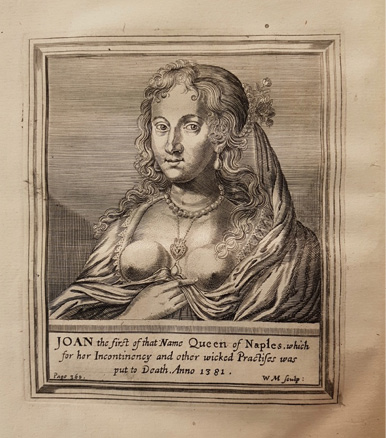
One point that arises from the observations made in the above section is the cultural association of deviance or evilness (e.g., witchcraft, demonology) with female expressions of sexuality.[13] This point is represented visually in a selection of the library’s books, whose inherent biases are in turn reflected in the catalogue’s cross-referencing. This remark is not intended to suggest that Osler himself made these associations between female sexuality and deviance, but the index demonstrates that he – or perhaps more accurately, final index compilers W.W. Francis, R.H. Hill, and Archibald Malloch – recognized their existence in works he collected. The appearance of demonized women is sometimes incidental to Osler’s motivation for collecting, but those instances nonetheless provide powerful examples of the precarity of women in society. The image of Joanna I (1326-1382), Queen of Naples, in Thomas Fuller’s The Holy State and the Profane State is a case in point. Osler’s content notes highlight what we can presume to be his reasons for including this work in the Bibliotheca Litteraria: the inclusion of “The good physician” and “The life of Paracelsus” in book two. Although this indicates that he collected the book for its medical content, he also made a note in his catalogue of “The profane state,” the fifth book in the volume, wherein the second chapter gave Joanna I distinctly misogynistic treatment.[14]
The image of Joanna I included in “The profane state” allows for the pretense of respectability on the part of the author while highlighting the queen’s lack of respectability in a way that is quasi-pornographic. Fuller describes her as “a woman of a beautifull body and rare endowments of nature, had not the heat of lust soured all the rest of her perfections.”[15] His account of her “wicked life”[16] is as voyeuristic as it is judgmental. He takes care to note that she had no children “either because the drought wantonness parched the fruit of her womb; or else because provident Nature prevented the generation of Monsters from her.”[17] Meanwhile, the portrait he includes serves to reaffirm her sin while titillating his audience by the presentation of her full breasts, including prominent nipples, resting above her dress.
Visually striking in a different way is Johann Remmelin’s flap anatomy, Catoptrum microcosmicum, which offers a paper dissection of the human body, including a section specifically on the female sexual anatomy, recently analyzed by Rosemary Moore.[18] In the 1619 edition, one can only examine the female genitalia and womb after first pulling back a paper sheet, then folding down the head of a figure that seems to invoke both the devil and Medusa, which is inscribed invidia at the top of the frame, orge across the forehead, diabole across the left shoulder, and neanias across the right shoulder.[19]
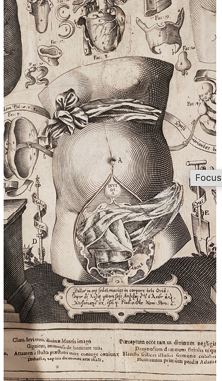
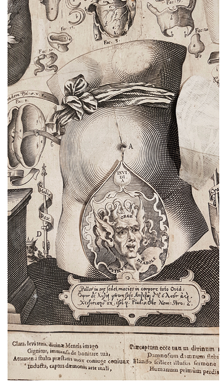
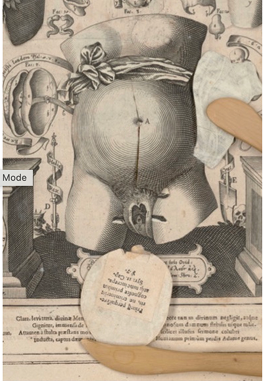
What the imagery in Remmelin and Fuller speak to is a common if conflicting representation of women. Depictions of their sexuality or sexual anatomy highlight the dangers of the female sex, while likely serving a pornographic purpose for some of those who interacted with them. The line between sexual information intended for arousal and that posing as medical knowledge can be fine. Though different in their message and approach, both Remmelin and Fuller exhibit how female sexuality could be regarded as errant and sinister. At the same time, Remmelin’s work uses the flaps to suggest visually the potential to gain secret biological knowledge.
There is a considerable amount of overlap between works that deal with medical aspects of female sexuality (e.g., midwife manuals) and those that provided advice for generating healthy offspring. Dealing with the act of sex rather than pregnancy and childbirth, the latter were more likely to offer sexual arousal disguised as education. Osler tended towards the ostensibly medical over the merely sexual in the items he selected for his library. This is apparent in his acquisition of four sixteenth-century editions of Eucharius Rösslin’s works on midwifery, including the first edition of his manual for midwives, Der Swangern Frauwen und Hebammen Rosegarten (1513), two subsequent editions in Latin, and one English translation.[20] What is significant to note, however, is that Rösslin’s work appeared when male midwives were increasing their presence and power in the birthing process.[21] Osler’s attention to Rösslin highlights the privilege he gave to midwifery (recall: seventy-one entries in the index), while raising the question of whether he prioritized the professionalism associated with male entry into a traditionally female realm of medical care. This focus on the medical profession, and on medical knowledge that had academic approval, is important. Works that were about sexuality and generation but which had lacked purported medical legitimacy were of less interest to him. For instance, Pseudo-Aristotle’s Masterpiece was a popular sex guide from the eighteenth century, but Osler included only one of those in his original donation.[22]
Osler may not have been interested in popular guides like the Masterpiece or popular anatomical flap books like Remmelin, but he was drawn to medical curiosities. In some cases, his fascination reinforces a sense of ignorant wonder at the female sex. The story of Mary Toft, who allegedly gave birth to rabbits in 1726, touches upon many of the themes that surface when we start to examine the treatment of and dialogues about females in medical literature written predominantly by men. The doctors who examined and wrote about Mary Toft reveal a fascination with a medically impossible case and in so doing reveal prevailing professional ignorance about the female body. Mary Toft is presented as an ignorant woman, yet the ignorance that is projected onto her and other women both allows and perpetuates this sort of fantastical tale that encourages awe, fear, and mistrust of women’s sexuality in general.[23] As outlined by Karen Harvey, the case of Mary Toft was further complicated by the social, economic, and political conditions, not to mention power dynamics, in her village.[24]
The suspicion of women goes beyond suggestions of moral corruption; in the case of Mary Toft, the ignorance of women projected onto a woman, was achieved under the guise of medical curiosity. Osler’s inclusion of Mary Toft was not limited to a pamphlet or two; he was interested enough, fascinated enough, to purchase a comprehensive bound volume of published and manuscript pamphlets on Toft collated in the eighteenth century by George Steevens and purchased at auction in 1800 by the Duke of Roxburghe, who in turn added to the collection a letter claiming to be from one of the men who examined Toft. It is interesting to read in the catalogue Osler’s note that he was drawn to Mary Toft’s case as “one of the most celebrated instances of hysterical deception.”[25]
The collection of pamphlets and notes on Toft was not the only case pertaining to a gestating body that Osler found exciting enough to collect. A related fascination and mystery (and, again, a judgment of something aberrant in presumed-female sexuality) may be seen in Osler’s interest in James Barry, who was raised as a female but who entered the medical faculty at Edinburgh as James Barry in 1809 and enjoyed a full career as a male British military surgeon. Osler was too young to have crossed paths with Barry, but knew of him via common contacts in Montreal. Years after Barry’s death in London in 1865, which resulted in the revelation of his sexual anatomy and a presumed past pregnancy, Osler sought – unsuccessfully – to procure an autopsy report.[26]
4. Osler under the microscope
Osler not only collected select items about the mysteries of female sexuality, he wrote about them, albeit under a pseudonym. Two of the most notorious writings of his alter ego, Egerton Yorrick Davis, are further reflections of both a personal and societal ignorance of and fascination with the female body: “Professional notes among the Indian tribes about Gt Slave Lake, NWT” (1882) and an editorial under the heading “Vaginismus” (1884). These pieces perpetuate the idea that one can joke about women in ways that highlight women’s sexual health as mysterious while unlocking that mystery via descriptions that might be regarded as pornographic. Osler wrote “Professional notes” when he was making his name as a professor at McGill; it was never published in his lifetime and was intended as a practical joke on his rival and socio-economic superior Dr. William A. Molson.[27] The piece relies heavily upon the racist anthropology of G.J. Engelmann, who in 1881 and 1882 published, respectively, “Posture in Labour: An Ethnographical Study” and Labour among Primitive Peoples.[28] Even if Osler knew that the content had no basis in reality, his choice of joke plays with the ignorance and imagination of dominant white society as he describes being allowed to witness childbirth in an Indigenous community. As Jenna Healey notes in her criticism of the piece, humour “can be invaluable for interrogating professional values that are rarely made explicit.”[29] What does it say about the male medical profession and its continued enjoyment of a piece that “reads like a catalogue of racist tropes about Indigenous peoples.”[30] Crucially for this article, which examines women in the collections of the Osler Library, we must acknowledge the role that the library itself played in the afterlife of “Professional notes”. Healey describes how the manuscript of this famously suppressed hoax took on a life of its own when the first Osler Librarian, W.W. Francis, ensured that it was “displayed, circulated, and even read aloud at parties, a tradition arguably more ‘vile’ than any of the customs described therein.”[31]
As seen with Mary Toft, a recurring theme in these fantastical accounts is ignorance on the part of a male author who in turn presents his subject as ignorant and unreasonable. In the case of “Professional notes,” the negative impact is exacerbated by Osler’s reliance upon racist stereotypes and language. The second item in question, an editorial on vaginismus resulting in penis captivus (“de cohesione in coitu”), does not contain the blatant racism of “Professional notes” but it does play into the simultaneous fear and ignorance of female sexuality while purporting to make a joke of it. Unlike “Professional notes,” this piece was published: in the Medical News of Philadelphia not long after Osler left McGill to take up a post at the University of Pennsylvania.[32]
When weighing the sexism – and, with “Professional notes,” the racism – inherent in the works described above, it is worth recalling that the maleness of Osler’s Library reflects the same in Western medicine. The world he inhabited, the academic world of the late-nineteenth and early-twentieth centuries, was overwhelmingly a world of white Protestant men. Even if women were not universally considered the derivative sex, males were undeniably the normative one. Thus, when women appear, it tends to be for that aspect that most obviously deviates from the norm: the ability to gestate.[33] There was a long tradition of looking at women as gestational bodies. Govard Bidloo’s 1685 Anatomia humani corporis, whose images by Gérard de Lairesse are reproduced in William Cowper’s 1698 The anatomy of humane bodies, with figures drawn after the life, illustrates this well.[34] In the opening pages Bidloo presents a male figure, then a female; this is a format that Cowper copies, while translating the text into English. Cowper’s remarks on the female focus on her shape, including narrow shoulders and wide hips, and incorporate comments relating to the impact of pregnancy and menstruation on swelling in the legs. About the diagram of a female he says, simply, “The other remarkable Parts, which differ from a Man, and appear Externally in a Woman, are; …The Mammae.…The Pudendum.”[35] These massive anatomical works (they are elephant folios, the Osler Library copies measuring 53 and 58 centimetres, respectively) present a third diagram with general points of posterior human anatomy and for this Lairesse offers a female body. One wonders if that choice was made to provide male readers with an opportunity to gaze safely and almost secretly upon the body of a woman: the view is from behind, her head turned straight out over her shoulder.
Even though the female sexual anatomy was shrouded – quite literally in Remmelin’s flap book – in ignorance and suspicion, it still lay within the purview of male medical knowledge. The authorities in Osler’s library were male, with a few exceptions. At the same time, there are hints that Osler was somewhat self-conscious about the potential women had to contribute to the corpus of medical knowledge, though they had been denied the opportunity to do so. His note about Trotula illustrates that he had what was, for his time, an unusual appreciation and respect for female intellectual peers. He may have included Trotula’s De passionibus mulierum (1547) because of its importance to the history of medicine, but he went a step further in adding an editorial note to the catalogue: “The first woman professor has been deprived of more than her chair by the unchivalrous mythoclasts of the school of Sudhoff,” taking clear exception to Charles Singer’s assertion that the name “Trotula” was the result of a misunderstanding based upon a male Salernitan doctor “Trottus.”[36]
Women appear in works on anatomy, but as noted above there is no cross-referencing within the index to inform researchers which of those contain information on female sexual anatomy. Perhaps women played a small role in most of these works, but one might wonder why Osler, and those who continued work on the Bibliotheca Osleriana index after his death, did not think to provide cross-references to those authors who devoted more than the odd page to female anatomy: e.g., Charles Estienne, who included a series of ten images of a pregnant woman in the third book of De dissectione partium corporis humani (1545).[37]
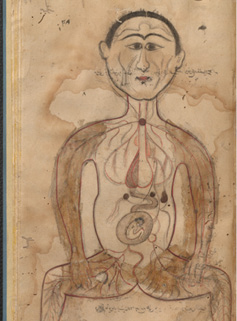
A second point about the female form in Osler’s library is that even though women themselves appear in an unexpectedly high number, they are not given priority. It is true that Osler awarded Florence Nightingale her own section in the Bibliotheca Prima, but when one looks more closely at entries relating to the female sexual anatomy: gynaecology, ovariotomy, uterus, and adding in midwifery for good measure, he placed very few in the Bibliotheca Prima. Under gynaecology, he included male authors: a section of works by and about Soranus of Ephesus (B.O. 318-324), and then Johann Lachs’ 1903 Die Gynaekologie des Galen. Eine geschichtlich-gynaekologische Studie (B.O. 414). Under Midwifery, there is one Hippocratic work listed in the Prima (B.O. 157), the same works by Soranus are repeated under “gynaecology,” and finally Florence Nightingale’s work on Lying-In Hospitals, which is among those included in her named section. In other words, out of 1,703 entries in the Prima, there is very little – if anything – that is thought to be foundational about the female body or its treatment. The sense that comes out of the Bibliotheca Osleriana is mixed: women appear in greater number and are clearly valued as more than gestational vessels, yet they continue to suffer from the invisibility experienced by those who are not the normative sex. Moreover, where women do appear, the reason for that appearance in early texts tends to be for a male author to provide information about women’s sexual anatomy. For modern scholars, those images of women do provide an opportunity to compare representations of female reproductive anatomy across cultures, as can be seen in the pregnant female depicted in two works inspired by medieval manuscripts: a printed copy of Joannes de Ketham’s Fasciculus medicinae (1500) and a ca. 1600 manuscript copy of Manṣūr ibn Muḥammad’s Tashrīḥ-i badan.[38]

5. The library post-Osler
In the century since Osler’s death, some progress has been made in balancing the content of the library. This has come with changes in the medical world itself. Not only do women study medicine, as they were not permitted to do at McGill during Osler’s time, but medical schools in North America now routinely enroll classes that are more than fifty percent female and are increasingly ethnically diverse. Despite that his ashes rest in the Osler Niche beneath the Vernon plaque, Osler did not imagine his library to be a static metaphorical mausoleum. In the same introduction where he lay out the purpose of his library and its structure, among his final words were, “I hope to make provision for [the library’s] extension and upkeep.”[39] He intended for his library to be a seed for an expanding and dynamic collection.
There is some irony in following Osler’s vision to overcome silences within his library. The number of acquisitions that touch upon female sexual anatomy – deliberately or in passing – has increased considerably since his death. Today, the Osler Library for the History of Medicine has collections that not only support the study of the female form in Western medicine, but also allow for cross-cultural comparison. New additions to the collections span many centuries and make the collection far more global than it was a century ago. The changes reflect more diversity not only in the medical field, but also in the academic world. History of medicine as a discipline has become firmly established in way it was not when Osler created his library; that field, too, reflects increasing diversity: of personnel, of thought. Anecdotally, I recall female history professors in the early 1990s remarking that they would never have dared to study women until after they received tenure. Such a climate discourages the acquisition of materials by and about women, but with an increase in the number of scholars recognizing the intellectual legitimacy and originality of such research, library acquisitions have increased to support that work.
Not all books featuring women have been acquired because of their attention to the feminine form. In the library today, the works of Jacques Fabien Gautier D’Agoty enjoy a place of prominence, yet Osler did not own a single one of these volumes. They are visually striking and one wonders whether Osler might have been amused by the frankly bizarre depictions of sexual anatomy; regardless, the absence of Gautier D’Agoty’s work in the Bibliotheca Osleriana indicates that he did not meet Osler’s collecting criteria. Although Gautier D’Agoty’s work may be of questionable utility to the study of medical anatomy, it is important in that he explored human sexuality beyond binary norms; both Exposition anatomique de la structure du corps humain (1759) and Observations sur l’histoire naturelle (1752-1755) include intersex anatomy.[40]
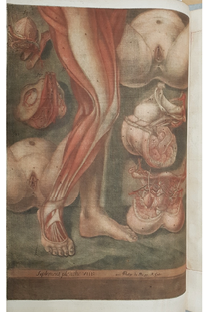
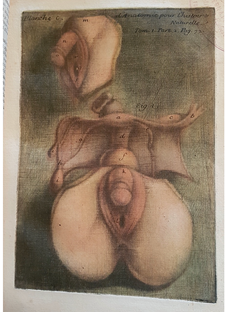
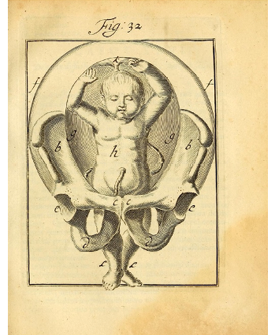
One can understand Osler’s omission of Gautier D’Agoty since he would likely have seen the value of those works as being primarily art historical rather than medical historical. Nonetheless, there are other great anatomical atlases of the eighteenth century that did speak to developments in the profession, which he also overlooked. Osler included William Hunter’s atlas on the gravid uterus, but not the complementary obstetrical works of William Smellie or Charles Nicholas Jenty, both of whom are represented in the library today.[41] Nor did he include any of the works of Hendrik van Deventer, the Dutch physician whose graphic depictions of obstetrical cases were published in the first two decades of the eighteenth century; van Deventer would influence self-taught Japanese practitioner Kagawa Genteki, whose works are also among the library’s recent acquisitions.[42] Given that Osler missed these works of medical men, it is no surprise that he also neglected the work of Angélique Marguerite Le Boursier du Coudray. Her work included much of the same illustrated information about complications in childbirth and how to address them as did van Deventer, Smellie, and others, an observation that provides an interesting starting point for studying the transmission of medical knowledge in the eighteenth century, within and beyond Europe.[43]
The building of collections over time has helped the library take steps to reflect more accurately the world in which it now operates. Arguably, what began as occasional additions have become self-perpetuating: as more researchers learn of our holdings by and about women, the more we build that strength to support academic teaching and research. The past decade has seen the addition not only of the physically and visually grand Exposition anatomique of Gautier D’Agoty (see Illustration 7, above), but also a Japanese scroll from ca. 1800 depicting the dissection of an executed woman who reportedly had recently given birth. Librarians have sought to open up new areas of research, such as encouraging discussions of cross-cultural transmission of knowledge. Thanks to acquisitions made in the past few years, it is possible to lay out for comparison the obstetrical works of van Deventer, Kagawa, and Du Coudray, as shown below. In the midst of these developments have come efforts to fill gaps in the collection, including the addition of Johann Jakob Huber’s De uaginae uteri structura rugosa nec non de hymene commentatio cum adiunctis iconibus (1742) and a first edition printing of Jean Louis Baudelocque, L’art des accouchemens (1781).
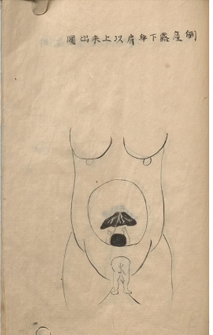
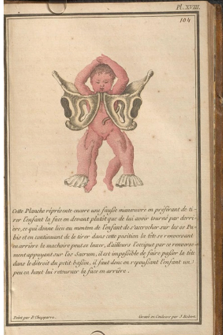
These acquisitions reflect the increased visibility of women and women’s roles in their own reproductive health; they reflect local historical developments, too. Though best known internationally for its comprehensive collection of works representing Western medical knowledge, the Osler Library also seeks to serve as an unofficial repository documenting local health initiatives. Thus, within the Osler Library one can learn about important contributions to women’s health made in the surrounding community. The library preserves several early editions of the Birth Control Handbook, first published by the McGill Students’ Council in 1968, spearheaded by undergraduate students Allan Feingold and Donna Cherniak. Millions of copies of the Handbook were disseminated in Canada and the United States at a time when information about sexual health was difficult to obtain and many reproductive health services were tightly controlled or illegal.[44] Responding to our acknowledgement of Montreal’s role in the history of reproductive health, a scholar connected us with Margaret Crane, the inventor of the Predictor, the first reliable home pregnancy test kit, from whom we acquired an original for our artifacts collection.[45]
The accumulation of items around sexual and reproductive health is an example of how librarians respond to the surrounding environment. The open and frank information about the female form that library staff now present as reflecting key developments in medicine, might have been regarded as marginal at best and more likely as inappropriate and risqué in Osler’s time. Acknowledging that our approach to collections development is user-centred is in contrast to Osler’s approach. That is, although Osler imagined the library as one that would expand, he collected what he understood to be works that lay the foundations of the history of medicine. He was foremost an educator and he shaped his library so as to inform others, to instruct them, about what he thought was key knowledge. Today, we operate with a confidence that Osler provided a solid foundation for the medicine he practised, which allows us to take the approach of collecting not simply to tell others what is important, but in a way that allows our users to convey to us which additional stories our collections should preserve. With respect to the representation of the feminine form, changes that have taken place during the Osler Library’s history have been positive ones. This moment of reflection gives some reason for optimism; we anticipate that future analyses will dissect and expose the implicit prejudices of our times just as we have done with Osler’s. The visible place of women in our current approach to acquisitions reflects a moment in time where information about female bodies continues to be less stigmatized, more available, less mysterious. Perhaps in the next iteration a study like this one will be able to highlight a future Osler Library that is less binary, less presumptive of heteronormative viewpoints, and will reflect a society that embraces fluidity.
Auteurs
Bibliography
Arons, Wendy, When Midwifery Became the Male Physician’s Province. The Sixteenth Century Handbook: The Rose Garden for Pregnant Women and Midwives, Jefferson, NC, McFarland, 1994
Bliss, Michael, William Osler: A Life in Medicine, Toronto, University of Toronto Press, 1999
Carlino, Andrea, “Knowe Thyself: Anatomical Figures in Early Modern Europe”, RES: Anthropology and Aesthetics, 1995, t. 27, p. 52-69, URL: https://www.jstor.org/stable/20166917; https://doi.org/10.1086/RESv27n1ms20166917
Casteen, Elizabeth, From She-Wolf to Martyr: The Reign and Disputed Reputation of Johanna I of Naples, Ithaca, NY, Cornell University Press, 2015, https://doi.org/10.7591/cornell/9780801453861.001.0001
Del Carmen Lacy-Niebla, M., “El Dr. James Miranda Stuart Barry. Un Gran Médico Con Un Gran Secreto”, Archivos de Cardiología de México, 2023, t. 93, no 1, p. 1-3, https://doi.org/10.24875/acm.m22000084
Didi-Huberman, Georges, Invention of Hysteria: Charcot and the Photographic Iconography of the Salpêtrière, Cambridge, MA, MIT Press, 2003
Du Preez, Michael, Dronfield, Jeremy, Dr. James Barry: A Woman Ahead of Her Time, London, Oneworld Publications, 2016
Febvre, Lucien, The Problem of Unbelief in the Sixteenth Century, the Religion of Rabelais, trans. Beatrice Gottlieb, Cambridge, MA, Harvard University Press, 1982
Fissell, Mary E., “Hairy Women and Naked Truths: Gender and the Politics of Knowledge in ‘Aristotle’s Masterpiece’”, The William and Mary Quarterly, 2003, t. 60, no 1, p. 43-74, https://doi.org/10.2307/3491495
Gillett, Margaret, We Walked Very Warily: A History of Women at McGill, Montreal, Eden Press Women’s Publications, 1981
Harley, David, “Historians as Demonologists: The Myth of the Midwife-witch”, in Witchcraft, Healing, and Popular Diseases: New Perspectives on Witchcraft, Magic, and Demonology, ed. Brian P. Levack, Hoboken, Taylor and Francis, 2012
Harvey, Karen, The Imposteress Rabbit-Breeder: Mary Toft and Eighteenth-Century England, Oxford, Oxford University Press, 2020
Healey, Jenna, “‘A Vile Custom’: The Strange Career of William Osler’s ‘Professional Notes’”, Journal of the History of Medicine and Allied Sciences, 2023, t. 20, p. 1-21, https://doi.org/10.1093/jhmas/jrad072
Heilmann, Ann, Neo-/Victorian Biographilia and James Miranda Barry: A Study in Transgender and Transgenre, [Cham, Switzerland], Palgrave Macmillan, 2018, https://doi.org/10.1007/978-3-319-71386-1
Jordanova, Ludmilla, Sexual Visions: Images of Gender in Science and Medicine between the Eighteenth and Twentieth Centuries, Madison, University of Wisconsin Press, 1989
Massey, Lyle, “The Alchemical Womb: Johann Remmelin’s Catoptrum microcosmicum”, in Visual Cultures of Secrecy in Early Modern Europe, ed. Timothy McCall, Sean Roberts, University Park, PA, Penn State University Press, 2013, https://doi.org/10.5325/j.ctv1gbrrmt.14
Moore, Rosemary, “Monsters and the Maternal Imagination: The ‘First Vision’ from Johann Remmelin’s 1619 Catoptrum microcosmicum Triptych”, in Exceptional Bodies in Early Modern Culture Concepts of Monstrosity before the Advent of the Normal, ed. Maja Bondestam, Baltimore, Maryland, Project Muse, 2020, p. 59-83, URL: https://muse.jhu.edu/book/78765/; https://doi.org/10.5040/9789048566709.ch-002
Nichols, Marcia D., Fixing Women: The Birth of Obstetrics and Gynecology in Britain and America, San Francisco, CA, University of California, Medical Humanities Consortium, 2021
Olszynko-Gryn, Jesse, “Predictor: The First Home Pregnancy Test,” Journal of British Studies, 2020, t. 59, no 3, p. 638-642, https://doi.org/10.1017/jbr.2020.70
Osler, William, Bibliotheca Osleriana, Oxford, Clarendon Press, 1929
Sethna, Christabelle, “The Evolution of the Birth Control Handbook: From Student Peer-Education Manual to Feminist Self-Empowerment Text, 1968-1975”, Canadian Bulletin of Medical History / Bulletin canadien d’histoire de la médecine, 2006, t. 23, no 1, p. 89-117, https://doi.org/10.3138/cbmh.23.1.89
Stephens, Elizabeth, “Re-Imagining the “Birthing Machine”: Art and Anatomy in Obstetric and Anatomical Models Made by Women”, in Anatomy of the Medical Image, Leiden, Brill, 2021, https://doi.org/10.1163/9789004445017_005
Van der Weiden, Robin M. F., Uhlenbeck, G. C., “European 18th-Century Obstetrical Pioneers in Japan: A New Light in the Empire of the Sun”, Journal of Medical Biography, 2010, t. 18, no 2, p. 99-101, https://doi.org/10.1258/jmb.2010.010006
Van Lieburg, M. J., Nieuw Licht Op Hendrik van Deventer (1651-1724), Rotterdam, Erasmus, 2002
Veith, Ilza, “The beginnings of modern Japanese obstetrics”, Bulletin of the History of Medicine, 1951, t. 25, no 1, p. 45-59
Wilson, Adrian, The Making of Man-Midwifery: Childbirth in England, 1660-1770, Abingdon, Oxon, Routledge, 1995
Footnotes
- 1 W. Osler, Bibliotheca Osleriana, Oxford, Clarendon Press, 1929, p. XXI.
- 2 William Osler to Casey Wood, 29 June 1912, CUS417/113.85, P417 Harvey Cushing Fonds, file 113, number 85, Osler Library Archives, McGill University. URL: https://digitalarchives.library.mcgill.ca/OSLER/P417/osl_cushing-fonds_P417-3-3-113-085.pdf, consulted on 9.03.2025.
- 3 L. Febvre, The Problem of Unbelief in the Sixteenth Century, the Religion of Rabelais, trans. B. Gottlieb, Cambridge, MA, Harvard University Press, 1982, p. 2. Original edition: L. Febvre, Le problème de l’incroyance au XVIe siècle : la religion de Rabelais, L’évolution de l’humanité, synthèse collective, dir. H. Berr [3. Section, LIII], Paris, A. Michel, 1942.
- 4 W. Osler, Bibliotheca, op. cit., p. XXV-XXVI.
- 5 M. Gillett, We Walked Very Warily: A History of Women at McGill, Montreal, Eden Press Women’s Publications, 1981, p. 282-283.
- 6 M. Bliss, William Osler: A Life in Medicine, Toronto, University of Toronto Press, 1999, p. 230.
- 7 William Osler, “Note on the first edition of the anatomy of Vesalius, 1543,” March 9, 1909. Housed with Andreas Vesalius, De humani corporis fabrica (Brussels, 1543), Bibliotheca Osleriana (henceforth B.O.) 567.
- 8 M. Bliss, op. cit., p. 148. Osler’s record on women is mixed. Many of his comments discouraging women from studying medicine can be linked to the hostility women faced from male medical students and professors, not to mention the concern that they would not be accepted in society as practitioners. This context seems to have informed Osler’s general statements advising women not to go into medicine; he opined that women were better suited to science.
- 9 Dorothy Reed, Maude Abbott, and Mabel FitzGerald are notable women with whom Osler exchanged medical ideas and whose careers he supported.
- 10 W. Osler, Bibliotheca, op. cit., p. 705-785.
- 11 Osler’s colleague at the University of Pennsylvania, Dr. William Goodell, opened an address with the assertion: “Hysteria is closely allied to insanity.” W. Goodell, “The Nervous Rectum. Read in the Section on Obstetrics and Gynecology at the Thirty-Ninth Annual Meeting of the American Medical Association, May 8, 1888”, Journal of the American Medical Association, 1888, t. XI, no 1, p. 5-9. URL: https://doi.org/10.1001/jama.1888.02400530021001a, consulted on 19.03.2025. Another contemporary who highlighted commonalities between insanity, epilepsy, and hysteria was W. Dewees, “Relation of Gynaecology to Neurology. Read in the Section of Obstetrics and Diseases of Women, at the Forty-Second Annual Meeting of the American Medical Association, May, 1891”, Journal of the American Medical Association, 1891, t. XVI, no 24, p. 837-839, URL: https://doi.org/10.1001/jama.1891.02410760009001b, consulted on 19.03.2025. Finally, G. Hungerford, “Hysteria and Its Relation to Insanity,” Journal of Mental Science, 1900, t. 46, no 192, p. 83-87, URL: https://doi.org/10.1192/bjp.46.192.83, consulted on 19.03.2025.
- 12 This is particularly interesting at a time when a budding psychological specialty capitalized on women’s mental health. See, for instance G. Didi-Huberman, Invention of Hysteria: Charcot and the Photographic Iconography of the Salpêtrière, Cambridge, MA, MIT Press, 2003. Though not a surprise, it is worth noting that neurasthenia does cross-reference to melancholy.
- 13 Critiquing the supposed link between midwifery and witchcraft is D. Harley, “Historians as Demonologists: The Myth of the Midwife-witch”, in Witchcraft, Healing, and Popular Diseases: New Perspectives on Witchcraft, Magic, and Demonology, ed. B. P. Levack, Hoboken, NJ, Taylor and Francis, 2012.
- 14 Th. Fuller, The Holy State and the Profane State (Cambridge, 1642), B.O. 4833, URL: https://archive.org/details/McGillLibrary-osl_the-holy-state_folioF9677h1642-20573, consulted on 9.03.2025. For an updated consideration of Joanna I of Naples, see E. Casteen, From She-Wolf to Martyr: The Reign and Disputed Reputation of Johanna I of Naples, Ithaca, NY, Cornell University Press, 2015; M. D. Nichols, Fixing Women: The Birth of Obstetrics and Gynecology in Britain and America, San Francisco, CA, University of California, Medical Humanities Consortium, 2021.
- 15 Ibid, p. 361.
- 16 Ibid.
- 17 Ibid, p. 363. Joanna did have three children, each of whom died in infancy or very young.
- 18 R. Moore, “Monsters and the Maternal Imagination: The ‘First Vision’ from Johann Remmelin’s 1619 Catoptrum microcosmicum Triptych,” in Exceptional Bodies in Early Modern Culture Concepts of Monstrosity before the Advent of the Normal, ed. M. Bondestam, Baltimore, Maryland, Project Muse, 2020, p. 59-83, URL: https://muse.jhu.edu/book/78765/, consulted on 19.03.2025. See also, A. Carlino, “Knowe Thyself: Anatomical Figures in Early Modern Europe”, RES: Anthropology and Aesthetics, 1995, t. 27, p. 52-69, URL: https://www.jstor.org/stable/20166917, consulted 19.03.2025, and L. Massey, “The Alchemical Womb: Johann Remmelin’s Catoptrum microcosmicum”, in Visual Cultures of Secrecy in Early Modern Europe, ed. T. McCall and S. Roberts, University Park, PA, Penn State University Press, 2013, p. 208-228, URL: https://doi.org/10.1515/9780271091143, consulted on 19.03.2025.
- 19 J. Remmelin, Catoptrum microcosmicum (Augsburg, David Franck, 1619), URL: https://archive.org/details/McGillLibrary-osl_elf_cum-deo-johannis-remmelini_elfWZ250R388c1619-19996, consulted on 9.03.2025. Osler acquired copies of Remmelin’s Elucidarius, Tabulis synopticis (n. p., 1614) and Pinax microcosmographicus, (n. p., 1615), which come bound together and explain the plates included in the original elephant folio-sized Catoptrum Microcosmicum (1613). The Osler Library’s 1619 copy of this work and its later English translation, A Survey of the Microcosm (London, 1702), were later acquisitions. For the latter, see URL: https://archive.org/details/McGillLibrary-osl_survey-microcosme_elfWZ260R389p1702-20528, consulted on 9.03.2025. The moralizing is stripped from the 1702 edition, which would make an interesting point for further critical examination.
- 20 The Library recently acquired a Dutch translation of the work: E. Rösslin, Den Rosegaert Vande[n] Bevruchten Vrouwen (n. p., 1551).
- 21 W. Arons, When Midwifery Became the Male Physician’s Province. The Sixteenth Century Handbook: The Rose Garden for Pregnant Women and Midwives, Jefferson, NC, McFarland, 1994; A. Wilson, The Making of Man-Midwifery: Childbirth in England, 1660-1770, Abingdon, Oxon, Routledge, 1995.
- 22 The library now has five copies dating from ca. 1766-1850. For more information on the Masterpiece, see M. E. Fissell, “Hairy Women and Naked Truths: Gender and the Politics of Knowledge in ‘Aristotle’s Masterpiece’,” The William and Mary Quarterly, 2003, t. 60, no 1, p. 43-74, https://doi.org/10.2307/3491495
- 23 While unrelated, it is interesting that the creators of the film The Favourite depicted Queen Anne (d. 1714) as keeping a rabbits, each of whom was named for a deceased child. One wonders whether the writers were aware of the story of Mary Toft, from later in the 18th century, or whether it was pure coincidence that Mary Toft had rabbits as progeny, whereas the fictional retelling of Queen Anne had rabbits representing children.
- 24 K. Harvey, The Imposteress Rabbit-Breeder: Mary Toft and Eighteenth-Century England, Oxford, Oxford University Press, 2020.
- 25 A Complete Collection, of All the Tracts, Both Printed and Manuscript, Relating to Mary Tofts, the Celebrated Rabbit Woman of Godalming, compiled by G. Steevens, London, 1726, B.O. 4115, available at URL: https://archive.org/details/McGillLibrary-osl_osler-4115_mary-tofts_WZ260S8151726-1753-19146, consulted on 9.03.2025. For a complete listing of the tracts and for more on its provenance, see Bibliotheca Osleriana, op. cit., p. 371-372; the digitized volume contains further manuscript provenance notes on the front endpaper.
- 26 Though Osler does not factor into her study, Ann Heilmann’s observation that “What Barry represents and how he is represented invariably pinpoints the imaginative, the speculative and the performative,” seems appropriate to Osler’s curiosity. A. Heilmann, Neo-/Victorian Biographilia and James Miranda Barry: A Study in Transgender and Transgenre, [Cham, Switzerland], Palgrave Macmillan, 2018. The interest in Barry is also evident in M. du Preez and J. Dronfield, Dr. James Barry: A Woman Ahead of Her Time, London, Oneworld Publications, 2016; M. del Carmen Lacy-Niebla, “El Dr. James Miranda Stuart Barry. Un Gran Médico Con Un Gran Secreto,” Archivos de Cardiología de México, 2023, t. 93, no 1, p. 1-3, https://doi.org/10.24875/acm.m22000084. Osler’s fascination with Barry’s story can be seen in his inclusion of an early biography in his library: E. Rogers, A Modern Sphinx: A Novel, London, J. & R. Maxwell, 1895, B.O. 5394. Accounts of James Barry tend to employ both male and female pronouns (rarely non-binary ones) and many make gender pronouncements (e.g., that he was a woman) that cannot be supported given Dr. Barry’s silence on the issue and his having lived as a man for his entire adult life.
- 27 W. Osler, “Professional Notes among the Indian Tribes about Gt Slave Lake, NWT,” in The Works of Egerton Yorrick Davis, MD: Sir William Osler’s Alter Ego, ed. R. L. Golden, Osler Library Studies in the History of Medicine 3, Montreal, The Osler Library, 1999, p. 19-38. Molson was said to be a love rival of Osler, but it is also worth considering the role of their relative wealth and status in society. Osler was not independently wealthy as was Molson, and there may be some insecurity and a desire to belong that manifests itself in his bawdy humour (which, it should be repeated, we acknowledge today as racist, sexist, hurtful to marginalized groups, and entirely inappropriate). See S. Shaheen-Hussain, Fighting for a Hand to Hold: Confronting Medical Colonialism against Indigenous Children in Canada, McGill-Queen’s Indigenous and Northern Studies, 97, Montreal, McGill-Queen’s University Press, 2020.
- 28 Osler’s “Professional notes” not only sounds very much like the material that Engelmann passed off as academic research, but Osler also names Engelmann as a source in the essay. Osler never intended his piece to be published, but Engelmann’s research was published and was intended to be accepted as fact. G. J. Engelmann, “Posture in Labour: An Ethnographical Study”, Transactions of the American Gynecological Society, for the Year 1880, 1881, t. 5, p. 175-279 and G. J. Engelmann, Labour among Primitive Peoples, St. Louis, J. H. Chambers and Co., 1882.
- 29 J. Healey, “‘A Vile Custom’: The Strange Career of William Osler’s ‘Professional Notes’”, Journal of the History of Medicine and Allied Sciences 2023, p. 3, https://doi.org/10.1093/jhmas/jrad072
- 30 Ibid., p. 1.
- 31 Ibid., p. 2.
- 32 W. Osler, “Vaginismus,” in The Works of Egerton Yorrick Davis, op. cit., p. 39-49. Golden suggests that Osler had no intention of publishing this editorial, but had sent it to friends in Montreal, and that Dr. Molson had responded to the earlier joke of “Professional notes” by sending the editorial to the Medical News, where it was published on 29 November 1884 (W. Osler, “Vaginismus,” op. cit., p. 43).
- 33 L. Jordanova, Sexual Visions: Images of Gender in Science and Medicine between the Eighteenth and Twentieth Centuries, Madison, University of Wisconsin Press, 1989; E. Stephens, “Re-Imagining the “Birthing Machine”: Art and Anatomy in Obstetric and Anatomical Models Made by Women,” in Anatomy of the Medical Image, Leiden, Brill, 2021.
- 34 G. Bidloo, Anatomia humani corporis (Amsterdam, 1685); W. Cowper, The anatomy of humane bodies, with figures drawn after the life (Oxford, 1698). See P. Dumaître, La curieuse destinée des planches anatomiques de Gérard de Lairesse: peintre en Holland: Lairesse, Bidloo, Cowper, Amsterdam, Rodopi, 1982.
- 35 W. Cowper, “The Second Table,” The anatomy of humane bodies, op. cit., [n. p.].
- 36 Trotula, Curandarum aegritudinum muliebrium (1547), B.O. 3899. The running title of this work is De passionibus mulierum, Osler, Bibliotheca, p. 355. For the discredited remarks on Trotula, see Ch. and D. Singer, “Origin of the School of Salerno,” in Essays on the History of Medicine, presented to Karl Sudhoff, ed. Ch. Singer, H. Sigerist, London, 1924, p. 129.
- 37 Ch. Estienne, De dissectione partium corporis humani libri tres, Paris, Simonem Colinaeum, 1545, B.O. 2541.
- 38 J. de Ketham, Fasciculus medicinae (Venice, Johannes and Gregorius de Gregorii, 1500), URL: https://archive.org/details/McGillLibrary-osl_fasciculus-medicinae_WZ230K43f1500-19475, consulted 9.03.2025; Manṣūr ibn Muḥammad, Tashrīḥ-i badan, ca. 1600, B.O. 7785/75, URL: https://archive.org/details/McGillLibrary-osl_robe_7785-75-20276, consulted on 9.03.2025.
- 39 W. Osler, Bibliotheca, op. cit., p. XXVI.
- 40 J. F. Gautier D’Agoty, Exposition anatomique de la structure du corps humain (Marseille, Antoine Favet for Vial, Le Roy, Marc-Michel Rey, 1759), URL: https://archive.org/details/McGillLibrary-osl_exposition-anatomique-dagoty_elfWZ260G277e1759-20914, consulted on 9.03.2025; J. F. Gautier D’Agoty, Observations sur l’histoire naturelle (Paris, 1752-1755), URL: https://archive.org/details/McGillLibrary-osl_observations-lhistoire-naturelle_folioQH45G381752-ptie1-22623, consulted on 25.03.2025.
- 41 W. Hunter, Anatomia uteri humani gravidi tabulis illustrata (Birmingham, 1774), B.O. 3026; W. Smellie, A Sett of Anatomical Tables, with Explanations, and an Abridgment, of the Practice of Midwifery (London, 1754); C. N. Jenty, Demonstratio vteri praegnantis mulieris cum foetu ad partum maturi, trans. C. C. Schmidel (Nuremberg, 1761), URL: https://archive.org/details/McGillLibrary-125816-2609, consulted on 9.03.2025.
- 42 H. van Deventer, Operationes chirurgicae artis obstetricandi (Leiden, 1701), URL: https://archive.org/details/McGillLibrary-osl_henrici-a-deventer-medicinae-doctoris_WZ260D493mL1701-22603, consulted on 25.03.2025; G. Kagawa, Sanron yoku (Kyoto, 1775), URL: https://archive.org/details/McGillLibrary-osl_sanron-yoku_WZ260K138s1775_v1-20314, consulted on 9.03.2025. For the related text, see G. Kagawa, Shigenshi Sanron (Kyoto, 1775), URL: https://archive.org/details/McGillLibrary-osl_shigenshi-sanron_WZ260K134s1775a_v1-20313, consulted on 9.03.2025. As noted, several images in Kagawa’s work bear a striking resemblance to those shown by Henrik van Deventer. R. M. F. van der Weiden and G. C. Uhlenbeck, “European 18th-Century Obstetrical Pioneers in Japan: A New Light in the Empire of the Sun”, Journal of Medical Biography, 2010, t. 18, no 2, p. 99-101, https://doi.org/10.1258/jmb.2010.010006. See also I. Veith, “The beginnings of modern Japanese obstetrics,” Bulletin of the History of Medicine, 1951, t. 25, no 1, p. 45-59. For her study, Ilza Veith used the collection of Osler’s colleague and co-founding medical professor at Johns Hopkins, Howard Kelly. On van Deventer, see M. J. van Lieburg, Nieuw Licht Op Hendrik van Deventer (1651-1724), Rotterdam, Erasmus, 2002.
- 43 A. M. Le Boursier du Coudray, Abbrégé de l’art des accouchemens (Saintes, 1769), URL: https://archive.org/details/McGillLibrary-osl_abbrege-art_WZ260L433a1769-19954, consulted on 9.03.2025.
- 44 C. Sethna, “The Evolution of the Birth Control Handbook: From Student Peer-Education Manual to Feminist Self-Empowerment Text, 1968-1975”, Canadian Bulletin of Medical History/Bulletin canadien d’histoire de la médecine, 2006, t. 23, no 1, p. 89-117.
- 45 J. Olszynko-Gryn, “Predictor: The First Home Pregnancy Test”, Journal of British Studies, 2020, t. 59, no 3, p. 638-642, https://doi.org/10.1017/jbr.2020.70