
Stationary traffic as a challenge in the spatial planning of the city of Goražde
Haris GEKIĆ  *
*
Aida BIDŽAN-GEKIĆ *
Anisa BOSNO *
Emina AJANOVIĆ *
Péter REMÉNYI *
Abstract. Parking shortages increasingly constrain medium-sized post-socialist cities, yet empirical evidence on stationary traffic is scarce. This case study of Goražde (Bosnia and Herzegovina) inventories and GIS-maps parking supply measures weekday occupancy, surveys residents’ perceptions, and proposes a three-zone parking management scheme. Methods combined a field inventory with GIS mapping, hourly manual counts on 1 June 2023 (8:00 a.m. – 5:00 p.m.) at 11 lots (349 spots), and an online household survey (1–17 June 2023; n=103). Peak network occupancy reached 86.2%, and hotspot sites exceeded nominal capacity (up to 110%). The study provides a replicable baseline for monitoring and policy design in similar medium-sized cities.
Key words: stationary traffic, parking lots, parking zoning, parking, Goražde.
1. Introduction
The concept of successful urban development depends largely on the proper planning and implementation of various traffic solutions. To the extent that the transport network and infrastructure develop, all other urban functions can develop proportionately (Bublin, 2007). The socio-economic development of Bosnia and Herzegovina has led to an excessive concentration of population in cities, resulting in demographic decline and almost complete depopulation of significant parts of the state territory, accompanied by a simultaneous degradation of demographic structures (Nurković and Gekić, 2011). With the increasing need for individual transport, there is a growing need for a more detailed look at the issue of stationary traffic, especially in urban areas with a growing population. The overall improvement in transport conditions also enhances the quality of life (Gekić et al., 2015).
Automobiles require space to move around (roads) but also spend 98% of their existence stationary in parking spaces (Rodrigue, 2024). Many inner-city properties were built before automobile traffic and cannot conform to parking regulations (Kaplan et al., 2014).
The process of planning stationary traffic capacities should be an integral part of the spatial and urban planning of cities and should represent one of the basic documentation bases of the final agreed plans. In the urban planning process, apart from the agreed needs and possibilities for all functional city facilities, stationary traffic exceeds the framework of the past treatment of overall traffic. In today’s considerations of space requirements for any of the functions providing sufficient surfaces for stationary traffic, it is simply a necessity (Martinić et al., 2005). Parking management includes various parking policies and actions that can be used to manage the supply and demand for parking (Meyer, 2016).
This implies the rational use of land for the construction of parking spaces and the necessary infrastructure, establishment of an efficient parking policy, establishment of a system of zoning of parking areas, and planned construction of parking areas with real capacities based on previously determined needs (Hukić, 2017). In addition, a substantial body of international literature treats parking not only as a technical capacity issue but also as an urban policy instrument that shapes mobility behaviour and the allocation of public space.
Parking policy is widely discussed as a core urban-transport and public-space tool rather than a purely technical ‘storage’ problem. Conventional supply-led approaches, especially minimum parking requirements, tend to embed the cost of car use into housing and development, increase construction costs, and lock-in car dependency by normalizing abundant, underpriced parking (Shoup, 2005; Marsden, 2006; Lehe, 2018; Litman, 2024). Empirical and policy-oriented literature links rigid minimums with higher housing costs and constrained adaptive reuse or infill outcomes, particularly in older inner-city areas where retrofitting parking is difficult or prohibitively expensive (Lehe, 2018; Litman, 2024). More broadly, ‘free’ or underpriced parking functions as a subsidy that can shift travel behaviour toward solo driving, while reforms such as pricing and ‘cash-out’ of employer-paid parking can reduce car commuting and encourage mode shift (Willson and Shoup, 1990; Shoup, 1997).
A complementary stream of research frames parking as part of curb management and network governance: the curb is scarce, publicly owned infrastructure that cities allocate through prices, time limits, permits, and enforcement (ITF, 2018; Manville and Pinski, 2021). From this perspective, effective parking policy aims to manage demand, reduce cruising and its externalities (congestion and illegal parking), and support broader mobility and land-use goals. Modelling work shows how cruising for parking and congestion interact, implying that pricing and capacity management can reduce search time and traffic impacts (Arnott and Rowse, 1999; Arnott and Inci, 2006). Empirical studies also confirm that on-street parking demand responds to price, and that demand-responsive pricing can move occupancy toward target ranges – supporting performance-based approaches (Ottosson et al., 2013; Pierce and Shoup, 2013). Large-scale pilots such as SFpark operationalised these ideas using parking data and periodic price adjustments to improve availability and reduce unnecessary circulation (SFMTA, 2014; Pierce and Shoup, 2013).
International guidance and best-practice syntheses therefore recommend integrated packages rather than single instruments: priced on-street parking with clear goals (e.g., target occupancy), permit systems that limit spillover, reforms of minimum parking requirements in well-served areas, improved information/payment systems, and reinvestment of revenues into streetscape and sustainable mobility (GIZSUTP, 2010; ITDP, 2021; ITDP, 2024; Litman, 2024). In the European context, parking management is also positioned as a practical lever within Sustainable Urban Mobility Plans (SUMPs), linking parking measures to safety, congestion, air quality, public space, and multimodal accessibility (PARKSUMP, 2022). Evidence reviews caution, however, that parking policies are context-sensitive: outcomes depend on urban form, transit supply, enforcement capacity, political legitimacy, and the presence (or absence) of complementary measures such as improved public transport or active-mobility infrastructure (Marsden, 2006; ITF, 2018).
A specific challenge concerns post-socialist cities, where rapid motorisation after systemic transition often collided with inherited street layouts, underdeveloped parking governance, and competing claims over public space. Post-socialist mobility scholarship emphasises how automobility became associated with modernity and freedom, while institutions and everyday practices adapted unevenly (Tuvikene, 2018). In this setting, parking conflicts frequently surface through informal or semi-formal practices (e.g., sidewalk occupation), ambiguous enforcement, and contested legitimacy of pricing or regulation (Tuvikene, 2015; Popescu, 2022). Ethnographic work illustrates how tolerated sidewalk parking can marginalise pedestrians and normalise “hostile privatism” in residential public space, complicating the implementation of equitable curb policies (Popescu, 2022). Consequently, policy transfer from Western European/North American parking reforms must be adapted to local governance capacity, enforcement realities, and post-socialist socio-political meanings attached to car use and public space (Tuvikene, 2015; Tuvikene, 2018; PARKSUMP, 2022).
In Bosnia and Herzegovina, especially in medium-sized cities, systematic parking datasets and routine occupancy monitoring are extremely rarely available, which makes evidence-based parking management difficult to design and justify. Despite the growing global literature and guidance, there remains a gap in empirically grounded parking-policy analyses for medium-sized post-socialist and Western Balkan cities, especially studies that combine mapping of supply and regulation, occupancy observations, and user perceptions. This article contributes to that gap by using the City of Goražde as a case study and combining field occupancy observations with a household survey and spatial (GIS) representation to provide an empirical basis for discussing parking management directions in comparable post-socialist medium-sized cities.
According to the size of cities in Bosnia and Herzegovina, the city of Goražde belongs to the category of medium-sized cities (Gekić et al., 2022). Considering the area of the city, number of inhabitants, topography and configuration of the terrain, availability of construction land, and construction coefficient, the narrower urban area of the city is densely built, and the remaining areas should be rationally planned for construction with an optimal interweaving of functions to the extent that standards allow it.
The main objectives of the research are set in such a way as to determine: the current situation of stationary traffic on the ground and the level of development of the parking areas; and the average daily occupancy of the existing parking areas in the investigated area.
This study is based on the hypothesis that the problem of a lack of parking spots in existing parking lots is expressed in the researched area. Traditional planning solutions imply the planning and construction of parking lots for a smaller number of users. However, as parking requirements are increasing, it is necessary to prepare planning solutions conceptually in a different way. The second hypothesis assumes that when planning and building new parking lots, it is necessary to focus on the gradual creation of prerequisites and conditions for the transition from traditional conceptual solutions to modern ones, including the planning and construction of underground garages or basement spaces that will be adapted to the needs of parking users.
2. Methodology
The City of Goražde (hereinafter also as: Goražde) is located in the southeastern part of Bosnia and Herzegovina along the upper course of the Drina River at an altitude of approximately 345 m. It covers an area of 253.8 sq. km. According to the 2013 census, Goražde had 20,897 inhabitants. Most of administrative territory of the City of Goražde is dominated by steep terrain with large differences in elevation, while the flat alluvial plateau of the Drina River represents the most important part of the urban area and the functional focus of daily activities. Goražde is currently not served by an operational railway. The city’s former narrow-gauge rail connection (Sarajevo–Ustiprača–Goražde–Foča) was discontinued in 1978 (City of Goražde, 2017).
Goražde was selected as a case study because it is a medium-sized urban centre in Bosnia and Herzegovina where daily parking demand is concentrated in a compact inner core, while supply expansion is spatially constrained. As the administrative and service hub of the Bosnian-Podrinje Canton, the town attracts daily trips to public institutions, health services, education, and retail, which intensifies parking pressure in the central area. At the same time, the valley setting along the Drina River, steep surrounding terrain and limited developable flat land restrict the possibility of creating additional off-street parking capacity. This combination makes Goražde a relevant illustrative/typical case for examining stationary traffic as a spatial-planning challenge in medium-sized post-socialist cities. In addition, systematic local parking datasets are limited, so combining an inventory, occupancy observation and a household survey provides a practical evidence base for planning measures (City of Goražde, 2017; Bidžan-Gekić et al., 2020).
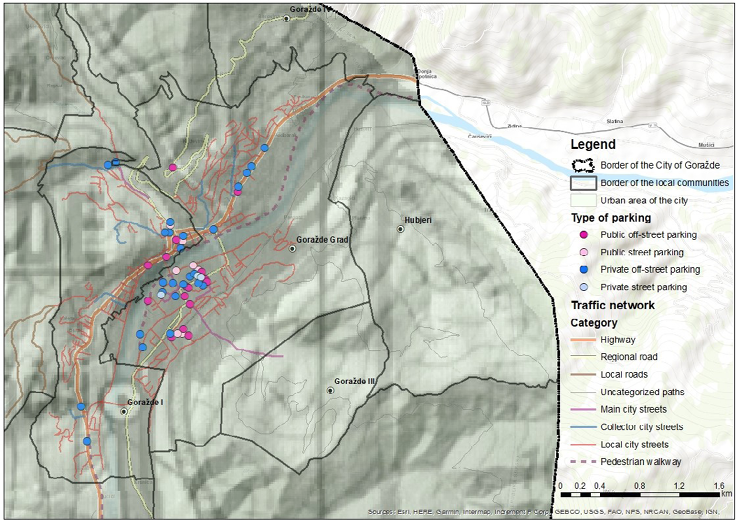
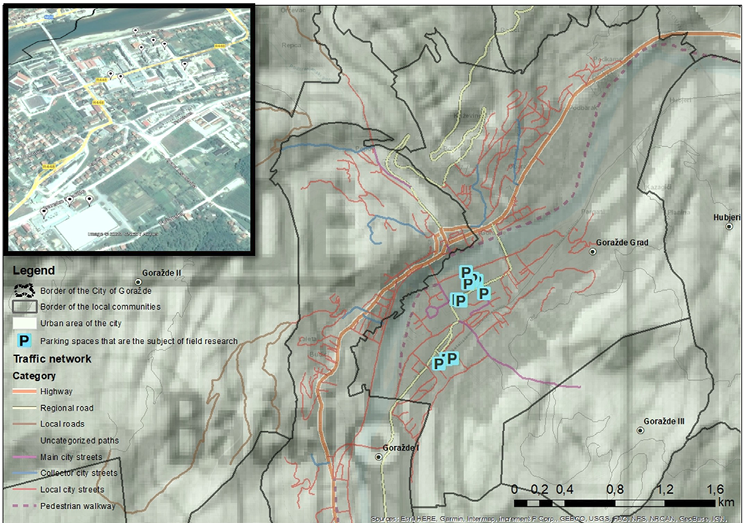
Therefore, the field research and analysis focus on the narrower urban area, where daily activities are concentrated and where the expansion of parking supply is most constrained due to dense built form and limited available land (Fig. 1).
The study applies a mixed-methods case-study design to examine stationary traffic (parking) as a spatial-planning challenge in a medium-sized post-socialist city. A combined approach was selected because parking pressures are expressed both objectively, through supply–demand mismatch and occupancy levels, and subjectively, through user experiences and perceived problems. Integrating a field inventory of parking supply, an occupancy survey, and a household survey enables triangulation and produces results directly usable for spatial and urban-planning recommendations.
The research was conducted in four stages. The first stage was inventory and spatial mapping of parking supply. Parking facilities in the narrower urban area of Goražde were identified and classified through a field survey. Parking lots were categorised as public or private and as on-street or off-street, and their capacities were recorded. Where parking spots were not delineated by markings, capacity (number of parking spots) was estimated in the field based on the usable paved area and standard parking-space dimensions. The inventory served as the basis for GIS-based mapping and for the later interpretation of occupancy patterns and zoning proposals. Field records were then digitised and georeferenced in a desktop GIS environment to build the spatial dataset used for mapping and zoning analysis; mobile GIS tools (e.g., QField) may be adopted in future multi-day campaigns to streamline in-field data capture and quality control.

Source: own work based on the GIS data.
The second stage was the parking-occupancy field survey. To quantify utilisation, we conducted an hourly vehicle-count survey on 1 June 2023 (Thursday) from 8:00 a.m. to 5:00 p.m. across a sample of 11 parking lots (349 parking spots). The parking-occupancy survey was conducted through manual vehicle counts at fixed time intervals using standardized tally sheets (no questionnaire instrument was used for the occupancy measurement). The surveyed sites were selected to capture the main functional corridors with the highest parking demand (central services/retail, public institutions, and adjacent residential blocks). The sample included two private on-street parking areas with a public character, two private off-street parking areas with a public character, and seven public off-street parking lots. Spatially, the surveyed locations are distributed along the principal streets of the urban core (Rabite Street, Zdravstvenih radnika Street, Ibrahima Čelika Street, and 43rd Drinske brigade Street), ensuring coverage of both central activity zones and nearby residential areas. This design enabled us to identify hourly occupancy patterns and to detect locations operating close to, or above, their nominal capacity. The one-day survey design follows established practice in comparable parking-occupancy studies (Razum, 2022) and was implemented as a resource-efficient ‘typical weekday’ snapshot. Thursday was chosen as a mid-week working day to avoid weekend-specific travel patterns and transitional effects often present on Mondays and Fridays. Multi-day and seasonal measurements could refine the estimates and are, therefore, noted as a direction for future research.
Because systematic local transport data are not collected at the city level, we conducted an online household survey to obtain indicative information on mobility and perceived parking problems. This was a third stage. The survey was administered from 1 to 17 June 2023 using a structured questionnaire with 27 items (closed and open questions). A total of 103 respondents participated. To ensure adequate coverage of the area most affected by parking pressure, the recruitment aimed for at least 100 responses and at least 50% of respondents residing in the urban local communities (Goražde I–IV). The achieved sample included both genders and covered a range of age groups and occupational statuses. Given the online, non-probability recruitment and the sample size relative to the city population, the survey results are reported as descriptive shares for the respondent group and used to complement the field inventory and occupancy measurements; they should not be interpreted as statistically representative population estimates.
The fourth stage was analysis and presentation. Quantitative indicators (capacities, hourly and daily occupancy rates) were analysed descriptively and presented in tables and graphs. GIS/cartographic methods were used to visualise the spatial distribution of parking facilities and to support zoning proposals. Survey results were summarised as percentages and interpreted alongside measured occupancy to provide an integrated assessment. The descriptive statistics and graphs were produced using spreadsheet software.
3. Results and discussion
3.1. Analysis and assessment of stationary traffic conditions
Areas intended for parking individual passenger cars can be classified into two basic categories: public and private parking lots (Razum, 2022). Most cities require off-street parking for all new constructions. Zoning rules for each possible type of land use have formulas to prescribe the number of parking spots that the developer must provide based on the size of the business or apartment (Krizek and King, 2021). In urban and suburban local communities, i.e., in the urban area of Goražde, there are 23 public parking lots with a total capacity of 602 parking spots and an additional 8 parking spots for people with disabilities. The total number of parking spots was determined by field research by counting them. Parking spots are located in marked places outside the street system as separate spots or along the street system as its primary and integral part.
The second type of parking lot includes private parking lots owned by public institutions and private companies. These parking lots are used for the needs of owners, as well as their employees and customers. However, some private parking lots can also have a public character, such as the parking lot of the Bingo shopping centre. Based on the field survey and land-use designation, we identified 35 private parking lots in the City of Goražde with a total capacity of 1,494 parking spots, including 1 designated spot for people with disabilities. These private lots constitute a substantial share of the mapped parking supply and, in the surveyed locations, show higher occupancy levels than public parking lots. In addition, private parking lots have the characteristics of both street and off-street separate spots.
The third type of parking lot includes private parking lots located within residential zones that are exclusively intended and available to the residents of these zones, and their use for any other purpose is prohibited.
Public off-street parking lots include areas separated from the street network system and are marked with appropriate traffic signs. A total of 16 public off-street parking lots with different capacities and numbers of parking spots are represented in the city area. The most important, and at the same time, the largest parking lot of the aforementioned characteristics is the parking lot of the Bingo shopping centre, whose capacities include a total of 188 parking spots. Public street parking lots include spots along streets, where one lane of traffic is usually reserved for parking, while the remaining lanes of the street carry traffic in one or both directions (Fig. 2).
The most important and the largest number of parking lots with the aforementioned characteristics are those on Maršala Tita Street and 1st Slavne višegradske brigade Street, which have the character of longitudinal parking and a capacity of a total of 60 parking spots each and an additional two parking spots for people with disabilities. The capacity of public parking lots in the urban area of Goražde is 481 parking spots. Of the 23 public parking lots, 17 are located off the streets, i.e., they include separate lots intended for stationary traffic, while seven public parking lots include street lots. The condition and quality of public parking lots in the urban and, to a lesser extent, suburban areas of Goražde are low. A certain number of parking lots (37.5%) did not have marked parking spots. One of the shortcomings reported by users is the insufficient security of vehicles in parking lots. In the local context of Goražde, inclusion in the paid-parking regime is primarily a indicator for basic parking management and on-site presence during charging hours (ticket issuance/enforcement), while most free parking areas function as open-access spots with limited monitoring. Since 79% of the analysed parking lots are outside the paid system, a large share of the parking supply lacks even basic oversight, which is consistent with the household survey results in which 67% of respondents identified poor car safety in parking lots as a major problem. Additionally, the charging system includes five public parking lots, whose capacities do not exceed 30 parking spots each, where the parking spots are marked (Table 1). In Tables 1 and 2, “Condition and quality” refers to a qualitative field assessment of the physical condition and basic functional equipment of each parking facility (pavement surface, horizontal markings, vertical signage, and overall organisation of the lot), rather than to parking availability or utilisation.
Source: own work based on field research.
| No. | Location | Spots | Condition and quality | Parking type | Charging | Price |
|---|---|---|---|---|---|---|
| 1 | Bingo shopping centre | 80+3* | Very good | Private off-street parking – public character | No | - |
| 2 | Bingo shopping centre | 14 | Very good | Private street parking – public character | No | - |
| 3 | Bingo shopping centre | 12** | Good | Private off-street parking – public character | No | - |
| 4 | Bingo shopping centre | 52 | Very good | Private off-street parking – public character | No | - |
| 5 | Bingo shopping centre | 30 | Very good | Private off-street parking – public character | No | - |
| 6 | Zdravstvenih radnika str. | 26 | Good | Public off-street parking | Yes | 1 KM/h*** |
| 7 | Trg branilaca (square) | 18 | Very good | Public off-street parking | Yes | 1 KM/h*** |
| 8 | Maršala Tita str. | 30+2* | Good | Public street parking | Yes | 1 KM/h*** |
| 9 | Seada Sofovića Sofe str. | 3 | Good | Public off-street parking | Yes | 1 KM/h*** |
| 10 | 1. Slavne višegradske brigade str. | 18 | Parking spots are not marked | Public street parking | No | - |
| 11 | Zdravstvenih radnika str. | 24* | Very good | Public street parking | No | - |
| 12 | Zdravstvenih radnika str. | 25+2* | Parking spots are not marked | Public off-street parking | No | - |
| 13 | Ibrahima Čelika str. | 22 | Parking spots are not marked | Public street parking | No | - |
| 14 | Ibrahima Čelika str. | 35** | Parking spots are not marked | Public street parking | No | - |
| 15 | Ruždije Islamagića str. | 8 | Parking spots are not marked | Public off-street parking | Yes | 1 KM/h*** |
| 16 | Panorama str. | 7** | Parking spots are not marked | Public off-street parking | No | - |
| 17 | Zdravstvenih radnika str. | 24 | Very good | Public off-street parking | No | - |
| 18 | 43. drinske brigade str. | 40** | Parking spots are not marked | Public off-street parking | No | - |
| 19 | Omladinska str. | 42 | Parking spots are not marked | Public off-street parking | No | - |
| 20 | Alije Hodžića str. | 14+1 | Very good | Public off-street parking | No | - |
| 21 | Muhidina Mašića Munje str. – City stadium | 37 | Parking spots are not marked | Public off-street parking | No | - |
| 22 | Sarajevska str. – Izletište Rorovi | 14 | Very good | Public off-street parking | No | - |
| 23 | Prve Drinske brigade str. – Stadium of NK Azot | 27 | Parking spots are not marked | Public off-street parking | No | - |
* Total number of parking spots + additional parking spots for people with disabilities.
** Estimated number of parking spots based on the full occupancy of the parking lot capacity at the time of parking lot counting.
*** KM is the Bosnian convertible mark; 1 KM ≈ €0.51.
Source: own work.
Public parking lots are built in a way that applies traditional solutions, which means that a larger number of parking lots with smaller capacities of parking spots have been built, while the system of charging and limiting parking time is not regulated in most parking lots. This way, it is possible to keep parked vehicles longer in parking lots with a smaller number of parking spots, which consequently results in overloading public parking lots with smaller capacities and the inability to expand the existing and build new ones (Fig. 3).
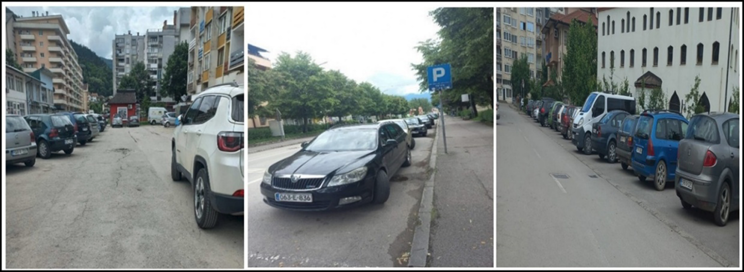
Source: photos by Anisa Bosno.
The total capacity of private parking lots in the urban and suburban areas of Goražde is 1,494 parking spots. Of the 35 registered private parking lots, 31 are located outside the streets, i.e., they include separate areas intended for stationary traffic, while four private parking lots include street spots (Table 2). The condition and quality of registered private parking lots in urban and, to a lesser extent, suburban areas are low. The highest quality is characterised by parking lots located within the Bingo shopping centre in Rabite and Zdravstvenih radnika streets, followed by parking lots within the Cantonal Hospital in Zdravstvenih radnika street, and parking lots located within industrial zones. These parking lots are characterised by a larger number of available parking spots, and the parking spots are marked.
| No. | Location | Spots | Condition and quality | Parking type | Charging | Price |
|---|---|---|---|---|---|---|
| 1 | “Hasib Hadžović” secondary school | 11 | Parking spots are not marked | Private off-street parking | No | - |
| 2 | “DM” drugstore | 3 | Parking spots are not marked | Private off-street parking | No | - |
| 3 | “Mirsad Hurić” city sports hall | 17 | Parking spots are not marked | Private off-street parking | No | - |
| 4 | Zdravstvenih radnika str. | 38 | Good | Private off-street parking | No | - |
| 5 | “Mirsad Hurić” city sports hall | 16 | Parking spots are not marked | Private street parking | No | - |
| 6 | EMKA company | 125 | Good | Private off-street parking | No | - |
| 7 | EMKA company | 130 | Good | Private off-street parking | No | - |
| 8 | “HIFA PETROL” | 10 | Very good | Private off-street parking | No | - |
| 9 | Cantonal hospital Goražde | 110 | Good | Private off-street parking | No | - |
| 10 | Cantonal hospital Goražde | 25 | Good | Private off-street parking | No | - |
| 11 | Cantonal radio-television Goražde | 10+1 | Good | Private off-street parking | No | - |
| 12 | Cantonal radio-television Goražde | 6 | Parking spots are not marked | Private off-street parking | No | - |
| 13 | Škafa company | 7 | Parking spots are not marked | Private off-street parking | No | - |
| 14 | “MOTOREX PJ” Goražde | 8 | Parking spots are not marked | Private off-street parking | No | - |
| 15 | “FA” furniture salon | 8 | Parking spots are not marked | Private off-street parking | No | - |
| 16 | “AS” shop | 6 | Parking spots are not marked | Private off-street parking | No | - |
| 17 | Employment service of the Canton | 10 | Good | Private off-street parking | No | - |
| 18 | “CM” cosmetic Market | 6 | Good | Private off-street parking | No | - |
| 19 | Čojo company | 7 | Good | Private off-street parking | No | - |
| 20 | Government of the Canton | 124 | Good | Private off-street parking | No | - |
| 21 | “Husein ef. Đozo” elementary school | 34 | Good | Private off-street parking | No | - |
| 22 | “Omega shop Goražde” | 5 | Good | Private off-street parking | No | - |
| 23 | “Drinski biser” restaurant | 8 | Good | Private off-street parking | No | - |
| 24 | “Dino Market” shop | 14 | Parking spots are not marked | Private off-street parking | No | - |
| 25 | EMKA company | 124 | Good | Private off-street parking | No | - |
| 26 | “Prevent Goražde” company | 206 | Good | Private off-street parking | No | - |
| 27 | “TVC” company | 103 | Good | Private off-street parking | No | - |
| 28 | Cantonal institute for public health | 54 | Good | Private off-street parking | No | - |
| 29 | “Pobjeda” company | 205 | Good | Private off-street parking | No | - |
| 30 | Elementary school “Mehmedalija Mak Dizdar” | 11 | Parking spots are not marked | Private off-street parking | No | - |
| 31 | “Casablanca” restaurant | 16 | Good | Private off-street parking | No | - |
| 32 | Zdravstvenih radnika str. | 12 | Good | Private off-street parking | No | - |
| 33 | Zdravstvenih radnika str. | 5 | Good | Private street parking | No | - |
| 34 | Zdravstvenih radnika str. | 5 | Good | Private street parking | No | - |
| 35 | Hotel “Behar” | 14 | Very good | Private off-street parking | Yes | 1 KM/h* |
* KM is the Bosnian convertible mark; 1 KM ≈ €0.51.
Source: own work based on field research.
It should also be emphasized that private parking lots in the urban area do not have a real private character but are mostly parking lots that are built on urban construction land owned by the City of Goražde, along with social infrastructure facilities. Parking spots in these parking lots are issued for use within the jurisdiction of the City of Goražde upon payment of a determined monthly fee for occupying public areas. The monthly fee in the form of an annuity is determined based on location, especially the distance from the centre. Private parking lots that are the subject of consideration in this study are not included in the system of hourly billing or daily ticket collection, except for the parking lot at the location next to the Behar hotel.
The level of security in public-private lots is reduced. Most private parking lots are marked with adequate traffic and supplementary signs indicating the prohibition of parking, except for users for whom the spots are intended to be used. However, there are also several parking lots occupied by the City of Goražde that are not adequately marked with traffic signs. There is no monitoring system in place to restrict or control access to private parking lots through the construction of ramps, toll booths, or other mechanisms. In this way, access is provided to all car drivers to park in parking lots with a private character. Parking congestion occurs in residential zones where, due to the lack of empty construction land, parking spots are built in significantly smaller numbers than the requirements and needs of users, especially when we consider that some housing units require the occupancy of two spots (Fig. 4).
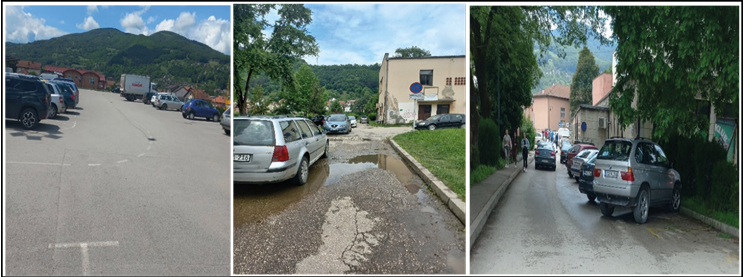
Source: photos by Anisa Bosno.
3.2. Proposal for zoning of parking lots
To support spatial and urban-planning measures, we delineated a simple three-zone parking scheme for the urban and suburban area of the City of Goražde (Fig. 5), based on the evidence collected in this study. The zoning is operational and relies on criteria that were available within the scope of our dataset: the existing regulatory framework of parking supply (presence/absence of charging and any posted time controls), spatial centrality and functional context (concentration of services, public institutions and retail in the inner urban core versus predominantly residential peripheral streets), and observed parking pressure reflected in the field inventory and the occupancy measurements.
Accordingly, Zone 3 represents the core high-demand area, in which charging is already present in practice (hourly payment regime) and where demand-management instruments are most justified. Zone 2 is defined as an intermediate transition area surrounding the core, where short-stay needs are evident (e.g., locations serving quick errands such as pharmacy use, where a 30-minute limit currently exists at specific sites) and where time-control measures can be used to protect turnover. Zone 1 covers the widest area outside the core where parking is predominantly unmanaged (no charging), and where the absence of time limitations is most likely to support long-stay parking and spillover. This zoning logic could help the city gradually align parking regulation with spatial structure and measured demand intensity, while prioritising the most constrained and functionally intensive parts of the urban area.
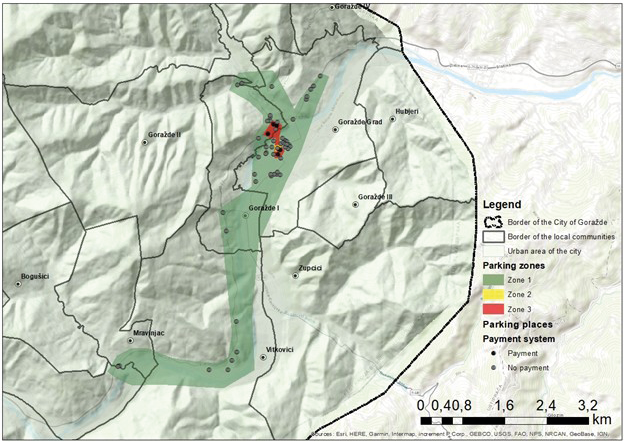
Source: own work based on field research.
We note that this study did not directly measure individual parking duration, drivers’ destinations, or detailed behavioural reasons for car use, nor did it quantify alternative transport options for specific journeys. Such behavioural evidence would be necessary for a more granular, performance-based design of pricing, time limits and permit rules. In line with this, the paper highlights the need for more detailed future research on who uses parking, for what purposes, and for how long. The study also did not systematically assess the availability and quality of alternative modes (public transport, walking and cycling) for specific journeys. However, in the study area there is no regular urban public transport service and there is no dedicated cycling infrastructure (e.g., cycling lanes), which likely contributes to a high reliance on private cars for many daily trips. These contextual constraints should be considered when interpreting the findings and when designing parking measures.
Such a conceptual solution enables the reduction of pressure on the parking lot in terms of limiting the retention of one parked vehicle for a longer period in the same parking space (Dadić et al., 2014). In this way, the frequency of parked vehicles increases while at the same time reducing the possibility of oversaturation of the capacity of parking lots and the number of illegal parking (Hukić, 2019; Borovac, 2021).
3.3. Recording and analysis of parking lot occupancy in the urban area of the City of Goražde
For a more detailed analysis of the condition and occupancy of parking lots in the urban area of Goražde, as well as to determine their level of quality and efficiency, field research was conducted.
| No. | Parking/Location | Number of parking spots | Parking type |
|---|---|---|---|
| 1 | Bingo shopping centre | 14 | Private street parking – public character |
| 2 | Bingo shopping centre | 12 | Private street parking – public character |
| 3 | Bingo shopping centre | 80+3* | Private off-street parking – public character |
| 4 | Bingo shopping centre | 30 | Private off-street parking – public character |
| 5 | Zdravstvenih radnika str. | 26 | Private off-street parking |
| 6 | Zdravstvenih radnika str. | 25+2* | Private off-street parking |
| 7 | Zdravstvenih radnika str. | 24 | Private off-street parking |
| 8 | Zdravstvenih radnika str. | 24 | Private off-street parking |
| 9 | Ibrahima Čelika str. | 35 | Private off-street parking |
| 10 | Zdravstvenih radnika str. | 34 | Private off-street parking |
| 11 | 43. Drinske brigade str. | 40 | Private off-street parking |
| Total | 349 | - | |
* Total number of parking spots + additional parking spots for people with disabilities
Source: own work based on field research.
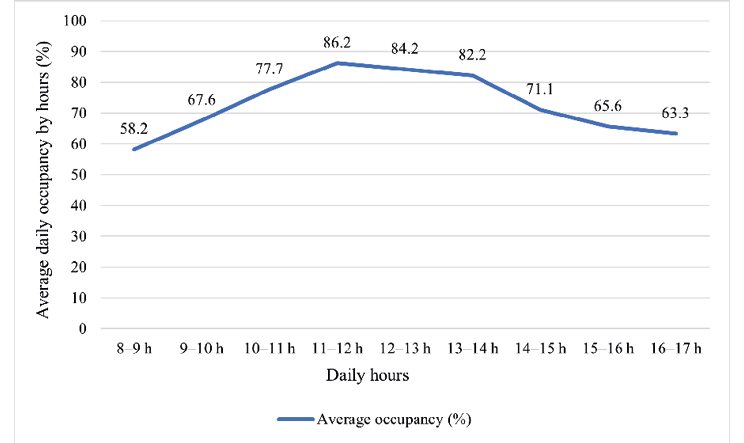
During the field research, the focus was placed on counting the number of vehicles parked inside the parking lot, which is the subject of consideration in this paper. Vehicle counting was conducted every hour in the period from 8:00 a.m. to 5:00 p.m. in all 11 parking lots (Fig. 6). A total of nine observations were conducted during the day, based on which input data was obtained to calculate the average occupancy of parking lots by hour. The average occupancy rate is expressed as a percentage and is obtained by dividing the number of recorded vehicles during one hour by the total number of all parking lots that are the subject of the research.
Source: own work based on field research.
The average occupancy of parking lots per hour during one working day is between 58.2% and 86.2%. Basically, it can be determined that the highest occupancy of parking lot capacity in the urban area of the city occurs during peak hours between 10:00 a.m. and 5:00 p.m.
If we analyse the average daily occupancy of the surveyed parking lots separately, the daily occupancy varies between 62.0% and 96.7% depending on the location. The highest average daily occupancy of capacity is recorded in the parking lot with a capacity of 40 parking spots on 43rd Drinske Brigade Street, which is 96.7%. At one of the observations, 26 illegally parked vehicles were recorded at this location during working hours, which means that 53% of illegal parking occurred at that location. The 43rd Drinske Brigade Street is almost full daily, and the modernisation of which would be necessary to access modern solutions and increase its capacity. The situation is similar in several other parking lots investigated as well, to which all the above can be applied (Table 4).
| No. | Parking/Location | Number of parking spots | Type of parking | Average daily occupancy (%) |
|---|---|---|---|---|
| 1 | Bingo shopping centre | 14 | Private street parking – public character | 79.4 |
| 2 | Bingo shopping centre | 12 | Private street parking – public character | 62.0 |
| 3 | Bingo shopping centre | 80+3 | Private off-street parking – public character | 70.6 |
| 4 | Bingo shopping centre | 30 | Private off-street parking – public character | 83.0 |
| 5 | Zdravstvenih radnika str. | 26 | Private off-street parking | 78.5 |
| 6 | Zdravstvenih radnika str. | 25+2 | Private off-street parking | 78.7 |
| 7 | Zdravstvenih radnika str. | 24 | Private off-street parking | 84.3 |
| 8 | Zdravstvenih radnika str. | 24 | Private off-street parking | 91.2 |
| 9 | Ibrahima Čelika str. | 35 | Private off-street parking | 34.3 |
| 10 | Zdravstvenih radnika str. | 34 | Private off-street parking | 88.6 |
| 11 | 43. Drinske brigade str. | 40 | Private off-street parking | 96.7 |
| Total | 349 | - | 72.9 | |
Source: own work based on field research.
Based on the analysis of the surveyed parking lots by hours of each separately, the field research determined that in the morning there are two periods of the peak hour (10:00 a.m. − 11:00 a.m. and 11:00 a.m. − 12:00 p.m.), while in the afternoon there are three periods of the peak hour (12:00 p.m. − 1:00 p.m.; 1:00 p.m. − 2:00 p.m., and 2:00 p.m. − 3:00 p.m.) (Fig. 7).
Source: own work based on field research.
Based on the research, it was determined that the average occupancy of all surveyed parking lots in the peak hours in the morning was 92.8%, while in the peak hours in the afternoon, it slightly decreased to 90.0%. At the parking lots in Zdravstvenih radnika and 43. Drinske brigade streets in the peak hours the average occupancy was observed in the range of 102.5-110%. This means that these investigated parking lots are exposed to parking above their available nominal capacities. The main cause of such a phenomenon is improper parking of vehicles, as a result of which the throughput of the mentioned parking lots is reduced, and within them, there is very often a larger number of parked vehicles than the actual capacity they can sufficiently handle (Table 5).
| No. | Parking/Location | In the morning | In the afternoon | ||
|---|---|---|---|---|---|
| Peak hour (h) | Occupancy (%) | Peak hour (h) | Occupancy (%) | ||
| 1 | Shopping center “Bingo” | 11–12 | 92.9 | 12–1 | 100.0 |
| 2 | Shopping center “Bingo” | 11–12 | 100.0 | 2–3 | 91.7 |
| 3 | Shopping center “Bingo” | 11–12 | 86.3 | 2–3 | 87.5 |
| 4 | Shopping center “Bingo” | 11–12 | 86.7 | 12–1 | 90.0 |
| 5 | Zdravstvenih radnika str. | 11–12 | 100.0 | 1–2 | 70.0 |
| 6 | Zdravstvenih radnika str. | 10–11 | 96.0 | 12–1 | 100.0 |
| 7 | Zdravstvenih radnika str. | 10–11 | 104.2 | 1–2 | 104.2 |
| 8 | Zdravstvenih radnika str. | 11–12 | 95.8 | 1–2 | 95.8 |
| 9 | Ibrahima Čelika str. | 11–12 | 48.6 | 1–2 | 51.4 |
| 10 | Zdravstvenih radnika str. | 11–12 | 100.0 | 1–2 | 97.1 |
| 11 | 43. Drinske brigade str. | 11–12 | 110.0 | 1–2 | 102.5 |
| Average occupancy over the time of the day | - | 92.8 | - | 90.0 | |
| Network-wide peak hourly average occupancy (all 11 lots combined): 86.2% | |||||
Source: own work based on field research.
During the research, a total of 2,290 parked vehicles were recorded at all investigated locations during one working day, of which 49 were not properly parked, which makes 2.1% of improperly parked vehicles of the total number of parked vehicles. Also, it was determined that illegally parked vehicles did not stay at the parking spot for more than 30 minutes. However, it is necessary to highlight and adequately treat this phenomenon, since it represents one of the key problems in the field of stationary traffic, although during the research, it could not be treated as a high-risk problem. However, due to the fact and data that the degree of motorisation and the number of registered motor vehicles are increasing every year, it can be expected that after a certain period, there will be a significant increase in the number of vehicles that will need to use the parking lots. If the current capacities of parking lots are not adequately and timely planned and developed in accordance with the requirements and needs, the number of illegally parked vehicles in parking lots will inevitably grow and pose increasing problems.
The analysis of parking occupancy at the surveyed locations shows an average daily occupancy of 72.9%, rising to 86.2% in the peak hour. These values provide a baseline for repeat monitoring at the same sites, but they should not be extrapolated to all parking lots in Goražde without additional coverage. Importantly, occupancy is highly uneven across locations: average daily values range from 34.3% to 96.7%, and several key sites exceed nominal capacity during peak periods (up to 110%), which is consistent with observed manoeuvring constraints and illegal parking. From a management perspective, the objective is not to maximise occupancy, but to maintain a small buffer of available spots; therefore, a practical target is to keep peak occupancy around 80–85% in the core area, while recurrent near-full conditions indicate the need for the zoning-based package proposed below (time limits, pricing, enforcement, and selective upgrades).
A household survey on the state of the local transport system was conducted via an online questionnaire in the City of Goražde in the period 1–17 June 2023 (n=103). The survey targeted adult residents, with emphasis on respondents from the urban local communities (Goražde I–IV), in order to capture perceptions in the area where parking pressure is most pronounced. Respondents could select more than one option from a predefined list of parking-related problems (multiple-response item). To the survey question, “In your opinion, what problems do drivers encounter the most when parking their cars in Goražde?”, the most frequently selected problem was the lack of parking spots (95.1%), followed by improper parking that prevents manoeuvring/exiting (80.6%) and concerns about vehicle safety in parking areas (67%). Given the sample size and non-probability recruitment, these percentages should be interpreted as descriptive results for the respondent group rather than population-representative estimates.
The survey responses are consistent with the field inventory and the occupancy observations, which together indicate that insufficient parking supply and limited demand-management measures are salient issues in the central urban area. These findings support the need to consider a phased package of measures (improved marking/signage, time limits, pricing, and where feasible off-street capacity solutions), while recognising that the survey results are descriptive and not population-representative.
3.4. Major problems which need to be tackled
The planning of parking locations and capacities, as well as the overall parking policy in the City of Goražde, is not addressed by the competent authorities in a sufficiently systematic manner. As a result, the parking subsystem shows low levels of functionality and service quality.
To date, there is no empirical evidence on who uses parking in Goražde, for how long, and when demand peaks by user group. We did not collect these behavioural dimensions because this study was designed as a baseline assessment of supply, regulation, and typical weekday occupancy. Reliable duration measurement would require vehicle re-identification over time (e.g., repeated plate matching or camera/sensor monitoring), while trip purpose typically requires intercept surveys or travel diaries. These approaches would have required a longer field campaign, additional staffing, and formal permissions with privacy safeguards, and the study area currently lacks automated data sources that could support such analysis. Therefore, duration and user profiles are identified as priorities for future research to inform performance-based pricing and time-limit policies.
Only five parking lots (17%) are integrated into the paid-parking regime, while the majority of parking supply remains outside any charging system. In this context, the lack of clear time limits and turnover rules in most locations may contribute to longer stays and higher saturation in the central area. The city also does not currently operate a formal, city-wide zoning scheme with clearly defined time limits by zone; instead, time limits appear only at specific locations (e.g., a 30-minute limit used for short-stay purposes). At the existing paid sites, charging is implemented from 7 a.m. to 9 p.m. through staff who issue tickets and charge according to the recorded retention time.
The parking fee at locations where charging has been established is 1 KM/h (≈ €0.51/h). The physical condition and basic functional equipment of parking facilities are uneven. Recently built lots are generally in good condition (paved surface, marked spots and basic signage indicating parking use and/or charging). However, even at paid locations basic information on price, payment method and maximum time limit is often not clearly displayed.
A significant number of parking lots also lack marked spots, which encourages improper parking and effectively reduces usable capacity. Taken together, these findings suggest that parking management in Goražde still relies predominantly on supply-led solutions, with limited use of demand-management instruments. This reinforces the need for clearer information and signage, more consistent marking of spots, and a gradual introduction of time-limit and pricing measures aligned with the proposed zoning scheme.
4. Conclusion
Traffic is one of the most important functions in an urban area, as it has a dominant impact on the lives of residents. Traffic influences the planning and distribution of all other functions in the area, because the planning of other functions, such as housing, work, and many others, depends highly on the level of quality and development of traffic. Given the increasing trend of the need for individual transport by the inhabitants of the researched area, new needs and requirements arise in the domain of stationary traffic. First of all, these needs and requirements relate to the optimal planning and rational use of construction land for the occupation and construction of spacious parking areas with maximum capacities of parking lots based on demand.
From a management perspective, the first priority is to use the existing parking supply more efficiently through consistent marking of spots, clear signage/information, zoning-based time limits, pricing/permits (where justified), and enforcement to increase turnover in the core area. Only where these measures remain insufficient, and where planning conditions allow, should targeted off-street additions be considered as a complementary long-term option. In that case, the most space-efficient approach is to integrate parking into new developments (e.g., basement/underground garages within residential buildings or shopping centres), as already envisaged in local planning documents (City of Goražde, 2020), while noting implementation/compliance constraints highlighted by Hrelja et al. (2020).
Peak-period occupancy reaches up to 110.0% at hotspot sites (Table 5), while the hourly average across all surveyed facilities peaks at 86.2%. The resulting occupancy capacity proportionally causes an increased number of illegal parking lots, which further causes problems in the smooth running of other functions in the city, which are interconnected with the traffic function.
The parking policy and the parking space payment system are almost non-existent as a separate and detailed aspect through spatial planning, implementation, and strategic documentation that would conduct the strategic and planned development of the parking system, as well as the entire part of the traffic infrastructure from the technical aspect of parking lots. One of the main problems which needs to be tackled is to make a transition from a traditional to a modern approach in terms of rehabilitation, reconstruction, and modernisation of the arrangement and construction of parking areas that will meet all modern standards and needs of users in the most efficient way.
Autorzy
REFERENCES
ARNOTT, R. and INCI, E. (2006), ‘An integrated model of downtown parking and traffic congestion’, Journal of Urban Economics, 60 (3), pp. 418–442. https://doi.org/10.1016/j.jue.2006.04.004
ARNOTT, R. and ROWSE, J. (1999), ‘Modeling parking’, Journal of Urban Economics, 45 (1), pp. 97–124. https://doi.org/10.1006/juec.1998.2084
BIDŽAN-GEKIĆ, A., GEKIĆ H., ŽUNIĆ L. and NEZIROVIĆ S. (2020), ‘Valorization of natural tourist potentials and their protection in the Podrinje tourist-geographical region’, Journal of Tourism and Hospitality Management, 6, pp. 36−49. https://doi.org/10.35666/25662880.2020.6.36
BOROVAC, A. (2021), ‘Analiza parkirališnih mjesta na području gradskog naselja Vrbik u Gradu Zagrebu’, PhD thesis, Zagreb: Sveučilište u Zagrebu – Fakultet prometnih znanosti, https://urn.nsk.hr/urn:nbn:hr:119:209637 [accessed on: 13.08.2024].
BUBLIN, M. (2007), Planiranje saobraćaja i saobraćajnica, Sarajevo: Građevinski fakultet u Sarajevu.
CITY OF GORAŽDE (2017), ‘Strategija razvoja Grada Goražda 2017–2026. godine’, Grad Goražde, https://sogfbih.ba/sites/default/files/javni_dokument/2021-06/Gora%C5%BEde%20-%20Strategija%20razvoja%202017%20-%202026.pdf [accessed on: 11.08.2024].
CITY OF GORAŽDE (2020), ‘Odluka o usvajanju i provođenju izmjena regulacionog plana Biserna u Goraždu’, Grad Goražde, https://gorazde.ba/wp-content/uploads/2023/12/OdlukaoPROVODJENJUplana.pdf [accessed on: 10.07.2024].
DADIĆ, I., KOS, G. and ŠEVROVIĆ M. (2014), Teorija prometnog toka, Zagreb: Sveučilište u Zagrebu – Fakultet prometnih znanosti.
GEKIĆ, H., BIDŽAN, A. and AVDIĆ, B. (2015), ‘The role of the Transport System in the Economic Development of Bosnia and Herzegovina’, Geography and Environmental Planning Journal, 57 (1), pp. 221−238.
GEKIĆ, H., BIDŽAN-GEKIĆ, A., DREŠKOVIĆ, N., MIRIĆ, R. and REMENYI, P. (2022), ‘Urban and Rural Geography of Bosnia and Herzegovina’, [in:] GEKIĆ, H. et al., The Geography of Bosnia and Herzegovina, World Regional Geography Book Series, Cham: Springer, pp. 241−263. https://doi.org/10.1007/978-3-030-98523-3_12
GIZSUTP (2010), ‘Parking Management (SUTP Module 2c)’, Deutsche Gesellschaft für Internationale Zusammenarbeit (GIZ) GmbH, https://sutp.org/publications/parking-management/ [accessed on: 20.12.2025].
HRELJA, E., SIVAC, A., AVDIĆ, A. and DŽAFERAGIĆ, A. (2020), ‘Analysis of land cover changes in the area of the City of Goražde’, Geografski pregled, 43, pp. 37−46.
HUKIĆ, E. (2017), ‘Analiza funkcije uličnih mjesta za parkiranje’, Zagreb: Sveučilište u Zagrebu – Fakultet prometnih znanosti, https://urn.nsk.hr/urn:nbn:hr:119:311263 [accessed on: 20.12.2024].
HUKIĆ, E. (2019): ‘Analiza parkirne politike u funkciji razvoja održive mobilnosti – Studija slučaja Grad Zagreb’, Zagreb: Sveučilište u Zagrebu – Fakultet prometnih znanosti, https://urn.nsk.hr/urn:nbn:hr:119:467411 [accessed on: 21.12.2024].
ITF (2018), ‘The Shared-Use City: Managing the Curb’, OECD Publishing/International Transport Forum, https://www.itf-oecd.org/sites/default/files/docs/shared-use-city-managing-curb_5.pdf [accessed on: 23.12.2025].
ITDP (2021), ‘On-Street Parking Pricing: A Guide to Management, Enforcement, and Evaluation’, Institute for Transportation and Development Policy, https://itdp.org/publication/on-street-parking-pricing/ [accessed on: 23.12.2025].
ITDP (2024), ‘The Opportunity of Reforming Parking: A Taming Traffic Deep Dive Report’, Institute for Transportation and Development Policy, https://itdp.org/publication/the-opportunity-of-reforming-parking/ [accessed on: 23.12.2025].
KAPLAN, D., HOLLOWAY, S. and WHEELER, J. (2014), Urban Geography, 3rd edition, New York: Wiley.
KRIZEK, K. and KING, D. (2021), Advanced Introduction to Urban Transport Planning, Cheltenham: Edward Elgar Publishing Limited.
LEHE, L. (2018), ‘Minimum parking requirements and housing affordability’, Journal of Transport and Land Use, 11 (1), pp. 1309–1321. https://doi.org/10.5198/jtlu.2018.1340
LITMAN, T. (2024), ‘Parking Management: Strategies, Evaluation and Planning’, Victoria Transport Policy Institute, https://vtpi.org/park_man.pdf [accessed on: 03.01.2025].
MANVILLE, M. and PINSKI, M. (2021), ‘The causes and consequences of curb parking management’, Transportation Research Part A: Policy and Practice, 152, pp. 295–307. https://doi.org/10.1016/j.tra.2021.07.007
MARSDEN, G. (2006), ‘The evidence base for parking policies – a review’, Transport Policy, 13 (6), pp. 447–457. https://doi.org/10.1016/j.tranpol.2006.05.009
MARTINIĆ, I., DADIĆ, I. and PEKO, I. (2005), ‘Stationary Traffic In The Urban Planning System’, Promet - Traffic & Transportation, 17 (2), pp. 113−119.
MEYER, M. (2016), Transportation planning handbook, New Jersey: Wiley.
NURKOVIĆ, R. and GEKIĆ, H. (2011), ‘New Spatial Development Processes of Urbanisation of Sarajevo’. Journal of Settlements and Spatial Planning, 2 (2), pp. 109−114.
OTTOSSON, D. B., CHEN, C., WANG, T. and LIN, H. (2013), ‘The sensitivity of on-street parking demand in response to price changes: A case study in Seattle, WA’, Transport Policy, 25, pp. 222–232. https://doi.org/10.1016/j.tranpol.2012.11.01
PARKSUMP (2022), ‘Parking and SUMP: Using parking management to achieve your SUMP objectives effectively and sustainably (Topic Guide)’, https://park4sump.eu/sites/default/files/2022-10/SUMP2.0%20Topic%20Guide%20on%20Parking%20management%20and%20SUMP_EN.pdf [accessed on: 03.01.2025].
PIERCE, G. and SHOUP, D. (2013), ‘Getting the prices right: An evaluation of pricing parking by demand in San Francisco’, Journal of the American Planning Association, 79 (1), pp. 67–81. https://doi.org/10.1080/01944363.2013.787307
POPESCU, R. (2022), ‘The culture of parking on the sidewalks’, Cities, 131, 103888. https://doi.org/10.1016/j.cities.2022.103888
RAZUM, D. (2022), ‘Analiza uličnih parkirališnih mjesta u zoni Maksimirske ceste u Gradu Zagrebu’, Zagreb: Sveučilište u Zagrebu – Fakultet prometnih znanosti, https://urn.nsk.hr/urn:nbn:hr:119:616444
RODRIGUE, J-P. (2024), The Geography of Transport Systems, 6th edition, New York: Routledge.
SFMTA (2014), ‘SFpark: Pilot Project Evaluation Summary’, San Francisco Municipal Transportation Agency, https://www.sfmta.com/getting-around/drive-park/demand-responsive-pricing/sfpark-evaluation [accessed on: 01.01.2025].
SHOUP, D. C. (1997), ‘Evaluating the effects of cashing out employer-paid parking: Eight case studies’, Transport Policy, 4 (4), pp. 201–216. https://doi.org/10.1016/S0967-070X(97)00019-X
SHOUP, D. C. (2005), The High Cost of Free Parking, Chicago: Planners Press, American Planning Association.
TUVIKENE, T. (2015), Freedom to park: post-socialist automobility in Tallinn, London: University College London, https://discovery.ucl.ac.uk/id/eprint/1463838/2/Tuvikene2015_Freedom-to-Park_PhD_3rd-party-content-removed%5B1%5D.pdf [accessed on: 23.12.2025].
TUVIKENE, T. (2018), ‘Post-socialist (auto)mobilities: Modernity, freedom and citizenship’, Geography Compass, 12 (3), e12362. https://doi.org/10.1111/gec3.12362
WILLSON, R. W. and SHOUP, D. C. (1990), ‘Parking subsidies and travel choices: Assessing the evidence’, Transportation, 17 (2), pp. 141–157. https://doi.org/10.1007/BF02125333