Gender Pay Gap in European Economy System with Focus on Poland from Global Perspective: in the Pursuit of Sustainability
Joanna Bojarska
* 
Wojciech M. Wolf *
Summary
Aim: This paper presents a comprehensive analysis of the gender pay gap (GPG) in Poland, examined within the national, European, and global contexts. It explores key causes, sectoral disparities, and the broader economic and policy implications. Particular emphasis is placed on the adjusted gender pay gap (GPG), which provides a more accurate measure by controlling for variables such as education, experience, and job position. This method reveals deeper and more persistent wage disparities than those suggested by the unadjusted GPG.
Methodology/Data sources: The study adopts a narrative literature review approach supported by secondary data analysis. It draws upon a wide range of national and international data sources, including Eurostat, Poland’s Central Statistical Office (GUS), OECD, and various EU and global reports published between 2015 and 2025.
Findings: In 2023, the unadjusted GPG in the EU was 12%, while in Poland it stood at 7.8%. Despite appearing relatively low, Poland’s GPG has stagnated or worsened over the past decade, while the EU has seen a gradual decline. The adjusted GPG – reflecting education, experience, and job type – was 11.4% for the EU and 12.5% for Poland (as of 2018). Sectoral differences in Poland are striking: 24.8% in information and communication and 27.6% in finance and insurance. Misinterpretation of unadjusted vs. adjusted data may distort the public debate and policy response.
Conclusions: The GPG remains a persistent challenge in both the EU and Poland. The lack of clarity between adjusted and unadjusted measures risks underestimating systemic inequality. Effective implementation of recent EU regulations, such as the Pay Transparency and Work-Life Balance Directives, will be key to narrowing the gap.
Significance/Originality: This is, to our knowledge, the first holistic synthesis of various GPG indicators for Poland, presented alongside EU and global comparisons. The findings underscore the importance of integrated, data-informed policies to advance gender equality as a cornerstone of sustainable development.
Keywords: gender pay gap, gender equality, economy, sustainable development, labour market, labor law, artificial intelligence, employee life cycle perspective
Różnica w wynagrodzeniach kobiet i mężczyzn w europejskim systemie gospodarczym ze szczególnym uwzględnieniem Polski z globalnej perspektywy: w dążeniu do zrównoważonego rozwoju
Streszczenie
Cel: W artykule przedstawiamy kompleksową analizę luki płacowej ze względu na płeć (GPG) w Polsce, uwzględniając kontekst krajowy, europejski i globalny. Omawiamy główne przyczyny, różnice sektorowe oraz szersze konsekwencje gospodarcze i społeczne. Szczególny nacisk kładziemy na skorygowaną lukę płacową ze względu na płeć (adjusted GPG), która stanowi dokładniejszy miernik, ponieważ uwzględnia zmienne takie jak wykształcenie, doświadczenie zawodowe oraz zajmowane stanowisko. Metoda ta ujawnia głębsze i trwalsze nierówności płacowe niż te wskazywane przez nieskorygowaną lukę płacową (unadjusted GPG).
Metodologia/Źródła danych: Badanie ma charakter narracyjnego przeglądu literatury, wspartego analizą danych wtórnych. Wykorzystaliśmy szeroki zakres źródeł krajowych i międzynarodowych, m.in. Eurostat, GUS, OECD oraz raporty UE i organizacji globalnych z lat 2015–2025.
Główne wyniki: W 2023 r. niezrównana (niekorygowana) luka płacowa w UE wynosiła 12%, a w Polsce 7,8%. Choć ten wynik wydaje się korzystny, GPG w Polsce nie ulega poprawie od dekady, w przeciwieństwie do trendów unijnych. Skorygowana GPG (uwzględniająca m.in. wykształcenie, doświadczenie i stanowisko) wynosiła 11,4% w UE i 12,5% w Polsce (dane z 2018 r.). W niektórych sektorach w Polsce różnice są znacznie wyższe: np. 24,8% w sektorze informacji i komunikacji czy 27,6% w finansach. Niezrozumienie różnicy między danymi korygowanymi i niekorygowanymi może prowadzić do błędnych wniosków.
Wnioski: Luka płacowa nadal stanowi poważne wyzwanie – zarówno w Polsce, jak i w UE. Klarowne rozróżnienie między metodami pomiaru (GPG skorygowana vs. niekorygowana) jest kluczowe dla skutecznych działań. Nowe regulacje UE, jeśli zostaną właściwie wdrożone, mogą pomóc w zmniejszeniu GPG.
Znaczenie/Oryginalność: To, według naszej wiedzy, pierwsza tak kompleksowa synteza różnych wskaźników GPG dla Polski w porównaniu z kontekstem unijnym i globalnym. Wyniki podkreślają potrzebę zintegrowanych, opartych na dokładnych danych działań na rzecz równości płci jako warunku zrównoważonego rozwoju.
Słowa kluczowe: luka płacowa między kobietami a mężczyznami, równość płci, zrównoważony rozwój, sztuczna inteligencja, perspektywa cyklu życia pracownika
1. Introduction
Gender equality, including the situation of women in the economic system, is a key priority for a sustainable world. Achieving gender equality and promoting decent work and economic growth are among the key objectives of the United Nations 2030 Agenda for Sustainable Development (UN General Assembly 2015). One of the most persistent challenges in this context is the gender pay gap (GPG) – the difference in average earnings between women and men.
The GPG has been the subject of academic discussion for over a century. As early as 1891, an article titled The Alleged Differences in the Wages Paid to Men and Women for Similar Work highlighted this issue (Webb 1891). Over time, various theoretical frameworks have attempted to explain the persistence of the gap. For instance, human capital theory attributes GPG to individual differences in education, work experience, and career choices (Becker 1962; Mincer 1974; Mincer, Polachek 1977). However, recent research suggests that these factors explain only part of the variation (Boll, Rossen, Wolf 2017; Zachorowska-Mazurkiewicz, Gomółka 2023). The GPG is now widely recognized as a multidimensional phenomenon, influenced by institutional, social, cultural, and economic factors (Altonji, Blank 1999).
In 2023, Professor Claudia Goldin was awarded the Nobel Prize in Economics for her research on women’s labor market outcomes. Her longitudinal analysis of over 200 years of data from the United States demonstrated that the evolution of women’s participation in the labor market follows a non-linear trajectory. She identified key historical turning points – such as industrialization, the growth of the service economy, and the introduction of birth control – that shaped female labor force participation and earnings. Her work emphasized that societal norms and legal frameworks continue to limit women’s earning potential, particularly after childbirth. Wages are not only a reflection of economic contribution but also a signal of social value. As Goldin stated, relative earnings can influence how individuals are perceived and valued in society (Goldin 2014). A persistent GPG can therefore reinforce gender-based inequalities beyond the labor market.
The struggle for women’s rights dates back to the mid-19th century, with early activism such as the 1848 Women’s Rights Convention in the United States (Roediger, Freedom 2015). Efforts to ensure equal pay for equal work have long been part of international and European policy frameworks. The International Labour Organization (ILO) introduced the principle of equal remuneration in 1919, and Convention No. 100 was adopted in 1951 (International Labour Organization 1951). Gender equality has been a legal principle in the European Union (EU) since the Treaty of Rome (1957), with key directives like Directive 2006/54/EC aimed at eliminating discrimination in employment and pay.
As an EU member, Poland has embedded gender equality in its Constitution (1997) and Labour Code, notably through Articles 32 and 33, which guarantee equal treatment and pay for men and women. However, despite these legal frameworks, practical challenges remain, and gender disparities persist in the Polish labor market. The country’s shift from a centrally planned to a market-based economy after 1989 significantly altered gender roles and labor dynamics. While the communist era promoted women’s employment, the post-transition period introduced new challenges such as labor market liberalization, privatization, and evolving social norms. Though EU membership has spurred policy harmonization and progress, structural and cultural barriers still influence wage gaps and career advancement.
On a global scale, full gender parity remains elusive. The Global Gender Gap Report notes only a slight improvement from 68.6% in 2024 to 69.0% in 2025, suggesting over 120 years before full equality is reached (World Economic Forum 2024). Despite the EU’s role as a benchmark for gender equality in labor markets (European Parliament and Council 2023), disparities are especially pronounced in Central and Eastern Europe. Poland’s economic transition has had lasting effects on women’s employment and wages (Iwasaki, Satogami 2023), with historical and cultural factors continuing to shape labor market outcomes (Eurostat 2023; European Central Bank 2025).
This paper aims to provide a comprehensive review of the gender pay gap in Poland, embedded in European and global contexts. It draws on recent literature, policy documents, and secondary statistical data from sources such as Euro-stat, GUS, and OECD, distinguishing clearly between unadjusted and adjusted GPG. While the unadjusted GPG reflects the raw average pay gap between men and women, the adjusted GPG accounts for factors like education, experience, occupation, and sector (European Parliament and Council 2023; European Parliament 2023). Additionally, we highlight sectoral and regional differences and discuss broader indicators of gender (in)equality, including the employment gap and income inequality. Through this analysis, we aim to offer a multi-dimensional understanding of gender pay disparities and to identify key challenges and policy directions relevant to both researchers and decision-makers.
2. Research methods
Although the gender pay gap (GPG) has been widely examined in both aca-demic and policy-oriented literature, comprehensive studies focusing specifically on both unadjusted and adjusted GPG in Poland – situated within an international and EU context – remain limited. This is particularly due to the complexity of calculating adjusted GPG, which requires access to detailed micro-level data and the application of advanced statistical methods. As a result, there is a notable gap in the scientific literature when it comes to an integrative analysis of gender-based disparities in earnings in Poland, especially when considering related indicators such as the income gap, employment gap, and broader measures of gender equality.
The primary aim of this article is to provide a holistic and multidimensional overview of the gender pay gap in Poland, analyzing its structural causes, socioeconomic consequences, and future challenges and policy implications. The analysis is particularly relevant given the ongoing political, economic, and social transformations in Poland since 1989, which have had lasting effects on labor market dynamics and gender equality – both domestically and in relation to European and global standards.
This paper is structured as a narrative literature review, supported by a descriptive analysis of secondary data from national and international sources. The research is grounded in peer-reviewed academic literature (primarily from Google Scholar and Scopus) and supplemented by national-level reports, especially those produced in Poland. Search terms included: “gender equality,” “gender pay gap,” “gender employment gap,” “income gap,” “(un)adjusted gender pay gap,” “Poland,” “European Union,” “global,” “sustainable development goals,” “SDG5,” “SDG8,” and “gender equality index.”
Due to the limited availability of recent academic publications specifically focused on Poland, we incorporated secondary statistical data from sources such as Eurostat, the Central Statistical Office of Poland (GUS), the National Bank of Poland, the European Central Bank, and the World Bank Group. Ad-ditional data was retrieved from publicly available sources, including statistical platforms (e.g., Statista) and specialized websites (e.g., bankier.pl, wynagrodzenia.pl), as well as official reports and surveys. The data span the period from 2002 to 2025 and are presented in the form of basic, descriptive figures to illustrate the key trends.
Basic Research Questions:
- What is the definition of the gender pay gap (GPG)?
- Does a gender pay gap still exist in the EU in 2025, and what is the current size of the gap in Poland compared to other EU countries?
- How has the GPG changed over time?
- What does the global perspective on the GPG reveal?
- What are the main causes and consequences of the GPG?
Advanced Research Questions:
- What are the differences between unadjusted and adjusted GPG in Poland and other EU countries?
- What other gender-related indicators (e.g., employment gap, income gap) provide a broader picture of the socio-economic position of women?
- How are composite indices such as the Gender Equality Index and the Global Gender Gap Index constructed, and what do they show about Poland’s performance?
- What is the relationship between gender equality and the UN 2030 Agenda for Sustainable Development?
- Which Sustainable Development Goals (SDGs) are directly linked to gender equality, and what is the status of their implementation in Poland and across the EU?
- Which legal frameworks and policy instruments govern gender equality at national and EU levels?
- Why is reducing the GPG a strategic priority, and what approaches and initiatives are currently being pursued to address it?
- What are the key challenges and future perspectives in eliminating gender disparities in the labor market?
This literature-based and data-informed analysis aims to provide both a conceptual framework and empirical insight into gender inequalities in the Polish labor market, with a focus on wage differentials. By integrating various data sources and contextualizing findings within the broader global and EU policy discourse, the article contributes to a better understanding of the current state and future direction of gender equality in Poland.
Due to the lack of access to micro-level (individual) data, conducting a full-fledged econometric analysis of adjusted GPG in Poland remains challenging, which further highlights the relevance of secondary data reviews in this area. This study may serve as a starting point for future empirical research, highlighting a clear research gap.
Furthermore, it is important to note that the measurement of both adjusted and unadjusted GPG is subject to methodological limitations, including potential biases in survey data (e.g., SES), limited sectoral coverage, and differences in labor market participation that affect the comparability of results across countries and over time.
3. Results and discussion
3.1. Gender Pay Gap: Concepts and definitions
The gender pay gap (GPG) represents the difference in average earnings between women and men in the labor market (European Parliament and Council 2023). It is a widely used indicator of gender inequality in economic outcomes. Two primary forms of GPG are typically analyzed: unadjusted and adjusted.
Unadjusted Gender Pay Gap (Raw GPG)
The unadjusted GPG (also known as the raw or uncontrolled GPG) refers to the difference between the average gross hourly earnings of women and men (Euro-pean Parliament and Council 2023; European Parliament 2023), expressed as a percentage of men’s earnings:
where: m = average gross hourly earnings for men, k = average gross hourly earnings for women (Wynagrodzenia.pl, n.d.).
This measure is straightforward and widely reported by institutions such as Eurostat. However, it does not control for individual or job-related characteristics, such as education, occupation, seniority, or working time (e.g., part-time vs. full-time). Thus, it reflects both structural inequalities and differences in employment patterns, including labor market segregation.
It is important to note that the unadjusted GPG only includes employees (typically those with permanent contracts), and therefore may not reflect the situation of all economically active individuals.
Adjusted Gender Pay Gap (Controlled GPG)
The adjusted GPG aims to estimate the difference in earnings between women and men who have comparable characteristics (e.g., education, experience, occupation, or sector) and are employed in similar or equivalent positions (ING 2024). This measure is designed to better capture disparities in pay that cannot be explained by observable variables – often referred to as the “unexplained” gap, potentially linked to discrimination.
Calculating the adjusted GPG requires more complex statistical techniques, including Blinder–Oaxaca decomposition, quantile regressions, and matching models, among others (De Poli, Maier 2024; Meara, Pastore, Webster 2020).
For example, Eurostat’s methodology decomposes the difference in log hourly earnings into an explained component, attributable to observable characteristics (e.g., age, occupation), and an unexplained component, which reflects the adjus-ted GPG and may indicate potential discrimination. This distinction is crucial, as even the “explained” portion can reflect underlying systemic inequalities (e.g., occupational segregation driven by social norms). Therefore, both the unadjusted and adjusted indicators are important for policy and academic analysis (European Commission 2018; Landmesser 2019).
The adjusted GPG is especially relevant in the context of the EU Pay Transparency Directive, which mandates greater disclosure of pay information by gender. It is also used in Equal Pay Certification schemes (e.g., Switzerland’s Equal Salary Certification). In Poland, the Ministry of Family, Labour and Social Policy recommends the use of adjusted pay gap estimates, although practical implementation remains limited.
In this paper, we do not perform original calculations of adjusted GPG. Instead, we rely on existing data and analyses from official sources such as Eurostat, OECD, and national statistical offices, supplemented by academic literature. Our aim is to critically synthesize and compare available findings, highlighting differences between the indicators and their implications for understanding gender inequality in Poland and the EU.
In summary, distinguishing between unadjusted and adjusted measures of the gender pay gap is essential, as they capture different dimensions of inequality – structural versus potentially discriminatory – each providing distinct insights for policy and research.
3.2. Gender Pay Gap in Poland
According to data from the Central Statistical Office (GUS) and Eurostat, the unadjusted gender pay gap (GPG) in Poland in 2023 was 7.8%, which is comparable to the figure from a decade earlier (7.5%) (Eurostat 2023; Statista 2024). However, this seemingly stable figure masks fluctuations and longer-term negative trends. As shown in Figure 1, temporary downward shifts in the GPG occurred after 2007, 2014, and 2018, but were interrupted by short-term reversals, notably in 2010, 2017, and 2020. Since 2022, the trend has remained relatively stable.
In Poland, similar to other Central and Eastern European (CEE) countries, both pre- and post-reform periods showed narrowing gender pay gap (GPG) trends (Brainerd 2000; Hunt 2002; Orazem, Vodopivec 2000). During the post-socialist transition to a market economy, some initial improvements in gender equality were observed. Data from the Household Budget Survey indicated that the position of women in wage distribution improved, approaching levels seen in industrialized countries such as the UK and Australia (Grajek 2003). These changes were partly due to an increase in women’s qualifications.
Nonetheless, the institutional legacies of the socialist era – including gendered occupational structures and labor market segmentation – continue to affect women’s economic outcomes (Landmesser 2019). In the early 2000s, the economic crisis led to a temporary narrowing of the GPG, as high-earning male workers were more likely to lose their jobs. However, this did not reflect an improvement in women’s relative economic status, but rather shifts in the structure of employment.
The COVID-19 pandemic significantly worsened the situation for women in the labor market. As care responsibilities disproportionately fell on wo-men, many were forced to reduce working hours or leave the workforce entirely, especially when their earnings were lower than their male partners’. This dynamics was driven not only by traditional gender roles, but also by economic rationality. In addition, rising inflation has exacerbated wage disparities, with men’s wages increasing more rapidly on average.
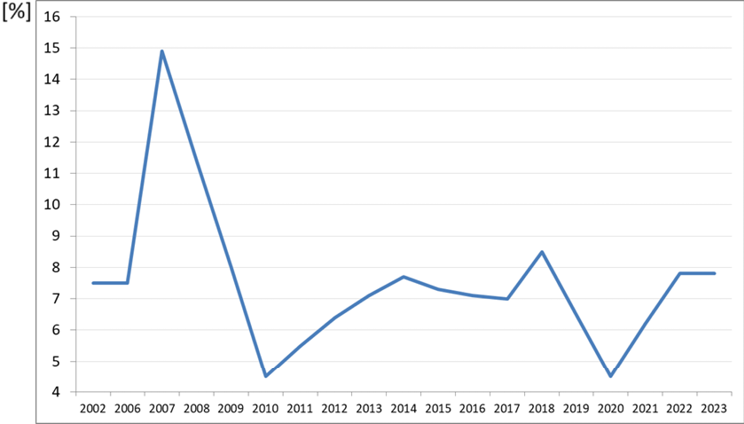
Source: https://www.statista.com/statistics/1441436/poland-gender-pay-gap/, last update February 2025.
Although the national unadjusted gender pay gap (GPG) was 7.8% in 2023, disaggregated data reveal much greater disparities in specific sectors. According to Eurostat (2025), the unadjusted GPG was 13.2% in the business economy, 16.3% in manufacturing, 17.7% in professional, scientific, and technical activities, 24.8% in information and communication, and 27.6% in financial and insurance activities.
The public sector displayed a much lower GPG (1%), compared to the private sector, where it reached 13.9% (Statistics Poland 2025).
The most recent data from the Central Statistical Office (GUS), published in March 2025, shed further light on gender-based wage differences in Poland (Statistics Poland 2025). Key findings from September 2024 show that the median gross monthly wage in Poland was PLN 6,683.15. Men earned a median wage of PLN 6,900.16, which was approximately 3.2% above the national median, while women earned PLN 6,480.00, about 3.0% below the median. This results in a gender wage gap in median earnings of PLN 420.17.
In terms of average gross monthly wages, the national average was PLN 8,075.07. Men earned PLN 8,452.31, and women earned PLN 7,685.28, leading to an absolute wage difference of PLN 767.03 between the sexes.
Another key features are sectoral disparities. In the financial and insurance activities sector, the median wage for men was 38% higher than for women. Only in two sectors – construction and administrative/support services – median wages for women were slightly higher than for men (35.2% and 5.3%, respectively). The largest difference in average wages was also found in financial and insurance activities: PLN 4,352.80 in favor of men. In information and communication sectors, the average gross monthly wage for men was PLN 14,765.16.
Adjusted Gender Pay Gap in Poland
While unadjusted GPG data is regularly published, adjusted GPG figures remain limited and less frequently updated. Estimates from institutions such as the Institute for Structural Research suggest that the adjusted GPG in Poland ranges between 12% and 20%, depending on the methodology used (Pro.rp.pl 2024).
Key patterns can be summarized as follows: the adjusted GPG is consist-ently higher in the private sector than in the public sector (Cukrowska-Torzewska 2019), and it is also higher in foreign-owned companies compared to domestic enterprises (Magda, Sałach 2021).
Despite the adjusted GPG providing a more precise measure of inequality – by controlling for differences in age, experience, and sector – it is not consist-ently tracked or reported in national statistical releases. This limits the ability to fully understand the structural components of pay inequality in Poland.
In summary, despite the overall stability of Poland’s unadjusted gender pay gap over the past decade, significant sectoral and structural disparities persist, with particularly high gaps in finance and ICT. Adjusted estimates reveal deeper, enduring inequalities that remain insufficiently monitored in official statistics.
3.3. GPG from the EU Perspective
Overall, the gender pay gap (GPG) in European Union (EU) countries is generally lower than in other parts of Europe (Iwasaki, Satogami 2023). This is largely due to the harmonization of national laws with the acquis communautaire – the body of EU legislation and legal principles – of which gender equality is a core component.
Despite progress, significant gender inequalities persist across the continent. For example, recent setbacks in women’s rights – such as Turkey’s 2021 withdrawal from the Istanbul Convention – and the socioeconomic consequences of Russia’s war in Ukraine have disproportionately affected women. Additionally, in some EU countries where democratic institutions are under strain (e.g., Hungary), women’s rights are increasingly undermined. This underscores a strong correlation between democracy and the protection of women’s rights (Buzmaniuk 2023). The post-socialist transformation in countries like Poland has had a particularly notable impact on the GPG, as eco-nomic liberalization interacted with entrenched gender norms (Iwasaki, Satogami 2023).
Unadjusted GPG trends in the EU
Recent data reveals a declining trend in the unadjusted GPG across the EU (Figure 2). In 2023, the average unadjusted GPG across the EU stood at 12%, higher than Poland’s rate of 7.8%.
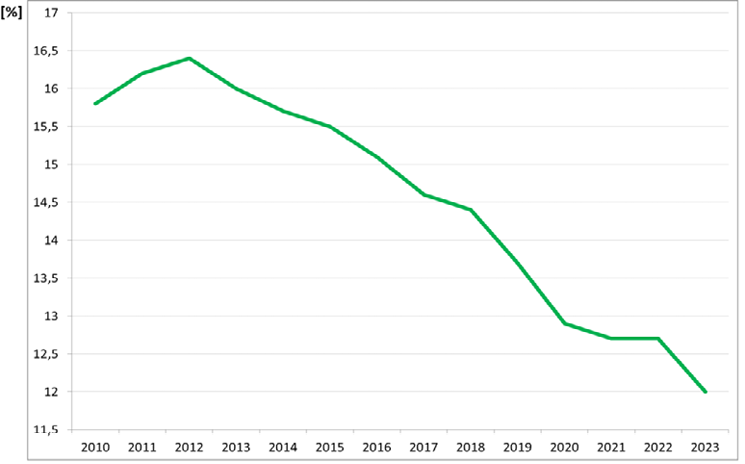
Source: https://www.statista.com/statistics/1203158/gender-pay-gap-in-europe, last update March 2025.
However, several EU countries had lower GPGs than Poland: Luxembourg: –0.9% (the only country with a reversed gap), Belgium: 0.7%, Italy: 2.2%, Romania: 3.8%, Malta: 5.1%, Slovenia: 5.4%, and Croatia: 7.4%. At the other end of the spectrum, Latvia recorded the highest GPG at 19% (Figure 3).
Looking at changes over time, notable declines in the GPG over the past decade were observed in countries such as: Spain: –10 percentage points (pp), Slovenia: –3.7 pp, Latvia: –2.2 pp, Poland: –1.4 pp, and Malta: –0.7 pp.
These figures demonstrate progress, but they remain limited due to the limitations of the unadjusted GPG, which does not account for structural differences in employment (e.g., occupational segregation, working hours).
Significant sector-specific variations exist across EU countries. In financial and insurance activities, the GPG is consistently higher than in the broader business economy. For instance: in Czechia, the GPG in finance reached 36.4%, while in Cyprus, 22.4%, well above the EU average.
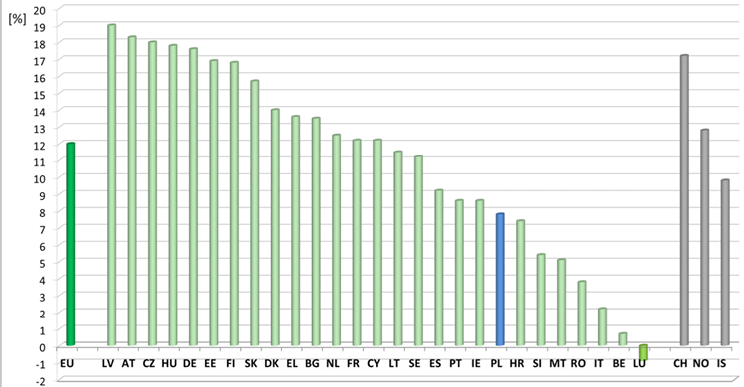
EU – European Union, LV – Latvia, AT – Austria, CZ – Czechia, HU – Hungary, DE – Germany, EE – Estonia, FI – Finland, SK – Slovakia, DK – Denmark, EL – Greece, BG – Bulgaria, NL – Netherlands, FR – France, CY – Cyprus, LT – Lithuania, SE – Sweden, ES – Spain, PT – Portugal, IE – Ireland, PL – Poland, HR – Croatia, SI – Slovenia, MT – Malta, RO – Romania, IT – Italy, BE – Belgium, LU – Luxembourg, CH – Switzerland, NO – Norway, IS – Iceland.
Source: https://ec.europa.eu/eurostat/statistics-explained/index.php?title=Gender_pay_gap_statistics; last update March 2025.
In nearly all EU countries – with exceptions like Hungary and Slovenia – the gender pay gap (GPG) is higher in the private sector (ranging from 6.1% in Belgium to 21.6% in Cyprus) than in the public sector (from –4.1% in Cyprus to 19.7% in Hungary) (Eurostat, 2025).
A symbolic acknowledgment of the gender wage gap is European Equal Pay Day, observed in mid-November. From that date onward, women in the EU are effectively “working for free” compared to men, based on the average GPG. This corresponds to a pay gap requiring women to work 1.5 additional months to earn the same annual salary as men (European Commission n.d.).
Adjusted GPG in the EU: Measurement and findings
While the unadjusted GPG is widely reported, adjusted GPG – which accounts for individual and workplace characteristics – is less consistently published. How-ever, key studies have used Eurostat’s Structure of Earnings Survey (SES) to estimate it.
According to Leythienne and Perez-Julian (2021), the EU average adjus-ted gender pay gap (GPG) was 11.4%, while the average unadjusted GPG was 14.4%. In Poland, the adjusted GPG was 12.5%, which is above the EU average. For comparison, Belgium recorded the best result at –0.1%, while Estonia had the worst at 18.8% (Leythienne, Perez-Julian 2021). Their methodology involved Blinder-Oaxaca decomposition (Blinder 1973; Fortin, Lemieux, Firpo 2011; Oaxaca 1973), which partitions the gender pay gap into two components: the explained part – due to observable differences such as education and age – and the unexplained part – often attributed to discrimination or differences in financial returns for similar characteristics.
They caution, however, that the “unexplained” portion should not automatically be interpreted as discrimination, since some important variables (e.g., total work experience, care responsibilities) are missing from the SES dataset. Crucially, they found no significant correlation between the GPG and a country’s development level (measured by GNI per capita in PPP). However, adjusting the GPG increases its explanatory power (R²) in regression models – supporting its usefulness in cross-country socioeconomic comparisons.
De Poli and Maier (2024) found that the EU average of adjusted GPG was 11.1%, while unadjusted GPG was 11.8%. They concluded that approximately 94% of the GPG in the EU could be attributed to unequal pay for equal work, while only 6% is due to differences in characteristics such as occupation and experience. Country-specific adjusted GPGs include Germany (5.7%), France and Belgium (7.1%), Poland (10.4%), and Czechia, Latvia, and Estonia (over 15%, up to 18%).
These results reveal that Central and Eastern European countries (CEE) have the highest adjusted GPG, Western and Northern Europe the lowest, and Southern Europe a mid-level GPG – with Italy as an outlier due to a high gap. Notably, De Poli and Maier (2024) employed a blocking with regression adjustment technique – an advancement over the traditional Blinder-Oaxaca approach. This method allows for greater flexibility, group classification, and precise subgroup comparisons (Leythienne, Perez-Julian 2021; Imbens 2015a, 2015b). Their conclusions suggest that eliminating wage penalties – i.e., paying men and women equally for equal work – would have only a marginal impact on labor earnings distribution in Western and Southern EU countries (e.g., Germany, France, Italy, Spain) (Figure 4). This implies that structural inequalities and employment patterns may be more relevant drivers of the GPG in those countries
In summary, while the EU has achieved gradual convergence in reducing the gender pay gap, substantial cross-country and sectoral disparities persist. Adjusted estimates reveal that structural and institutional factors, rather than individual characteristics alone, continue to drive wage inequalities across member states.
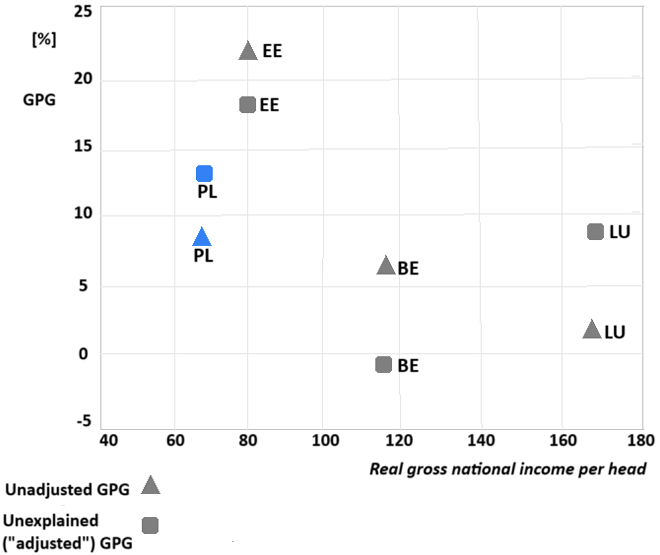
Source: SES based on (38), (Gender pay gaps in the UE – a statistical analysis. Eurostat 2021).
3.4. Other indicators of gender inequality
Income Gap
The income gap offers a broader perspective than the pay gap by including all sources of income – wages, pensions, and business earnings – and covering both employed and non-employed individuals. In Poland, women have historically earned significantly less than men across income categories. In the early 2000s, the gender income gap was around 33%, improving to approximately 17% by 2018, but only for annual wage income.
Persistent disparities remain. Women business owners earned 32% less than men in 2004; the gap grew to 36% in later years. Pension income disparities rose from 23% in 2007 to 28% in 2018, driven by earlier retirement, lower lifetime earnings, and longer female life expectancy (Bukowski, Chrostek, Novokmet Skawiński 2024). The largest regional income gaps were found in economically dynamic regions such as Śląskie, Lubuskie, and Warmińsko-Mazurskie, possibly reflecting gendered patterns in labor market access and regional development (Landmesser 2019; Bukowski et al. 2024; Greselin, Jędrzejczak 2020).
Gender Employment Gap (GEG)
The GEG reflects the difference in employment rates between women and men (aged 20–64). In 2024, the EU’s GEG stood at 10.0 percentage points, while Poland’s was higher at 11.6 pp. For Luxembourg, this score was 5.5 (Eurostat 2025; European Commission 2025) (Figure 5).
Although women’s employment in the EU exceeded 70% for the first time in 2023, disparities persist, especially among older workers (age 55–64), due to shorter average working lives for women; among mothers, with only 74.9% of women with children employed in 2023 compared to 91.9% of fathers; and in full-time work, as women are more likely to work part-time due to care responsibilities (Eurostat 2025; European Commission 2025; ILO 2019). Additional challenges include significantly lower employment rates among migrant women – up to 20 percentage points lower than nationals – and tax systems in some EU countries (e.g., Germany, Belgium) that discourage second earners, often women, from full labor market participation (European Commission 2025; Eurostat 2025; Hays 2024).
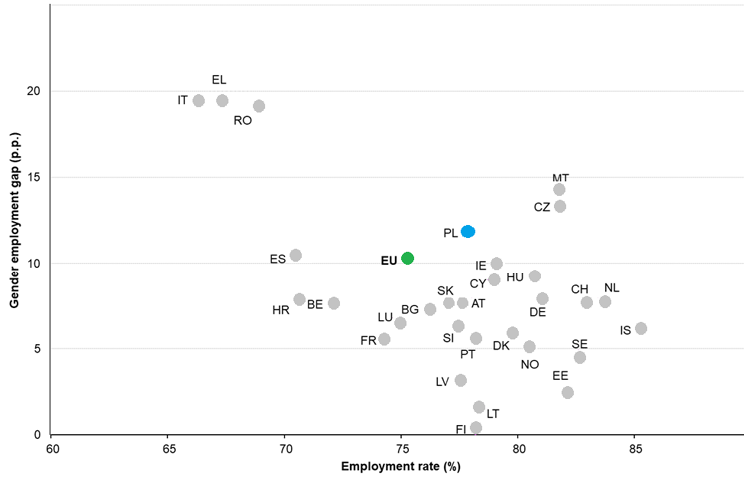
EU – European Union, LV – Latvia, AT – Austria, CZ – Czechia, HU – Hungary, DE – Germany, EE – Estonia, FI – Finland, SK – Slovakia, DK – Denmark, EL – Greece, BG – Bulgaria, NL – Netherlands, FR – France, CY – Cyprus, LT – Lithuania, SE – Sweden, ES – Spain, PT – Portugal, IE – Ireland, PL – Poland, HR – Croatia, SI – Slovenia, MT – Malta, RO – Romania, IT – Italy, BE – Belgium, LU – Luxembourg, CH – Switzerland, NO – Norway, IS – Iceland.
Source: https://ec.europa.eu/eurostat/statistics-explained/index.php?title=Gender_statistics
Gender Equality Index (GEI)
The Gender Equality Index (GEI), developed by the European Institute for Gender Equality, monitors six dimensions: work, money, knowledge, time, power, and health. The index ranges from 1 to 100, with higher scores indicating more equality. In 2024, the EU average GEI was 71.0, while Poland scored 63.4, up from 52.4 in 2005. Sweden scored highest (82), while Romania had the lowest score (57.5) (European Institute for Gender Equality 2024).
In Poland, progress has stagnated in the work domain due to occupational segregation and poor job quality. Women remain overrepresented in lower-paid sectors (e.g., health, education), while men dominate high-paying fields (e.g., finance, ICT). Gender inequality is compounded for single parents, migrants, and caregivers, and violence and harassment in the workplace remain barriers to equality across the EU.
In summary, complementary indicators such as the income gap, employment gap, and Gender Equality Index reveal that gender inequality in Poland and the EU remains deeply structural. Despite gradual improvements, disparities persist across income, labor participation, and access to high-quality employment.
3.5. Global perspective on gender equality
Globally, gender equality in labor markets is guided by frameworks such as the UN Convention on the Elimination of All Forms of Discrimination Against Wo-men (CEDAW) and various ILO conventions (UN 1979). Each year, International Equal Pay Day (18 September) reminds the global community of persistent wage disparities – even more pronounced than in the EU, where Equal Pay Day falls in November.
Global Gender Gap Index
The Global Gender Gap Index (GGG) by the World Economic Forum measures gender disparities across four dimensions: economic participation, education, health, and political empowerment. Women earn over 20% less than men worldwide (European Parliament 2020). In the 1970s, the gap exceeded 35%. Since 1971, the number of countries with pay equity laws has risen dramatically – from just two to 98. Despite this progress, significant disparities persist across regions (de Castro Romero, Barroso, Rosa Santero-Sánchez 2023). In 2025, no country had closed the gap entirely, though Iceland remained the global leader (92.6% gap closed), followed by Finland, Norway, and Sweden (World Economic Forum 2023; European Commission 2025). Poland ranked 22nd in Europe for economic participation (score: 0.750), while 102nd globally in wage equality for similar work (GGG sub-index: 0.584), up from 112th in 2024. The Luxembourg paradox illustrates the limitations of unadjusted GPG measures: while its raw GPG is −0.9% (lowest in the EU), this only includes full-time workers. Around one-third of women work part-time, and adjusted data shows women still earn 13% less, close to the EU average. Interestingly, Albania leads globally in the category of wage equality for similar work (score: 0.931, 1st place), while Poland remains well below the global average (World Economic Forum 2024).
OECD perspective: Women at Work Index
According to the 2025 PwC “Women at Work” Index, which evaluates gender equality in OECD countries based on employment, pay, job security, and working hours, Poland ranks:
- 7th overall, outperforming regional neighbors such as Hungary (Brainerd, 2000), the Czech Republic (Zachorowska-Mazurkiewicz & Gomółka, 2023), and Estonia (Orazem & Vodopivec, 2000).
- Just behind Slovenia (Grajek, 2003) and ahead of most Visegrád countries.
- Iceland, New Zealand, and Luxembourg took the top three spots (Wo-men in Work, 2025).
Sustainable Development Goals and gender equality
The United Nations’ 2030 Agenda for Sustainable Development identifies gender equality as a critical pillar of global progress. Specifically, SDG 5 (“Achieve gender equality and empower all women and girls”) and SDG 8 (“Promote decent work and economic growth”) are directly linked to gender disparities in the labor market, including the gender pay gap (UN General Assembly 2015; Gender and the Environment Building Evidence and Policies to Achieve the SDGs 2021; Europe Sustainable Development Report 2025).
SDG 5: Gender equality
SDG 5 aims to eliminate all forms of discrimination and violence against wo-men, ensure equal opportunities, and promote equal pay for equal work. While many European countries have made progress, no country has yet fully achieved this goal.
According to data from the SDG Index Dashboard, Poland is listed among countries where “significant challenges remain”, and the trend is stagnating, despite the raw GPG indicator being marked as “goal achieved.” This reflects the limitations of relying solely on unadjusted GPG, which does not account for broader inequalities in labor market access or unpaid care work.
A better situation is seen in countries like Sweden, Finland, and Germany, where the trend is “moderately improving.” In contrast, countries such as Hungary, Turkey, and Bosnia and Herzegovina face major challenges. Still, most EU countries have made incremental progress since 2002.
Importantly, gender equality is also interlinked with environmental sustainability. Women are more affected by ecological degradation but also more likely to engage in pro-environmental behavior. Their roles in natural resource management and climate action are increasingly recognized as vital for intergenerational sustainability (Gender and the Environment Building Evidence and Policies to Achieve the SDGs 2021).
SDG 8: Decent work and economic growth
SDG 8 emphasizes inclusive and productive employment, fair labor conditions, and equal pay. Like SDG 5, no European country has achieved this goal. Poland again shows a “significant challenge” with a declining trend, particularly concerning fundamental labor rights – which include protection from discrimination, freedom of association, and collective bargaining (source: World Justice Project).
Indicators relevant to SDG 8 include: gender-adjusted GDP growth, prevalence of modern slavery, access to financial institutions, enforcement of labor rights.
The troubling downward trend in labor rights protection in Poland raises concerns, especially in relation to gender, as weakening enforcement often disproportionately impacts women and marginalized groups.
In summary, global frameworks such as the SDGs, CEDAW, and ILO conventions demonstrate that gender equality remains a universal challenge despite formal progress. Cross-country comparisons reveal that while Poland performs relatively well among OECD economies, it still lags behind leading EU countries in wage equality and labor rights enforcement. Achieving true parity will require not only legal compliance but also structural reforms addressing the intersection of gender, economy, and sustainability.
3.6. Causes of GPG
The gender pay gap is a complex issue stemming from a combination of struc-tural, cultural, institutional, and individual factors. It cannot be explained solely by differences in experience or education.
Gender discrimination and occupational segregation
Women with comparable qualifications and experience often receive less favorable employment conditions, such as lower pay, worse contracts, and fewer promotion opportunities. Gender bias is embedded in job valuation systems, leading to the underestimation of roles typically held by women.
In Poland, the gender pay gap is more significant in small and medium-sized enterprises, where payroll transparency and formalized HR policies are lacking. In contrast, multinational corporations and unionized workplaces tend to show smaller wage gaps due to stronger oversight and negotiation mechanisms (Magda, Sałach 2021; Biasi, Sarsoon 2022). A major contributor to the gender pay gap is occupational and sectoral segregation. Women are overrepresented in lower-paid sectors, such as education, healthcare, and services. High-paying sectors like finance, IT, and engineering remain male-dominated (World Economic Forum 2024; Stat.gov.pl 2022). The pay gap is wider among highly educated women than those with lower education levels (Pay gap – Does it accurately show inequalities in the labour market? 2024). Although more Polish women are graduating in STEM fields than the EU average, they still face barriers to entry and retention in these traditionally male domains (Zając et al. 2025).
The “glass ceiling” and workplace hierarchies
The “glass ceiling” prevents women from reaching top leadership positions. In the EU, less than 8% of top corporate positions are held by women, and female managers earn significantly less than their male counterparts (World Economic Forum 2024). In Poland, only 20% of companies are led by women, with a slight upward trend in 2024. However, gendered perceptions – women often lead predominantly female teams, while leadership by men tends to favor mixed or male teams. Biases such as the belief that a “female management style will not work” still dominate (Zając et al. 2025).
Other barriers include: sticky floor – women are stuck in low-level roles without promotion opportunities, glass escalator – men advance faster in female-dominated professions, glass cliff: women are appointed to leadership roles in times of crisis, setting them up to fail.
Gender norms, care responsibilities, and the “maternity penalty”
Traditional gender roles continue to shape labor market outcomes in Poland. Wo-men carry the major burden of unpaid care work, including childcare, eldercare, and domestic tasks. On average, women spend three times more time on unpaid labor than men (Charmes 2019). This unequal division limits women’s availabil-ity for full-time or overtime work and slows career progression.
The “maternity penalty” refers to the wage decline women experience after childbirth. In contrast, men often benefit from a “fatherhood bonus”. Additionally, mothers are more likely to take sick leave for childcare and receive fewer bonuses or promotions.
Social expectations – shaped by institutions like the Catholic Church or even children’s literature – reinforce the notion of women as primary caregivers (“Matka Polka” model), making work–life balance harder to achieve.
Structural and legal barriers
- Part-time work is more common among women and is associated with lower wages and fewer benefits (Gallen 2019).
- Lack of salary transparency is a critical barrier in Poland. Wages are rarely disclosed or discussed, making it difficult to detect or challenge inequalities.
- Management discretion often replaces formal wage-setting procedures, especially in small businesses, further entrenching pay disparities.
Psychological and cultural factors
Women often exhibit lower wage expectations, less assertiveness, and self-doubt, especially in salary negotiations or leadership applications. These internalized barriers contribute to persistent underpayment and underrepresentation (Biasi, Sarsoon 2022; Report of the Women’s Congress Association 2023).
Recent external shocks
Crises such as the COVID-19 pandemic, influx of Ukrainian refugees, rising energy prices, and the green transition have disproportionately affected women, increasing unpaid labor and reducing income stability (Report of the Women’s Congress Association 2023; Brodeur, Gray, Islam, Bhuiyan 2021). Additionally, social programs like Poland’s 500+/800+ child benefits may discourage some women from returning to the workforce, particularly when men earn more (Grabowska, Magda, Czaczasty, Chłoń-Domińczak, Bolesta 2020).
Retirement policies
Finally, the lower retirement age for women in Poland contributes to lifetime income disparities and lower pension entitlements – both of which feed into the broader gender income gap.
In summary, the persistence of the gender pay gap in Poland reflects the combined influence of structural, cultural, and institutional barriers rather than individual choices. Discrimination in pay and promotion, unequal distribution of care responsibilities, and limited policy enforcement continue to reproduce inequality across generations. Tackling these root causes requires not only a legislative reform but also a shift in societal norms and workplace culture.
3.7. Challenges and perspectives
Challenges
In Poland, the National Action Programme for Equal Treatment 2022–2030 proposes comprehensive, periodic measures to monitor equal treatment at the regional level. This plan aims to integrate data from institutions such as the Central Statistical Office, Ministry of Justice, and Voivodeship Police Headquarters. However, awareness-raising initiatives on gender equality remain limited. Moreover, the Central Statistical Office lacks a legal mandate to collect gender-disaggregated data (Act of June 29, 1995 on Official Statistics), resulting in scarce and incomplete gender-related statistics.
The principle of “equal pay for work of equal value” is conceptually challenging to apply in practice due to the fundamentally different types of work performed by women and men, often leading to inappropriate comparisons and misinterpretations.
A significant barrier to reducing the gender pay gap (GPG) is the technical difficulty of developing fair job evaluation methodologies, combined with a lack of willingness among many men in leadership positions – particularly in Poland – to engage with the issue. A 2023 survey from the Women’s Congress found that 19% of men believe it is fair for women to be paid less for equal work and do not see the need to address the pay gap.
Additionally, women are less likely than men to have clear career development plans or to receive sufficient employer support, due to workplace discrimination and traditional social norms. Encouragingly, mentoring programs and educational initiatives are gradually improving this situation (European Institute for Gender Equality 2024).
Emerging challenges include artificial intelligence (AI), robotization (Aksoy, Özcan, Philipp 2021), the lasting effects of the COVID-19 pandemic (Brodeur, Gray, Islam, Bhuiyan 2021), and the green transition, all of which may disproportionately exacerbate women’s labor market disadvantages (Bauhardt 2022).
The rise of AI merits special attention: although AI and robotization may widen the gender pay gap by favoring men in high-skill, high-productivity roles (Aksoy, Özcan, Philipp 2021; Lutz 2022), they also present opportunities for wo-men, especially given their growing competencies in technology, data analysis, and project management. The World Economic Forum highlights the increasing demand for digital skills, where women can capitalize on their strengths (GIGROUP Holding, n.d.). The EU’s AI Act, adopted in March 2024, is a pioneering legal framework emphasizing human rights and gender equality in AI development and deployment, aiming to mitigate potential discriminatory effects (Munarini, 2022). Thus, careful, gender-sensitive management of AI implementation is essential to avoid reinforcing existing inequalities.
Perspectives
The EU roadmap for gender equality, announced in March 2025, sets out ambitious goals for equal employment, pay, economic empowerment, work-life balance, and organizational mechanisms supporting women’s rights (European Commission 2025). This will be implemented alongside existing EU laws through broad public consultations inviting active stakeholder participation.
To tackle gender imbalance in ICT, the EU’s Digital Europe program includes initiatives like “Girls and Women in Digital” aimed at increasing female participation in digital fields.
In Poland, legal and social pressures make progress toward gender equality in the labor market inevitable. The mandatory implementation by 2026 of the EU Pay Transparency Directive (Directive (EU) 2023/970) is a crucial step. This directive obliges employers to act when pay differences exceed 5% within com-parable employee categories and promotes salary transparency regardless of company size (with a pending decision on exemptions for small employers). Studies suggest pay transparency could reduce the gender pay gap by up to 15% within firms (Gamage, Kavetsos, Mallisck, Sevila 2023). To assist employers, Poland’s Ministry has developed the free app “Equal Salaries”, helping estimate fair wages considering employee characteristics.
Furthermore, the forthcoming EU Women on Boards Directive (effective mid-2026) requires at least 33% female representation on management and supervisory boards, and 40% on supervisory boards, fostering greater female leadership and potentially narrowing the pay gap (European Parliament and Council 2022; Codo za Zasady 2024).
Polish labor law is also evolving: proposed amendments to Articles 10 and 18 of the Labor Code aim to increase salary transparency by obliging employers to publish wage ranges in job offers and provide employees with gender-disaggregated pay information. Penalties for non-compliance are planned.
Social attitudes and values remain critical (Dzwigoł-Barosz 2024). The EU’s new Work-Life Balance Directive, recently transposed into Polish law, facilitates parents’ ability to combine care responsibilities with work, promoting gender equality in the labor market. Flexible work arrangements and systemic childcare solutions are needed to enable women’s career continuity, especially in smaller towns where access to affordable childcare is limited.
Addressing the pay gap requires innovative, dynamic approaches throughout the employee life cycle, recognizing that solutions differ depending on whether pay inequalities appear from hiring or emerge later due to lack of promotion.
Finally, education plays a vital role in raising awareness and understanding of the pay gap. Positive examples in Poland include the implementation of Gender Equality Plans (GEP 2.0), mandatory for public institutions and research units seeking EU funding, and campaigns such as “Girls to Technical Universities”. A Hays study of 2,500 specialists indicates growing female assertiveness and promotion based on merit, signaling positive cultural shifts (Kobiety na rynku pracy 2024).
In summary, Poland’s progress toward reducing the gender pay gap depends on the effective implementation of EU-level initiatives – particularly the Pay Transparency and Women on Boards Directives – combined with national reforms promoting salary openness, equal opportunities, and care system reform. How-ever, without parallel changes in social attitudes and workplace culture, legislative progress may have limited impact. The integration of digital and green transitions into equality policies represents both a challenge and an opportunity to redefine the future of gender equality in the labor market.
4. Conclusion
This paper offered a comprehensive analysis of gender pay inequality in Poland within the broader European and global context. It distinguished between unadjusted and adjusted gender pay gaps (GPG), emphasizing the latter as a more accurate indicator of wage discrimination by accounting for factors such as occupation, education, and experience. Although Poland’s unadjusted GPG (7.8% in 2023) remains below the EU average, adjusted estimates between 12% and 20% reveal more substantial underlying disparities. These are particularly visible across sectors – exceeding 27% in finance and insurance – and between the public (1%) and private (13.9%) spheres. Despite EU-level advances, Poland exhibits stagnation in narrowing gender-based inequalities. Broader indicators, including the income and employment gaps, confirm that structural and cultural barriers – such as occupational segregation, persistent stereotypes, and the “glass ceiling” – continue to shape unequal outcomes. While new EU directives on pay transparency and work–life balance represent important steps forward, their success will depend on effective implementation and enforcement. At the same time, emerging challenges such as digitalization and artificial intelligence require proactive, gender-sensitive policy design.
In conclusion, reducing the gender pay gap in Poland demands improved measurement, stronger institutional accountability, and a societal shift toward genuine equality of opportunity. Advancing gender equality is not only a matter of fairness – it is a prerequisite for sustainable social and economic development across Europe.
Autorzy
* Joanna Bojarska
* Wiktoria Kowalczyk
* Dominik Dusza
* Wojciech M. Wolf
References
Altonji J.G., Blank R.M. (1999), Race and gender in the labor market, [in:] O. Ashenfelter, D. Card (eds), Handbook of Labour Economics, vol. 3: 3143–3259, North-Holland, https://doi.org/10.1016/S1573-4463(99)30039-0
Annual Report 2023–2024. (2024), World Economic Forum, https://www3.weforum.org/docs/WEF_Annual_Report_2023_2024.pdf
Art. 11. (1979), UN Convention on the Elimination of All Forms of Discrimination Against Women (18 grudnia 1979).
Biasi F., Sarsoon A. (2022), Flexible wages, bargaining, and the gender gap, “The Quarterly Journal of Economics”, 137(1): 215–266, https://doi.org/10.1093/qje/qjab026
Blinder A.S. (1973), Wage discrimination: Reduced form and structural estimates, “Journal of Human Resources”, 8(4): 436–455, https://doi.org/10.2307/144855
Boll C., Rossen A., Wolf K. (2017), The EU gender earnings gap: Job segregation and working time as driving factors, “Journal of Economics and Statistics”, 237(5): 407–452, https://doi.org/10.1515/jbnst-2017-0100
Bukowski A., Chrostek A., Novokmet K., Skawiński J. (2024), Income inequality in the 21st century Poland, “INE PAN Working Paper Series”, Paper No. 58, https://inepan.pl/wp-content/uploads/2024/10/working-paper-58.pdf
Buzmaniuk S. (2023, 6 marca), Gender parity in Europe: A – still imperfect – model in the world, Robert Schuman Foundation Newsletter, No. 1013, https://www.robert-schuman.eu/en/questions-d-europe/659-gender-parity-in-europe-a-still-imperfect-model-in-the-world
C100 – Equal Remuneration Convention, 1951 (No. 100). (n.d.), International Labour Organization, https://normlex.ilo.org/dyn/nrmlx_en/f?p=NORMLEXPUB:12100:0::NO:12100:P12100_INSTRUMENT_ID:312245:NO
Charmes J. (2019), The unpaid care work and the labour market: An analysis of time use data based on the latest World Compilation of Time-use Surveys, International Labour Organization, https://www.ilo.org/wcmsp5/groups/public/---dgreports/---gender/documents/publication/wcms_732791.pdf
Cukrowska-Torzewska M. (2019), Gender wage gap in the workplace: Does the age of the firm matter? IBS Working Paper, https://doi.org/10.1177/0959680118825071
De Castro Romero X., Barroso C., Rosa Santero-Sánchez J. (2023), Does gender equality in managerial positions improve the gender wage gap? Compar-ative evidence from Europe, “Economies”, 11: 301, https://doi.org/10.3390/economies11120301
De Poli F., Maier T. (2024), Enforcing ‘equal pay for equal work’ in the EU: What would it take? “The Journal of Economic Inequality”, https://doi.org/10.1007/s10888-024-09654-5
Directive (EU) 2023/970 of the European Parliament and of the Council of 10 May 2023 to strengthen the application of the principle of equal pay for equal work or work of equal value between men and women through pay transparency and enforcement mechanisms (Text with EEA relevance). (2023), Official Journal of the European Union.
Dzwigoł-Barosz, M. (2024), The problem of the gender pay gap in Poland in the face of the challenges of today’s labour market, “Scientific Papers of Silesian University of Technology”, 206, https://doi.org/10.29119/1641-3466.2024.206.8
Europe Sustainable Development Report 2025. (2025), https://eu-dashboards.sdgindex.org/
Fortin N.M., Lemieux T., Firpo S. (2011), Decomposition methods in economics, [in:] O. Ashenfelter, D. Card (eds), Handbook of Labor Economics, vol. 4: 1–102, Elsevier, https://doi.org/10.1016/S0169-7218(11)00407-2
Gallen Y. (2019), The effect of maternity leave extensions on firms and coworkers, Working Paper, https://harris.uchicago.edu/files/gallen_parentalleave_2019.pdf
Gamage K., Kavetsos G., Mallisck W., Sevila B. (2023), Pay transparency intervention and the gender pay gap: Evidence from research-intensive universities in the UK, https://doi.org/10.1111/bjir.12778
Goldin C. (2014), A grand gender convergence: Its last chapter, “American Economic Review”, 104: 1091–1119, https://doi.org/10.1257/aer.104.4.1091
Grabowska M., Czaczasty Ł., Chłoń-Domińczak, A., Bolesta K. (2020), Report on national case study: Poland, SGH Warsaw School of Economics.
Grajek M. (2003), Gender pay gap in Poland, “Economics of Planning”, 36: 23–44, https://doi.org/10.1023/B:ECOP.0000005729.71467.38
Greselin F., Jędrzejczak A. (2020), Analyzing the gender gap in Poland and Italy, and by regions, “International Advances in Economic Research”, https://doi.org/10.1007/s11294-020-09810-3
Hunt J. (2002), The transition in East Germany: When is a ten-point fall in the gender gap bad news? “Journal of Labor Economics”, 20(1): 148–169, https://doi.org/10.1086/323935
Imbens G.W. (2015), Matching methods in practice: Three examples, “Journal of Human Resources”, 50: 373–419, https://doi.org/10.3368/jhr.50.2.373
Imbens G.W., Rubin D.B. (2015), Causal inference in statistics, social, and biomedical sciences, Cambridge University Press, https://doi.org/10.1017/CBO9781139025751
Iwasaki T., Satogami K. (2023), Gender wage gap in European emerging markets: A meta-analytic perspective, “Journal for Labour Market Research”, 57: 9, https://doi.org/10.1186/s12651-023-00333
Landmesser J.M. (2019), Decomposition of gender wage gap in Poland using counterfactual distribution with sample selection, “Statistics in Transition New Series”, 20(3): 171–186, https://doi.org/10.21307/stattrans-2019-030
Leythienne O., Pérez-Julián M. (2021), Gender pay gaps in the European Union – a statistical analysis, Eurostat.
Lutz B. (2022), Gender equality and artificial intelligence in Europe: Addressing direct and indirect impacts of algorithms on gender-based discrimination, “ERA Forum”, 23: 33–52, https://doi.org/10.1007/s12027-022-00709-6
Meara E., Pastore F., Webster M. (2020), The gender pay gap in the USA: A matching study, “Journal of Population Economics”, 33: 271–305, https://doi.org/10.1007/s00148-019-00743-8
Mincer J. (1974), Schooling and earnings, [in:] Schooling, Experience and Earnings, pp. 41–63, National Bureau of Economic Research.
Mincer J., Polachek S. (1977), An exchange: The theory of human capital and the earnings of women: Women’s earnings re-examined, “The Journal of Human Resources”, 13(1): 118–134, https://doi.org/10.2307/145305
Munarini M. (2022), New perspectives on the mitigation of gender bias in AI by EU regulations, “Peace Human Rights Governance”, 6(2): 111–136, https://doi.org/10.14658/PUPJ-PHRG-2022-2-2
Oaxaca R. (1973), Male–female wage differentials in urban labour markets, “International Economic Review”, 14(3): 693–709, https://doi.org/10.2307/2525981
Orazem P., Vodopivec M. (2000), Male–female differences in labor market outcomes during the early transition to market: The cases of Estonia and Slovenia, “Journal of Population Economics”, 13(2): 283–303, https://doi.org/10.1007/s001480050139
Pizzinelli M., Panton R., Tavares P., Cazzaniga F., Li R. (2023), Labor market exposure to AI: Cross-country differences and distributional implications, International Monetary Fund, https://doi.org/10.5089/9798400254802.001
Raffiotta E.C. (2024), Artificial intelligence and the protection of gender equality, “California Western International Law Journal”, 54(2): 489–516, https://scholarlycommons.law.cwsl.edu/cwilj/vol54/iss2/5
Report of the Women’s Congress Association „Kobiety, rynek pracy i równość płac”. (2023), Warszawa, https://kongreskobiet.pl/wp-content/uploads/2023/05/RAPORT.pdf
Roediger D. (2015), Slave emancipation and liberty for all, Verso.
Statista. (n.d.), Gender pay gap in Poland from 2002 to 2023, https://www.statista.com/statistics/1441436/poland-gender-pay-gap
Statistics Poland. (2025, 5 marca), Distribution of wages and salaries in the national economy in September 2024, https://stat.gov.pl/
The gender gap at work is closing – but slowly. (2025, 7 marca), European Central Bank, https://www.ecb.europa.eu/press/blog/date/2025/html/ecb.blog20250307~85fd774bd3.pl.html
The gender pay gap: Definition and causes. (2023, 5 kwietnia), European Parliament, https://www.europarl.europa.eu/topics/pl/article/20200109STO69925/luka-placowa-miedzy-kobietami-a-mezczyznami-definicja-i-przyczyny
Women in Work 2025. (2025), https://www.pwc.pl/pl/media/2025/polska-na-7-pozycji-women-in-work-index-ranking.html
World Economic Forum. (2024), Global gender gap 2025. https://www3.weforum.org/docs/WEF_GGGR_2024.pdf
Zachorowska-Mazurkiewicz B., Gomółka P. (2023), Gender wage gap: Occupation and industries analysis for Poland, “Eastern Journal of European Studies”, 14(1), https://doi.org/10.47743/ejes-2023-0105
Zając M., Bożykowski M., Chłoń-Domińczak A., Jasiński M. (2025), Gender pay gaps across STEM fields of study, “Studies in Higher Education”, 50(1): 126–139, https://doi.org/10.1080/03075079.2024.2330667