Understanding global dementia burden: Ageing and dairy supply as key predictors of total, male and female dementia incidence
 https://orcid.org/0000-0002-6229-1064
School of Medicine, Adelaide University, Adelaide, SA, Australia
School of Nursing and Midwifery, Western Sydney University, Sydney, Australia
https://orcid.org/0000-0003-1941-2286
School of Medicine, Adelaide University, Adelaide, SA, Australia
Institute of Evolutionary Medicine, University of Zurich, Zurich, Switzerland
Unit for Biocultural Variation in Obesity, University of Oxford, Oxford, UK
https://orcid.org/0009-0001-0502-8219
China Organic Food Certification Center, Beijing, China
Abstract
Introduction
Dementia incidence is rising worldwide, driven largely by population ageing and demographic transition. Although dietary factors have been proposed as modifiable contributors, the role of dairy consumption remains unclear, with inconsistent findings across regions, populations, and product types.
Study aim
This study examined whether total dairy supply independently predicts dementia incidence at the population level after accounting for key demographic and socioeconomic indicators.
Materials and methods
A global ecological analysis was conducted using data from 204 countries. Variables included dairy supply, dementia incidence (total, male, and female), ageing, gross domestic product adjusted for purchasing power parity (GDP PPP), Biological State Index, and urbanisation. Statistical analyses included Pearson and Spearman correlations, partial correlations, principal component analysis, and multivariable linear regression. Enter models were treated as the primary analyses, while stepwise regression was used as an exploratory model-reduction approach.
Results
Dairy supply showed significant positive correlations with total dementia incidence (r = 0.54, p < 0.001) and with both male and female dementia incidence (r = 0.53, p < 0.001). Ageing showed the strongest associations across all outcomes (r = 0.73–0.78). In the primary multivariable models, ageing remained the strongest independent predictor of total, male, and female dementia incidence. After adjustment, dairy supply remained an independent predictor, with modest effect sizes for total (β = 0.209, p < 0.001), male (β = 0.190, p = 0.001), and female (β = 0.223, p < 0.001) dementia incidence. Urbanisation and genetic vulnerability were associated with dementia incidence at the bivariate level but were not independent predictors in the adjusted models. Exploratory stepwise analyses showed a similar pattern.
Conclusions
Ageing remained the strongest global predictor of dementia incidence, while dairy supply showed an additional independent association. These findings suggest that nutritional transitions may interact with demographic ageing to shape global dementia patterns worldwide.
Keywords: dairy supply, ecological study, ageing, socioeconomic development, biological state index, urbanisation, global nutritional transition
Introduction
Dementia is a rapidly growing global health crisis. In 2021, 57 million people were living with dementia as estimated by The World Health Organization (WHO, 2025a). Nearly 10 million new cases occur annually, and this number will triple by 2050 as populations continue to age (Nichols et al., 2022; WHO, 2025a). Dementia is characterised by cognitive decline affecting memory, reasoning, and behaviour, leading to disability, dependency, and substantial social and economic burden (Cipriani et al., 2020; WHO, 2025a). Although ageing remains the most important non-modifiable risk factor, increasing attention has focused on modifiable determinants, including diet, that may influence dementia onset and progression (Lourida et al., 2019).
Diet has gained prominence because of its potential neuroprotective or neurodegenerative effects (Xu Lou et al., 2023; Yassine et al., 2022; You, 2025c; You & Feng, 2025). Dairy products are heterogeneous and include both fermented and non-fermented forms. They provide proteins, minerals, vitamins, and essential amino acids that may support cognition through neurotransmitter synthesis, neuronal integrity, and vascular health (Camfield et al., 2011; Otaegui-Arrazola et al., 2014). Fermented dairy products, such as yogurt and cheese, may contain anti-inflammatory and antioxidant bioactive compounds that reduce neuroinflammation and improve gut–brain interactions (Anderson & Alpass, 2024; Gao et al., 2025a; 2025b). By contrast, high-fat dairy products may adversely affect cognition through hyperinsulinemia, endothelial dysfunction, oxidative stress, and systemic inflammation (Tan & Norhaizan, 2019; Villoz et al., 2024). Thus, the association between dairy intake and dementia may differ according to product type and composition (Camfield et al., 2011).
Previous findings have been inconsistent. A meta-analysis of 15 cohort studies involving more than 300,000 participants reported a nonlinear inverse association between dairy intake and cognitive decline or dementia, with the lowest risk observed at around 150 g/day. The association was stronger among participants aged under 65 years (RR = 0.88, 95% CI: 0.76–1.01) than among those aged 65 years and older (RR = 0.95, 95% CI: 0.75–1.21) (Villoz et al., 2024). Studies including both sexes showed an inverse association (RR = 0.85, 95% CI: 0.78–0.93), whereas sex-specific findings were more heterogeneous, and subtype analyses suggested different patterns for milk and cheese (Villoz et al., 2024). The same meta-analysis also reported an overall inverse association when all dairy types were combined (RR = 0.89, 95% CI: 0.83–0.95). Subtype analyses suggested a null association for milk at ≤0.3 times/day, with lower risk at higher intakes, and a nonlinear pattern for cheese, with lower risk around 0.3 times/day and null or positive associations at higher intakes (Villoz et al., 2024). Another meta-analysis also reported that higher dairy intake may be associated with lower risk of cognitive decline or dementia, although findings varied by sex, age, region, and dairy type (Lee et al., 2018; Villoz et al., 2024). Studies in Asia showed a stronger inverse association than studies in Europe (Villoz et al., 2024). European populations generally consume more dairy (170–711 g/day) than Asian populations (29–165 g/day), despite increasing dietary Westernisation in Asia (Suzuki et al., 2024; Villoz et al., 2024). Recommendations also differ, with Asian guidelines typically suggesting 1–4 servings per day compared with 2–4 servings in Europe, highlighting the importance of cultural and nutritional context (Cámara et al., 2021; Villoz et al., 2024).
Evidence from specific dairy products also supports treating dairy as a heterogeneous exposure. In UK Biobank, Deng et al. reported that soy milk consumption was associated with a lower risk of all-cause dementia (HR = 0.69, 95% CI: 0.54–0.90) and Alzheimer’s disease (HR = 0.70, 95% CI: 0.51–0.94), whereas other milk types did not show the same clear pattern (Deng et al., 2023). Emerging evidence also suggests potential cognitive relevance of probiotic dairy products. Kasselman et al. found that older adults reporting daily yogurt/dairy consumption had higher cognitive test scores than non-consumers (40.03 ± 0.64 vs. 36.28 ± 1.26, p = 0.017), although this association was attenuated after adjustment for sociodemographic factors (p = 0.074) (Kasselman et al., 2024). Together, these findings reinforce the importance of considering dairy as a heterogeneous exposure, as different dairy products may relate differently to cognitive health.
Many studies have examined individual dairy components, often cheese, in relation to cognitive decline (Villoz et al., 2024). Although this approach provides useful mechanistic insight, it does not fully reflect dietary behaviour, as people typically consume multiple dairy products such as milk, cream, butter, yogurt, and cheese (Lourida et al., 2013; Vauzour et al., 2017). Focusing on one component may therefore underestimate the combined effects of overall dairy consumption. Consequently, total dairy consumption, or total dairy supply, may provide a more realistic indicator of population-level dairy exposure (Comerford et al., 2021; Villoz et al., 2024). However, because total dairy supply is analysed as a single aggregated exposure, it cannot distinguish potentially divergent effects of fermented and non-fermented dairy products or low-fat and high-fat dairy products. This heterogeneity should be considered when interpreting any observed associations.
Mediterranean and MIND dietary patterns have shown protective associations with cognitive health through higher intake of plant-based foods and healthy fats and lower consumption of red and processed meats (Chen et al., 2023; Fekete et al., 2025). These patterns also incorporate fermented and low-fat dairy in moderation, suggesting that both type and quantity may influence cognitive outcomes (Morris et al., 2015; Wade et al., 2020). Greater cortical thickness in Alzheimer’s-vulnerable regions among individuals adhering to Mediterranean-style diets further supports a neuroprotective role, while dietary responses may also vary by genetic susceptibility, with nutrient effects differing between APOE4 and non-APOE4 carriers (Mosconi et al., 2014; Norwitz et al., 2021; Yassine & Finch, 2020).
Economic affluence and urbanisation may influence dementia incidence and prevalence through multiple, and sometimes opposing, pathways. Lower socioeconomic position is associated with greater dementia risk, whereas age-specific dementia incidence has declined in many high-income countries, possibly reflecting improvements in education, public health, and vascular risk control. Evidence on urbanisation is mixed (Giebel et al., 2025; Mollalo et al., 2025). A recent meta-analysis found higher Alzheimer’s disease dementia prevalence in rural than urban settings, particularly in lower-resource regions, while a systematic review showed that rural populations often face delayed diagnosis and reduced access to dementia care (Giebel et al., 2025; Mollalo et al., 2025). Thus, affluence and urbanisation may shape dementia burden through both underlying risk exposure and differences in healthcare access and diagnostic infrastructure.
Sex differences in dementia risk are also widely reported. Women generally experience higher dementia incidence and prevalence than men, which has been attributed to a combination of longer life expectancy, hormonal and reproductive factors, and broader sociocultural influences (Beam et al., 2018; Huque et al., 2023; You, 2025b). These established sex differences underscore the importance of examining dementia patterns separately for males and females in epidemiological research (IHME, 2023).
Despite increasing research, the global relationships among dairy supply, demographic factors, and dementia incidence remain unclear. Most studies have relied on individual-level dietary data, regional cohorts, or specific dairy products, which limits generalisability across populations. There remains a lack of population-level evidence assessing whether dairy availability contributes independently to dementia incidence when accounting for ageing, economic affluence, biological ageing burden, and urbanisation (Lee et al., 2018; Villoz et al., 2024). Therefore, this global ecological study examined whether dairy supply predicts total, male, and female dementia incidence across countries after controlling for major demographic and development-related factors at the population level.
Materials and methods
Data collection and selection
For this global ecological study, data were compiled from major international datasets maintained by United Nations bodies and the Institute for Health Metrics and Evaluation (IHME). Dementia incidence data were obtained from the IHME database (IHME, 2023), and a standardised list of 204 geographic units was sourced from the World Bank to ensure consistent alignment across variables. In this study, the term country refers to any territorial unit that reports its own demographic, health, and economic statistics within international reporting frameworks. As this does not necessarily imply political independence, the terms country and population are used interchangeably throughout the analysis (The World Bank, 2022a).
The main explanatory variable was dairy supply, defined as the mean per-person daily availability of dairy products between 2019 and 2021. These data were retrieved from the Food and Agriculture Organization Corporate Statistical Database (FAOSTAT) Food Balance Sheets (FBS) and expressed as kilocalories per capita per day (FAO, 2025).
For each country, total dairy supply was calculated by summing the energy contributions from the FAOSTAT categories Butter and Ghee (F2740), Cream (F2743), and Milk – Excluding Butter (F2848). Category-specific values reported as Food supply (kcal/capita/day) were extracted for each year, averaged across 2019–2021, and combined into a single aggregated measure. This variable reflects the energy supply derived from dairy products available for human consumption at the national level. Although it does not quantify specific nutrient components and may overrepresent fat-rich products such as butter and ghee, it provides a widely used ecological indicator of population-level dairy availability and dietary exposure patterns.
FAOSTAT Food Balance Sheets were selected because this study examined dairy exposure as a population-level food availability measure rather than as individual dietary intake. Food Balance Sheets provide standardised national estimates of per-capita food and energy availability, which aligned with the ecological objective of the study and with the construction of a total dairy supply variable in kcal/capita/day. By contrast, the Global Dietary Database (GDD) primarily estimates individual intake and reports separate dairy-related variables rather than a directly comparable total dairy-energy measure, while IHME Global Burden of Disease (GBD) dietary risk estimates are designed for comparative risk assessment and include milk as a specific dietary risk rather than total dairy supply. Nevertheless, intake-based datasets such as GDD may be valuable in future studies aimed at distinguishing dairy subtypes and approximating individual-level consumption patterns.
The outcome variable was dementia incidence rate, defined as the number of new cases per 100,000 people. These data were obtained from the 2021 IHME dataset (IHME, 2023).
IHME, an independent centre based at the University of Washington, is widely recognised for its global health monitoring and analytical rigour (IHME, 2023; Murray & Frenk, 2008). Three outcome measures were extracted: overall dementia incidence, male dementia incidence, and female dementia incidence.
Because dementia arises from multiple interacting factors, several potential confounders were included. Economic affluence was measured using 2018 per-capita gross domestic product adjusted for purchasing power parity (GDP PPP) from the World Bank. Higher economic affluence is associated with greater longevity, higher education levels, and increased prevalence of lifestyle-related conditions such as obesity and diabetes (Talukdar et al., 2020; The World Bank, 2018; Xu et al., 2017). It may also affect the ability of health systems to detect dementia earlier, reflecting differences in healthcare capacity across countries (Gaziano et al., 2010). Economic affluence and urbanisation were included as key socioeconomic indicators because they may influence dementia burden through multiple pathways, including longevity, lifestyle change, healthcare access, and diagnostic capacity.
Genetic vulnerability was assessed using the Biological State Index ((Ibs)), a population-level measure intended to reflect the extent to which deleterious genetic variants may accumulate within a population. The index ranges from 0 to 1.0 and was calculated using fertility data from 2005 (WHO, 2015) and mortality data from 2009 (WHO, 2012). Its underlying premise is that reduced natural selection in modern populations may allow deleterious genetic variants to persist and accumulate, potentially contributing to population-level genetic vulnerability to non-communicable diseases such as dementia. Higher (Ibs) values therefore indicate greater population-level genetic vulnerability and have been associated with increased dementia incidence in prior ecological research (Beam et al., 2018).
Population ageing was approximated using life expectancy at birth, obtained from the World Bank (The World Bank, 2022b). Although dementia can occur at different life stages, it is concentrated primarily among older adults; therefore, life expectancy data from 2018 were used as a proxy for population ageing. While life expectancy at birth may partly reflect early-life mortality, in contemporary populations much of its variation is driven by adult and older-age survival. It remains a widely used and internationally comparable indicator of population longevity in cross-national analyses (Cambois et al., 2023; You et al., 2025).
Urbanisation, defined as the percentage of the population living in urban areas in 2018 (The World Bank, 2018), was also obtained from the World Bank. Urban settings may influence dementia risk through changes in lifestyle and health-related behaviours. Modernisation and industrialisation are associated with shifts in diet, including greater intake (You & Henneberg, 2016a; 2016b), increased consumption of processed foods high in salt, sugar, and fat (Smith et al., 2012), and generally lower levels of physical activity (Allender et al., 2008). At the same time, urban areas often provide better access to health services, which may facilitate earlier recognition and diagnosis of dementia and thereby influence reported incidence figures.
All variables were collated and managed in Microsoft Excel® 2016 prior to analysis. Within this ecological framework, each country or population was treated as one observational unit. The number of countries included in specific analyses varied across variables because complete data were not consistently available for every indicator, reflecting reporting gaps across United Nations–affiliated data sources.
Statistical analyses
The association between national dairy availability and dementia incidence (total, male, and female) was investigated through a staged analytical strategy.
- Preliminary Data Screening: Initial visual assessments were undertaken by producing scatterplots in Microsoft Excel® 2016 to explore broad patterns between dairy supply and dementia incidence and to detect potential outliers or inconsistencies in reporting, thereby supporting data reliability.
- Correlation Analyses: Both Spearman’s rho and Pearson’s r correlation coefficients were calculated to determine the magnitude and direction of relationships among dairy supply, dementia incidence indicators, economic development (GDP PPP), genetic vulnerability ((Ibs)), life expectancy (Ageing), and urbanisation. These analyses provided an overview of how dementia outcomes align with development-related variables at the global level.
- Adjusted Correlation Models: Partial correlations were then used to examine the association between dairy supply and dementia incidence while statistically adjusting for GDP PPP, (Ibs), Ageing, and urbanisation. This allowed assessment of whether dairy supply remained related to dementia incidence independent of major demographic and socioeconomic influences.
- Principal Component Analysis (PCA): To examine shared variance among key variables, PCA using Kaiser’s criterion (eigenvalues ≥ 1) was conducted.
- Regression Modelling: Regression diagnostics were used to assess multicollinearity, residual normality, and homoscedasticity using tolerance, variance inflation factors (VIF), and inspection of residual plots. Multiple linear regression analyses were then conducted to examine predictors of total, male, and female dementia incidence. Dementia incidence was specified as the dependent variable, with dairy supply and prespecified development-related indicators entered as independent variables. Enter models were treated as the primary analyses to assess the simultaneous contribution of all covariates, whereas stepwise models were used only as an exploratory model-reduction approach. Entry and removal criteria for stepwise regression were set at p ≤ 0.05 and p ≥ 0.10, respectively. Changes in R² and standardised beta coefficients were examined to assess the independent contribution of dairy supply after adjustment for demographic and socioeconomic factors. Because the primary inferential analyses were based on linear models, the polynomial trendline in Figure 1 was included for descriptive visualisation only and was not interpreted as a formal test of non-linearity.
- Regional Stratified Analyses: To examine whether the association between dairy supply and dementia incidence varied across population contexts, correlation analyses were also conducted within selected subgroup classifications. These regional and subgroup analyses were treated as exploratory and were used to assess variation across economic, geographic, and cultural groupings. Because several subgroup sample sizes were small and multiple comparisons were performed, these findings were interpreted cautiously as hypothesis-generating rather than confirmatory. Countries were stratified according to several international frameworks, including World Bank income groups (high, upper-middle, lower-middle, and low income) (World Bank, 2022); United Nations designations of developed and developing countries (United Nations Statistics Division, 2013), WHO regional groups: Africa, the Americas, Eastern Mediterranean, Europe, South-East Asia, and the Western Pacific (WHO, 2025b), cultural, political, and economic blocs: Asia Cooperation Dialogue (Asia Cooperation Dialogue, 2018), Asia-Pacific Economic Cooperation (Asia-Pacific Economic Cooperation, 2015), the Arab World (The World Bank, 2015), English-speaking countries (official government sources), Latin America (The United Nations Educational Scientific and Cultural Organization, 2014), Latin America and the Caribbean (The United Nations Educational Scientific and Cultural Organization, 2014), OECD member states (OECD, 2015), and the Southern African Development Community (Southern African Development Community, 2015).
All statistical analyses were carried out using Statistical Package for Social Sciences version 31 (SPSS Inc., Chicago, IL, USA) alongside Microsoft Excel® 2016. A significance threshold of p < 0.05 was applied, with results also presented at the p < 0.01 and p < 0.001 levels where relevant.
Results
To our knowledge, this is among the first global ecological analyses to investigate whether total dairy supply predicts dementia incidence across countries. A positive association was observed, supported by correlation, regression, and partial correlation analyses, with dairy supply remaining a modest independent predictor after accounting for ageing, economic affluence, genetic burden, and urbanisation. Regional comparisons revealed marked variability, indicating that the dairy–dementia relationship is context dependent rather than universally uniform.
Visual trend analysis of dairy supply and dementia incidence
Figure 1 shows a positive association between total dairy supply and dementia incidence across countries. Visual inspection of the scatterplot suggested that higher per capita dairy availability generally corresponded with higher dementia incidence rates. A polynomial trendline was included for descriptive visualisation only and was not intended as a formal test of non-linearity. The scatterplot also suggested clustering by level of development, with many low- and middle-income countries concentrated at lower levels of both dairy supply and dementia incidence, whereas higher-income countries tended to cluster at higher levels of both variables. Overall, the visual pattern was consistent with the correlation and regression analyses, supporting a positive association between dairy supply and dementia incidence at the global level. However, the distribution of observations also suggested that this relationship may be influenced by broader development-related factors, including ageing, economic affluence, and biological ageing burden.
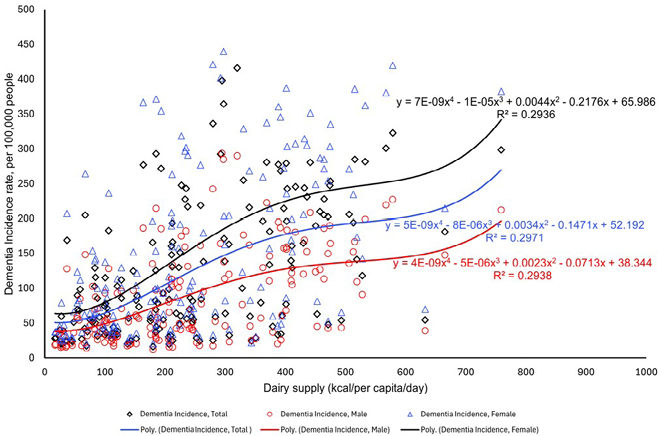
Global correlation patterns among dairy supply, dementia incidence, and development factors
Dairy supply was moderately and positively correlated with dementia incidence across all groups. Higher total dairy supply was associated with higher total dementia incidence (Pearson r = 0.54), as well as male and female incidence (both r = 0.53; all p <0 .001). Dairy supply was also moderately correlated with GDP per capita, (Ibs), Ageing, and urbanisation (r range 0.45–0.53, p < 0.001), indicating that countries with greater dairy availability tended to be more affluent, more urbanised, and to have higher life expectancy.
The three dementia incidence indicators were very highly inter-correlated (r = 0.98–0.99, p < 0.001), and each showed strong positive associations with GDP, (Ibs), ageing, and urbanisation (r generally ≥ 0.50, p < 0.001), suggesting a shared pattern across sociodemographic development and dementia burden. Spearman coefficients were very similar in magnitude to the Pearson correlations (e.g. dairy vs total dementia ρ = 0.54; dairy vs Ageing ρ = 0.55; all p < 0.001), supporting the robustness of these positive monotonic relationships and indicating that results were not driven by linearity assumptions or outliers.
| Variable | 1 | 2 | 3 | 4 | 5 | 6 | 7 | 8 |
|---|---|---|---|---|---|---|---|---|
| 1. Dairy total mean 2019–2021 | 1 | 0.537*** | 0.534*** | 0.534*** | 0.468*** | 0.473*** | 0.528*** | 0.452*** |
| 2. Dementia incidence, total | 0.543*** | 1 | 0.984*** | 0.994*** | 0.604*** | 0.606*** | 0.741*** | 0.502*** |
| 3. Dementia incidence, male | 0.546*** | 0.983*** | 1 | 0.972*** | 0.623*** | 0.631*** | 0.775*** | 0.526*** |
| 4. Dementia incidence, female | 0.539*** | 0.990*** | 0.974*** | 1 | 0.595*** | 0.594*** | 0.725*** | 0.493*** |
| 5. Affluence | 0.560*** | 0.777*** | 0.793*** | 0.773*** | 1 | 0.567*** | 0.733*** | 0.649*** |
| 6. Genetic vulnerability | 0.597*** | 0.848*** | 0.870*** | 0.844*** | 0.895*** | 1 | 0.876*** | 0.523*** |
| 7. Ageing | 0.551*** | 0.829*** | 0.859*** | 0.818*** | 0.880*** | 0.930*** | 1 | 0.604*** |
| 8. Urbanisation | 0.459*** | 0.525*** | 0.549** | 0.523*** | 0.720*** | 0.630*** | 0.640*** | 1 |
Notes: Pearson coefficients appear above the diagonal and Spearman’s rho below, with pairwise deletion applied (N = 168–204). Bolded values indicate statistically significant associations. *** p < 0.001 (2-tailed). Dairy supply (kcal/capita/day, 2019–2021) came from the Food and Agriculture Organization Corporate Statistical Database; dementia incidence (new cases per 100,000 in 2021) from the Institute for Health Metrics and Evaluation. Genetic vulnerability ((Ibs), 2018), affluence (GDP PPP, 2018), ageing (life expectancy at birth, 2018), and urbanisation (percentage urban, 2018) were sourced from the World Bank.
Partial correlations
Partial correlations showed that the positive association between dairy supply and dementia incidence weakened after accounting for development-related factors but remained statistically significant. Controlling for affluence reduced the correlations to around .036, and further adjustment for biological state, ageing, and urbanisation lowered them to approximately 0.25–0.27 across total, male, and female outcomes. Across all models, the direction and significance of the associations were consistent, indicating that dairy supply contributes a modest independent effect beyond key socioeconomic and demographic influences. These findings highlight that broader development conditions explain much of the variation in dementia incidence, while dairy availability still plays a small but meaningful role.
| Adjustment Model (Control Variables stabilised) |
Dairy ↔ Dementia Total | Dairy ↔ Dementia Male | Dairy ↔ Dementia Female | n |
|---|---|---|---|---|
| Full model: Affluence + Genetic vulnerability + Ageing + Urbanisation | 0.256*** | 0.249*** | 0.267*** | 162 |
| Affluence + Genetic vulnerability + Ageing | 0.256*** | 0.249*** | 0.265*** | 163 |
| Affluence + Genetic vulnerability | 0.276*** | 0.269*** | 0.284*** | 164 |
| Affluence only | 0.358*** | 0.356*** | 0.362*** | 166 |
| Unadjusted (Pearson r) | 0.537*** | 0.534*** | 0.534*** | 173 |
Notes: Partial correlation coefficients (r) are shown. *** p < 0.001 (2-tailed). Dairy supply (kcal/capita/day, 2019–2021) came from the Food and Agriculture Organization Corporate Statistical Database; dementia incidence (new cases per 100,000 in 2021) from the Institute for Health Metrics and Evaluation. Genetic vulnerability ((Ibs), 2018), affluence (GDP PPP, 2018), ageing (life expectancy at birth, 2018), and urbanisation (percent urban, 2018) were sourced from the World Bank.
Principal component analysis
Principal component analysis demonstrated that the country-level variables shared a strong underlying structure. Sampling adequacy was acceptable (KMO = 0.756), and Bartlett’s test indicated sufficient intercorrelations among variables (χ²(10) = 512.20, p < 0.001). Only one component met the Kaiser criterion (eigenvalue = 3.34), accounting for 66.7% of the total variance, suggesting a dominant latent dimension. Ageing, GDP per capita, (Ibs), and urbanisation showed high communalities (0.58–0.85) and strong factor loadings (0.76–0.92), while dairy supply displayed a moderate loading (0.70). This pattern indicates that dairy availability is embedded within a broader cluster of socioeconomic and demographic characteristics. Overall, the extracted component appears to represent a socioeconomic–development index, reflecting shared variance among development-related indicators that co-occur with higher dairy supply across countries.
| Measure / Variable | Value / Loading | |
|---|---|---|
| KMO Measure of Sampling Adequacy | 0.756 | |
| Bartlett’s Test of Sphericity | χ²(10) = 512.20, p < 0.001 | |
| Extraction Method | Principal Component Analysis | |
| Number of Components Extracted | 1 | |
| Eigenvalue (Component 1) | 3.34 | |
| Variance Explained (Component 1) | 66.7% | |
| Variable | Communality (Extraction) | Component Loading |
| Dairy supply, total | 0.489 | 0.699 |
| Affluence | 0.703 | 0.839 |
| Genetic vulnerability (Ibs) | 0.715 | 0.846 |
| Ageing (Life expectancy at birth) | 0.850 | 0.922 |
| Urbanisation | 0.579 | 0.761 |
Notes: Only one component had an eigenvalue > 1, so no rotation was applied. Dairy supply (kcal/capita/day, 2019–2021) came from the Food and Agriculture Organization Corporate Statistical Database; dementia incidence (new cases per 100,000 in 2021) from the Institute for Health Metrics and Evaluation. Genetic vulnerability ((Ibs), 2018), affluence (GDP PPP, 2018), ageing (life expectancy at birth, 2018), and urbanisation (percent urban, 2018) were sourced from the World Bank. Bolded values indicate key PCA results and do not denote statistical significance, except for Bartlett’s test p value.
Multiple linear regression analyses (enter and stepwise methods)
Regression diagnostics indicated no major violation of model assumptions. Although some covariates were moderately to strongly intercorrelated, tolerance and variance inflation factor (VIF) values remained within acceptable limits, and inspection of residual plots suggested approximate normality and homoscedasticity.
Multiple linear regression analyses showed that ageing was the strongest independent predictor of dementia incidence across all models. The full enter models were treated as the primary analyses because they retained all prespecified covariates simultaneously. In these models, ageing remained highly significant across total, male, and female dementia incidence outcomes (β = 0.596–0.754, p < 0.001), whereas affluence, genetic vulnerability ((Ibs)), and urbanisation were not significant independent predictors (p > 0.05). Adding dairy supply improved model fit across all three outcomes, increasing explained variance by approximately 2% to 4% (ΔR² = 0.022–0.033) and reducing the standard error of the estimate. Dairy supply also remained an independent predictor of dementia incidence in the adjusted enter models (total: β = 0.209, p < 0.001; male: β = 0.190, p = 0.001; female: β = 0.223, p < 0.001), although its effect size was modest relative to ageing.
| Outcome & Model | R | R² | Adj. R² | SE | ΔR² | Significant Predictors (β, p) | Stepwise Predictors Retained |
|---|---|---|---|---|---|---|---|
| Dementia incidence, total | |||||||
| ENTER Model 1: Affluence, Genetic vulnerability, Ageing, Urbanisation | 0.743 | 0.552 | 0.541 | 65.36 | – | Ageing (0.788, <0.001) | Ageing |
| ENTER Model 2: + Dairy supply | 0.761 | 0.579 | 0.566 | 62.09 | 0.027 | Ageing (0.634, <0.001); Dairy supply (0.209, <0.001) |
Ageing + Dairy supply |
| STEPWISE Model 1 | 0.734 | 0.538 | 0.536 | 64.23 | – | Ageing (0.734, <0.001) | Ageing |
| STEPWISE Model 2 | 0.756 | 0.571 | 0.566 | 62.10 | 0.033 | Ageing (0.623, <0.001); Dairy supply (0.212, <0.001) |
Ageing + Dairy supply |
| Dementia incidence, male | |||||||
| ENTER Model 1: Affluence, Genetic vulnerability, Ageing, Urbanisation | 0.780 | 0.609 | 0.600 | 42.79 | – | Ageing (0.896, <0.001) | Ageing |
| ENTER Model 2: + Dairy supply | 0.794 | 0.631 | 0.620 | 40.92 | 0.022 | Ageing (0.754, <0.001); Dairy supply (0.190, 0.001) |
Ageing + Dairy supply |
| STEPWISE Model 1 | 0.772 | 0.596 | 0.593 | 42.31 | – | Ageing (0.772, <0.001) | Ageing |
| STEPWISE Model 2 | 0.788 | 0.622 | 0.617 | 41.06 | 0.026 | Ageing (0.673, <0.001); Dairy supply (0.188, 0.001) |
Ageing + Dairy supply |
| Dementia incidence, female | |||||||
| ENTER Model 1: Affluence, Genetic vulnerability, Ageing, Urbanisation | 0.726 | 0.527 | 0.517 | 86.85 | – | Ageing (0.755, <0.001) | Ageing |
| ENTER Model 2: + Dairy supply | 0.748 | 0.560 | 0.546 | 82.03 | 0.033 | Ageing (0.596, <0.001); Dairy supply (0.223, <0.001) |
Ageing + Dairy supply |
| STEPWISE Model 1 | 0.717 | 0.514 | 0.511 | 85.21 | – | Ageing (0.717, <0.001) | Ageing |
| STEPWISE Model 2 | 0.742 | 0.551 | 0.545 | 82.15 | 0.037 | Ageing (0.598, <0.001); Dairy supply (0.226, <0.001) |
Ageing + Dairy supply |
Notes: Multiple linear regression was used. Enter models were treated as the primary analyses, whereas stepwise models were used only as an exploratory model-reduction approach. Across the enter models, ageing was the strongest independent predictor of total, male, and female dementia incidence, whereas affluence, genetic vulnerability ((Ibs)), and urbanisation were not significant independent predictors. Adding dairy supply improved model fit across all outcomes (ΔR² = 0.022–0.033) and reduced the standard error of the estimate. In the stepwise models, ageing entered first and dairy supply entered second for all outcomes. Because all inferential models were linear, the results should be interpreted as indicating a positive adjusted linear association between dairy supply and dementia incidence. Data sources: the Food and Agriculture Organization Corporate Statistical Database (dairy supply, 2019–2021); the Institute for Health Metrics and Evaluation (dementia incidence, 2021); World Bank (GDP PPP, life expectancy at birth, urbanisation, 2018); Biological State Index ((Ibs)). Bolded values indicate statistically significant predicting effects. * p < 0.05, ** p < 0.01, *** p < 0.001.
Stepwise models were conducted as an exploratory model-reduction approach and produced a materially similar pattern. In each case, ageing was retained at the first step and dairy supply at the second step, with statistically significant improvements in explanatory power for total, male, and female dementia incidence. The consistency between the enter and stepwise models supports the robustness of the findings and suggests that the substantive interpretation was not dependent on the stepwise selection procedure. Because the primary inferential analyses were based on linear regression models, these findings should be interpreted as evidence of a positive adjusted linear association rather than as confirmation of non-linear or threshold effects.
Regional and economic variability in the dairy–dementia relationship
Exploratory subgroup analyses showed that the correlation between dairy supply and dementia incidence varied across global classifications. Significant positive correlations were observed in some middle- and higher-income settings and in selected regional groupings, including the Americas, Latin America, Latin America and the Caribbean, APEC, and English-speaking countries. However, no significant associations were observed in several other groups, including low-income countries, the Arab World, Eastern Mediterranean, and several European classifications. Some Asian subgroupings showed inverse or negative trends, although these findings should be interpreted cautiously given the small sample sizes in several groups and the large number of comparisons undertaken. Overall, the subgroup analyses suggest possible contextual variation in the dairy–dementia relationship, but these findings are exploratory and should be regarded as hypothesis-generating.
Discussion
This global ecological study examined whether country-level dairy supply predicts dementia incidence after accounting for major demographic and development-related factors. Overall, higher total dairy supply was associated with higher dementia incidence, although the strength of this relationship varied across regional and cultural groupings. Stronger associations were observed in the Americas, Latin America, the Caribbean, APEC, and English-speaking countries, rather than uniformly across the most affluent or highly urbanised settings. These findings both converge with and diverge from existing literature, underscoring the complexity of dairy–dementia relationships across intake levels, dairy types, and population contexts.
| Country Grouping (N) | Method | Dairy vs Tota Dementia r (p) | Dairy vs Male Dementia r (p) | Dairy vs Female Dementia r (p) |
|---|---|---|---|---|
| World Bank Classification | ||||
| Low income (N=20) | Pearson | 0.148 (0.533) | 0.102 (.668) | 0.189 (0.424) |
| Spearman | 0.024 (0.920) | –0.051 (.830) | 0.096 (0.686) | |
| Lower middle (N=48) | Pearson | 0.269 (0.065) | 0.334* (0.021) | 0.286* (0.049) |
| Spearman | 0.204 (0.164) | 0.280 (0.054) | 0.209 (0.154) | |
| Upper middle (N=51) | Pearson | 0.381** (0.006) | 0.331* (0.018) | 0.359** (0.010) |
| Spearman | 0.385** (0.005) | 0.299* (0.033) | 0.357** (0.010) | |
| High income (N=54) | Pearson | 0.396** (0.003) | 0.391** (0.003) | 0.393** (0.003) |
| Spearman | 0.422*** (0.001) | 0.416** (0.002) | 0.399** (0.003) | |
| United Nations Common Practice | ||||
| Developing (N=129) | Pearson | 0.315*** (<0.001) | 0.308*** (<.001) | 0.313*** (<0.001) |
| Spearman | 0.311*** (<0.001) | 0.317*** (<0.001) | 0.305*** (<0.001) | |
| Developed (N=44) | Pearson | 0.015 (0.923) | 0.055 (0.725) | –0.005 (0.975) |
| Spearman | 0.033 (0.831) | 0.049 (0.754) | –0.017 (0.912) | |
| World Health Organization Region | ||||
| AF (Africa, N=38) | Pearson | 0.189 (0.257) | 0.199 (0.230) | 0.177 (0.288) |
| Spearman | 0.235 (0.155) | 0.210 (0.206) | 0.199 (0.231) | |
| AM (Americas, N=34) | Pearson | 0.660*** (<0.001) | 0.618*** (<0.001) | 0.670*** (<0.001) |
| Spearman | 0.639*** (<0.001) | 0.565*** (<0.001) | 0.631*** (<0.001) | |
| EM (Eastern Mediterranean, N=19) | Pearson | –0.059 (0.809) | –0.075 (0.761) | –0.040 (0.871) |
| Spearman | 0.068 (0.781) | 0.086 (0.726) | 0.109 (0.658) | |
| EU (WHO Europe, N=50) | Pearson | 0.220 (0.125) | 0.236 (0.099) | 0.208 (0.146) |
| Spearman | 0.164 (0.254) | 0.172 (0.233) | 0.139 (0.337) | |
| SEA (Southeast Asia, N=10) | Pearson | –0.477 (0.163) | –0.485 (0.155) | –0.449 (0.193) |
| Spearman | –0.624 (0.054) | –0.758* (0.011) | –0.467 (0.174) | |
| WP (Western Pacific, N=22) | Pearson | 0.164 (0.465) | 0.176 (0.434) | 0.154 (0.493) |
| Spearman | 0.092 (0.684) | 0.109 (0.629) | 0.100 (0.658) | |
| Cultural, Economic, and Political Regional Blocs | ||||
| ACD (Asia Cooperation Dialogue, N=27) | Pearson | –0.314 (0.110) | –0.343 (0.080) | –0.294 (0.137) |
| Spearman | –0.401* (0.038) | –0.445* (0.020) | –0.372 (0.056) | |
| APEC (Asia-Pacific Economic Cooperation, N=17) | Pearson | 0.570* (0.017) | 0.595* (0.012) | 0.548* (0.023) |
| Spearman | 0.490* (0.046) | 0.525* (0.031) | 0.475 (0.054) | |
| Arab World (N=19) | Pearson | 0.020 (0.935) | 0.029 (0.906) | 0.023 (0.925) |
| Spearman | 0.091 (0.710) | 0.111 (0.652) | 0.091 (0.710) | |
| EEA (European Economic Area, N=29) | Pearson | –0.036 (0.853) | –0.023 (0.907) | –0.041 (0.833) |
| Spearman | –0.031 (0.873) | –0.017 (0.929) | –0.083 (0.670) | |
| EU (European Union-27, N=27) | Pearson | –0.019 (0.924) | –0.020 (0.922) | –0.019 (0.926) |
| Spearman | 0.002 (0.993) | –0.034 (0.868) | –0.056 (0.781) | |
| English, Official Language (N=49) | Pearson | 0.552*** (<0.001) | 0.554*** (<0.001) | 0.547*** (<0.001) |
| Spearman | 0.394** (0.005) | 0.400** (0.004) | 0.390** (0.006) | |
| LA (Latin America, N=23) | Pearson | .647*** (<0.001) | 0.605** (0.002) | 0.650*** (<0.001) |
| Spearman | 0.597*** (0.003) | 0.513* (0.012) | 0.578** (0.004) | |
| LAC (Latin America and the Caribbean, N=32) | Pearson | 0.586*** (<.001) | 0.529** (0.002) | 0.595*** (<0.001) |
| Spearman | 0.582*** (<.001) | 0.494** (0.004) | 0.574*** (<0.001) | |
| OECD (Organisation for Economic Co-operation and Development, N=36) | Pearson | 0.193 (0.259) | 0.196 (0.253) | 0.188 (0.273) |
| Spearman | 0.205 (0.231) | 0.188 (0.273) | 0.136 (0.428) | |
| SADC (Southern African Development Community, N=16) | Pearson | 0.245 (0.360) | 0.221 (0.411) | 0.254 (0.343) |
| Spearman | 0.591* (0.016) | 0.485 (0.057) | 0.571* (0.021) | |
| SCO (Shanghai Cooperation Organization, N=26) | Pearson | 0.088 (0.669) | 0.074 (0.719) | 0.089 (0.665) |
| Spearman | 0.081 (0.694) | 0.115 (0.575) | 0.049 (0.813) | |
Data sources and variable definitions: Dairy supply (kcal/capita/day, 2019–2021) was obtained from the Food and Agriculture Organization Corporate Statistical Database, and dementia incidence (new cases per 100,000 in 2021) was sourced from the Institute for Health Metrics and Evaluation. Significance level: Bolded values indicate statistically significant associations. * p < 0.05, ** p < 0.01, *** p < 0.001 (2-tailed).
At the crude level, total dairy kcal supply showed moderate positive correlations with total, male, and female dementia incidence (r ≈ 0.53–0.54). These associations remained statistically significant after adjustment for GDP PPP, Biological State Index ((Ibs)), ageing, and urbanisation, although they were attenuated (partial r ≈ 0.25–0.27). Multiple regression models further showed that dairy supply contributed a small but independent proportion of variance in dementia incidence (ΔR² ≈ 0.02–0.04), whereas ageing remained the dominant predictor. This pattern suggests that dairy availability is part of a broader cluster of development-related exposures associated with dementia rather than a stand-alone causal factor (Villoz et al., 2024).
Although the independent contribution of dairy supply was modest, it may still matter at the population level because dietary exposures are widespread and potentially modifiable (FAO, 2025). However, its effect was small relative to ageing and should not be interpreted as a strong stand-alone clinical predictor or as a basis for individual dietary recommendations (Townsend et al., 2024). Rather, dairy supply is better understood as one contextual factor embedded within broader demographic and development-related processes.
Compared with individual-level evidence, our ecological findings appear partially discordant with studies reporting neutral or protective effects of dairy intake. The systematic review and meta-analysis cited in the Introduction reported that higher dairy consumption was associated with a lower risk of cognitive decline or dementia, although findings varied by sex, age, region, and dairy type (Villoz et al., 2024). Several cohort studies have also suggested that fermented or low-fat dairy products may benefit cognitive function, potentially through anti-inflammatory, antioxidant, and gut–brain mechanisms (Andersen & Alpass, 2024; Gao et al., 2025a; 2025b). In contrast, our country-level analysis indicated that greater total dairy supply was, on average, associated with higher dementia incidence, particularly in upper-middle and high-income settings and in regions such as the Americas, Latin America, and the Caribbean.
Several methodological and contextual factors may explain this discrepancy. First, our exposure was total dairy energy supply rather than individual intake. FAOSTAT food supply data reflect per capita availability and do not account for wastage, unequal distribution, or within-country heterogeneity (Balances, 2013). Countries with high dairy supply also tend to have older populations, stronger diagnostic systems, and more developed health services, all of which may increase recorded dementia incidence. The PCA findings, in which dairy supply loaded moderately on a single “development” component alongside affluence, ageing, (Ibs), and urbanisation, support the view that dairy availability may partly function as a marker of broader socioeconomic and demographic transition rather than a discrete causal exposure (Abu Hatab et al., 2019; Delgado, 2003).
Interpretation of the findings must also consider dairy heterogeneity. Because total dairy supply was analysed as a single aggregated exposure, the study could not distinguish between fermented and non-fermented dairy products or between low-fat and high-fat dairy products. These subtypes may relate differently to cognitive health (Villoz et al., 2024), and the observed positive association may therefore reflect the combined influence of heterogeneous dairy exposures rather than a uniform effect of all dairy products. Fermented or lower-fat dairy products may support cognitive health through anti-inflammatory and antioxidant actions, gut–brain modulation, and bioactive compounds that benefit neuronal and vascular function (Anderson & Alpass, 2024; Gao et al., 2025a; 2025b). By contrast, high-fat dairy products may contribute to hyperinsulinemia, endothelial dysfunction, oxidative stress, and systemic inflammation, all of which are implicated in dementia pathogenesis (Ataei Kachouei et al., 2025; Ghosh et al., 2017). As total dairy supply was analysed as an ecological aggregate, the present findings likely reflect the net effect of multiple, potentially opposing, mechanisms.
Relatedly, our analysis combined butter and ghee, cream, and milk (excluding butter) into a single measure of total dairy energy consumption. This differs from many epidemiological studies that separate high-fat from low-fat dairy, or fermented from non-fermented products (Lee et al., 2018; Suzuki et al., 2024; Villoz et al., 2024). Existing evidence suggests that these subtypes may have opposing effects: fermented dairy and low-fat products may confer neuroprotective benefits, whereas high-fat dairy may contribute to vascular and metabolic pathways linked to dementia (Anderson & Alpass, 2024; Suzuki et al., 2024; Villoz et al., 2024). The positive association observed at the population level is therefore compatible with the possibility that, in countries with high dairy availability, total supply is disproportionately characterised by energy-dense, high-fat products consumed within Westernised dietary patterns rich in saturated fat, refined carbohydrates, and processed foods, which have been repeatedly linked to increased dementia risk (Ellouze et al., 2023; Li et al., 2022; Pongutta, 2025).
The regional patterns observed here are broadly consistent with the more nuanced findings of the meta-analysis (Villoz et al., 2024). We found significant positive correlations between dairy supply and dementia incidence in upper-middle- and high-income countries and in groupings such as the Americas, Latin America, Latin America and the Caribbean, APEC, and English-speaking countries. In contrast, no significant associations were observed in low-income countries, Africa, the Arab World, the Eastern Mediterranean, or European-based groups (EU, EEA, and WHO Europe), while some Asian groupings (ACD and SEA) showed inverse or negative trends. The meta-analysis similarly reported stronger inverse associations in Asian cohorts, where dairy intake is generally low to moderate, and no clear pattern in European cohorts, where intake is high (Villoz et al., 2024). Although the scatterplot suggested possible curvature, the present study did not formally test non-linear effects. Accordingly, the findings are best interpreted as indicating that the association between dairy supply and dementia incidence may vary across dietary and population contexts, rather than as evidence confirming a threshold or curvilinear relationship. This interpretation is also consistent with broader dietary literature showing that the health effects of specific foods often depend on background diet and intake range (Fabiani et al., 2023; Jacobs Jr & Steffen, 2003). In populations more closely adhering to Mediterranean or MIND dietary patterns, where dairy intake is generally modest and plant-based foods, fish, and unsaturated fats are emphasised, protective effects against cognitive decline and Alzheimer’s disease have been reported consistently (Fu et al., 2022; Tse et al., 2025). Our results do not contradict such evidence; rather, they suggest that, at the macro level, high dairy supply may co-occur with departures from these protective patterns. The subgroup analyses should nevertheless be interpreted with caution. These analyses were exploratory, involved a large number of comparisons, and included several groupings with relatively small sample sizes. Accordingly, isolated significant findings, particularly inverse associations observed in some smaller Asian subgroupings, may reflect sampling instability or multiple-testing effects rather than robust underlying differences (Cuijpers et al., 2021; Wang et al., 2021). These results should therefore be regarded as hypothesis-generating and require confirmation in future studies using larger and more comparable regional datasets.
Our findings also align with broader demographic literature emphasising the dominant roles of ageing and genetic predisposition in dementia risk (Kim et al., 2009; Stocker et al., 2018; WHO, 2025a; You et al., 2022). Ageing emerged as the strongest predictor in all regression models (β ≈ 0.60–0.80), exceeding the contributions of affluence, genetic vulnerability, urbanisation, and dairy supply. This is consistent with global burden evidence showing that population ageing is the primary driver of rising dementia incidence worldwide (WHO, 2025a). The Biological State Index further reflects how reduced natural selection in developed populations may permit the accumulation of deleterious alleles contributing to non-communicable diseases, including dementia (You et al., 2022). Dairy supply added a modest but statistically significant contribution on top of these factors, suggesting that diet-related exposures may modulate risk within a broader, largely non-modifiable landscape of ageing and genetic vulnerability. Although economic affluence and urbanisation were positively associated with dementia incidence in the correlation analyses, they were not retained as independent predictors in the final regression models, suggesting that their effects are largely embedded within broader demographic and development-related conditions.
Sex-specific findings were also broadly consistent with existing literature (Beam et al., 2018). Sex-specific analyses showed that the association between dairy supply and dementia incidence was similar in males and females. Higher dementia prevalence and incidence in women have been attributed to ageing, hormonal transitions, decreasing fertility, social roles, and gender equity (Han et al., 2023; You, 2025a, 2025b). More broadly, sex differences in dementia risk have been widely reported, with women generally showing higher prevalence and, in many settings, higher incidence than men (Beam et al., 2018; Huque et al., 2023). Proposed explanations include longer life expectancy, hormonal and reproductive factors, genetic susceptibility, and social determinants such as education, caregiving roles, and gender inequality (You, 2025b). Although we did not find strong evidence that dairy supply differentially affects male versus female dementia incidence at the population level, the consistently higher female rates reinforce the importance of examining dementia patterns separately for males and females and support the need for future sex-stratified individual-level studies, particularly those assessing interactions between diet, hormonal status, and genetic risk such as APOE4 (Gong et al., 2023; O’Shea et al., 2024; Valencia‐Olvera et al., 2023).
Study limitations
Several limitations should be considered. First, as an ecological analysis based on country-level data, this study cannot support individual-level causal inference. The observed associations reflect population-level patterns and may not apply to individual dairy consumption or dementia risk. Residual confounding is also possible, particularly from unmeasured country-level factors such as education, healthcare access, physical activity, and other dietary components. In addition, IHME dementia incidence estimates are modelled and may be influenced by diagnostic capacity, especially in low- and middle-income countries where underdiagnosis remains common.
Second, total dairy supply was analysed as a single aggregated ecological indicator and therefore did not distinguish between fermented and non-fermented products or between low-fat and high-fat dairy. FAOSTAT Food Balance Sheets reflect food availability rather than actual intake and do not account for household wastage, unequal distribution, or within-country variation in consumption. The dairy variable should therefore be interpreted as an indicator of population-level availability rather than individual intake. Intake-based datasets such as the Global Dietary Database and IHME dietary risk estimates may be useful in future studies to examine dairy subtypes and better approximate individual-level dietary patterns.
Third, stepwise regression was used only as an exploratory model-reduction approach because it can produce unstable models and inflate Type I error; enter models were therefore treated as the primary analyses. In addition, although the scatterplot suggested possible curvature, non-linear effects were not formally modelled. The findings should therefore be interpreted as showing a positive adjusted association at the population level rather than a confirmed threshold or curvilinear relationship.
Finally, the subgroup analyses involved multiple comparisons across heterogeneous country groupings, several with small sample sizes, and should therefore be regarded as exploratory and hypothesis-generating.
Despite these limitations, this study adds an important ecological perspective to the literature on dairy and cognitive health. While cohort studies and meta-analyses often suggest possible benefits of specific dairy products or moderate intake (Camfield et al., 2011; Lee et al., 2018; Villoz et al., 2024), the present findings indicate that, at the country level, higher dairy availability tends to cluster with demographic and lifestyle conditions associated with higher dementia incidence. These results support caution in extrapolating benefits from specific dairy patterns to unqualified increases in total dairy consumption and are more consistent with broader whole-diet approaches, such as Mediterranean and MIND patterns, in which modest dairy intake is embedded within a cardiometabolically favourable dietary context (Lourida et al., 2019; Morris et al., 2015).
Conclusion
This study shows that global dairy supply is positively associated with dementia incidence, although this relationship is largely explained by broader demographic and socioeconomic development rather than dairy supply alone. The findings extend existing evidence by highlighting regional heterogeneity, variation across population contexts, and the importance of interpreting dairy within the broader context of dietary patterns and demographic transition. However, because this was an ecological study based on country-level data, the results should not be interpreted as evidence of individual-level causality and may not apply to individual dairy consumption or dementia risk. Because total dairy supply was analysed as a single aggregated exposure, the study could not distinguish potentially divergent effects of fermented versus non-fermented dairy products or low-fat versus high-fat dairy products. Future research using individual-level longitudinal data, together with more detailed assessment of dairy types, intake levels, and overall dietary patterns across regions, will be essential to clarify whether, and under what conditions, dairy consumption may contribute to dementia prevention or risk.
References
Abu Hatab, A., Cavinato, M. E. R., & Lagerkvist, C. J. (2019). Urbanization, livestock systems and food security in developing countries: A systematic review of the literature. Food Security, 11(2), 279–299. https://doi.org/10.1007/s12571-019-00906-1
Allender, S., Foster, C., Hutchinson, L., & Arambepola, C. (2008). Quantification of urbanization in relation to chronic diseases in developing countries: a systematic review [Review]. J Urban Health, 85(6), 938–951. https://doi.org/10.1007/s11524-008-9325-4
Anderson, R. C., & Alpass, F. M. (2024). Effectiveness of dairy products to protect against cognitive decline in later life: A narrative review. Frontiers in Nutrition, 11, 1366949. https://doi.org/10.3389/fnut.2024.1366949
Asia-Pacific Economic Cooperation. (2015). Member Economies-Asia-Pacific Economic Cooperation. http://www.apec.org [Accessed 26 November 2015]
Asia Cooperation Dialogue. (2018). Member Countries. http://www.acddialogue.com [Accessed 18 October 2025]
Ataei Kachouei, A., Singar, S., Wood, A., Flatt, J. D., Rosenkranz, S. K., Rosenkranz, R. R., & Akhavan, N. S. (2025). Cardiovascular Risk Factors, Alzheimer’s Disease, and the MIND Diet: A Narrative Review from Molecular Mechanisms to Clinical Outcomes. Nutrients, 17(14), 2328. https://doi.org/10.3390/nu17142328
Balances, F. N. F. (2013). Description of Utilization Variables. Food and Agriculture Organization of the United Nations: Rome, Italy, 1–22.
Beam, C. R., Kaneshiro, C., Jang, J. Y., Reynolds, C. A., Pedersen, N. L., & Gatz, M. (2018). Differences between women and men in incidence rates of dementia and Alzheimer’s disease. Journal of Alzheimer’s Disease, 64(4), 1077–1083. https://doi.org/10.3233/JAD-180141
Cámara, M., Giner, R. M., González-Fandos, E., López-García, E., Mañes, J., Portillo, M. P., Rafecas, M., Domínguez, L., & Martínez, J. A. (2021). Food-based dietary guidelines around the world: a comparative analysis to update AESAN scientific committee dietary recommendations. Nutrients, 13(9), 3131. https://doi.org/10.3390/nu13093131
Cambois, E., Duthé, G., & Meslé, F. (2023). Global trends in life expectancy and healthy life expectancy. In Oxford Research Encyclopedia of Global Public Health.
Camfield, D. A., Owen, L., Scholey, A. B., Pipingas, A., & Stough, C. (2011). Dairy constituents and neurocognitive health in ageing. British Journal Of Nutrition, 106(2), 159–174. https://doi.org/10.1017/S0007114511000158
Chen, H., Dhana, K., Huang, Y., Huang, L., Tao, Y., Liu, X., Van Lent, D. M., Zheng, Y., Ascherio, A., & Willett, W. (2023). Association of the Mediterranean dietary approaches to stop hypertension intervention for neurodegenerative delay (MIND) diet with the risk of dementia. Journal of the American Medical Association Psychiatry, 80(6), 630–638. https://doi.org/10.1001/jamapsychiatry.2023.0800
Cipriani, G., Danti, S., Picchi, L., Nuti, A., & Fiorino, M. D. (2020). Daily functioning and dementia. Dementia & Neuropsychologia, 14(2), 93–102. https://doi.org/10.1590/1980-57642020dn14-020001
Comerford, K. B., Miller, G. D., Boileau, A. C., Masiello Schuette, S. N., Giddens, J. C., & Brown, K. A. (2021). Global review of dairy recommendations in food-based dietary guidelines. Frontiers in Nutrition, 8, 671999. https://doi.org/10.3389/fnut.2021.671999
Cuijpers, P., Griffin, J. W., & Furukawa, T. A. (2021). The lack of statistical power of subgroup analyses in meta-analyses: a cautionary note. Epidemiology and Psychiatric Sciences, 30, e78. https://doi.org/10.1017/S2045796021000664
Delgado, C. L. (2003). Rising consumption of meat and milk in developing countries has created a new food revolution. The Journal of Nutrition, 133(11), 3907S–3910S. https://doi.org/10.1093/jn/133.11.3907S
Deng, Z., Xie, D., Cai, J., Jiang, J., Pan, D., Liao, H., Liu, X., Xu, Y., Li, H., & Shen, Q. (2023). Different types of milk consumption and the risk of dementia: analysis from a large-scale cohort study. Clinical Nutrition, 42(10), 2058–2067. https://doi.org/10.1016/j.clnu.2023.08.019
Ellouze, I., Sheffler, J., Nagpal, R., & Arjmandi, B. (2023). Dietary patterns and Alzheimer’s disease: An updated review linking nutrition to neuroscience. Nutrients, 15(14), 3204. https://doi.org/10.3390/nu15143204
Fabiani, R., La Porta, G., Li Cavoli, L., Rosignoli, P., & Chiavarini, M. (2023). Adherence to data-driven dietary patterns and lung cancer risk: a systematic review and dose-response meta-analysis. Nutrients, 15(20), 4406. https://doi.org/10.3390/nu15204406
FAO. (2025). FAOSTAT-Food Balance Sheet. Food and Agriculture Organization of the United Nations, FAOSTAT. Rome: FAO. http://faostat3.fao.org/ [Accessed 26 August 2025]
Fekete, M., Varga, P., Ungvari, Z., Fekete, J. T., Buda, A., Szappanos, Á., Lehoczki, A., Mózes, N., Grosso, G., & Godos, J. (2025). The role of the Mediterranean diet in reducing the risk of cognitive impairment, dementia, and Alzheimer’s disease: a meta-analysis. Geroscience, 1–20. https://doi.org/10.1007/s11357-024-01488-3
Fu, J., Tan, L.-J., Lee, J. E., & Shin, S. (2022). Association between the mediterranean diet and cognitive health among healthy adults: A systematic review and meta-analysis. Frontiers in Nutrition, 9, 946361. https://doi.org/10.3389/fnut.2022.946361
Gao, T., Li, Y., Niu, L., Wang, Z., Li, S., Niu, Y., Li, Y., Meng, Y., Gao, X., & Xu, X. (2025a). Dairy products intake and its association with cognitive function in older adults: a systematic review and dose-response meta-analysis. Clinical Nutrition. https://doi.org/10.1016/j.clnu.2025.09.020
Gao, Y., Liu, Y., Ma, T., Liang, Q., Sun, J., Wu, X., Song, Y., Nie, H., Huang, J., & Mu, G. (2025b). Fermented dairy products as precision modulators of gut microbiota and host health: mechanistic insights, clinical evidence, and future directions. Foods, 14(11), 1946. https://doi.org/10.3390/foods14111946
Gaziano, T. A., Bitton, A., Anand, S., Abrahams-Gessel, S., & Murphy, A. (2010). Growing epidemic of coronary heart disease in low-and middle-income countries. Current Problems in Cardiology, 35(2), 72–115. https://doi.org/10.1016/j.cpcardiol.2009.10.002
Ghosh, A., Gao, L., Thakur, A., Siu, P. M., & Lai, C. W. (2017). Role of free fatty acids in endothelial dysfunction. Journal of Biomedical Science, 24(1), 50. https://doi.org/10.1186/s12929-017-0357-5
Giebel, C., Readman, M. R., Godfrey, A., Gray, A., Carton, J., & Polden, M. (2025). Geographical inequalities in dementia diagnosis and care: A systematic review. International Psychogeriatrics, 37(3), 100051. https://doi.org/10.1016/j.inpsyc.2025.100051
Gong, J., Harris, K., Lipnicki, D. M., Castro-Costa, E., Lima-Costa, M. F., Diniz, B. S., Xiao, S., Lipton, R. B., Katz, M. J., Wang, C., Preux, P-M., Guerchet, M., Gbessemehlan, A., Ritchie, K., Ancelin, M-L., Skoog, I., Najar, J., Rydberg Sterner, T., Scarmeas, N., Yannakoulia, M., Kosmidis, M. H., Guaita, A., Rolandi, E., Davin, A., Gureje, O., Trompet, S., Gussekloo, J., Riedel-Heller, S., Pabst, A., Röhr, S., Shahar, S., Devinder Kaur Ajit Singh, Nurul Fatin Malek Rivan, Martin van Boxtel, Sebastian Köhler, Mary Ganguli, Chang, C-C., Jacobsen, E., Haan, M., Ding, D., Zhao, Q., Xiao, Z., Narazaki, K., Chen, T., Chen, S., Pin Ng, T., Gwee, X., Numbers, K., Mather, K. A., Scazufca, M., Lobo, A., De-la-Cámara, C., Lobo, E., Sachdev, P. S., Brodaty, H., Hackett, M. L., Peters, S. A. E., Woodward, M., for the Cohort Studies of Memory in an International Consortium (COSMIC) (2023). Sex differences in dementia risk and risk factors: individual‐participant data analysis using 21 cohorts across six continents from the COSMIC consortium. Alzheimer’s & Dementia, 19(8), 3365–3378. https://doi.org/10.1002/alz.12962
Han, S.-L., Liu, D.-C., Tan, C.-C., Tan, L., & Xu, W. (2023). Male-and female-specific reproductive risk factors across the lifespan for dementia or cognitive decline: a systematic review and meta-analysis. BMC Medicine, 21(1), 457. https://doi.org/10.1186/s12916-023-03159-0
Huque, H., Eramudugolla, R., Chidiac, B., Ee, N., Ehrenfeld, L., Matthews, F. E., Peters, R., & Anstey, K. J. (2023). Could country-level factors explain sex differences in dementia incidence and prevalence? A systematic review and meta-analysis. Journal of Alzheimer’s Disease, 91(4), 1231–1241. https://doi.org/10.3233/JAD-220724
IHME. (2023). GBD Results. Institute for Health Metrics and Evaluation. https://vizhub.healthdata.org/gbd-results/ [Accessed 12 September 2025]
Jacobs Jr, D. R., & Steffen, L. M. (2003). Nutrients, foods, and dietary patterns as exposures in research: a framework for food synergy. The American Journal of Clinical Nutrition, 78(3), 508S–513S. https://doi.org/10.1093/ajcn/78.3.508s
Kasselman, L. J., Peltier, M. R., De Leon, J., & Reiss, A. B. (2024). Cognitive function and the consumption of probiotic foods: a national health and nutrition examination survey study. Nutrients, 16(21), 3631. https://doi.org/10.3390/nu16213631
Kim, J., Basak, J. M., & Holtzman, D. M. (2009). The role of apolipoprotein E in Alzheimer’s disease. Neuron, 63(3), 287–303. https://doi.org/10.1016/j.neuron.2009.06.026
Lee, J., Fu, Z., Chung, M., Jang, D.-J., & Lee, H.-J. (2018). Role of milk and dairy intake in cognitive function in older adults: a systematic review and meta-analysis. Nutrition Journal, 17(1), 82. https://doi.org/10.1186/s12937-018-0387-1
Li, H., Li, S., Yang, H., Zhang, Y., Zhang, S., Ma, Y., Hou, Y., Zhang, X., Niu, K., & Borné, Y. (2022). Association of ultraprocessed food consumption with risk of dementia: a prospective cohort study. Neurology, 99(10), e1056–e1066. https://doi.org/10.1212/WNL.0000000000200871
Lourida, I., Hannon, E., Littlejohns, T. J., Langa, K. M., Hyppönen, E., Kuźma, E., & Llewellyn, D. J. (2019). Association of lifestyle and genetic risk with incidence of dementia. Journal of the American Medical Association, 322(5), 430–437. https://doi.org/10.1001/jama.2019.9879
Lourida, I., Soni, M., Thompson-Coon, J., Purandare, N., Lang, I. A., Ukoumunne, O. C., & Llewellyn, D. J. (2013). Mediterranean diet, cognitive function, and dementia: a systematic review. Epidemiology, 24(4), 479–489. https://doi.org/10.1097/EDE.0b013e3182944410
Mollalo, A., Kramer, M., Cutty, M., & Hoseini, B. (2025). Systematic review and meta-analysis of rural-urban disparities in Alzheimer’s disease dementia prevalence. The Journal of Prevention of Alzheimer’s Disease, 100305. https://doi.org/10.1016/j.tjpad.2025.100305
Morris, M. C., Tangney, C. C., Wang, Y., Sacks, F. M., Barnes, L. L., Bennett, D. A., & Aggarwal, N. T. (2015). MIND diet slows cognitive decline with aging. Alzheimer’s & Dementia, 11(9), 1015–1022. https://doi.org/10.1016/j.jalz.2015.04.011
Mosconi, L., Murray, J., Tsui, W., Li, Y., Davies, M., Williams, S., Pirraglia, E., Spector, N., Osorio, R., & Glodzik, L. (2014). Mediterranean diet and magnetic resonance imaging-assessed brain atrophy in cognitively normal individuals at risk for Alzheimer’s disease. The Journal of Prevention of Alzheimer’s Disease, 1(1), 23.
Murray, C. J., & Frenk, J. (2008). Health metrics and evaluation: strengthening the science. The Lancet, 371(9619), 1191–1199. https://doi.org/10.1016/S0140-6736(08)60526-7
Nichols, E., Steinmetz, J. D., Vollset, S. E., Fukutaki, K., Chalek, J., Abd-Allah, F., Abdoli, A., Abualhasan, A., Abu-Gharbieh, E., & Akram, T. T. (2022). Estimation of the global prevalence of dementia in 2019 and forecasted prevalence in 2050: an analysis for the Global Burden of Disease Study 2019. The Lancet Public Health, 7(2), e105–e125. https://doi.org/10.1016/S2468-2667(21)00249-8
Norwitz, N. G., Saif, N., Ariza, I. E., & Isaacson, R. S. (2021). Precision nutrition for Alzheimer’s prevention in ApoE4 carriers. Nutrients, 13(4), 1362. https://doi.org/10.3390/nu13041362
OECD. (2015). List of OECD Member countries. http://www.oecd.org [Accessed 20 October 2025]
O’Shea, D. M., Zhang, A. S., Rader, K., Shakour, R. L., Besser, L., & Galvin, J. E. (2024). APOE ε4 carrier status moderates the effect of lifestyle factors on cognitive reserve. Alzheimer’s & Dementia, 20(11), 8062–8073. https://doi.org/10.1002/alz.14304
Otaegui-Arrazola, A., Amiano, P., Elbusto, A., Urdaneta, E., & Martínez-Lage, P. (2014). Diet, cognition, and Alzheimer’s disease: food for thought. European Journal of Nutrition, 53(1), 1–23. https://doi.org/10.1007/s00394-013-0561-3
Pongutta, S. (2025). Undernutrition and Overnutrition in Thailand: A Double Burden. In Handbook of Public Health Nutrition: International, National, and Regional Perspectives (pp. 1–36). Springer.
Smith, S., Ralston, J., & Taubert, K. (2012). Urbanization and cardiovascular disease. Raising heart-healthy children in today’s cities The World Heart Federation. https://world-heart-federation.org/wp-content/uploads/2017/05/FinalWHFUrbanizationLoResWeb.pdf [Accessed 24 December 2024]
Southern African Development Community. (2015). Southern African Development Community: Member States. http://www.sadc.int [Accessed 18 October 2015]
Stocker, H., Möllers, T., Perna, L., & Brenner, H. (2018). The genetic risk of Alzheimer’s disease beyond APOE ε4: systematic review of Alzheimer’s genetic risk scores. Translational Psychiatry, 8(1), 166. https://doi.org/10.1038/s41398-018-0221-8
Suzuki, T., Osuka, Y., Kojima, N., Sasai, H., Nakamura, K., Oba, C., Sasaki, M., & Kim, H. (2024). Association between the Intake/Type of Cheese and Cognitive Function in Community-Dwelling Older Women in Japan: A Cross-Sectional Cohort Study. Nutrients, 16(16), 2800. https://doi.org/10.3390/nu16162800
Talukdar, D., Seenivasan, S., Cameron, A. J., & Sacks, G. (2020). The association between national income and adult obesity prevalence: Empirical insights into temporal patterns and moderators of the association using 40 years of data across 147 countries. PLoS One, 15(5), e0232236. https://doi.org/10.1371/journal.pone.0232236
Tan, B. L., & Norhaizan, M. E. (2019). Effect of high-fat diets on oxidative stress, cellular inflammatory response and cognitive function. Nutrients, 11(11), 2579. https://doi.org/10.3390/nu11112579
The United Nations Educational Scientific and Cultural Organization. (2014). UNESCO Regions-Latin America and the Caribbean. http://www.unesco.org [Accessed 11 September 2015]
The World Bank. (2015). Arab World | Data. The World Bank. http://data.worldbank.org/region/ARB [Accessed 20 October 2025]
The World Bank. (2018). Indicators | Data. https://data.worldbank.org/indicator [Accessed 21 October 2025]
The World Bank. (2022a). How does the World Bank classify countries? The World Bank. https://datahelpdesk.worldbank.org/knowledgebase/articles/378834-how-does-the-world-bank-classify-countries [Accessed 24 September 2025]
The World Bank. (2022b). Life expectancy at birth, total (years). https://data.worldbank.org/indicator/SP.DYN.LE00.IN [Accessed 5 September 2025]
Townsend, R., Fairley, A., Gregory, S., Ritchie, C., Stevenson, E., & Shannon, O. M. (2024). Nutrition for dementia prevention: a state of the art update for clinicians. Age and Ageing, 53(Supplement_2), ii30–ii38. https://doi.org/10.1093/ageing/afae030
Tse, J. H. W., Law, Q. P. S., Tsang, J. T. Y., Suen, L. K. P., Tyrovolas, S., & Kwan, R. Y. C. (2025). The association between the MIND diet and cognitive health in middle-aged and older adults: A systematic review. The Journal of Nutrition, Health and Aging, 29(9), 100630. https://doi.org/10.1016/j.jnha.2025.100630
United Nations Statistics Division. (2013). Composition of macro geographical (continental) regions, geographical sub-regions, and selected economic and other groupings. http://unstats.un.org [Accessed 3 October 2021]
Valencia‐Olvera, A. C., Maldonado Weng, J., Christensen, A., LaDu, M. J., & Pike, C. J. (2023). Role of estrogen in women’s Alzheimer’s disease risk as modified by APOE. Journal of Neuroendocrinology, 35(2), e13209. https://doi.org/10.1111/jne.13209
Vauzour, D., Camprubi-Robles, M., Miquel-Kergoat, S., Andres-Lacueva, C., Bánáti, D., Barberger-Gateau, P., Bowman, G. L., Caberlotto, L., Clarke, R., & Hogervorst, E. (2017). Nutrition for the ageing brain: towards evidence for an optimal diet. Ageing Research Reviews, 35, 222–240. https://doi.org/10.1016/j.arr.2016.09.010
Villoz, F., Filippini, T., Ortega, N., Kopp-Heim, D., Voortman, T., Blum, M. R., Del Giovane, C., Vinceti, M., Rodondi, N., & Chocano-Bedoya, P. O. (2024). Dairy intake and risk of cognitive decline and dementia: a systematic review and dose-response meta-analysis of prospective studies. Advances in Nutrition, 15(1), 100160. https://doi.org/10.1016/j.advnut.2023.100160
Wade, A. T., Davis, C. R., Dyer, K. A., Hodgson, J. M., Woodman, R. J., Keage, H. A., & Murphy, K. J. (2020). A Mediterranean diet supplemented with dairy foods improves mood and processing speed in an Australian sample: results from the MedDairy randomized controlled trial. Nutritional Neuroscience, 23(8), 646–658. https://doi.org/10.1080/1028415X.2018.1543148
Wang, X., Piantadosi, S., Le-Rademacher, J., & Mandrekar, S. J. (2021). Statistical considerations for subgroup analyses. Journal of Thoracic Oncology, 16(3), 375–380. https://doi.org/10.1016/j.jtho.2020.12.008
WHO. (2012). World Health Statistics 2012. World Health Organization. https://www.who.int/docs/default-source/gho-documents/world-health-statistic-reports/world-health-statistics-2012.pdf [Accessed 20 October 2025]
WHO. (2015). World Fertility Data 2008: Data. http://www.un.org/esa/population/publications/WFD%202008/WP_WFD_2008/Data.html [Accessed 19 October 2025]
WHO. (2025a). Dementia. World Health Organization. https://www.who.int/news-room/fact-sheets/detail/dementia [Accessed 12 October 2025]
WHO. (2025b). WHO regional offices. http://www.who.int [Accessed 26 August 2025]
World Bank. (2022). How does the World Bank classify countries? The World Bank. https://datahelpdesk.worldbank.org/knowledgebase/articles/378834-how-does-the-world-bank-classify-countries [Accessed 24 December 2024]
Xu Lou, I., Ali, K., & Chen, Q. (2023). Effect of nutrition in Alzheimer’s disease: A systematic review. Frontiers in Neuroscience, 17, 1147177. https://doi.org/10.3389/fnins.2023.1147177
Xu, Z., Yu, D., Yin, X., Zheng, F., & Li, H. (2017). Socioeconomic status is associated with global diabetes prevalence. Oncotarget, 8(27), 44434. https://doi.org/10.18632/oncotarget.17902
Yassine, H. N., & Finch, C. E. (2020). APOE alleles and diet in brain aging and Alzheimer’s disease. Frontiers in Aging Neuroscience, 12, 150. https://doi.org/10.3389/fnagi.2020.00150
Yassine, H. N., Samieri, C., Livingston, G., Glass, K., Wagner, M., Tangney, C., Plassman, B. L., Ikram, M. A., Voigt, R. M., & Gu, Y. (2022). Nutrition state of science and dementia prevention: recommendations of the Nutrition for Dementia Prevention Working Group. The Lancet Healthy Longevity, 3(7), e501–e512. https://doi.org/10.1016/S2666-7568(22)00120-9
You, W. (2025a). Birth rate as a determinant of dementia incidence: a comprehensive global analysis. American Journal of Alzheimer’s Disease & Other Dementias®, 40, 01–11. https://doi.org/10.1177/15333175241287677
You, W. (2025b). Dementia risk and gender equality: global insights into social determinants. Nursing & Health Sciences, 27(3), e70230. https://doi.org/10.1111/nhs.70230
You, W. (2025c). Global patterns linking total meat supply to dementia incidence: A population-based ecological study. AIMS Neuroscience. https://doi.org/10.3934/Neuroscience.2025012
You, W., & Feng, S. (2025). Diet and dementia worldwide: the role of meat fat, meat protein, and development indicators. Journal of Dementia and Alzheimer’s Disease, 2(4), 43. https://doi.org/10.3390/jdad2040043
You, W., & Henneberg, M. (2016a). Meat consumption providing a surplus energy in modern diet contributes to obesity prevalence: an ecological analysis. BMC Nutrition, 2(1), 1–11. https://doi.org/10.1186/s40795-016-0063-9
You, W., & Henneberg, M. (2016b). Meat in modern diet, just as bad as sugar, correlates with worldwide obesity: an ecological analysis. Journal of Nutrition & Food Sciences, 6(517), 4. https://doi.org/10.4172/2155-9600.1000517
You, W., Henneberg, R., & Henneberg, M. (2022). Healthcare services relaxing natural selection may contribute to increase of dementia incidence. Scientific Reports, 12(1), 1–10. https://doi.org/10.1038/s41598-022-12678-4
You, W., Koo, F. K., Ge, Y., & Sevastidis, J. (2025). Reevaluating the role of biological aging in dementia: A retrospective cross-sectional global analysis incorporating confounding factors. Geriatric Nursing, 63, 643–651. https://doi.org/10.1016/j.gerinurse.2025.04.023
Final information
Contributions from individual authors
WY, MH, and SF contributed to the conceptualization, data curation, formal analysis, investigation, methodology, validation, visualization, and both the original draft preparation and review and editing of the manuscript. WY and SF were responsible for project administration and resources, while WY and MH contributed to the software.
Ethics approval
The study used only population-level data, with no ability to identify individuals, families, or communities, ensuring zero risk of re-identification. The University of Adelaide’s Office of Research Ethics, Compliance, and Integrity (ORECI) determined that the project met exemption criteria and did not require formal ethics approval (Approval No. 36289).
Data availability
Details of all data sources are provided in the Materials and Methods section. The study used only publicly accessible international datasets from FAO, IHME, the World Bank, WHO/UN sources, and related public repositories. As these data are open access and contain no identifiable information, individual consent was not required, and no additional permissions were necessary.
Financial disclosure
The authors received no specific funding for this work from any funding agency in the public, commercial, or not-for-profit sectors.
Conflict of interest
Co-author Maciej Henneberg is a member of the Anthropological Review editorial board. He had no involvement in the handling of this manuscript.
Corresponding authors
Wenpeng You, PhD, Postal address: Adelaide Medical School, the University of Adelaide, Frome Road, Adelaide, South Australia 5005, Australia, e-mail: wenpeng.you@adelaide.edu.au
Shuhuan Feng, China Organic Food Certification Center, No. 59, Xueyuan South Road, Haidian District, Beijing 100081, China, e-mail: fengshuhuan@ofcc.org.cn